STORE AUCTIONS ALL SPECIMENS ON SALE MINERALS ACCESSORIES BOOKSTORE RULES REGISTER LOGIN ABOUT US CONTACT US MAILING


SPECIMENS
now available:
Mineral notes:
"Dragon Eye" fluorites from Kleine Spitzkoppe, Namibia
by Tomasz Praszkier

“Dragon Eye” fluorites represent an unusual color-zoned variety of fluorite that is found sporadically in a small open pit located near the well-known Kleine Spitzkoppe in the Erongo Region of Namibia. The name, created by local diggers, refers to a distinctive visual effect observed under backlighting – a purple to pink “eye” becomes visible in the center of the cubic crystals.
Spirifer Minerals activity in Namibia encouraged a small group of local miners in early 2025 to carry out small-scale diggings at this site, yielding a few dozen specimens. This work was undertaken primarily as an experimental project rather than a „serious” commercial operation. Nevertheless, it is worth noting that the locality appears to retain potential for the future recovery of more numerous and higher-quality specimens.
Kleine Spitzkoppe (from the German Spitzkoppe, meaning “pointed dome”) is a group of granite peaks that rise abruptly from an otherwise flat, arid desert plain. The highest summit of the ridge reaches an elevation of 1,584 m. Kleine Spitzkoppe is located approximately 15 km west–southwest of the much better-known Grosse Spitzkoppe, an even more spectacular group of granite peaks of the same geological origin, protected within a national park.
The granites forming both Spitzkoppe complexes are dated at approximately 135 Ma (Late Jurassic–Early Cretaceous). They intrude metamorphic schists and marbles of the Damara Supergroup, which is about 650 Ma old, as well as significantly younger Karoo sedimentary rocks.
Mineral specimens and gemstones – predominantly topaz – are known from pegmatites occurring within the granites of Kleine Spitzkoppe. These were first discovered in 1889 and have been mined with varying intensity over the past ~130 years. Full articles about the locality can be downloaded HERE and HERE.
Approximately 2 km west of the margin of the Kleine Spitzkoppe granite outcrop, small fluorite workings are located. Fluorite-bearing veins occur there within metamorphic rocks of the Damara Supergroup. This small deposit has been known for a long time, and fluorite was occasionally mined for industrial purposes. In recent years, fluorite specimens have also been recovered from these workings. However, due to the remote location and the very limited size of the deposit, it has never been systematically mined for specimens. Digging is carried out only occasionally by small groups of local artisanal miners, using predominantly hand tools.
Fluorite occurs mainly as visually attractive, multicolor banded veins. Colors vary from green, purple, pink through black, white to colorless. Occasionally narrow lenticular pockets are found. Most of these pockets contain drusy aggregates of purple octahedral fluorite crystals with etched surfaces. Much more rare, but significantly more interesting, are pockets hosting complex, multi-stage and multicolored fluorite crystals showing the so-called “Dragon Eye” effect.
The most remarkable specimens from this locality, called by the local diggers “Dragon Eye” fluorites, require several specific growth conditions to form. They occur in pockets containing at least two or three successive generations of fluorite. The earliest generation typically consists of deep purple or deep pink fluorite, which is overgrown by colorless and/or pale green transparent fluorite. For the characteristic “Dragon Eye” appearance to develop, euhedral crystals must be formed, with two successive crystal habits. Older octahedral crystals have to be syntaxially overgrown by younger cubic forms – a phenomenon known from many fluorite localities worldwide. In some pockets, this complex growth results in forms known as “Aztec pyramids,” whereas in other cases cubes become large enough to completely enclose the earlier octahedrons. The size of these crystals usually varies between 1 and 2 cm. Unfortunately, usually the luster is medium or poor.
The “Dragon Eye” effect itself is a manifestation of color zoning, in which the central part of the younger crystal generation remains transparent, creating a visual “window” into the older purple or pink fluorite core. When backlit, this core appears as a glowing square or cross-shaped feature within the cube. This distinctive optical effect is the reason local miners have informally named these specimens “Dragon Eye fluorite”.
Although “Dragon Eye” fluorite specimens cannot be compared in overall quality with the finest fluorites from world-class localities, they are sufficiently distinctive to be recognized by the mineral-collecting community. During the past few years, only a very limited number of such specimens has reached the market, and there are currently no prospects for large-scale or sustained mining activity in the area.
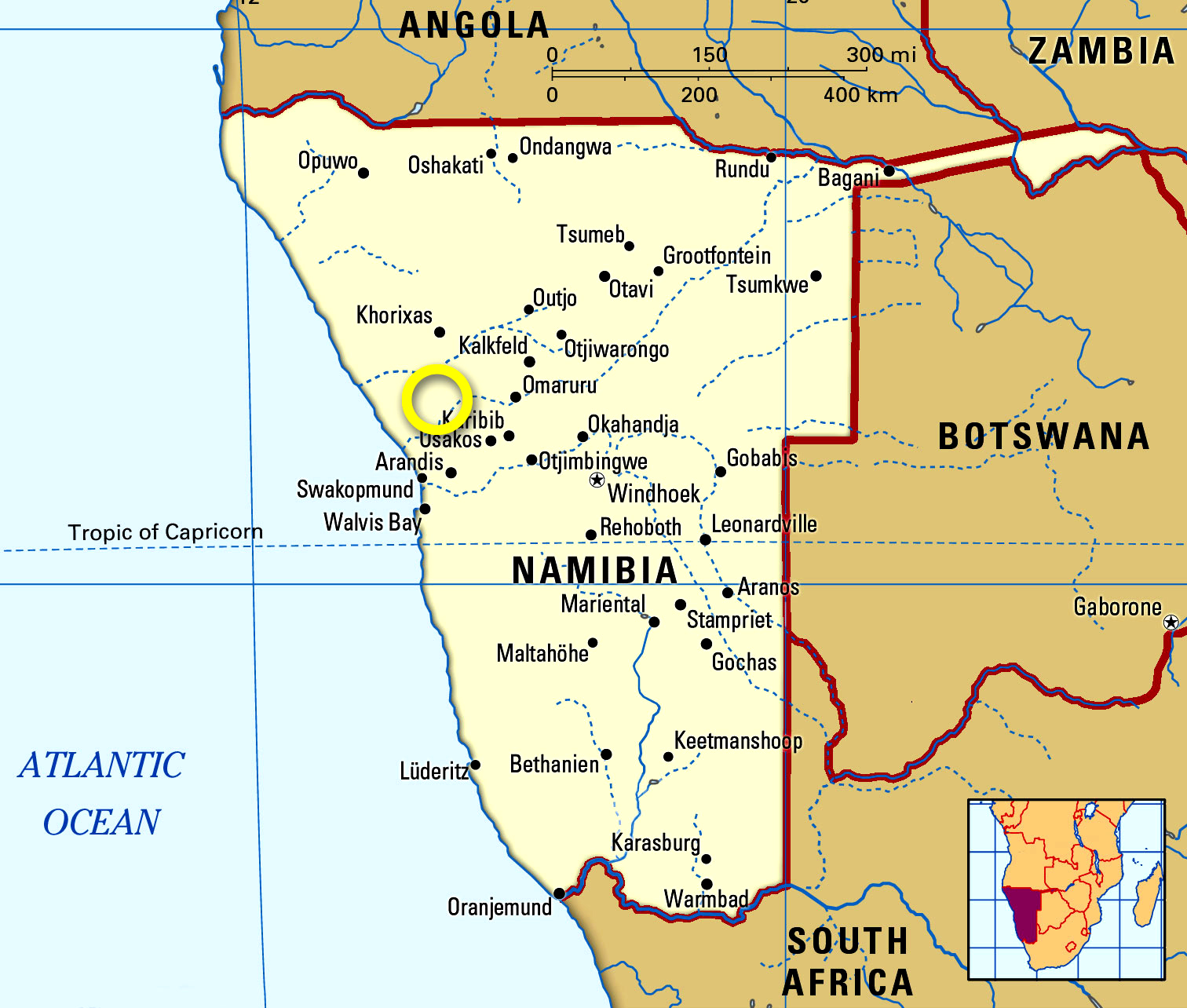
Map of Namibia with marked location of the Spitzkoppe area.

Map showing the location of the fluorite workings in relation to the Kleine and Grosse Spitzkoppe.
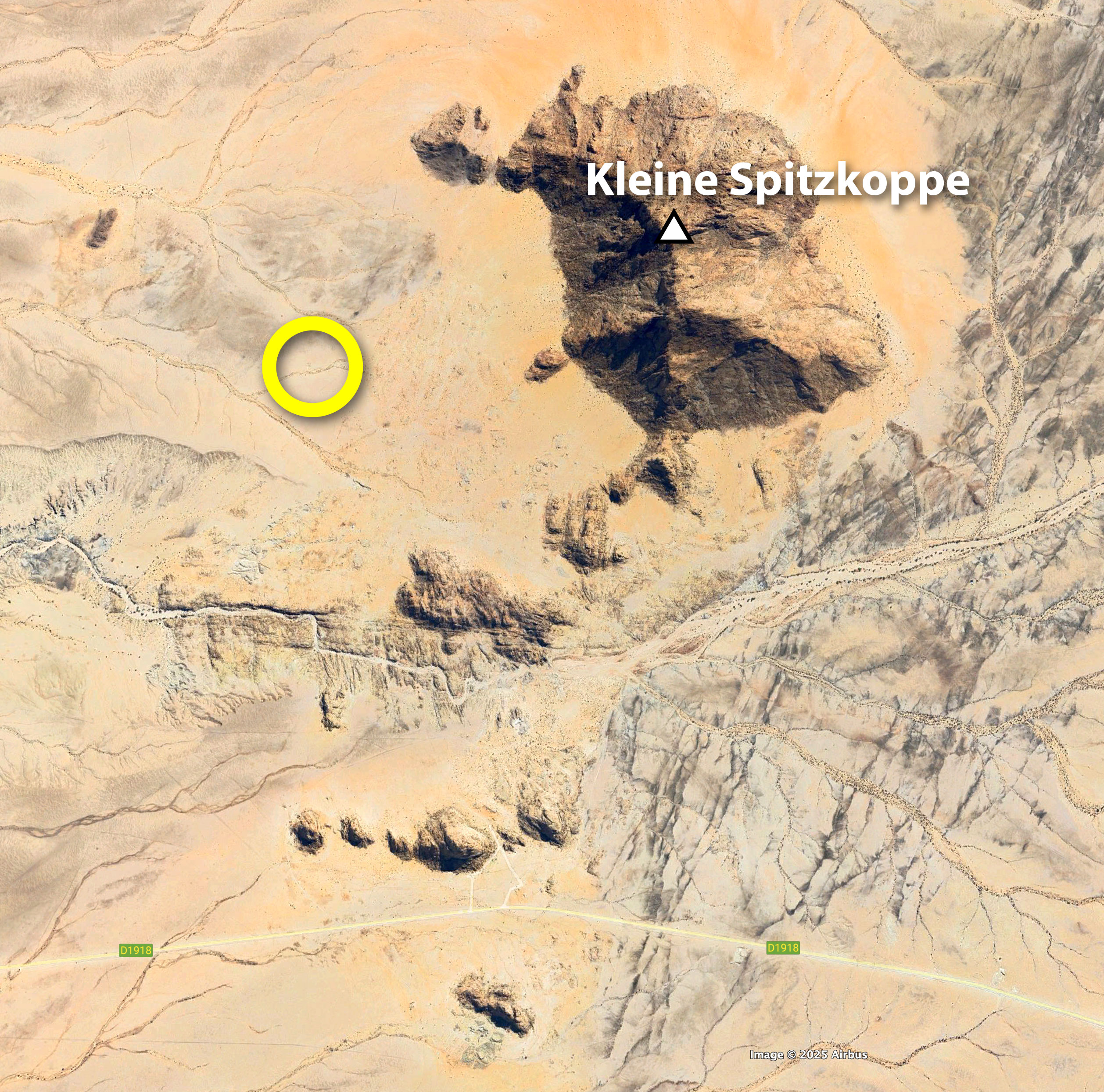
Map showing the location of the fluorite workings in relation to the Kleine Spitzkoppe.

Geological map of Kleine Spitzkoppe area. Granites (forming the prominent peaks in the area’s morphology) are marked with a brownish hatch pattern. Blue areas represent marbles, part of the metamorphic Damara Supergroup. The fluorite deposit is indicated by a blue dot and the letter “F”.
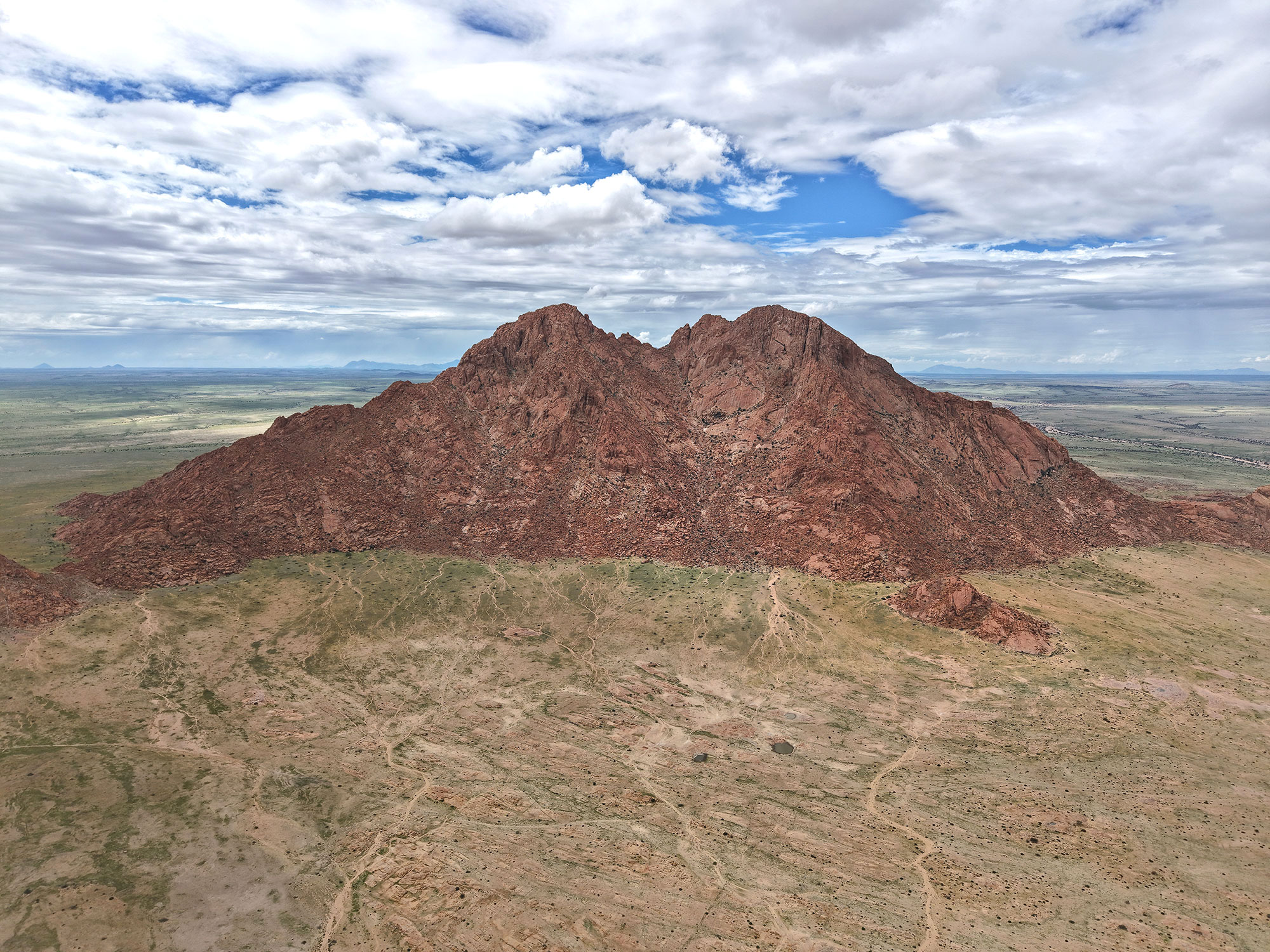
Granite peaks of the Kleine Spitzkoppe rising from the flat, arid desert plain. Spirifer Minerals photo.
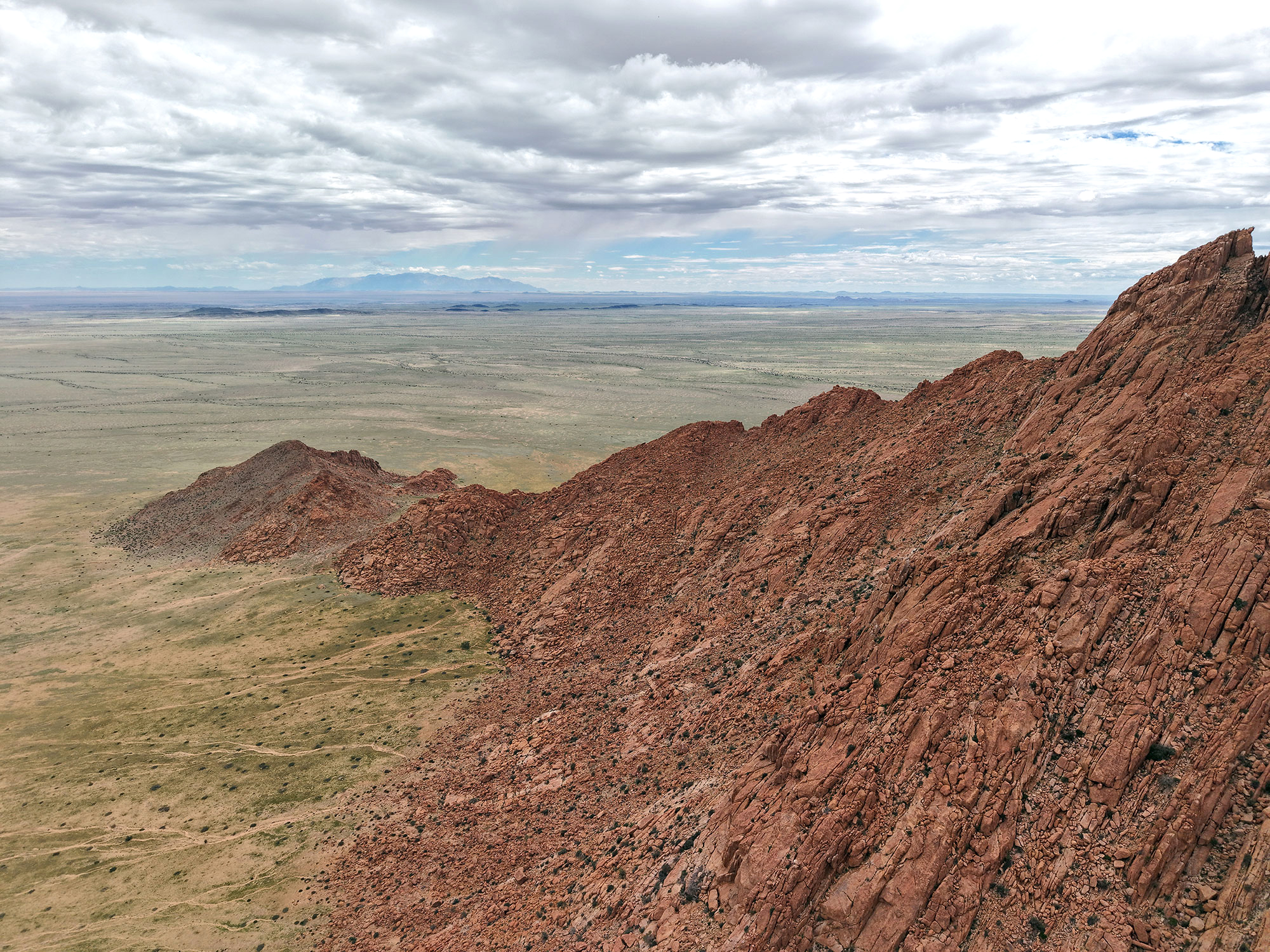
Granite peaks of the Kleine Spitzkoppe rising from the flat, arid desert plain. Spirifer Minerals photo.
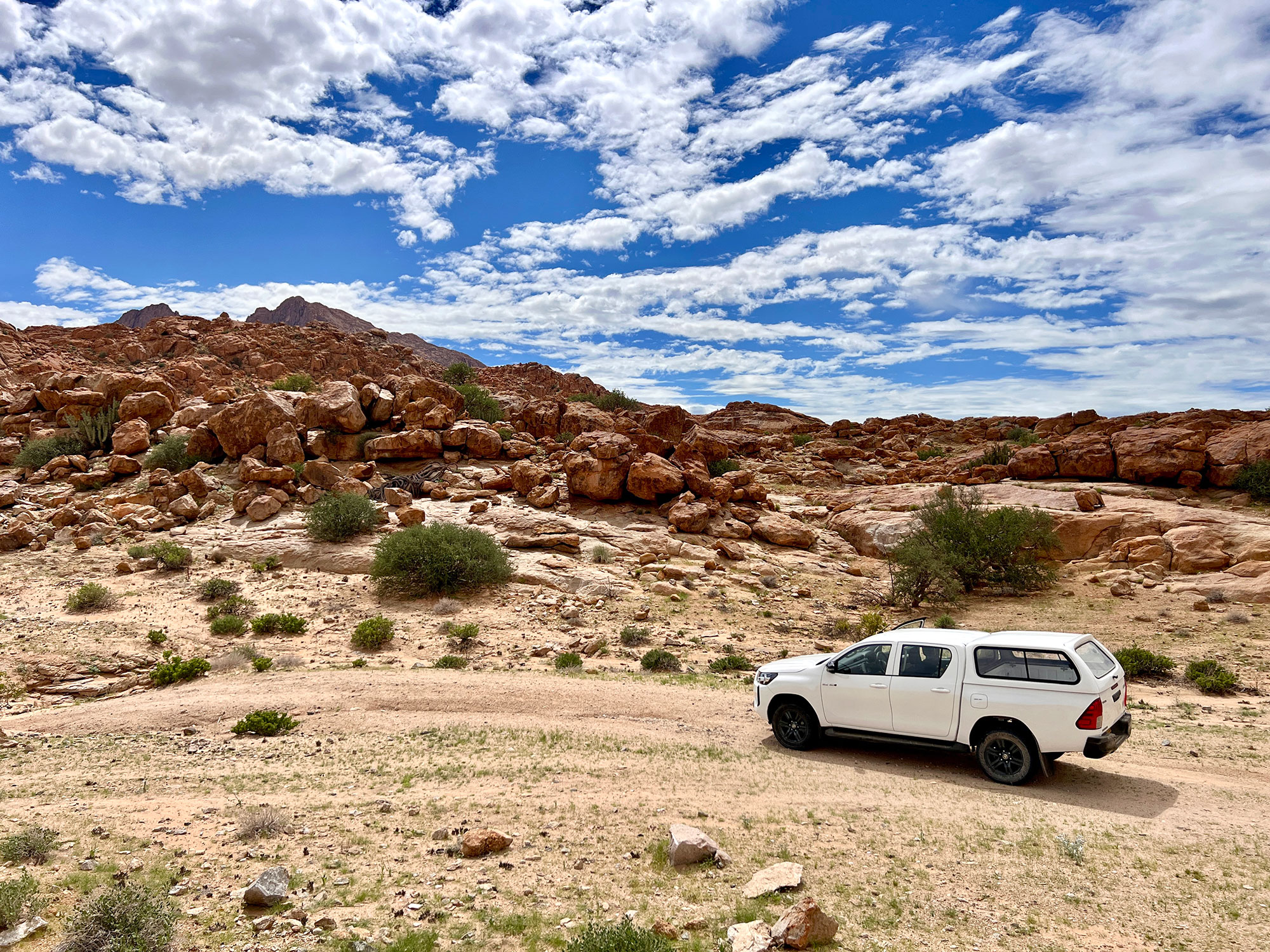
Driving through granites outcrops at the Kleine Spitzkoppe. Spirifer Minerals photo.

Pegmatites in granites at the Kleine Spitzkoppe. Spirifer Minerals photo.
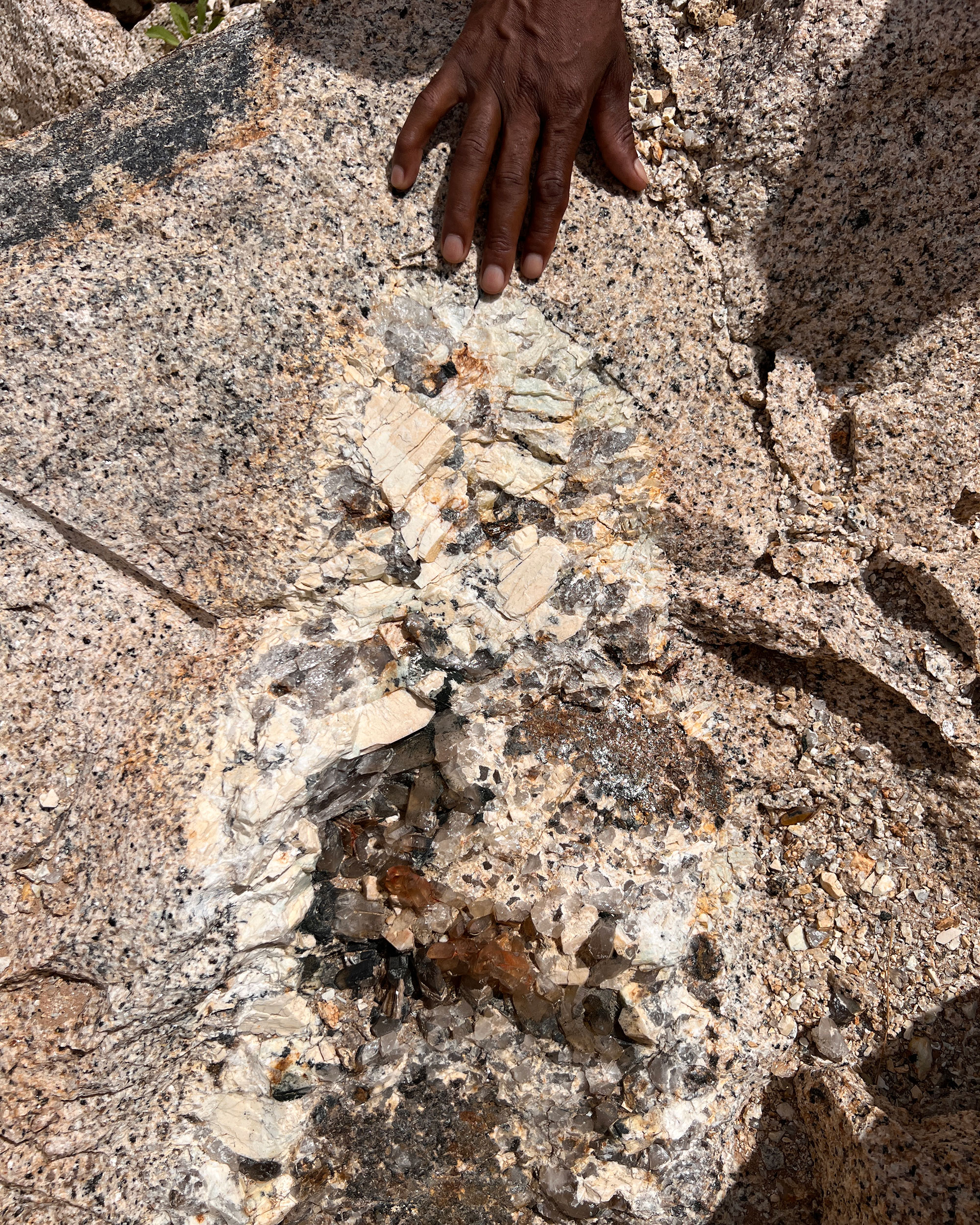
Pegmatite in granite at the Kleine Spitzkoppe. Spirifer Minerals photo.

Open pocket with automorphic crystals of quartz, feldspar, and mica in the central part of a pegmatite hosted in granite at the Kleine Spitzkoppe. Spirifer Minerals photo.
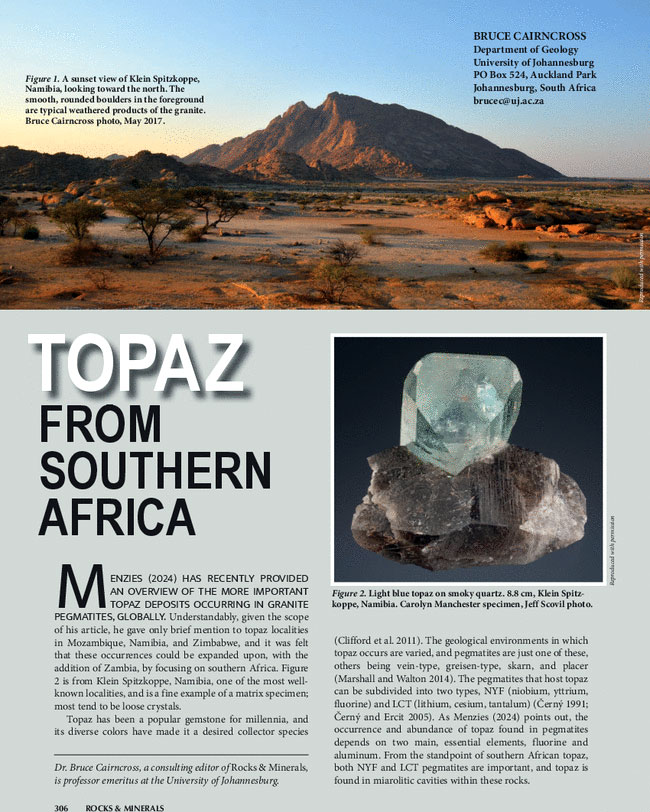
The Kleine Spitzkoppe area is especially famous for pegmatites that bear gem-quality topaz. Full articles about the locality can be downloaded HERE and HERE.
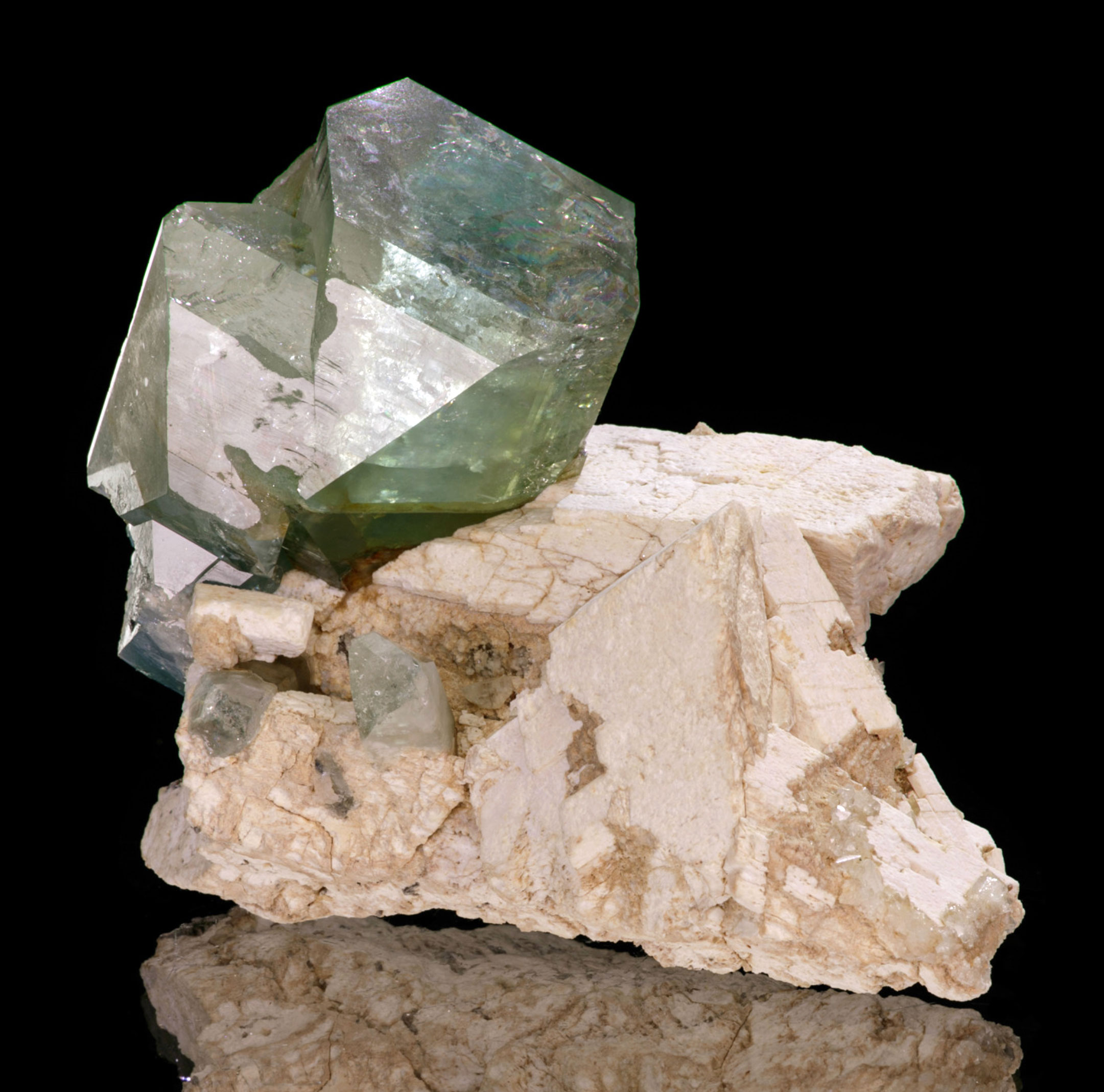
A classic Kleine Spitzkoppe specimen of topaz on feldspar matrix. Size 12 cm. Ex Gene Meieran collection. The Arkenstone specimen and photo.
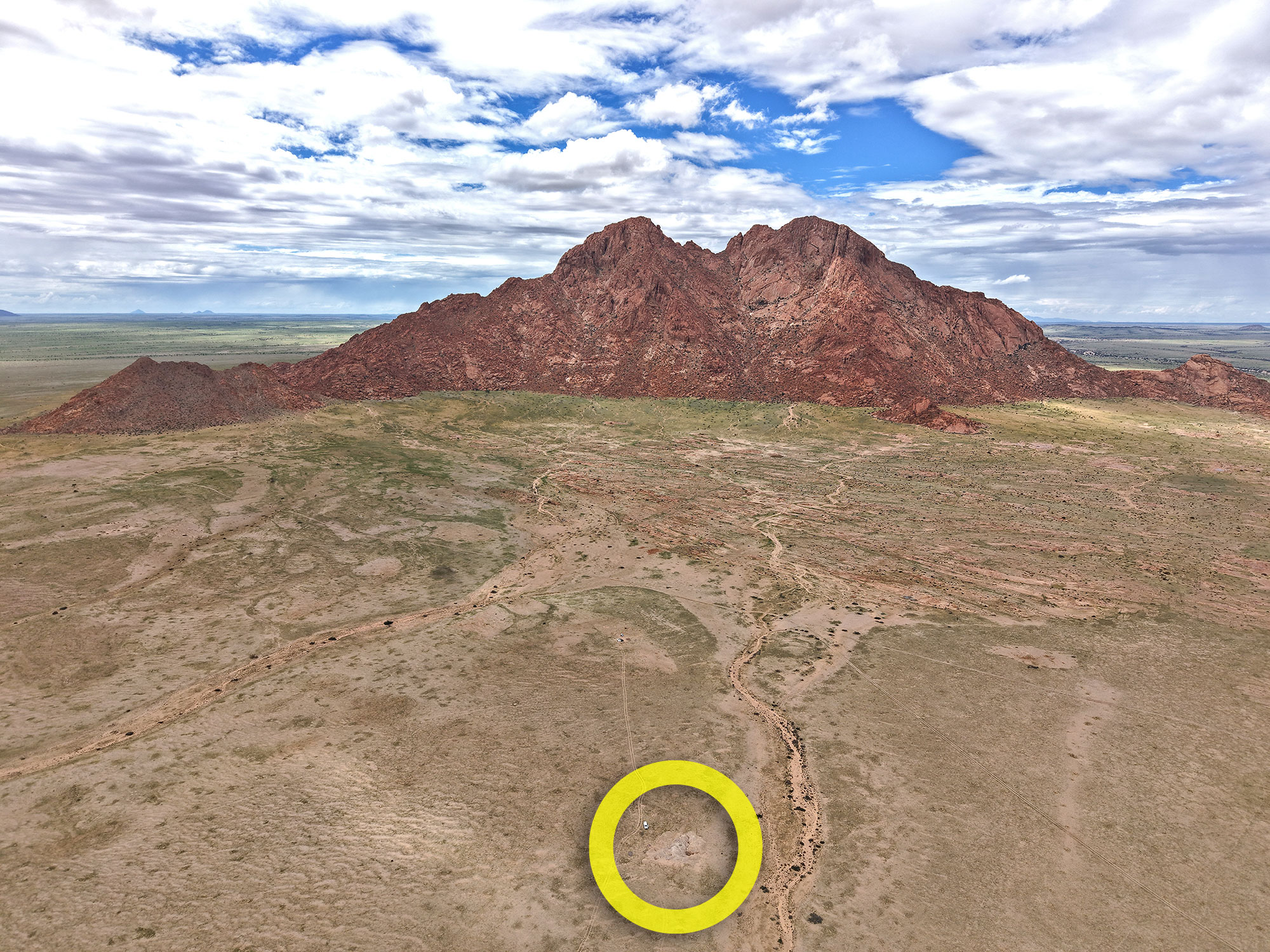
Fluorite workings (marked) located at the foot of the granite peaks of the Kleine Spitzkoppe. Spirifer Minerals photo.
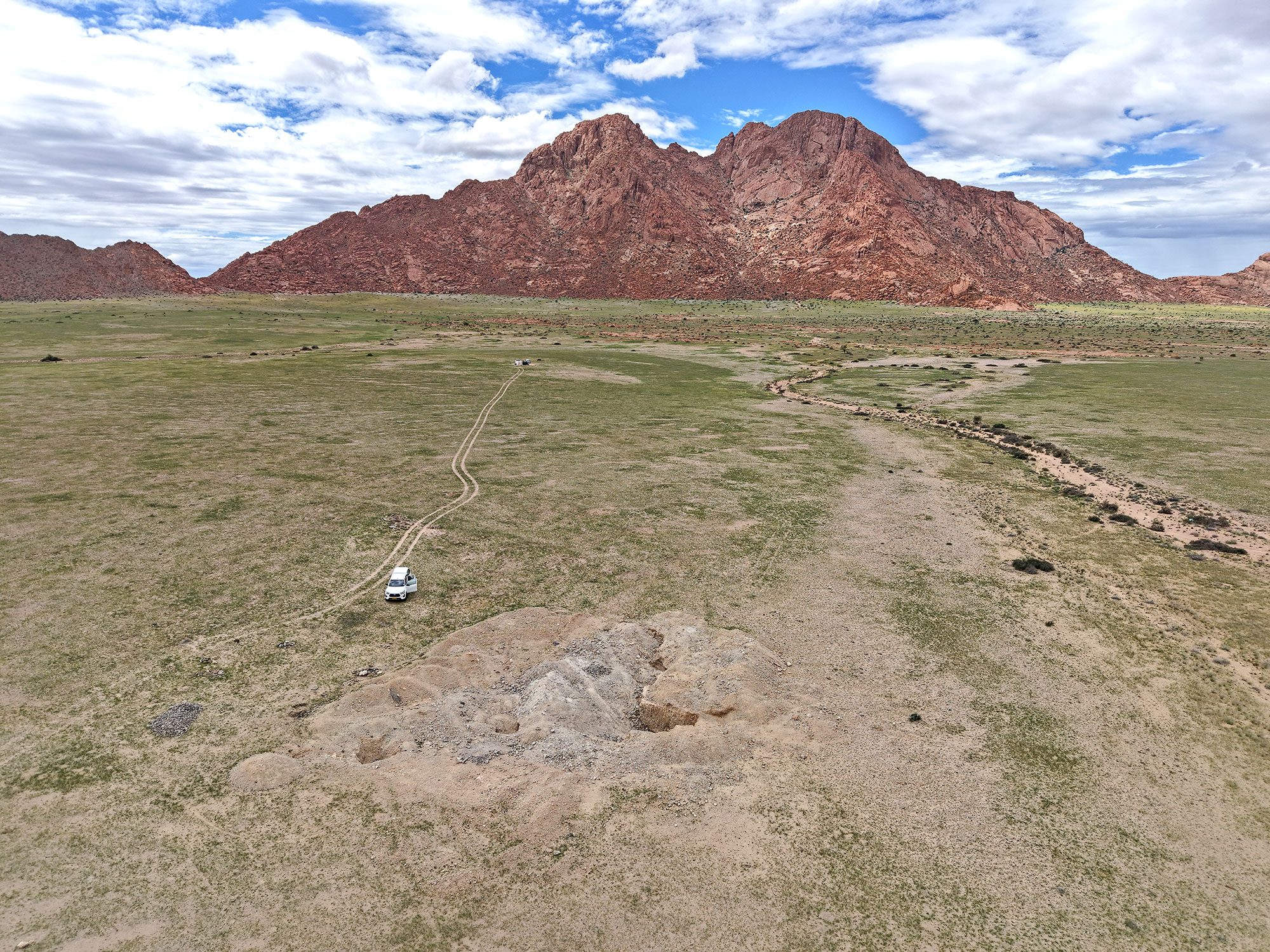
Fluorite workings at the foot of the granite peaks of the Kleine Spitzkoppe (view to the east). Spirifer Minerals photo.
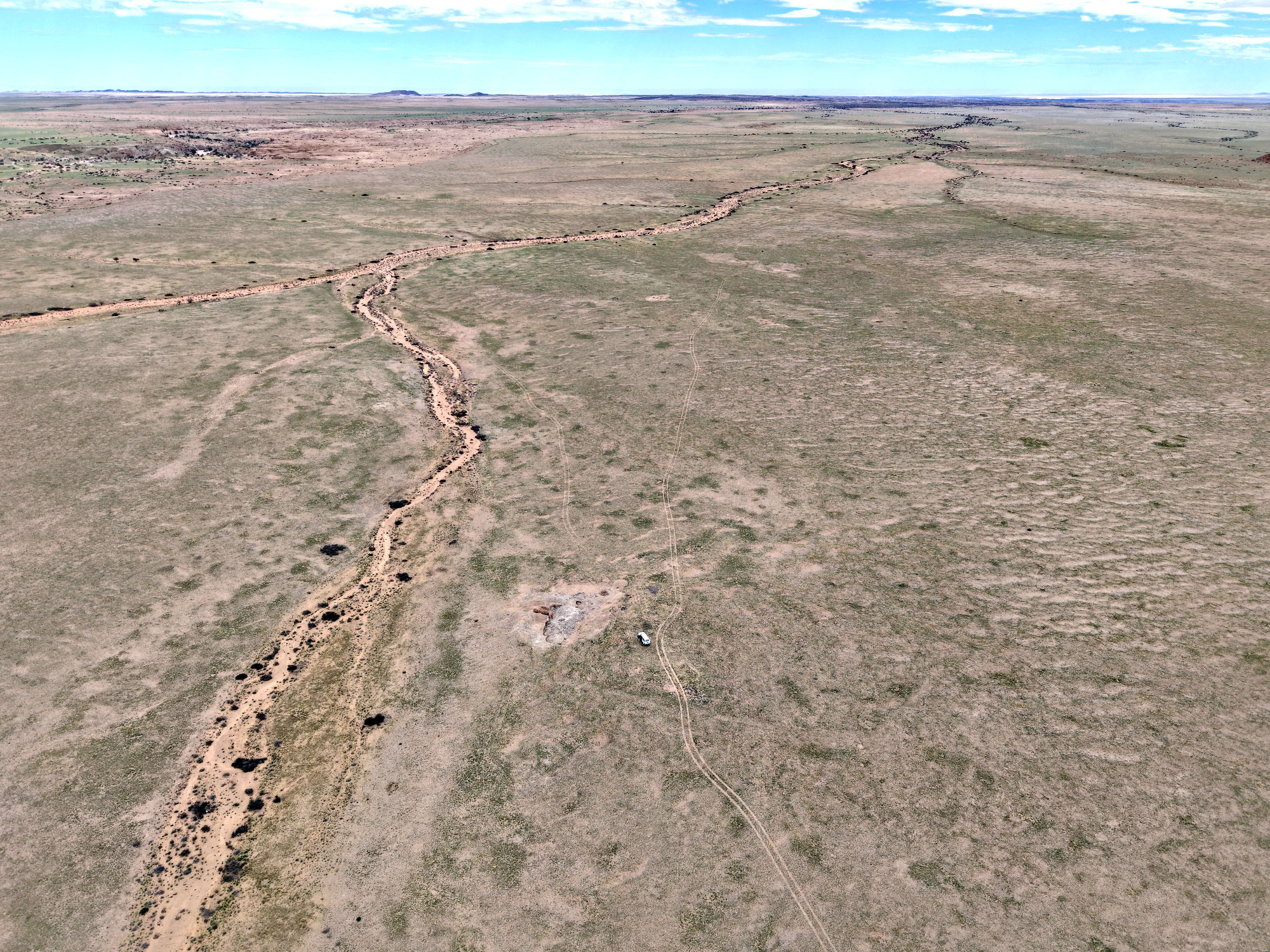
Fluorite workings surrounded by a flat, desert plain (view to the east). Spirifer Minerals photo.
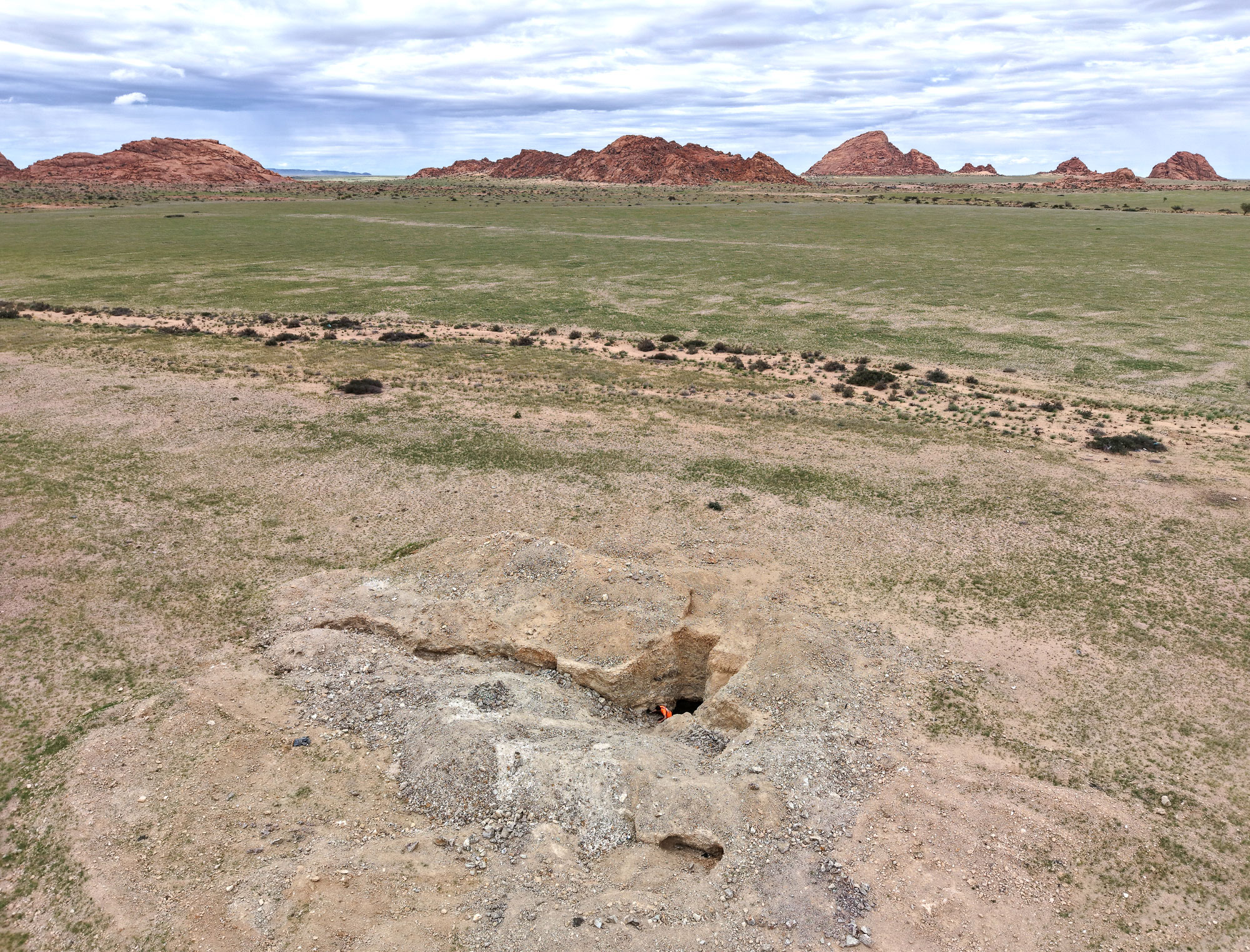
Fluorite workings with the granite peaks of the Spitzkoppe in the background. Spirifer Minerals photo.
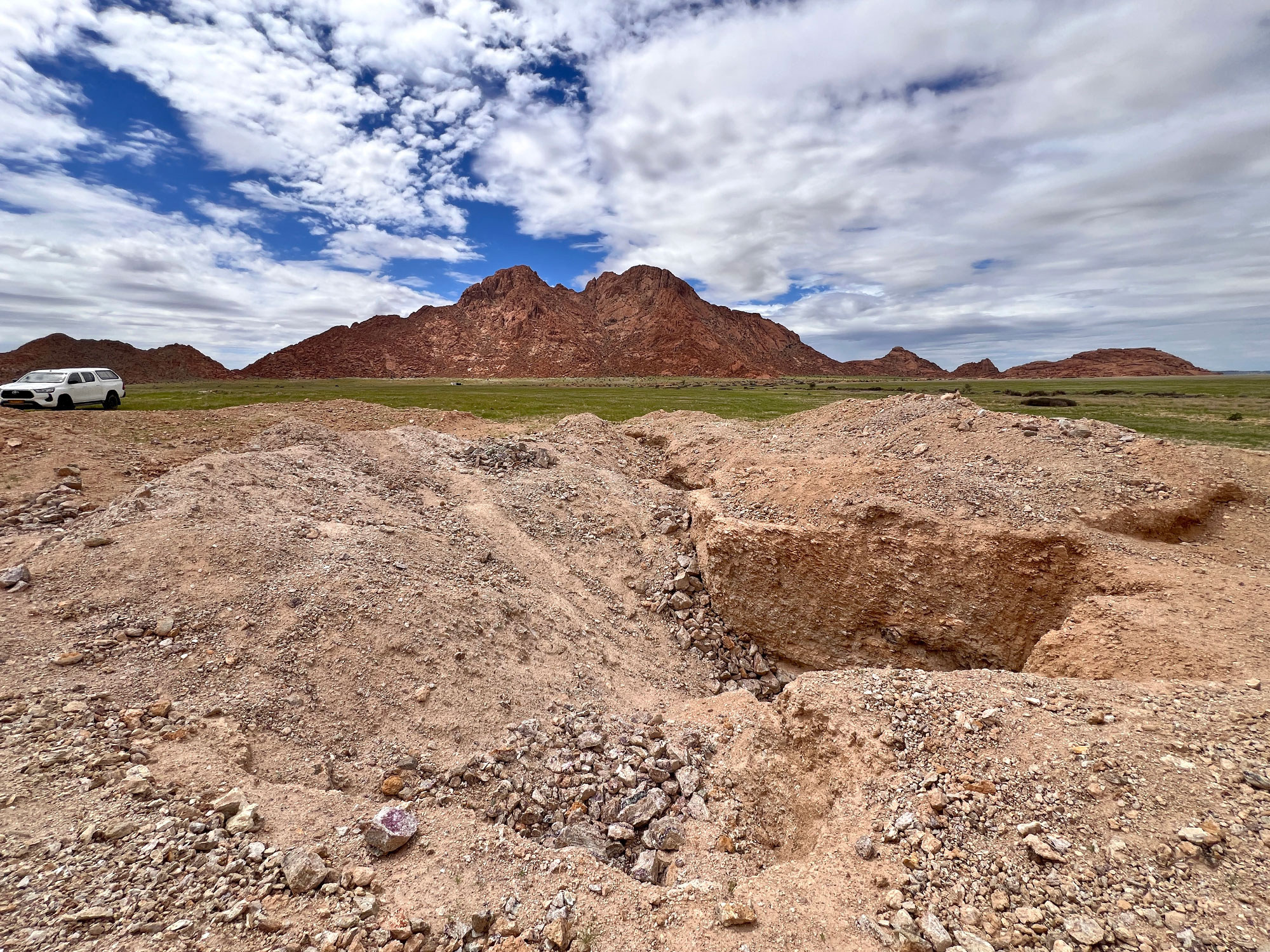
Fluorite workings with the granite peaks of the Kleine Spitzkoppe in the background. Spirifer Minerals photo.
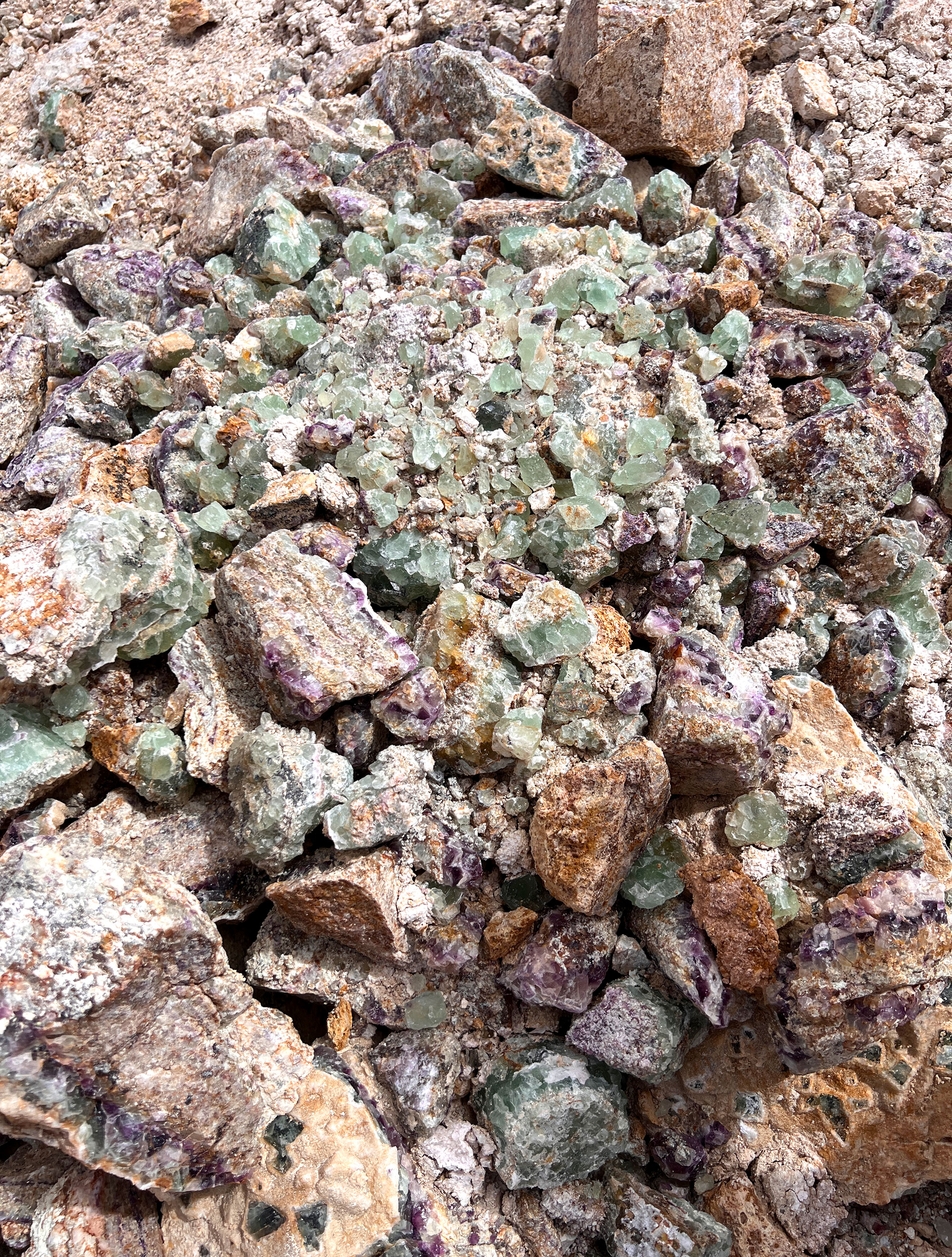
Dump with chunks of colorful fluorite. The fluorite was mined there mainly for industrial purposes. Spirifer Minerals photo.

Fragment of banded, colorful fluorite vein. Spirifer Minerals photo.

Drusy purple–pink fluorite octahedrons on matrix, from the fluorite workings dump. Spirifer Minerals photo.
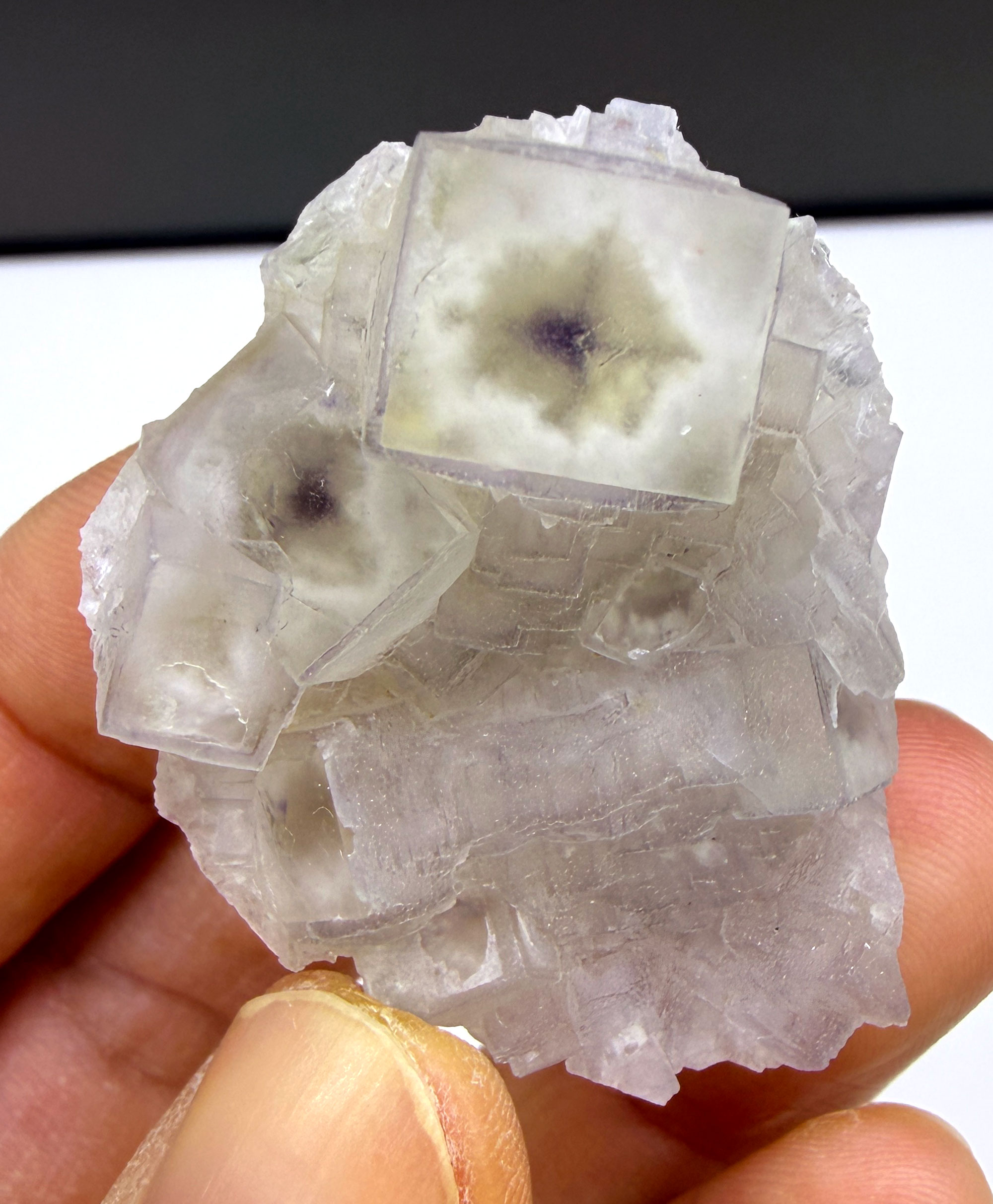
Fluorite specimen of typical “Dragon Eye” style (without backlighting). Some specimens of this type, when backlit, reveal a purple-to-pink cross at the center of the crystal. Spirifer Minerals specimen and photo.

Fluorite specimen of typical “Dragon Eye” style (without backlighting). Some specimens of this type, when backlit, reveal a purple-to-pink cross at the center of the crystal. Spirifer Minerals specimen and photo.

The following three photos show the same specimen from different angles. This fluorite originally grew as octahedra; over time, the growth habit changed to cubic crystals, which grew syntactically on the earlier crystals, forming the so-called “Aztec Pyramid” form. Spirifer Minerals specimen. Laszlo Kupi photo.

The following three photos show the same specimen from different angles. This fluorite originally grew as octahedra; over time, the growth habit changed to cubic crystals, which grew syntactically on the earlier crystals, forming the so-called “Aztec Pyramid” form. Spirifer Minerals specimen. Laszlo Kupi photo.

The following three photos show the same specimen from different angles. This fluorite originally grew as octahedra; over time, the growth habit changed to cubic crystals, which grew syntactically on the earlier crystals, forming the so-called “Aztec Pyramid” form. Spirifer Minerals specimen and photo.

“Dragon Eye”–style fluorite specimen (without backlighting). This is one of the specimens that, when backlit, reveal a purple-to-pink cross at the center of the crystal (see following photo). Spirifer Minerals specimen and photo.

The same specimen shown above, backlit to reveal unusual color zoning. Spirifer Minerals specimen and photo.

“Dragon Eye”–style fluorite specimen (without backlighting). This is one of the specimens that, when backlit, reveal a purple-to-pink cross at the center of the crystal (see following photos). Spirifer Minerals specimen and photo.
The same specimen shown above, backlit to reveal unusual color zoning. Spirifer Minerals specimen and photo.

The same specimen shown above, backlit to reveal unusual color zoning. Spirifer Minerals specimen and photo.

The same specimen shown above, backlit to reveal unusual color zoning. Spirifer Minerals specimen. Laszlo Kupi photo.
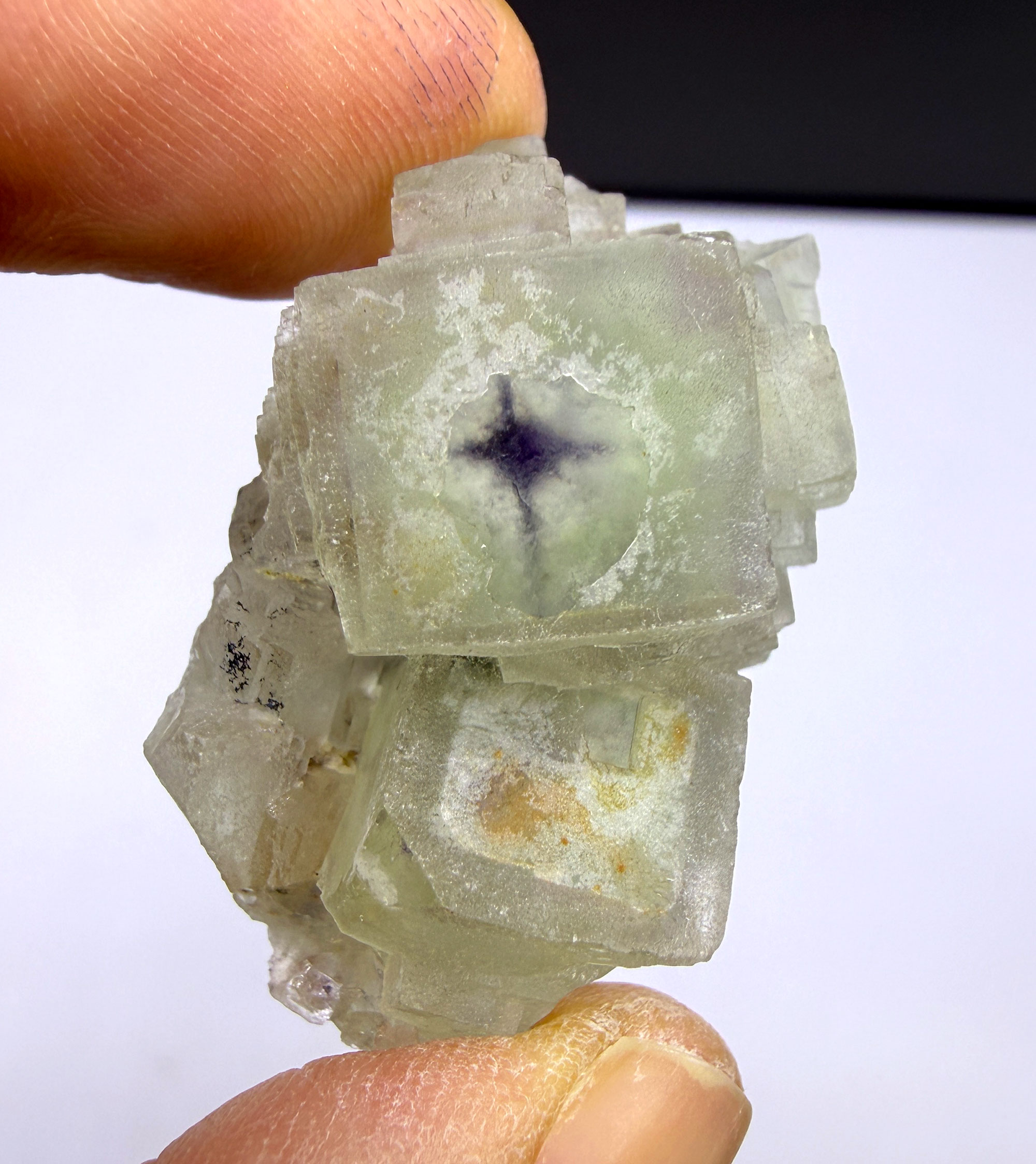
“Dragon Eye”–style fluorite specimen (without backlighting). This is one of the specimens that, when backlit, reveal a purple-to-pink cross at the center of the crystal (see following photo). Spirifer Minerals specimen and photo.

The same specimen shown above, backlit to reveal unusual color zoning. Spirifer Minerals specimen. Laszlo Kupi photo.
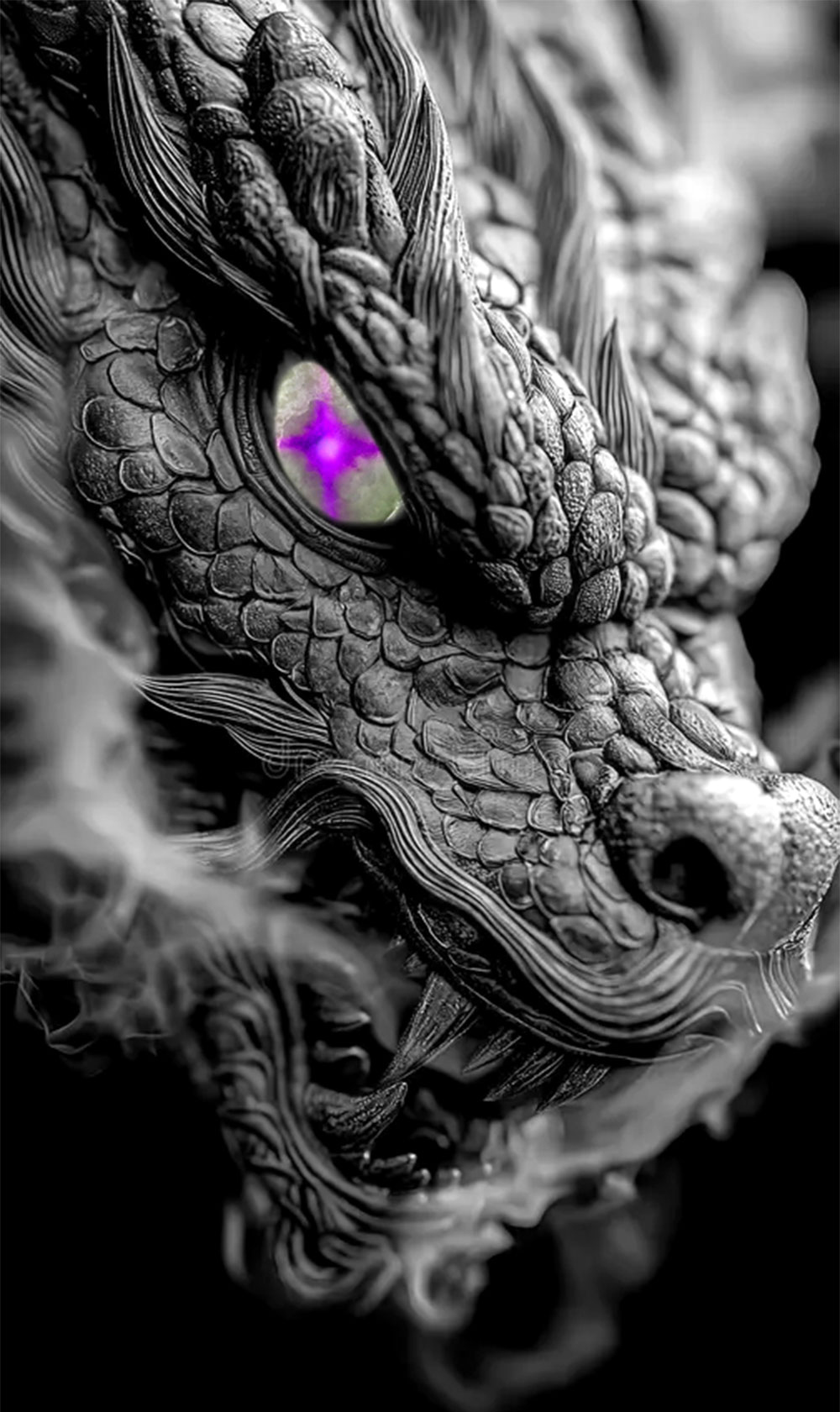
Fluorite Dragon Eye by AI.
Fluorite Dragon Eye by AI.
| Comments |
| NICE WORK |
| MARTIN WATKINS |
| 2026-01-07 06:37:22 |
| Very exiting; gorgeous specimens. |
| Heidi Naude |
| 2026-01-07 07:57:49 |
| Very informative, and a good read as always Thomasz. Cant wait to see some articles about goboboseb and Buks claim once you start mining there. |
| Herman du Plessis |
| 2026-01-07 08:39:36 |
NEW ARTICLES
TRAVELS & ARTICLES
- Mimetite Bonanza from Yanga Koubenza, Republic of the Congo
- Mineral notes: "Dragon Eye" fluorites from Namibia
- Mineral notes: Boltwoodite from Goanikontes, Namibia
- Pyrite find in Finland
- Mineral notes: New zircons and pyrochlores from Morocco
- Mineral notes: New natrolites from Morocco
- Mineral pottery by Dr. Justyna Domańska-Siuda
- Calcites from Malaysia
- Veszelyites and other minerals from Congo
- Travelling through Arizona & New Mexico, USA
OUR PUBLICATIONS
- "Barytes from Nador, Morocco" in Mineralogical Record
- "Fluorites from Taourirt, Morocco" in Mineralogical Almanach
- "Calcites from Grabiszyce, Poland" in LRM 2018
- "Baryte" article in the extraLapis
- MINERALS - The Collectors Newspaper #9
- MINERALS - The Collectors Newspaper #8
- Solno halites article in the Mineralogical Record
- MINERALS - The Collectors Newspaper #7
- MINERALS - The Collectors Newspaper #6
- Mibladen monograph in the Mineralogical Record