STORE AUCTIONS ALL SPECIMENS ON SALE MINERALS ACCESSORIES BOOKSTORE RULES REGISTER LOGIN ABOUT US CONTACT US MAILING


SPECIMENS
now available:
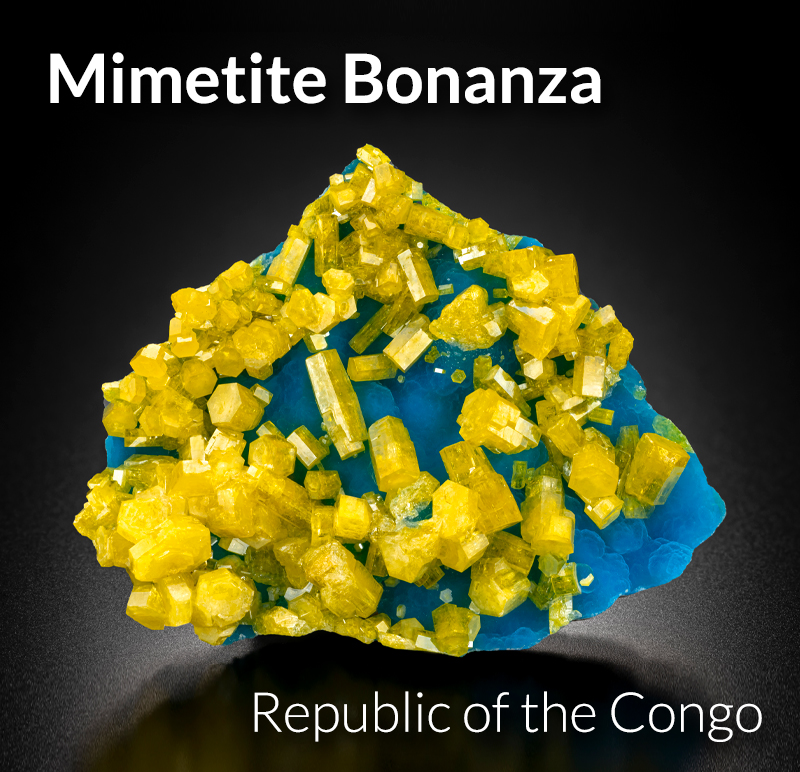
Mimetite Bonanza and Associated Minerals from Yanga Koubenza Quarry, Republic of the Congo
by Tomasz Praszkier
INTRODUCTION
The Republic of the Congo became one of the major areas of interest for our company (Spirifer Minerals) around 2017, beginning with a single—somewhat adventurous—trip undertaken by the author together with his wife, Joanna (Asia) Praszkier. Following this initial visit, we established local logistic support and a field crew, visited a large number of outcrops and mines, and worked on numerous new mineral finds throughout the country.
Some of these activities and localities were previously described in an article concerning the discovery of veszelyite from the nearby Palabanda workings published on our website HERE. The Yanga Koubenza quarry, described there in its early stages, subsequently developed significantly and has produced several important mineral specimen finds. However, it was the Mimetite Bonanza discovery in 2024 that elevated this locality to the rank of the world’s top specimen-producing sites, yielding high-quality specimens of uncommon species, occurring in remarkable associations and displaying exceptional color.
In the present article, the author focuses primarily on the mimetite discovery, while also presenting other significant finds from this locality made over the past few years, during which time the site evolved into a fully developed large-scale mining operation.
LOCATION AND MINING HISTORY
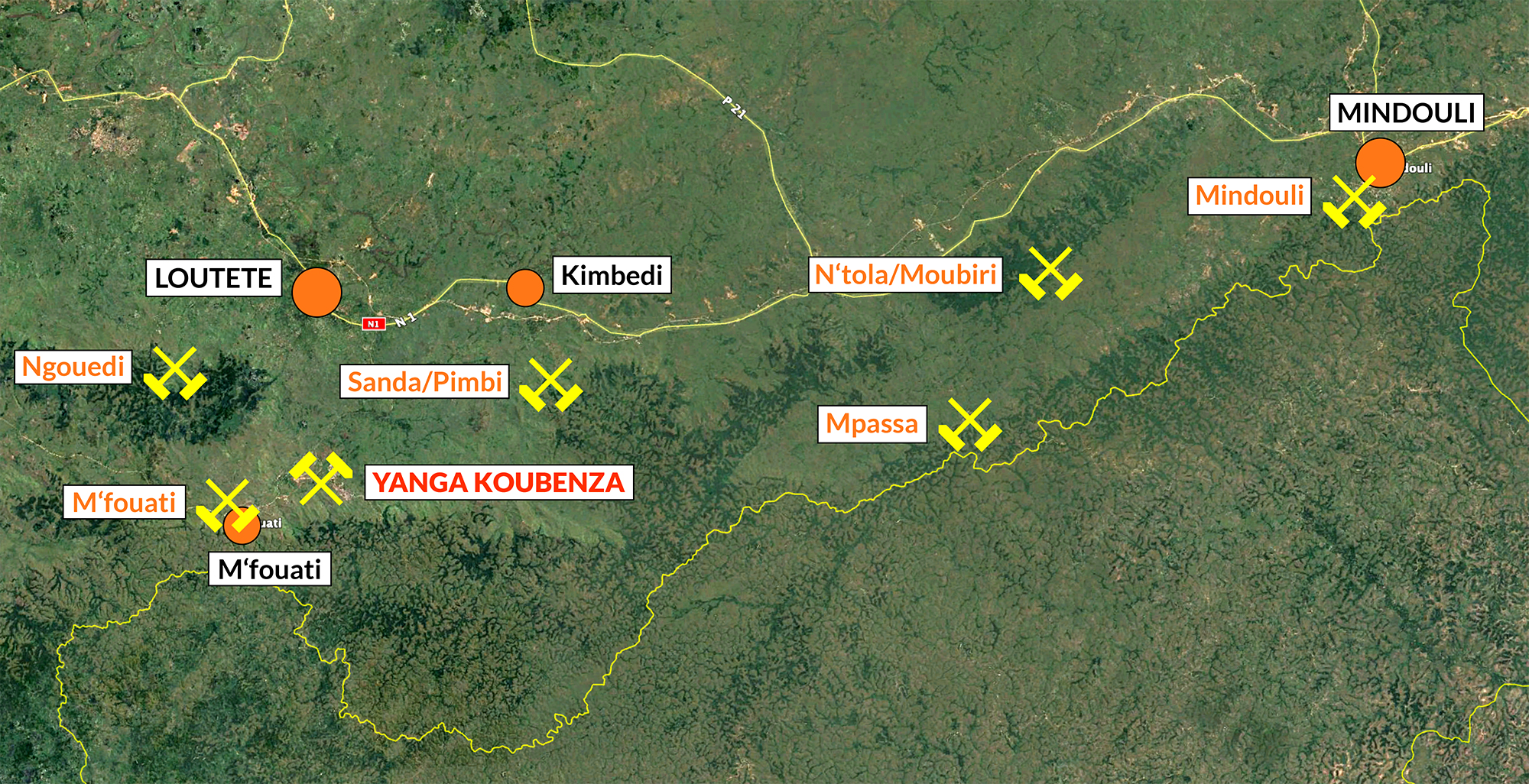
Yanga Koubenza is located in the M’fouti District, Bouenza State, in the Republic of the Congo. Yanga Koubenza Hill, together with the Palabanda and Mandoki hills, forms a medium-sized ridge situated east of the road connecting Louete with M’fouti.
The Yanga Koubenza deposit was discovered and worked between 1932 and 1933, with a total of 759 m of underground galleries and 71 m of shafts were developed. These works confirmed the presence of an oxidized lead–zinc deposit, with estimated resources of 3,680 tonnes of ore grading approximately 20% Pb.
From 1938 to 1941, exploration and mining were conducted in another part of the hill. During this period, 923 m of galleries and 98 m of shafts were driven. Extensive surface stripping was carried out concurrent with trial mining of calamine, mainly smithsonite.
Following a geological study of the region, a drilling campaign was conducted at Yanga Koubenza and Palabanda. Between 1953 and 1955, 38 m of shafts were sunk and 15 drill holes were completed, leading to the discovery of a new mineralized zone of oxidized lead. This zone was estimated to contain approximately 15,000 tonnes of ore grading 12–14% Pb.
In December 1958, a comprehensive reserve evaluation, based on all previous work, estimated 63,700 tonnes of oxidized lead ore, grading 10–12% Pb, distributed across three ore bodies.
In 1960, a detailed geological study and mapping of the area were completed by the BRGM (Bureau de Recherches Géologiques et Minières). Further drilling campaigns were conducted between 1967 and 1975, resulting in a cumulative total of approximately 13,000 m (!) of drill holes.
As a result of all investigations, the Yanga Koubenza deposit was ultimately estimated to contain 5.53 million tonnes of ore grading approximately 8% lead, 7% zinc, and 1.9% copper.
Despite extensive exploration, the deposit remained largely dormant until recently, when polymetallic mining permits were obtained by the Chinese-owned company Société de Recherche et d’Exploitation Minière (SOREMI). Construction of mine infrastructure, including a flotation plant and mine headquarters, began in 2015, leading to a slow start of mining operations in 2016 and full production in 2017.
Initially, mining activities were conducted at both the Palabanda and Yanga Koubenza deposits; however, Palabanda was soon abandoned, and further development focused exclusively on Yanga Koubenza.
Today, the Yanga Koubenza open pit is a large quarry approximately 1 km long and 750 m wide, with multiple benches and active mining faces. Mining methods and equipment are modern, especially when compared to other mining operations in the region.
More recently, following complex ownership changes and legal disputes, it appears that the Gerald Group, an American company, will assume ownership of the project.
.jpg)
Location of the Republic of the Congo on a general map, highlighting the area discussed in this article.
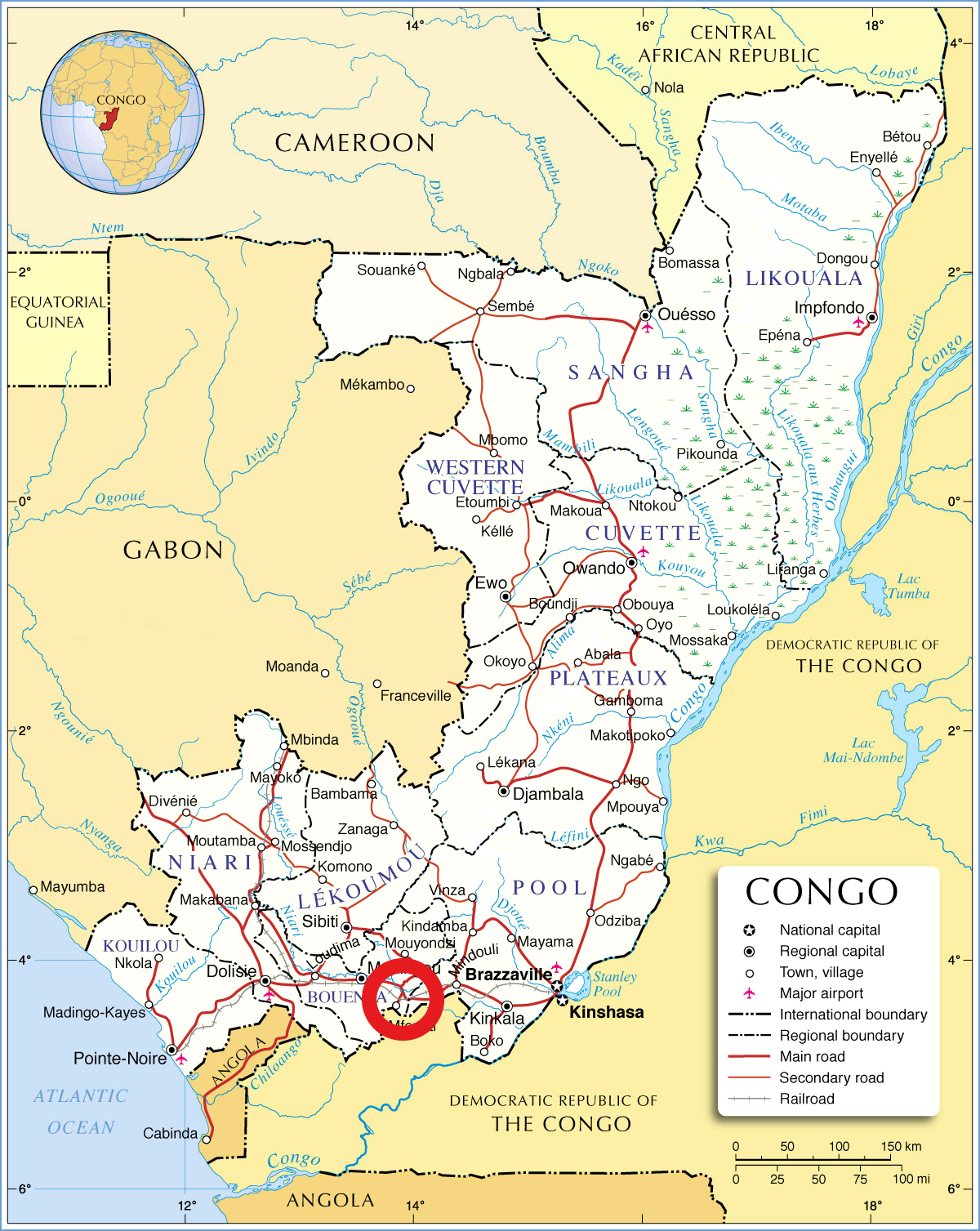
Map of the Congo highlighting the area discussed in this article.
Location of the Republic of the Congo on a general map, highlighting the area discussed in this article.
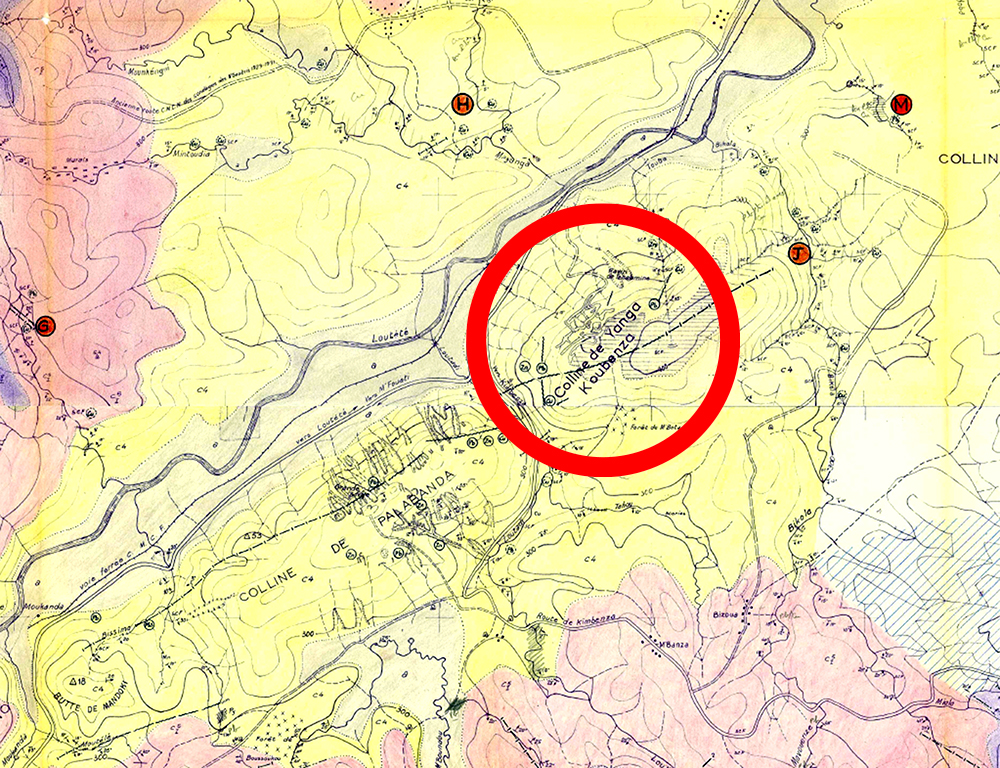
Documentation map of the deposits from the 1960, showing the Yanga Koubenza (marked) and Palabanda hills.
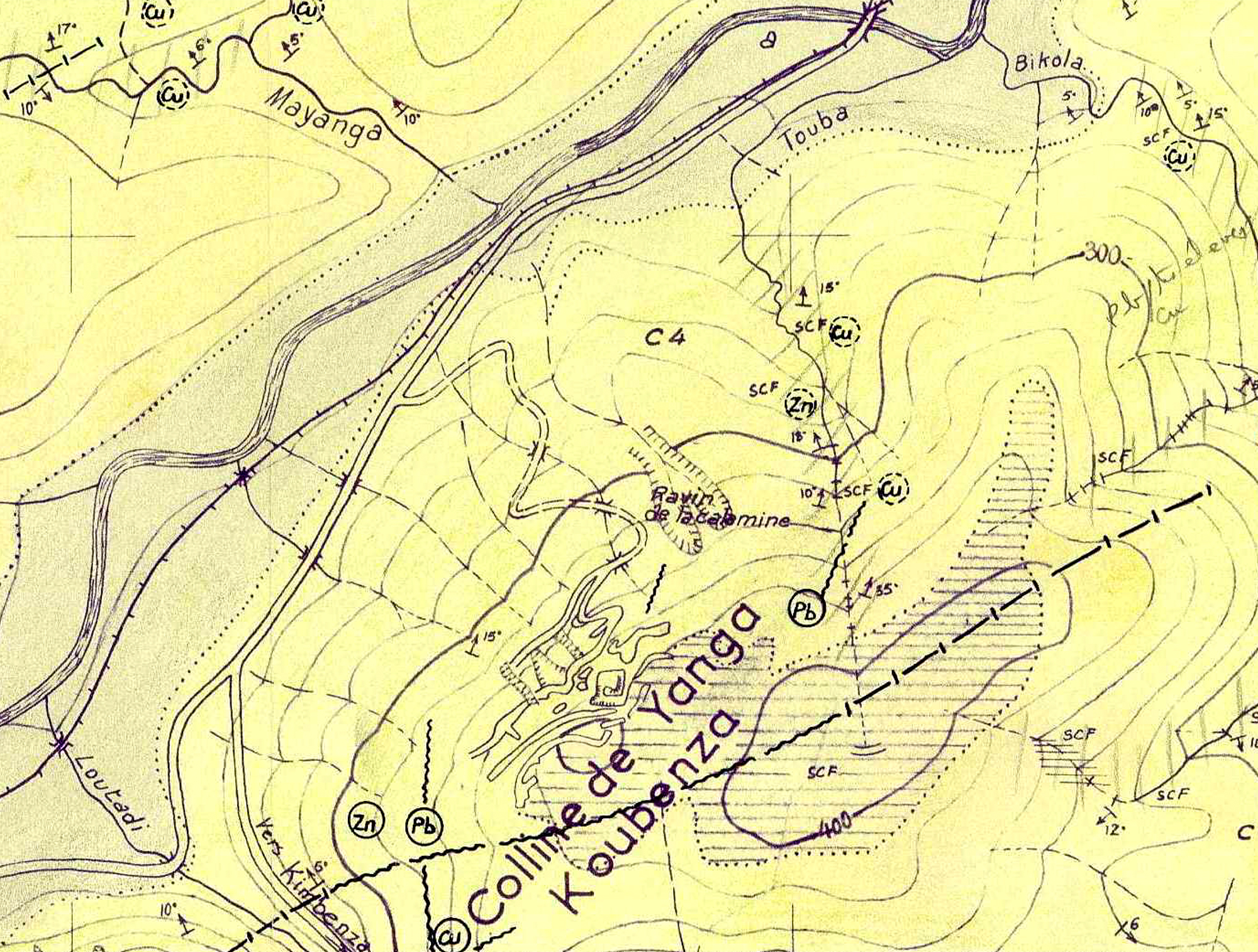
Development of the workings in 1960 within the Yanga Koubenza deposit.

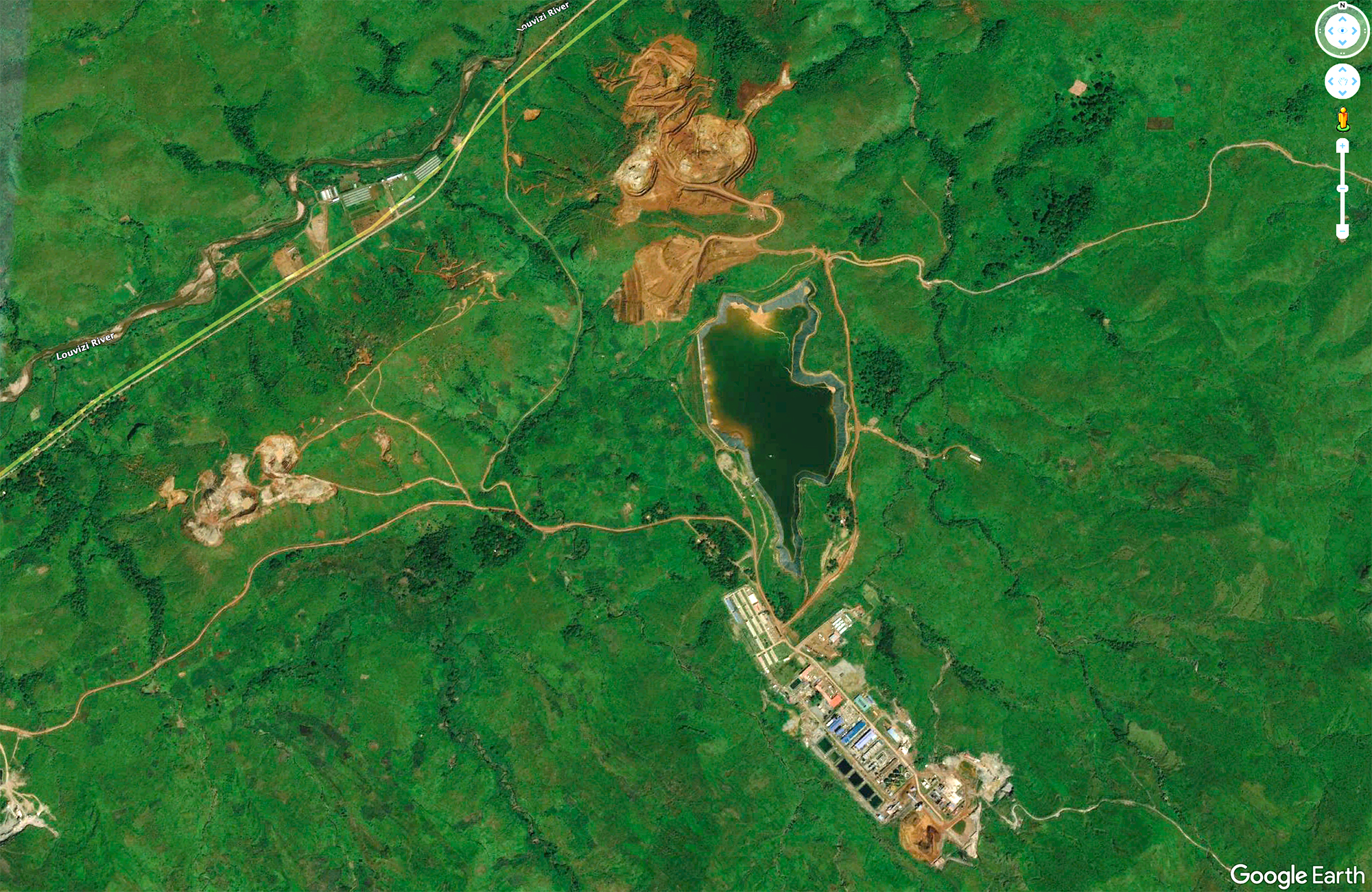
View of the Yanga Koubenza area in 2015 (upper photo) and the same area in 2020—what a difference!
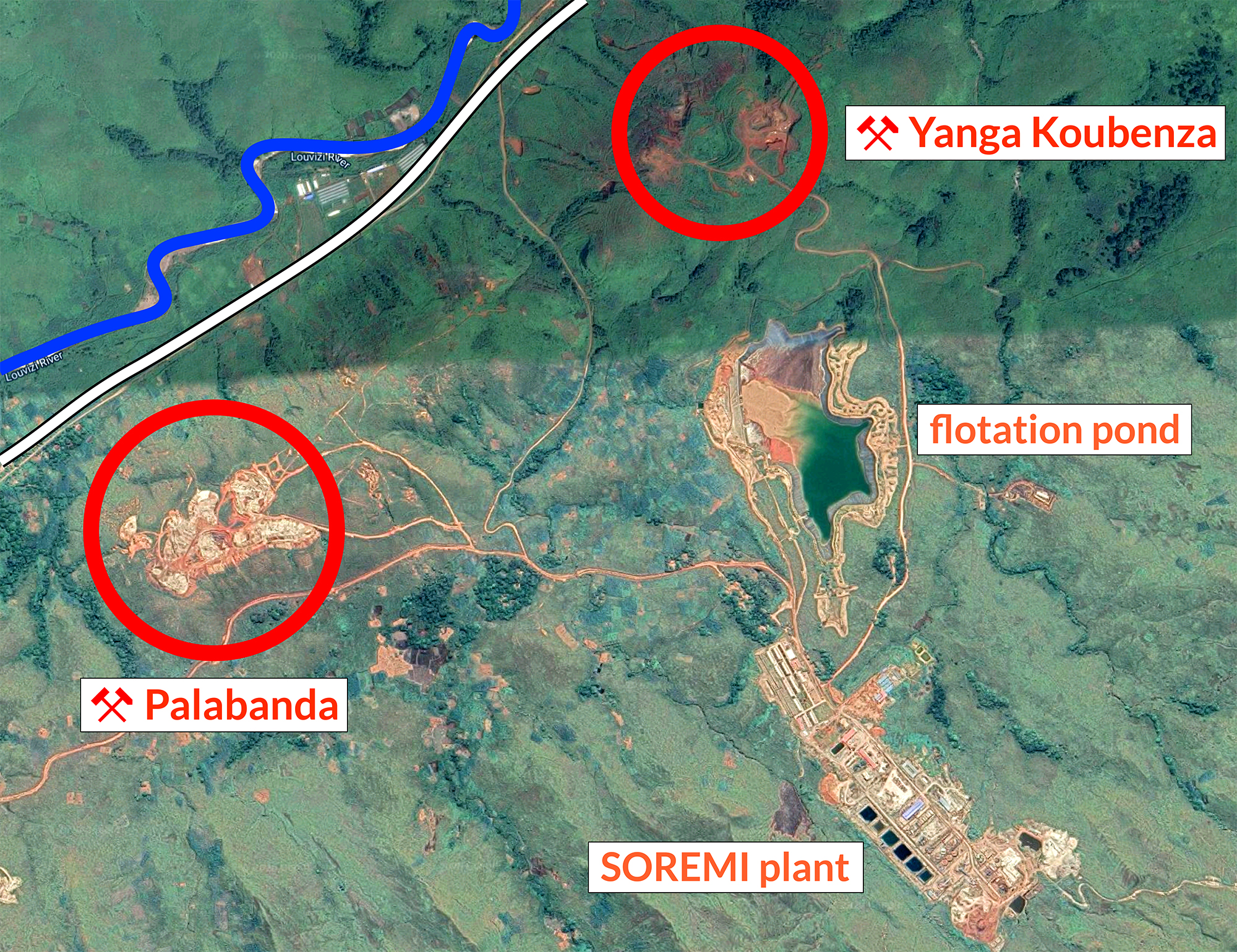
Satellite view of the Yanga Koubenza and Palabanda quarries, the SOREMI ore-processing plant, and the flotation pond.
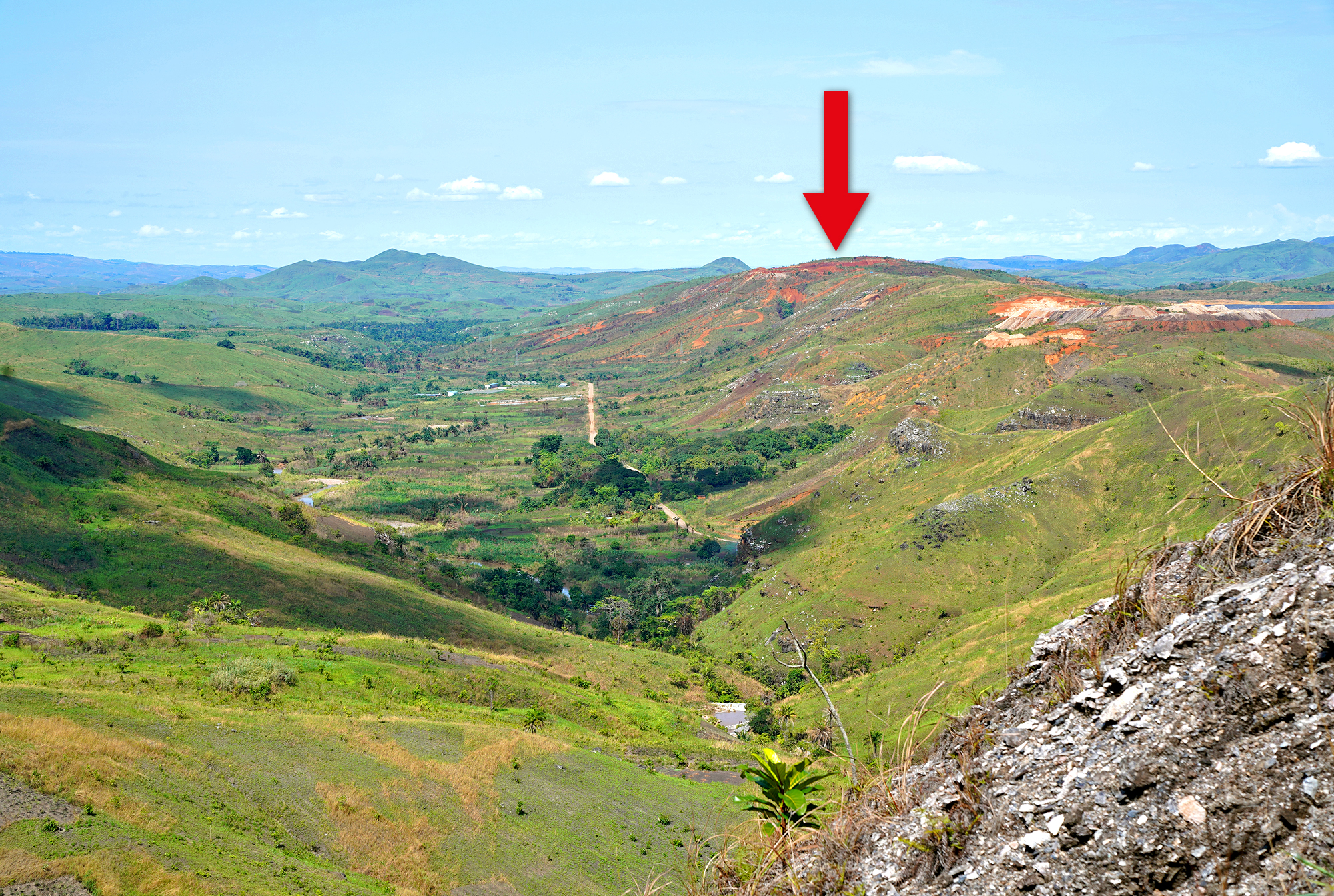
View to the northeast from M'fouati Hill, with Yanga Koubenza marked and the Palabanda quarries visible on the right side.
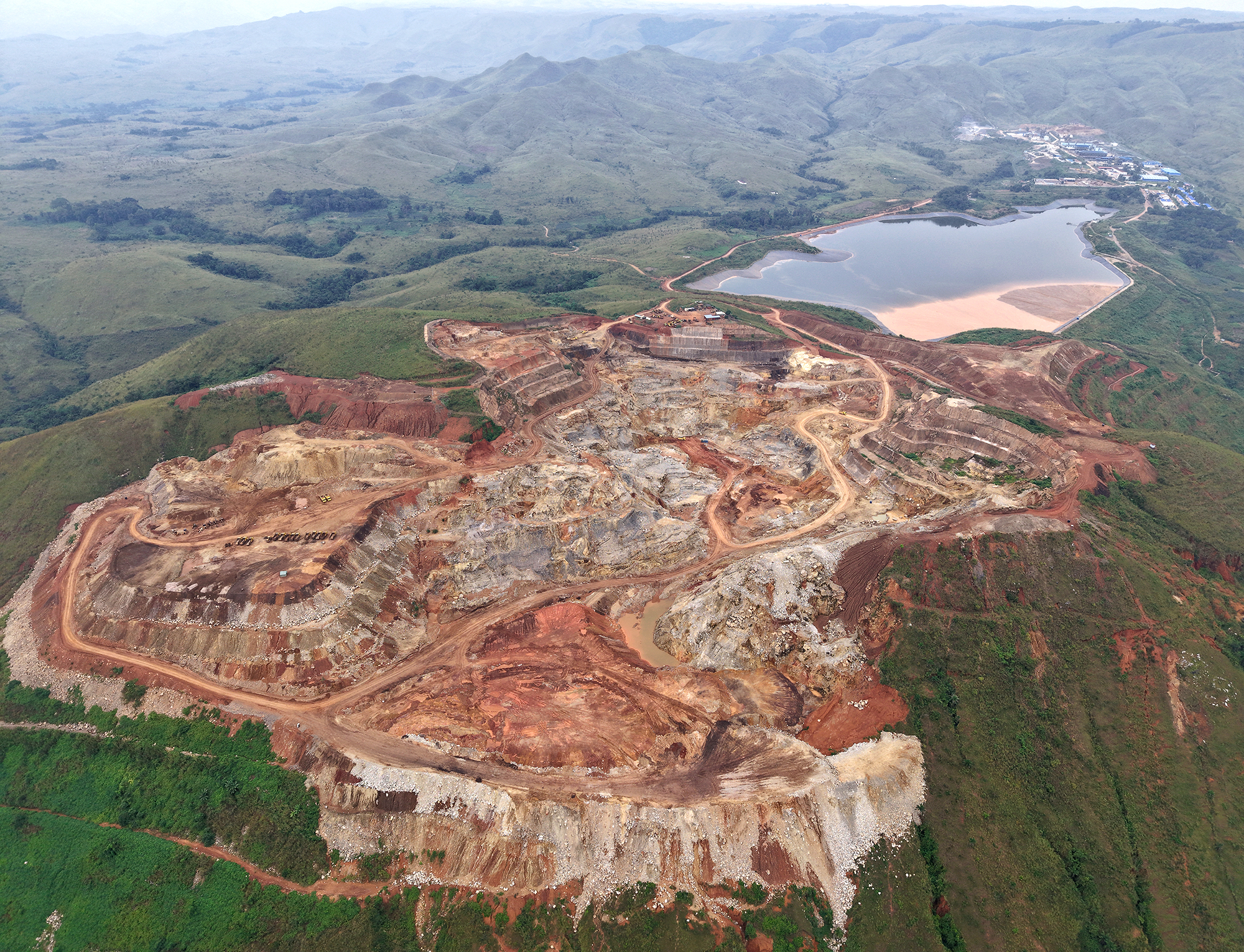
Drone view of the Yanga Koubenza quarry, with the flotation pond and ore-processing plant visible in the background (2025).
GEOLOGY
Mineralogically, the most interesting part of the Republic of the Congo is a Neoproterozoic geological unit known as the Niari Basin, located along the Congo River on the border with the Democratic Republic of the Congo.. The Niari Basin extends for more than 150 km in a NW–SE direction and hosts numerous metalliferous deposits, mainly of Cu, Zn, and Pb. Most of these deposits are small, and only a few are large enough to have been mined on an industrial scale.
The Niari Basin is composed of rocks belonging to the upper part of the West Congo Supergroup (WCS). The upper central portion of the WCS is known as the Schisto-Calcaire Group (SCG), dated to approximately 541–635 Ma. The SCG represents a marine sedimentary sequence about 800 m thick, composed predominantly of siliciclastic and carbonate rocks deposited during three transgressive–regressive cycles. Ore deposits are hosted within the central part of the SCG, known as the SCII Subgroup (formerly C4), dated at approximately 575 Ma.
Mineralization in the Niari Basin is strictly controlled by tectonics. Most significant mineral specimens from the area originate from supergene mineralization developed through replacement of carbonate host rocks in close proximity to fault zones, where hydrothermal dissolution created karstic cavities (e.g., Palabanda, M’Fouati, and Yanga Koubenza). Voids associated with this type of deposit host a wide variety of secondary Cu–Pb–Zn minerals, including dioptase, malachite, cerussite, smithsonite, wulfenite, duftite, plancheite, hemimorphite, veszelyite, and mimetite.
Although the origin of the mineralization was previously thought to be related primarily to deep lateritic weathering, recent research supports a model involving deeper hypogene ore bodies overlain by shallower supergene mineralization. Minerals of greatest interest to collectors are almost exclusively associated with the supergene stage of deposit evolution.
The Yanga Koubenza deposits occur in the upper part of the Schisto-Calcaire Group, within the so-called SCII Subgroup (formerly SC4). This unit is composed predominantly of shallow-marine dolomites, locally silicified.
The dolomites locally exhibit intense karstification, with collapse breccias composed of residues derived from carbonate decalcification, mainly clays. Mineralization is clearly structurally controlled and associated with sub-vertical fault systems, which commonly exploit and infill karstified zones.
The mineralized horizon in the area is highly irregular and has an approximate thickness of 90 m and contains four types of ore, corresponding to a vertical zonation:
– lead ochre ore: hematite-rich clays occurring in the central upper part of the deposit,
– lead carbonates: present in the central part of the deposit and composed of approximately 85% cerussite,
– lead–copper carbonates: forming a possible aureole surrounding the central ore types,
– zinc carbonates: occurring within plastic clays at the periphery of the deposit and consisting mainly of smithsonite and hemimorphite, accompanied by minor malachite and azurite.
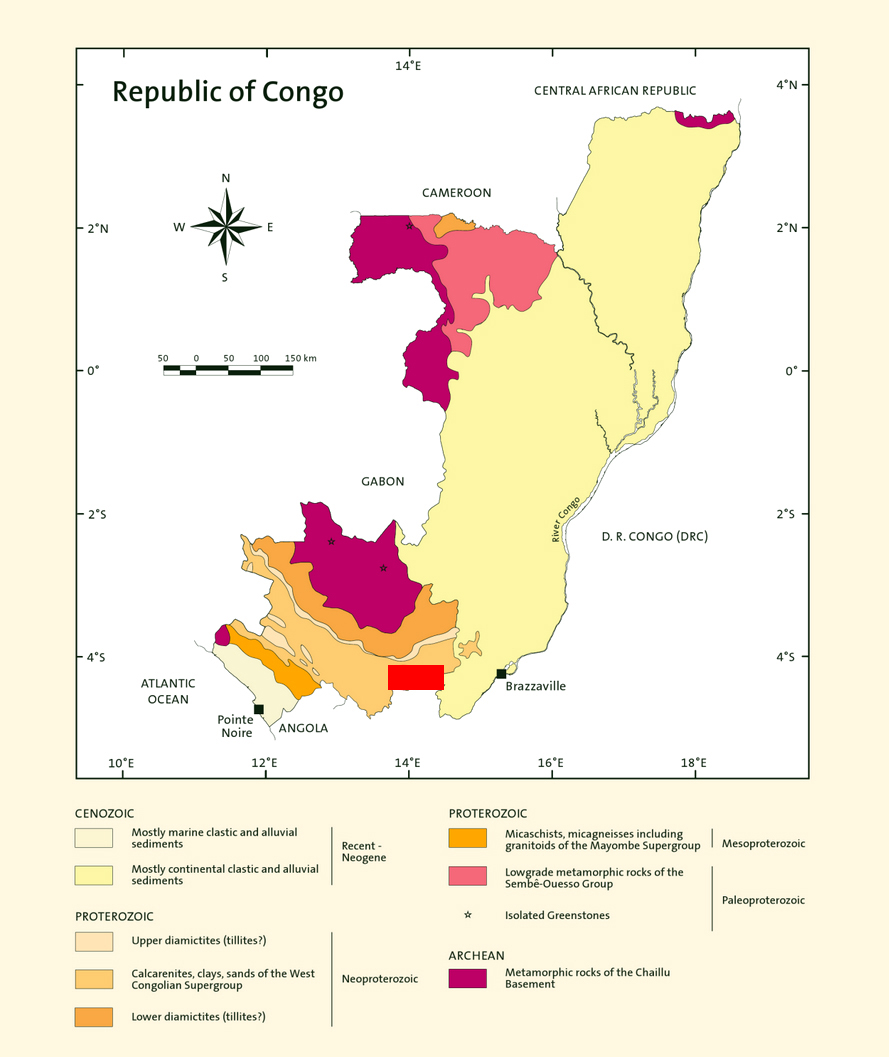
Simplified geological map of the Republic of the Congo. The red square marks the Niari Basin (see detailed map below), where the most interesting secondary Cu–Pb–Zn mineralization occurs.
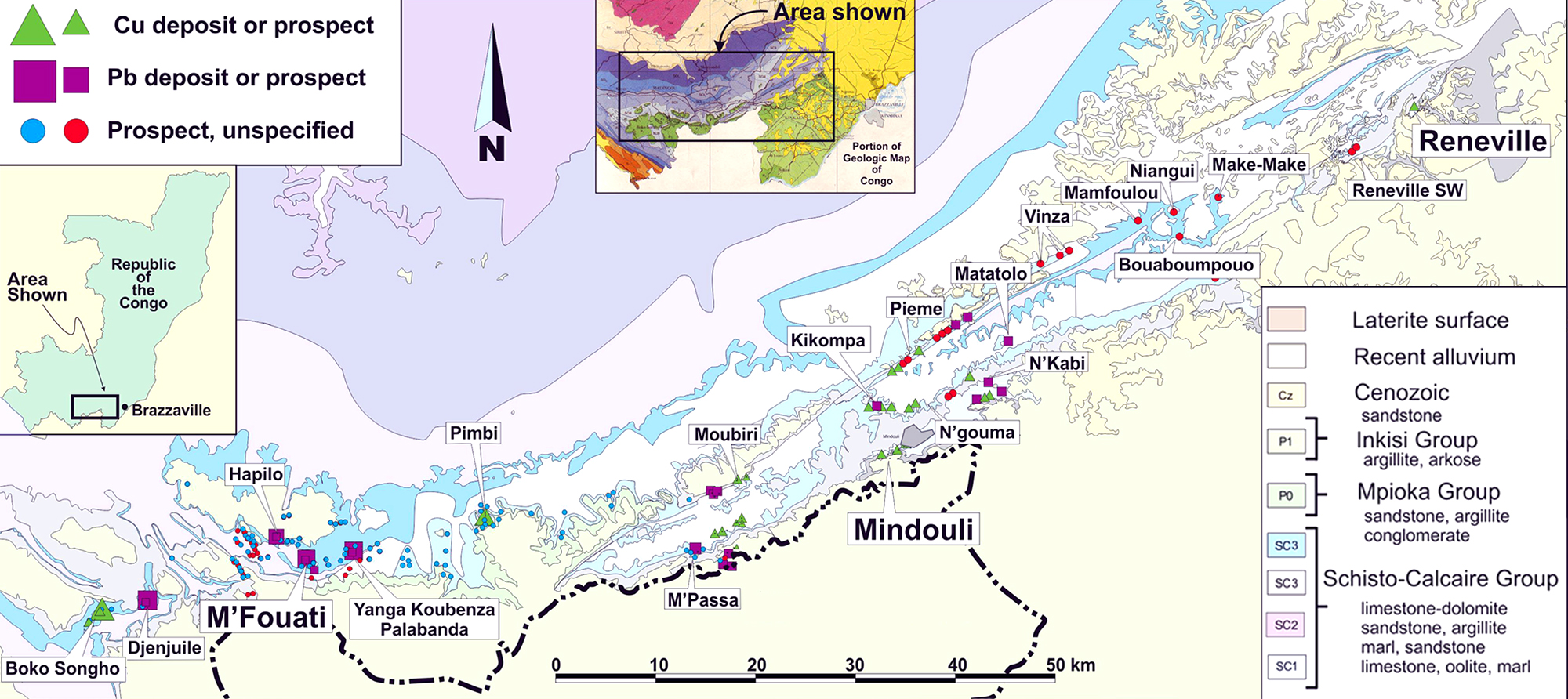
The Niari Basin is composed of Neoproterozoic sedimentary rocks divided into three groups. The most important Cu–Pb–Zn deposits (marked on the map) are hosted in the so-called Shisto-Calcaire Group, built mostly of carbonates such as limestone, dolomite, and marl. Map by S. Olson.
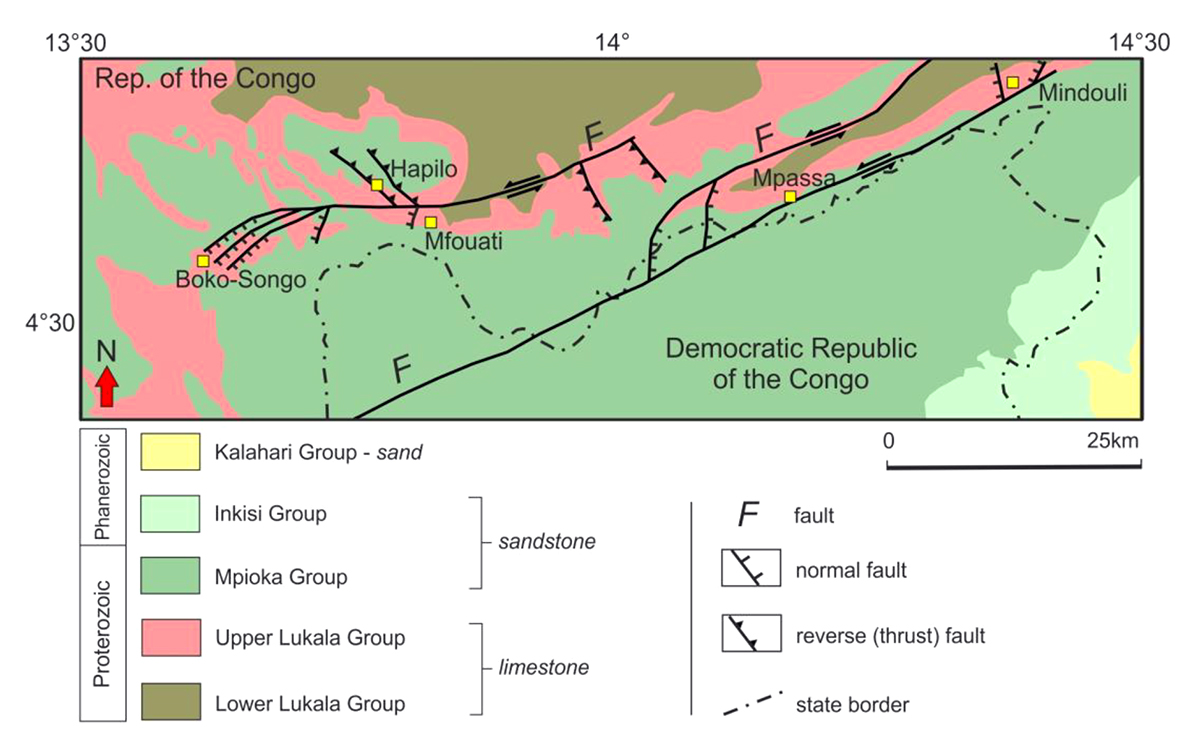
Simplified geological map of the Mindouli–Loutete area showing the most important Cu–Zn–Pb deposits. Yanga Koubenza is located just northeast of M'fouati. The “Lukala Group” is a synonym of the “Shisto-Calcaire Group” (Rademakers et al 2018).
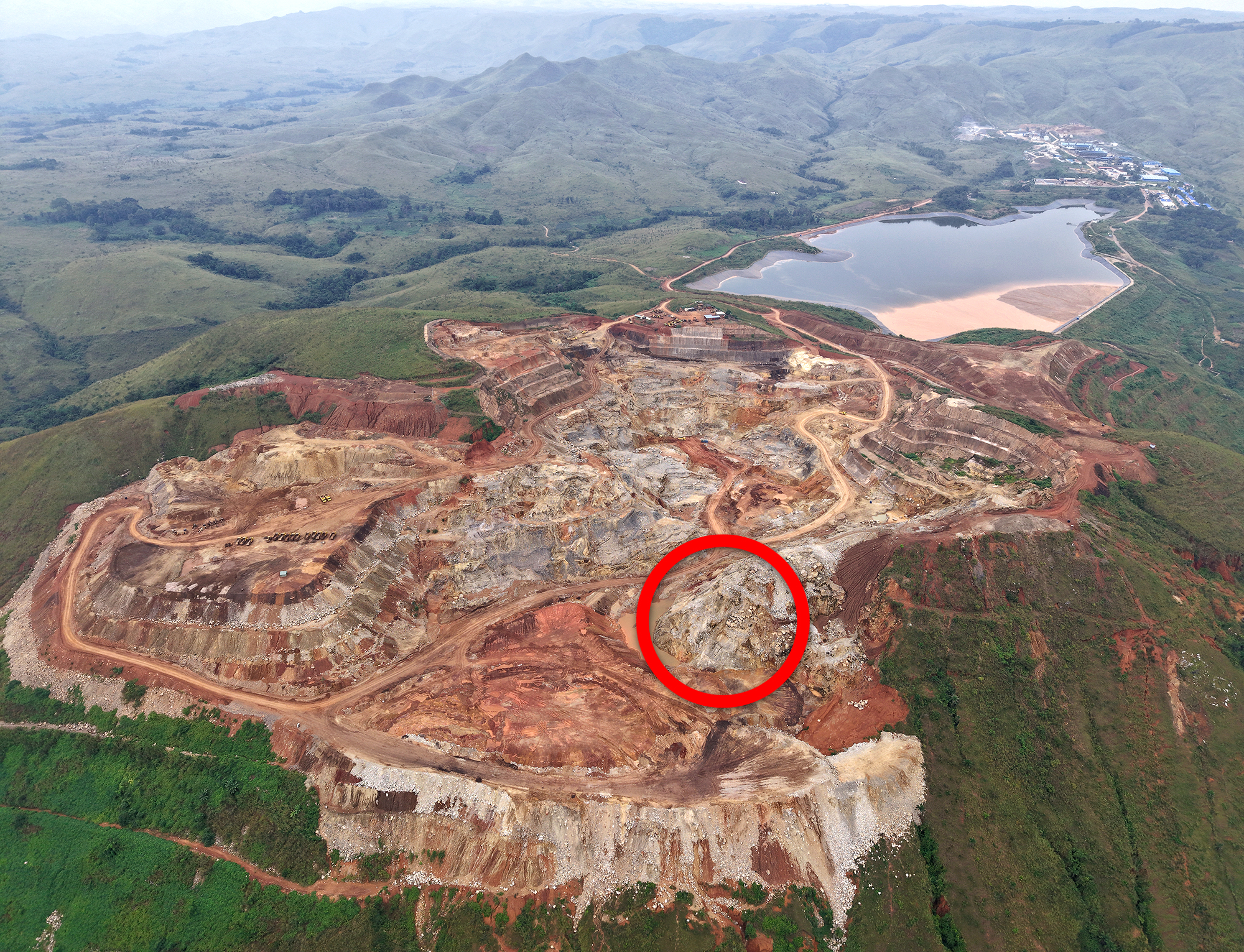
Yanga Koubenza quarry, with the area that produced mimetite and associated species in 2024 marked.

Zone with high-grade ore in the Yanga Koubenza quarry.
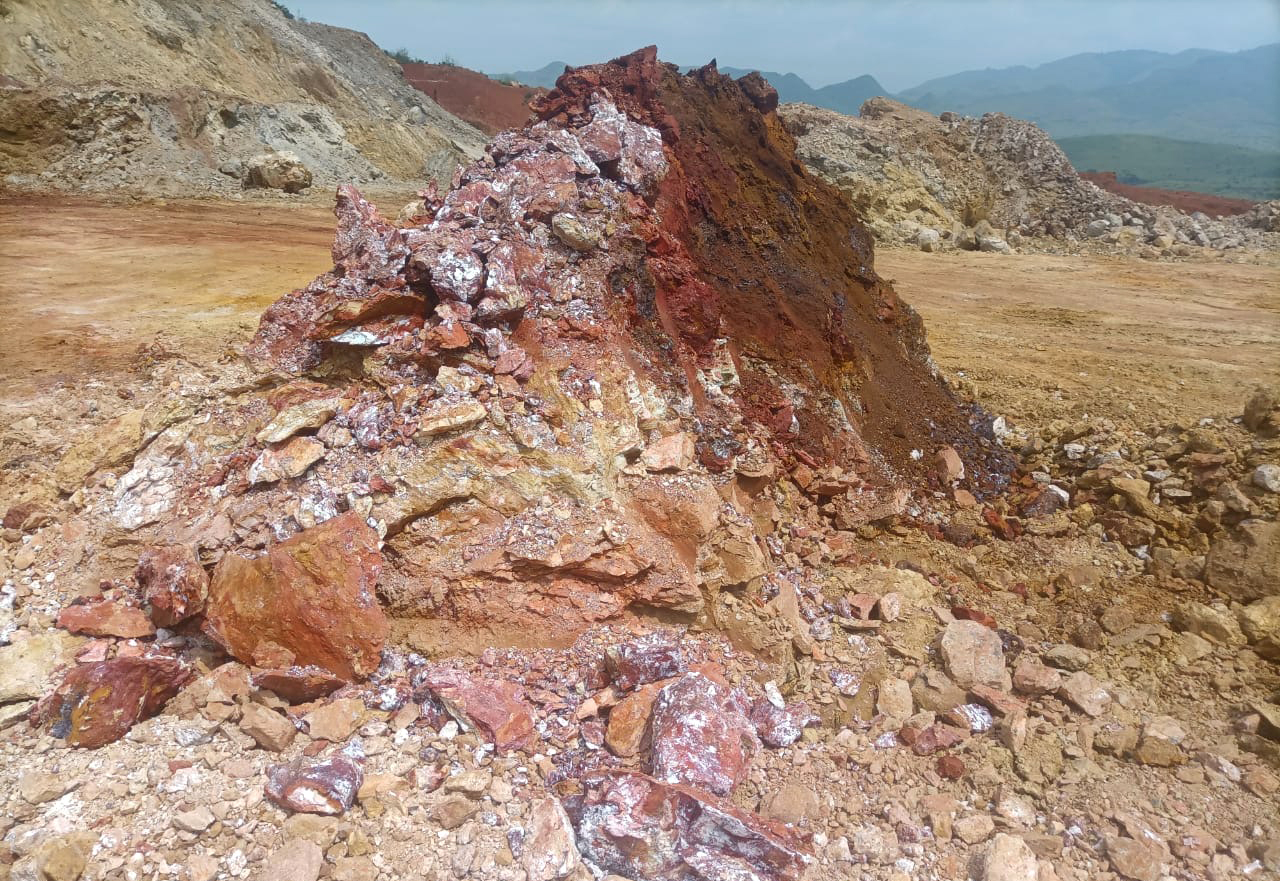
Zone with high-grade ore in the Yanga Koubenza quarry.
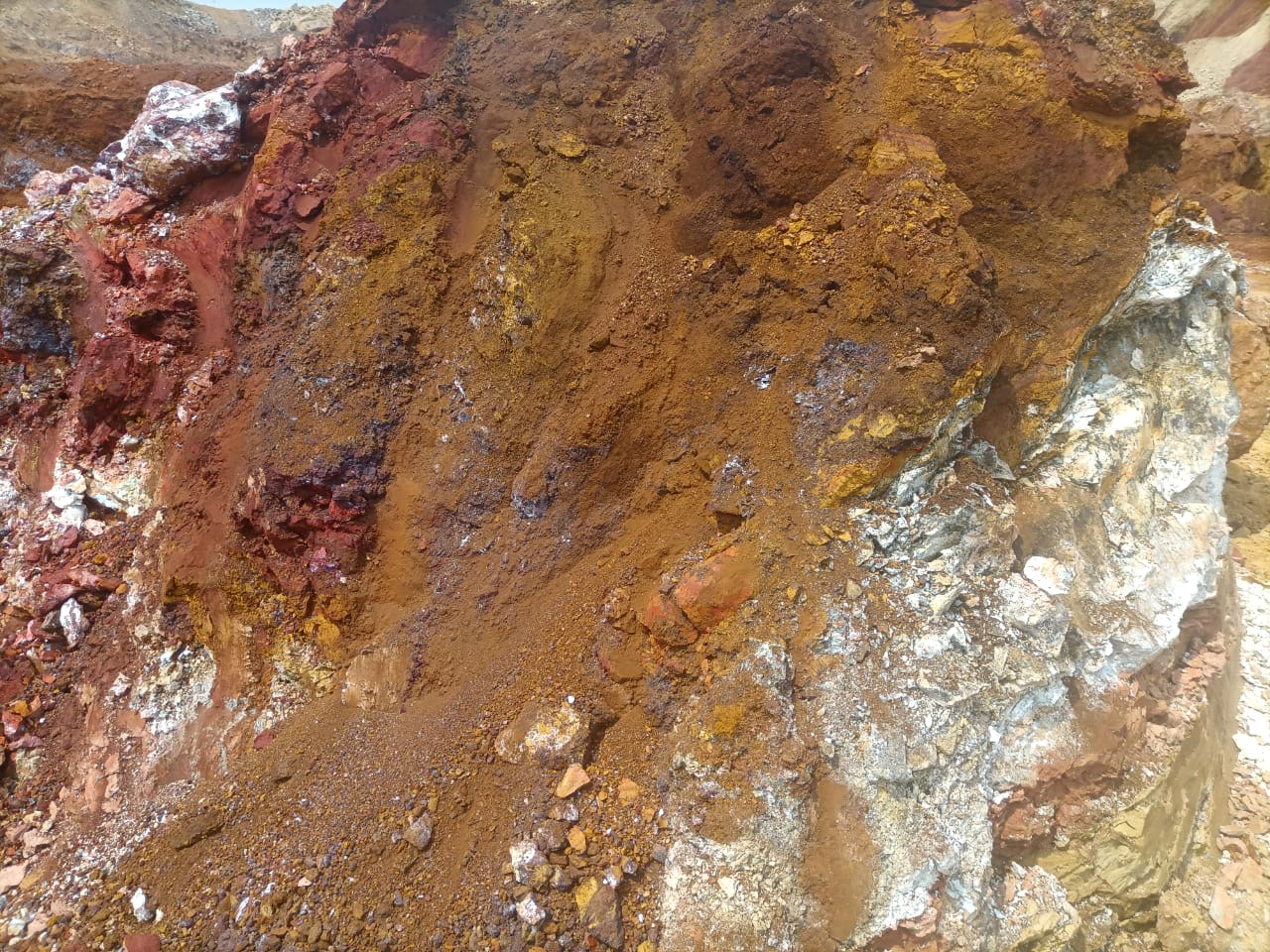
Zone with high-grade ore in the Yanga Koubenza quarry.
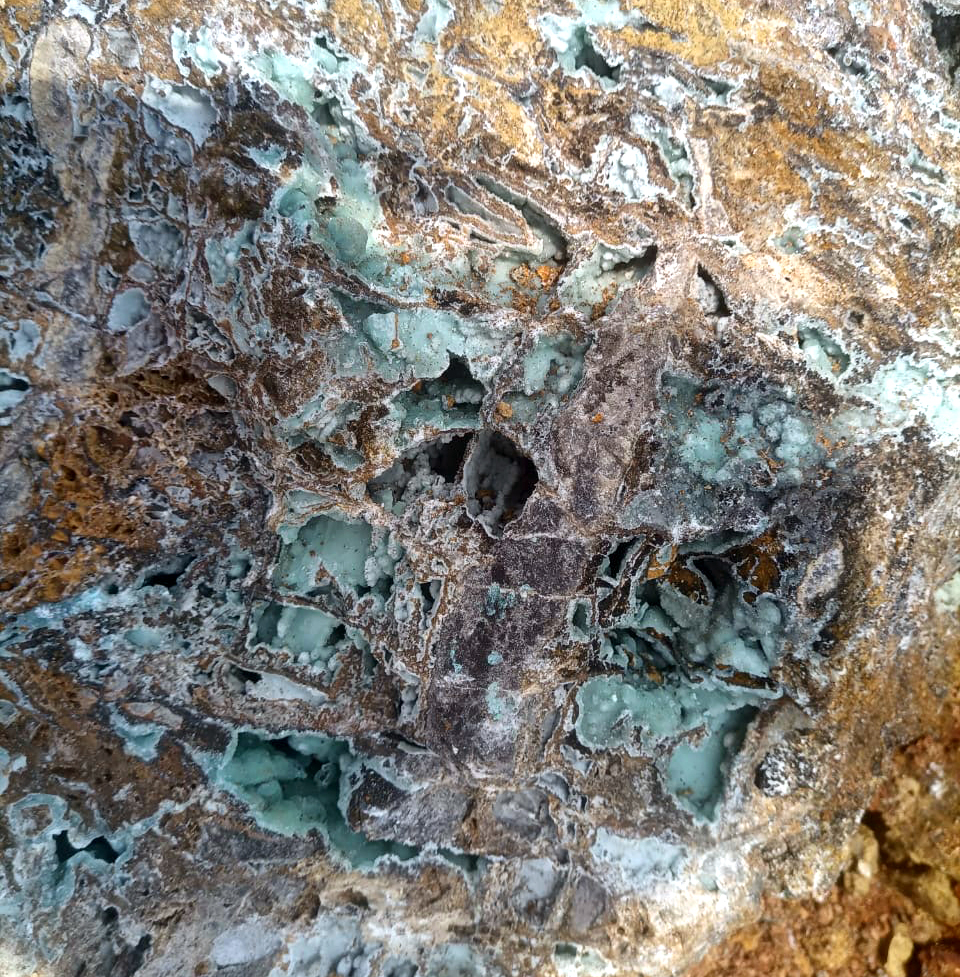
Cavernous dolomites with pockets lined with smithsonite, Yanga Koubenza quarry.
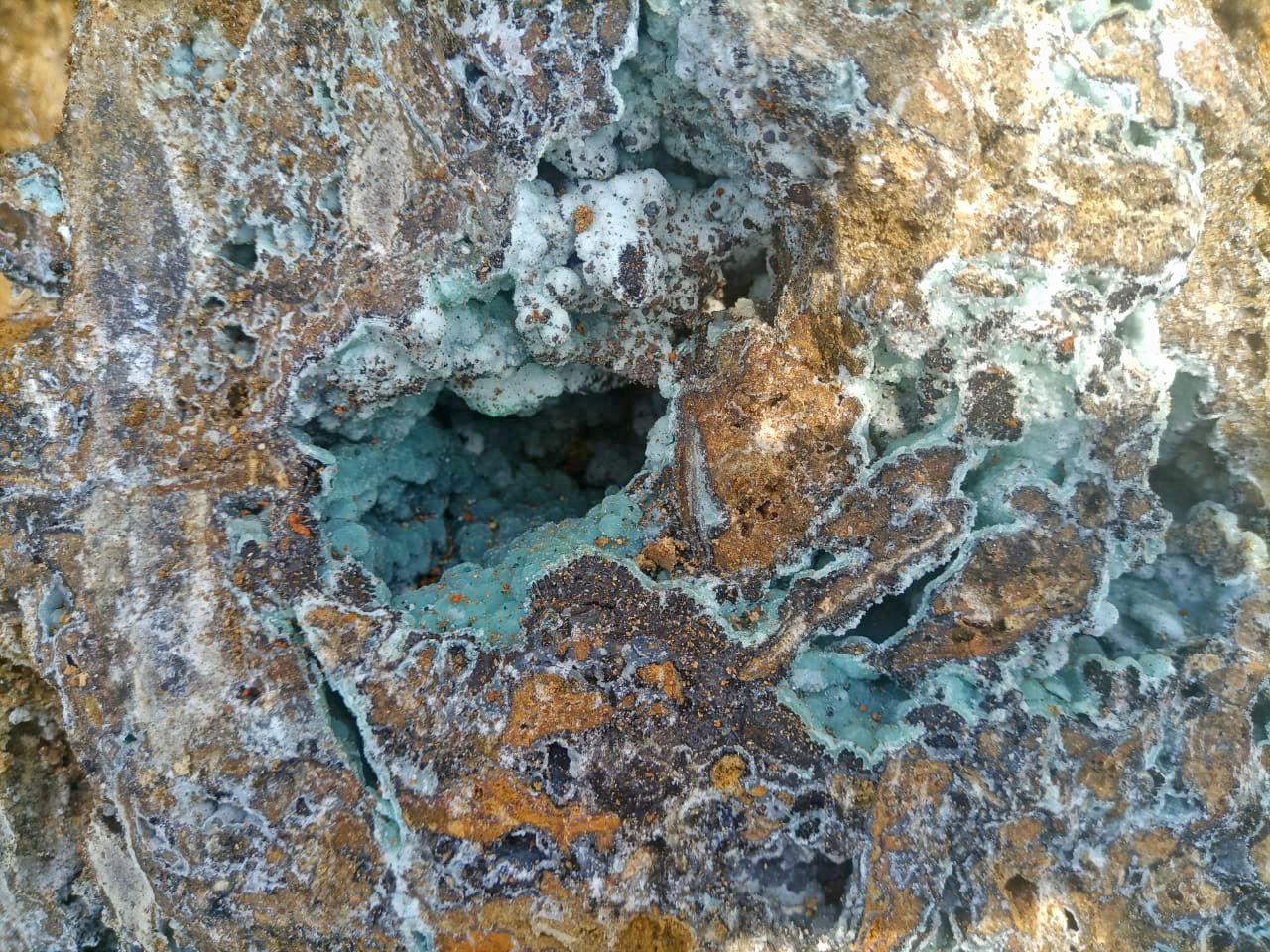
Cavernous dolomites with pockets lined with smithsonite, Yanga Koubenza quarry.
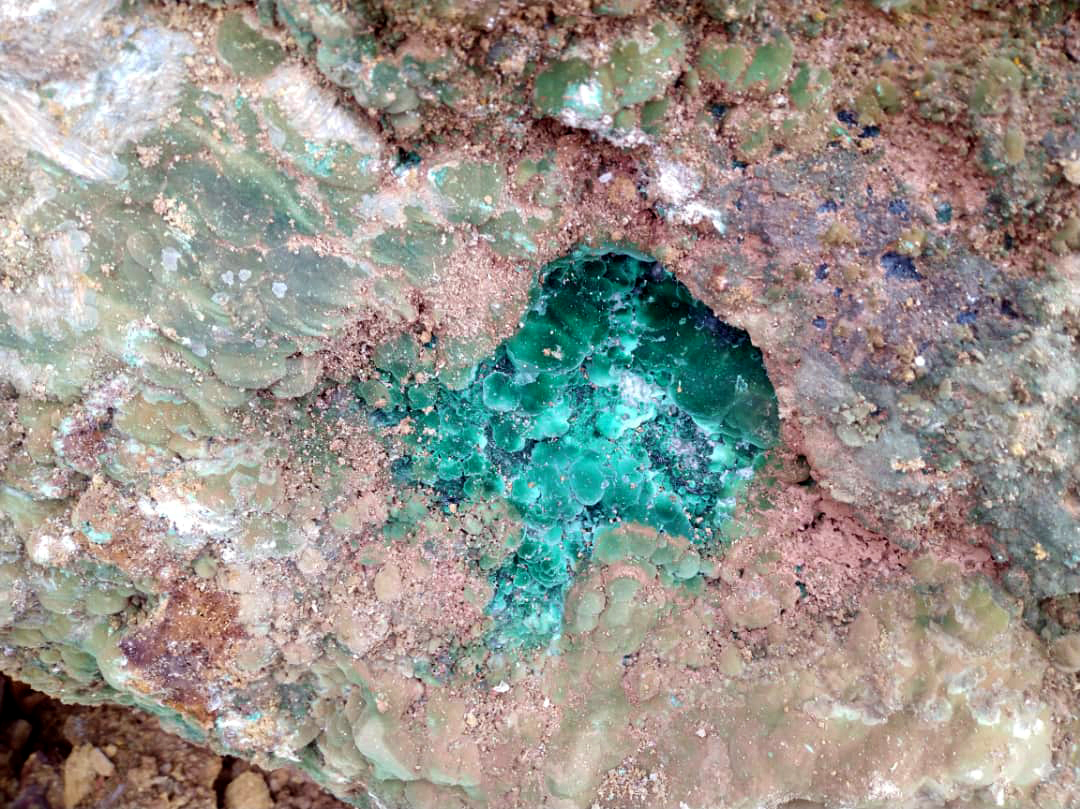
Malachite pocket in situ in the host rock, Yanga Koubenza quarry.
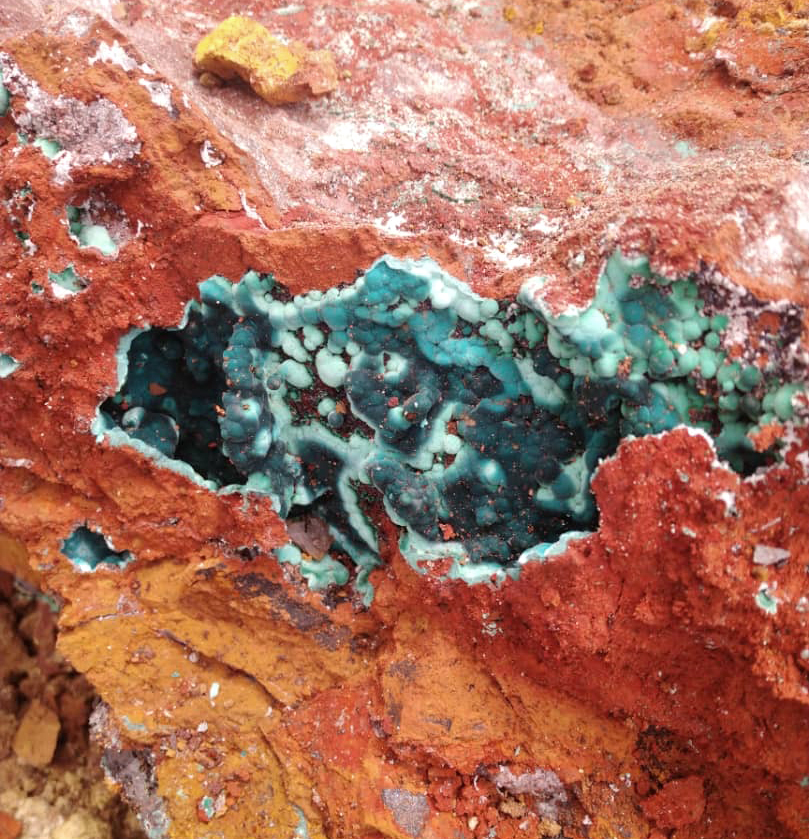
Rosasite pocket in situ in the host rock, Yanga Koubenza quarry.
MINERAL SPECIMEN OCCURRENCE AND MAJOR FINDS
No mineral specimens from the early mining at Yanga Koubenza are known to the author. The year 2016 marked a turning point in the exploitation of the deposit, when large-scale mining operations conducted by SOREMI commenced. As smithsonite is one of the principal ore minerals, it was inevitable that specimens of this species would begin to be recovered shortly after the start of the new operation. It also quickly became apparent that several other mineral species occur within the deposit and form important and attractive specimens.
Owing to the nature of the deposit, mineralization is irregularly distributed, concentrating in small, isolated zones. Consequently, the production of particular specimens is highly episodic: certain types may be recovered in significant quantities for a brief period, only to disappear entirely once a specific zone has been mined out.
The potential for a diverse range of specimens—including such species as smithsonite, cerussite, azurite, malachite, rosasite, aurichalcite, and mimetite, as well as their uncommon combinations—is undoubtedly very high. Unfortunately, the recovery of high-quality specimens is severely constrained by the nature of the mine itself, which is a large-scale industrial operation focused on the extraction of millions of tons of ore. At present, it is probably the largest ore mine in the Republic of the Congo.
Collecting mineral specimens is typically forbidden by mine management, and miners have neither the time nor the means to properly collect and pack specimens. Opportunities for recovery are generally limited to brief moments after large machinery has passed, when only remnants remain accessible. This is a typical—and regrettable—situation in large industrial mines that nevertheless have the potential to produce outstanding mineral specimens. One can only imagine how many exceptional pieces have been destroyed by heavy machinery or reduced to powder in the processing mills.
Following the reopening of the mine in 2016, several important and distinctive mineral specimen finds have been made at the site. These are briefly described below.
Smithsonite, being one of the principal ore minerals, has been produced almost continuously since 2017, with certain periods of increased abundance and quality. The best specimens of the species from Yanga Koubenza closely resemble the famous blue smithsonites from the Kelly mine in New Mexico, USA. As at Kelly, the blue coloration of smithsonite in Yanga Koubenza is caused by inclusions of aurichalcite.
The most productive periods for smithsonite specimens at the Yanga Koubenza quarry occurred in 2020/21, 2022, and 2025. Colors vary between vivid blue, blue-green, sea-blue, and green. The finest specimens display good luster and attractive botryoidal forms and are sometimes associated with rosasite and other secondary minerals.
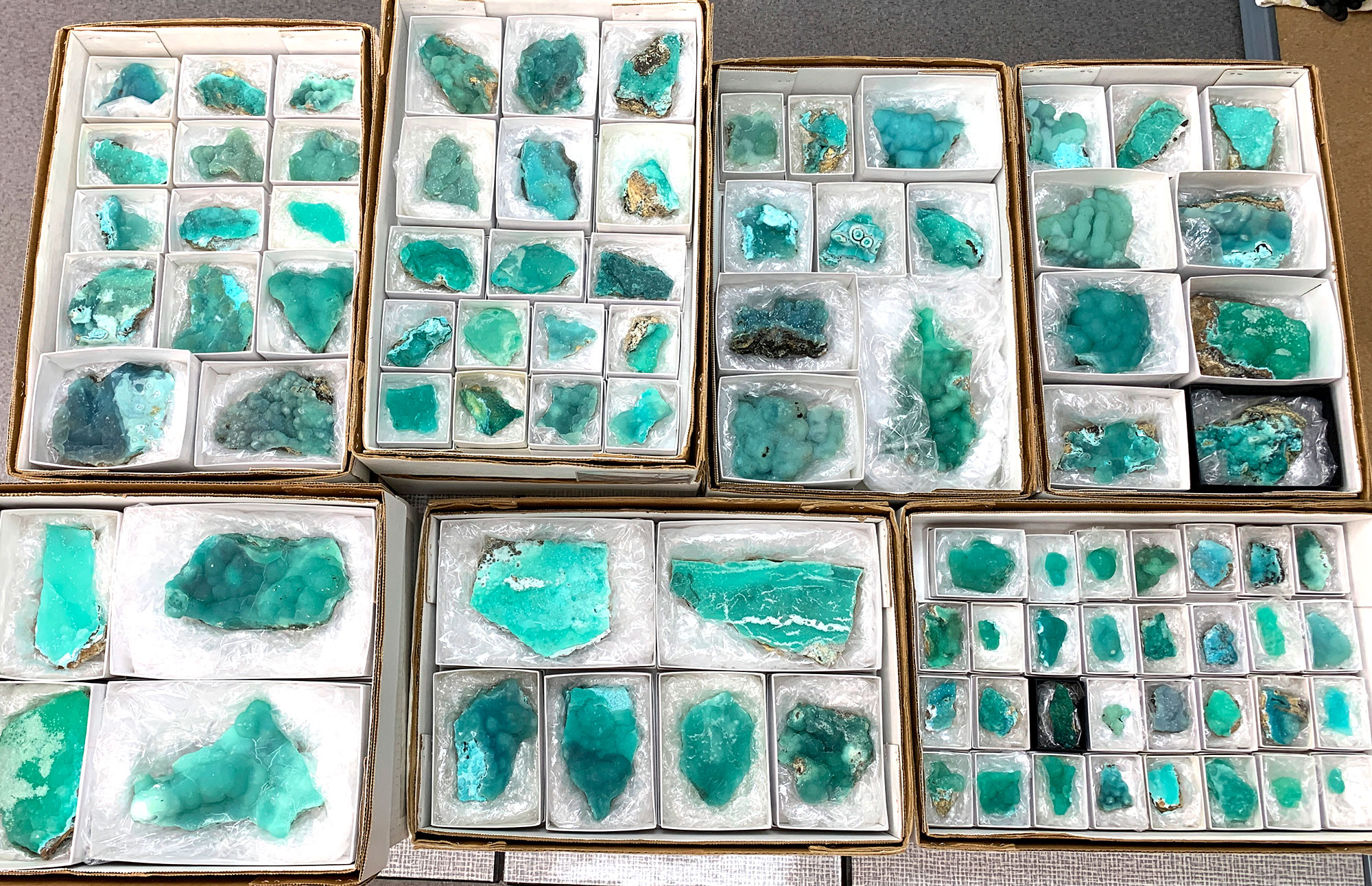
Group of prepared smithsonite specimens from the 2020–2021 production of the Yanga Koubenza mine.
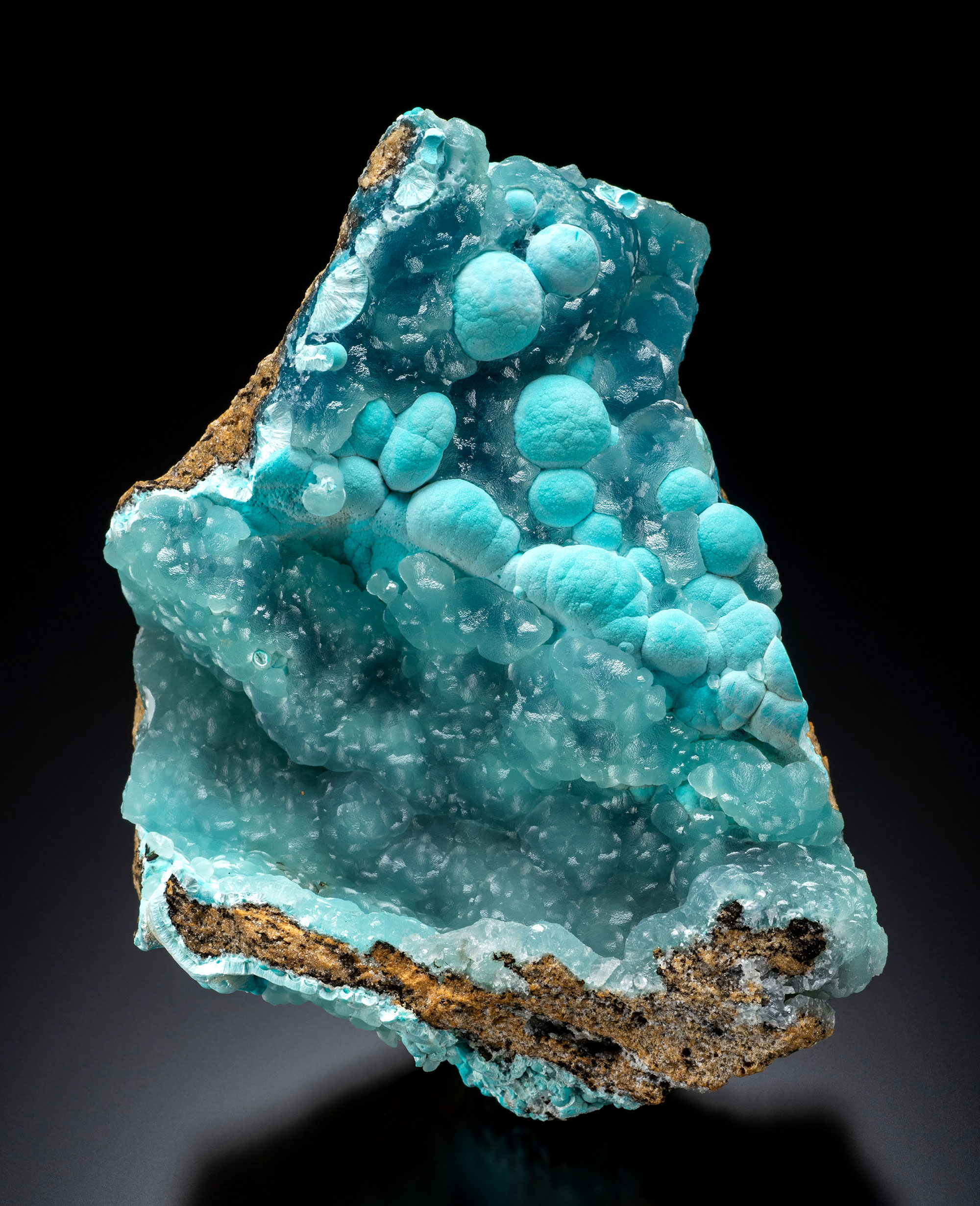
Specimen of smithsonite with aurichalcite from early production. Size 6.9 cm. Photo by Jeff Scovil.
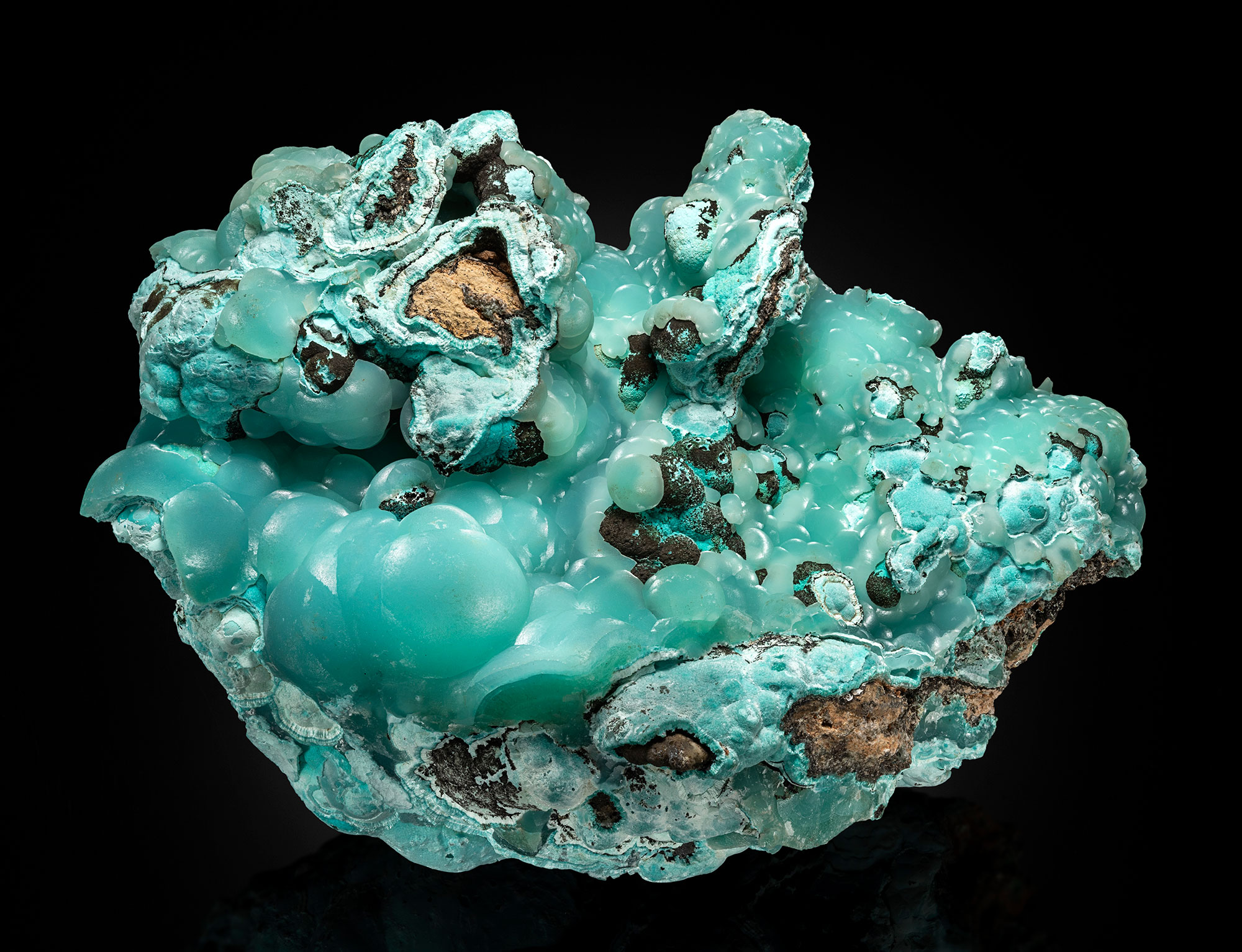
Large specimen of smithsonite with aurichalcite from early production. Size 21 cm. Photo by Mark Mauthner.
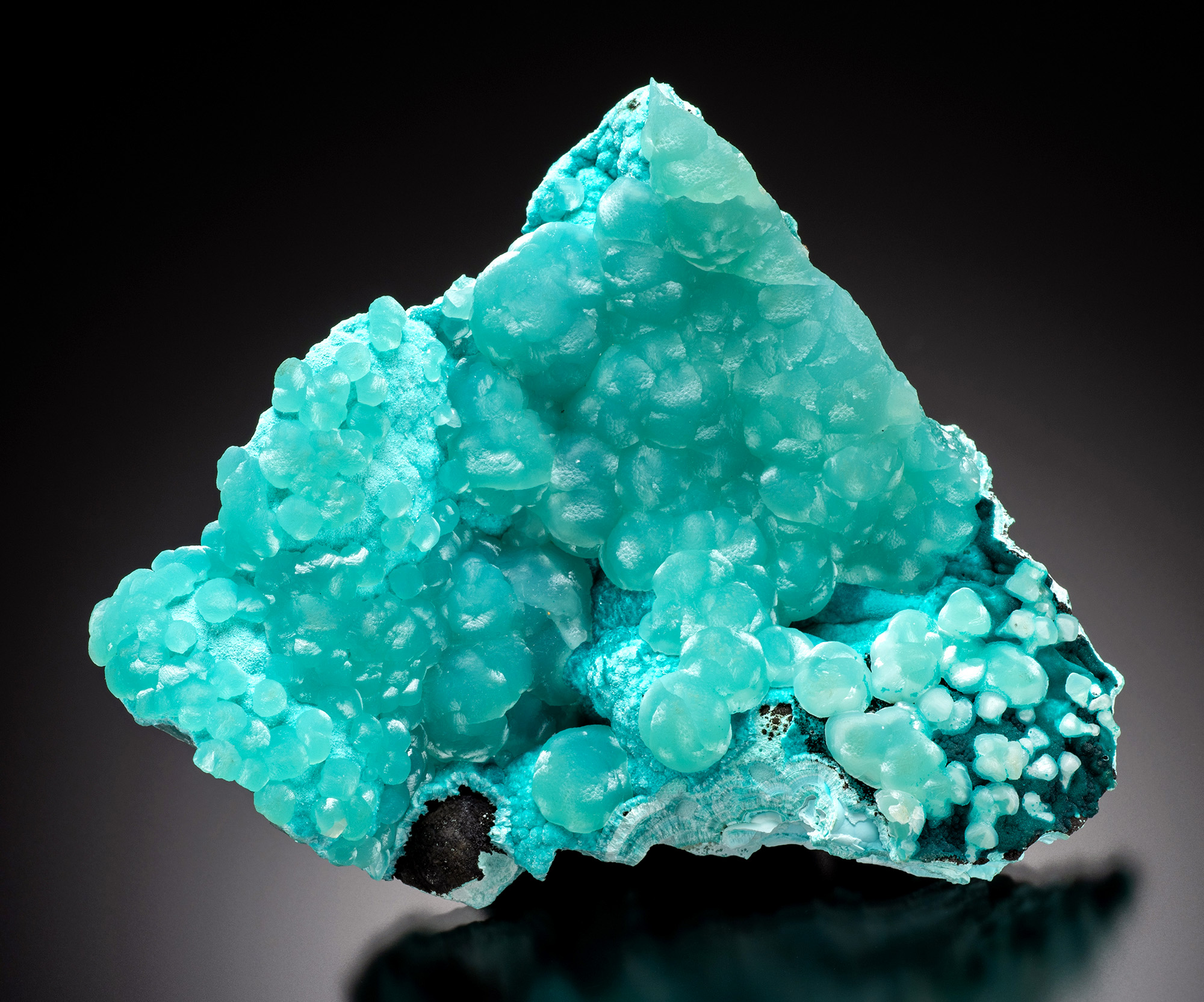
Specimen of smithsonite with aurichalcite and rosasite from early production. Size 9.3 cm. Spirifer collelction. Photo by Jeff Scovil.
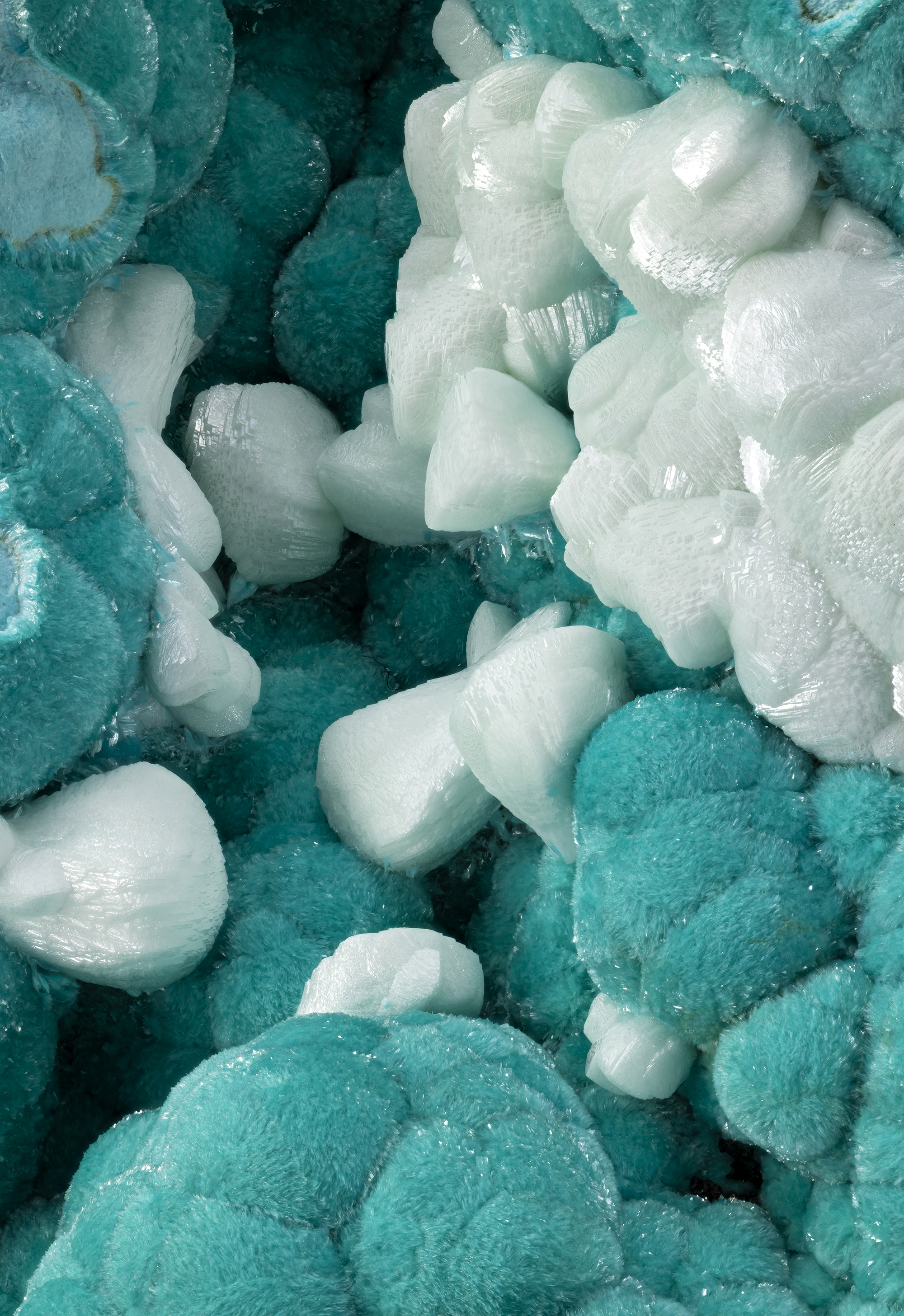
Close-up of a specimen of white smithsonite on aurichalcite. FOV 3.5 cm. Photo by László Kupi.
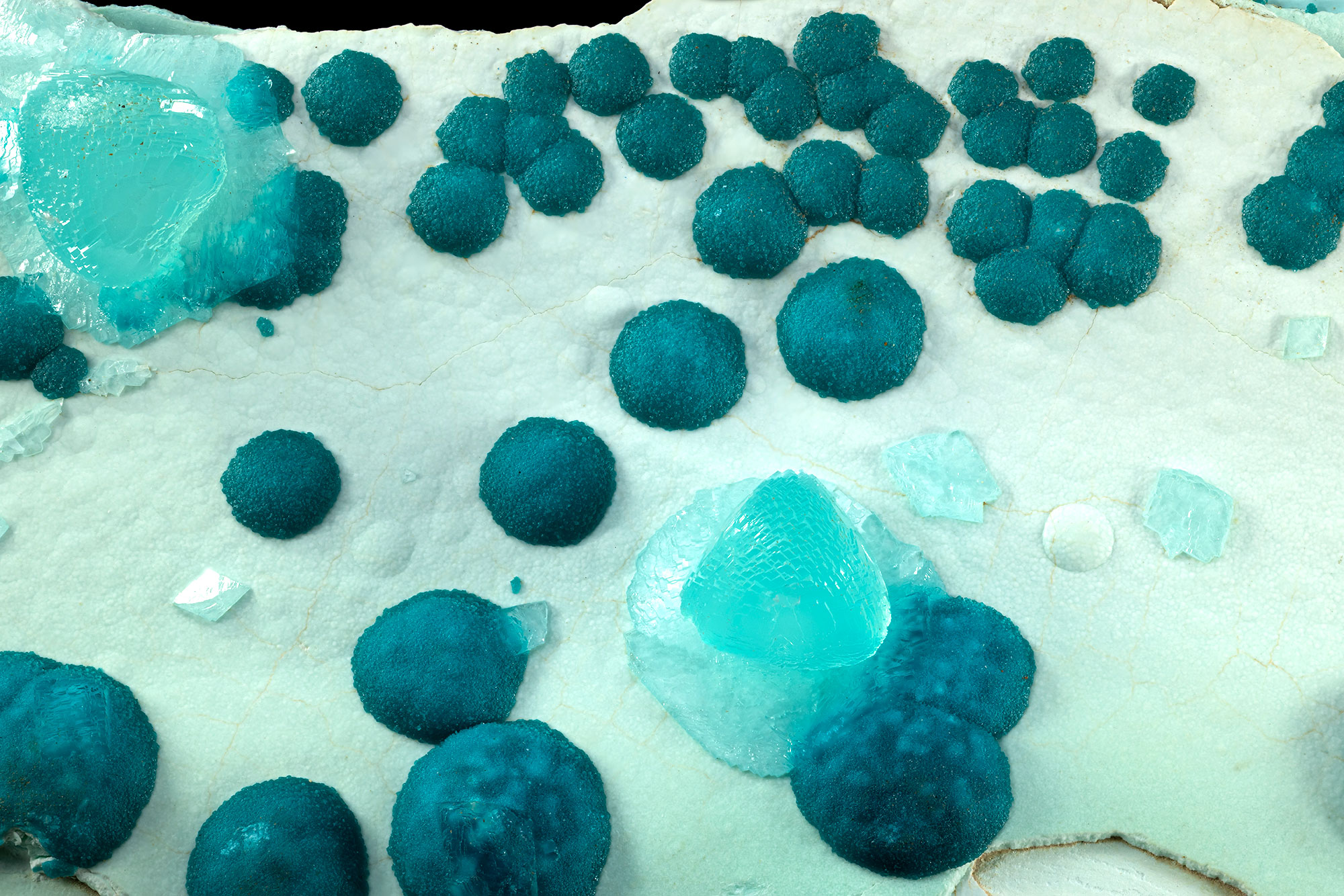
Close-up of a specimen of bluish smithsonite and rosasite on white smithsonite. FOV 4 cm. Spirifer collection. Photo by László Kupi.
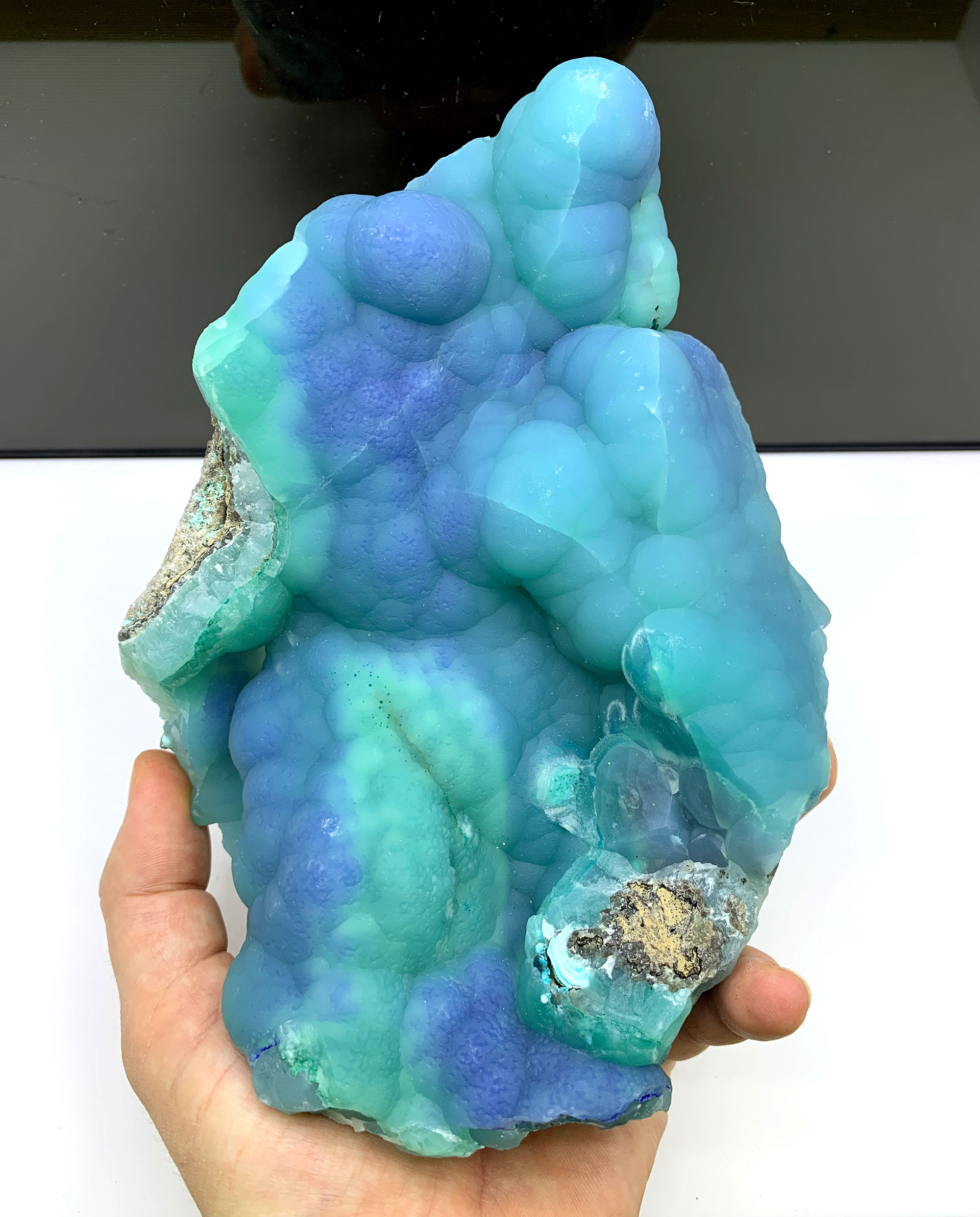
Unusual specimen of smithsonite with included azurite, whose color is visible through the smithsonite.
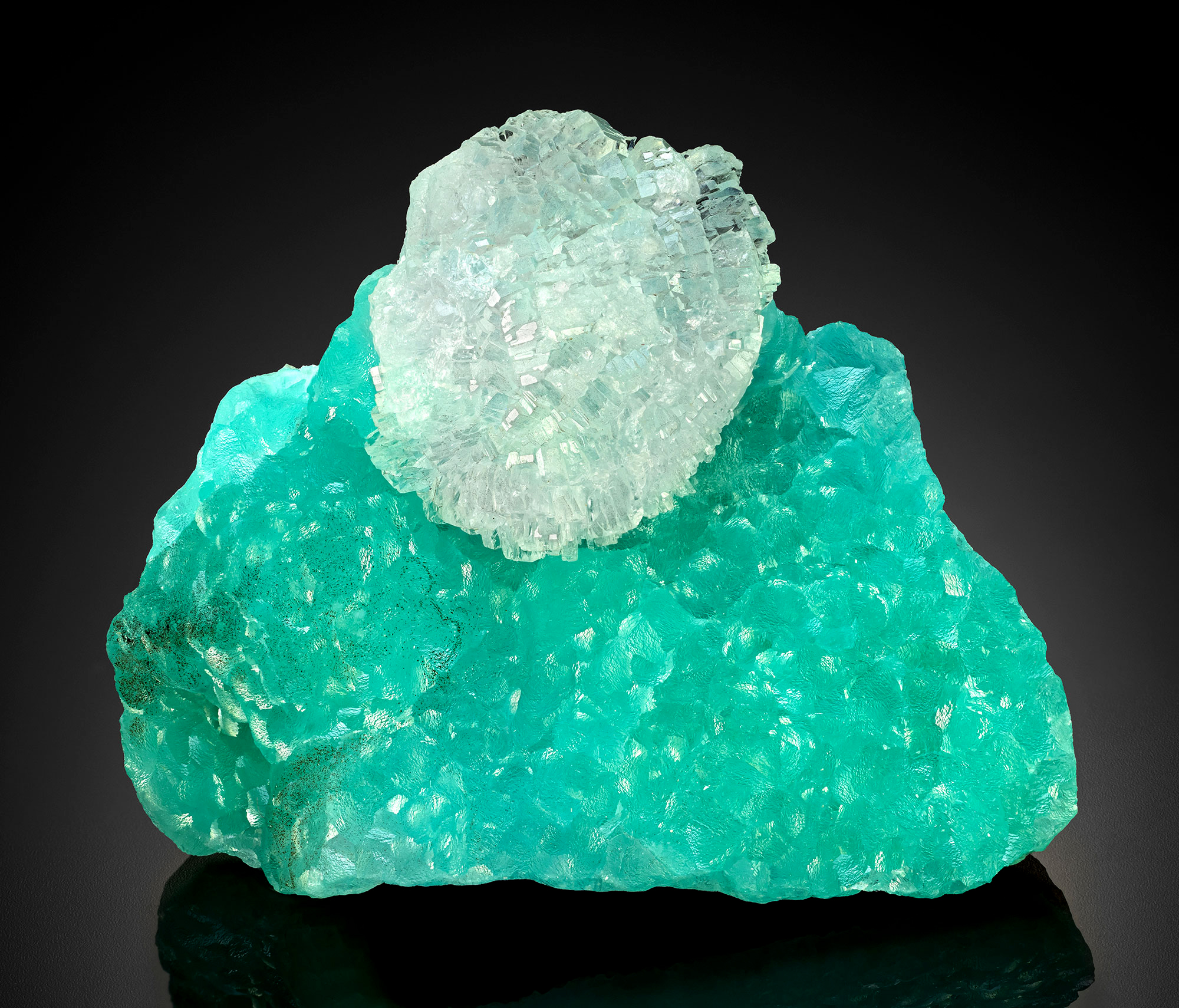
Hemimorphite on smithsonite. Size 4.6 cm. Joanna Praszkier collection. Photo by László Kupi.
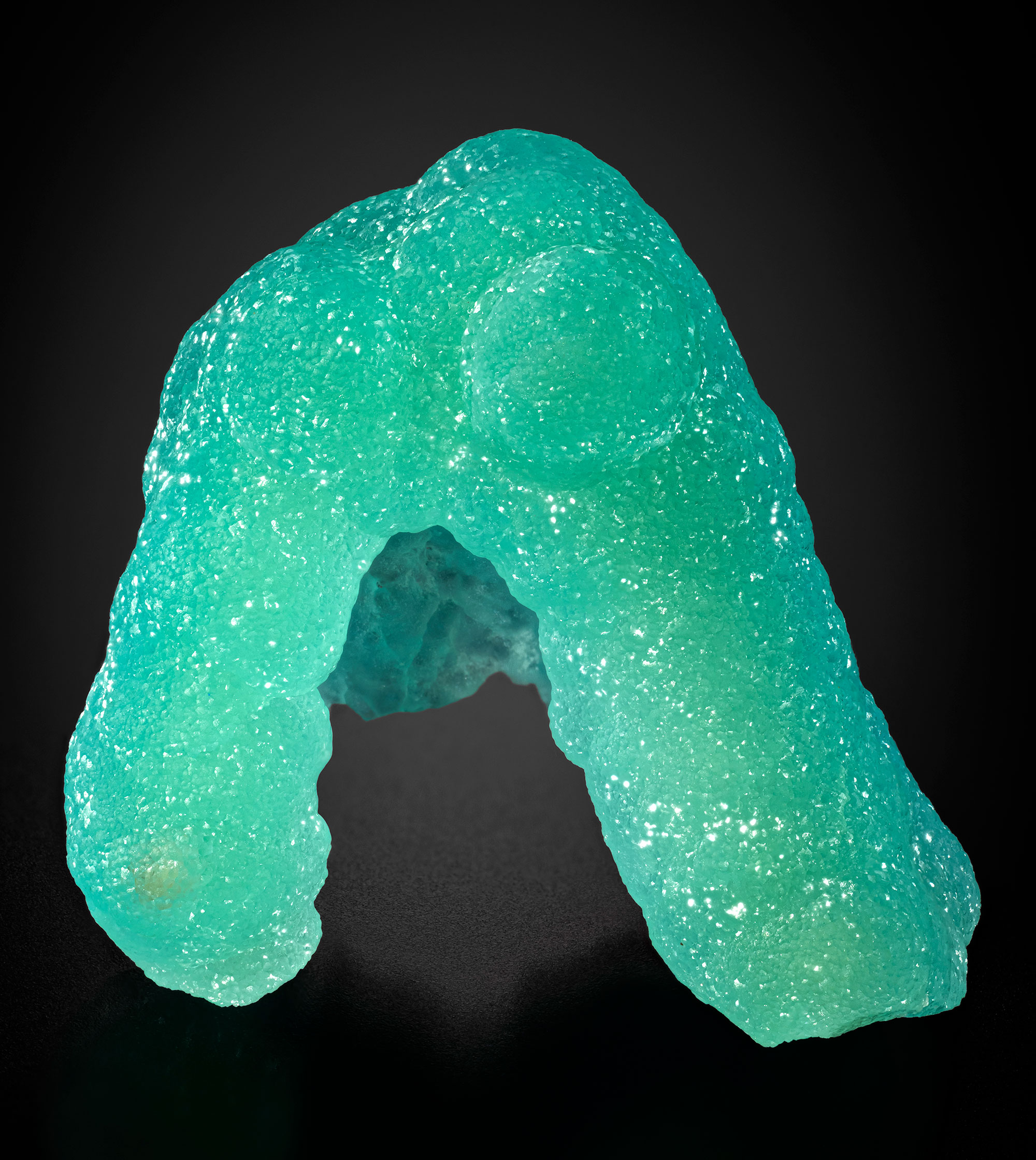
Sparkly smithsonite thumbnail. Size 2.4 cm. Joanna Praszkier collection. Photo by László Kupi.
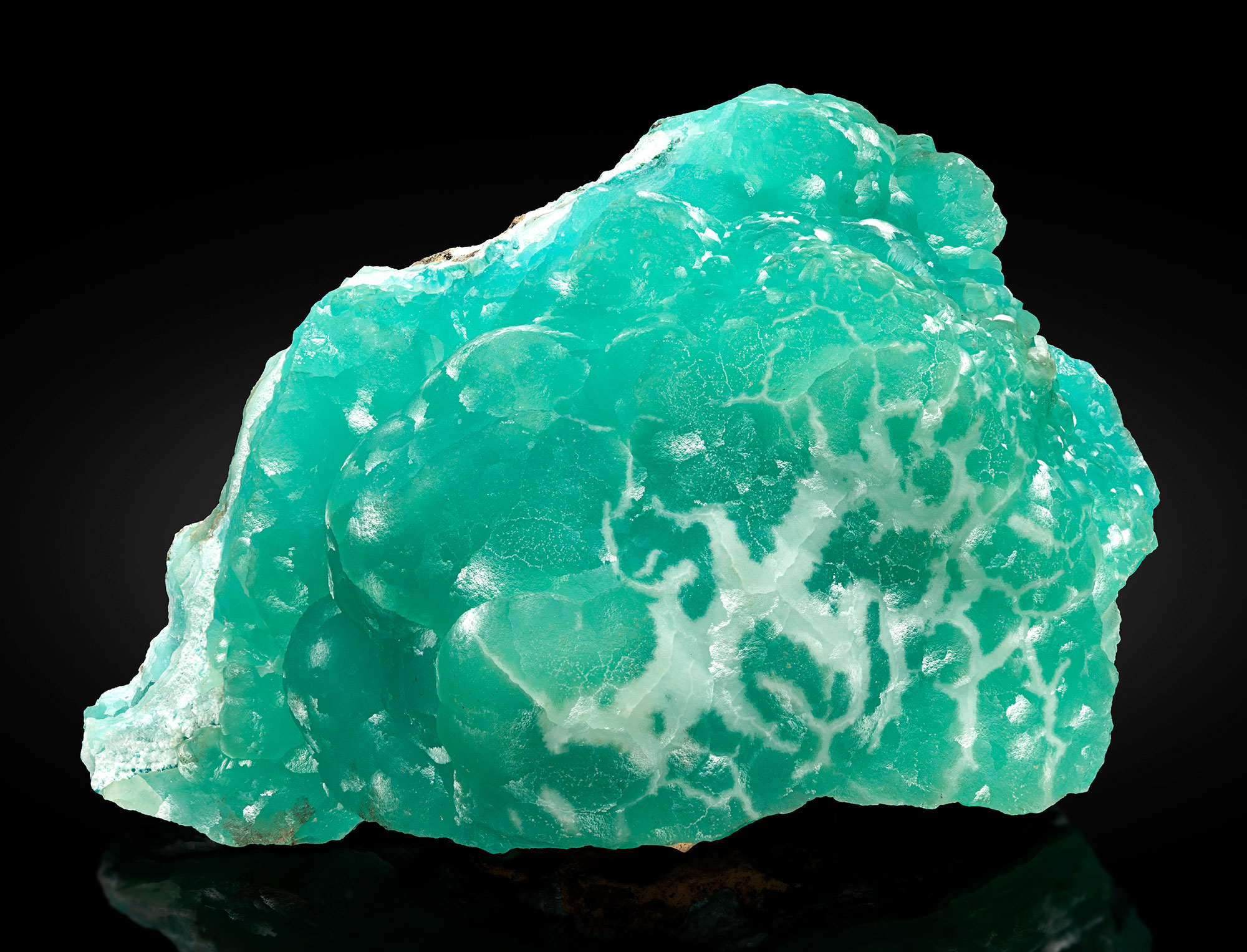
Smithosnite with unususal collor pattern. Size 9 cm. Spirifer collection. Photo by Mark Mauthner.
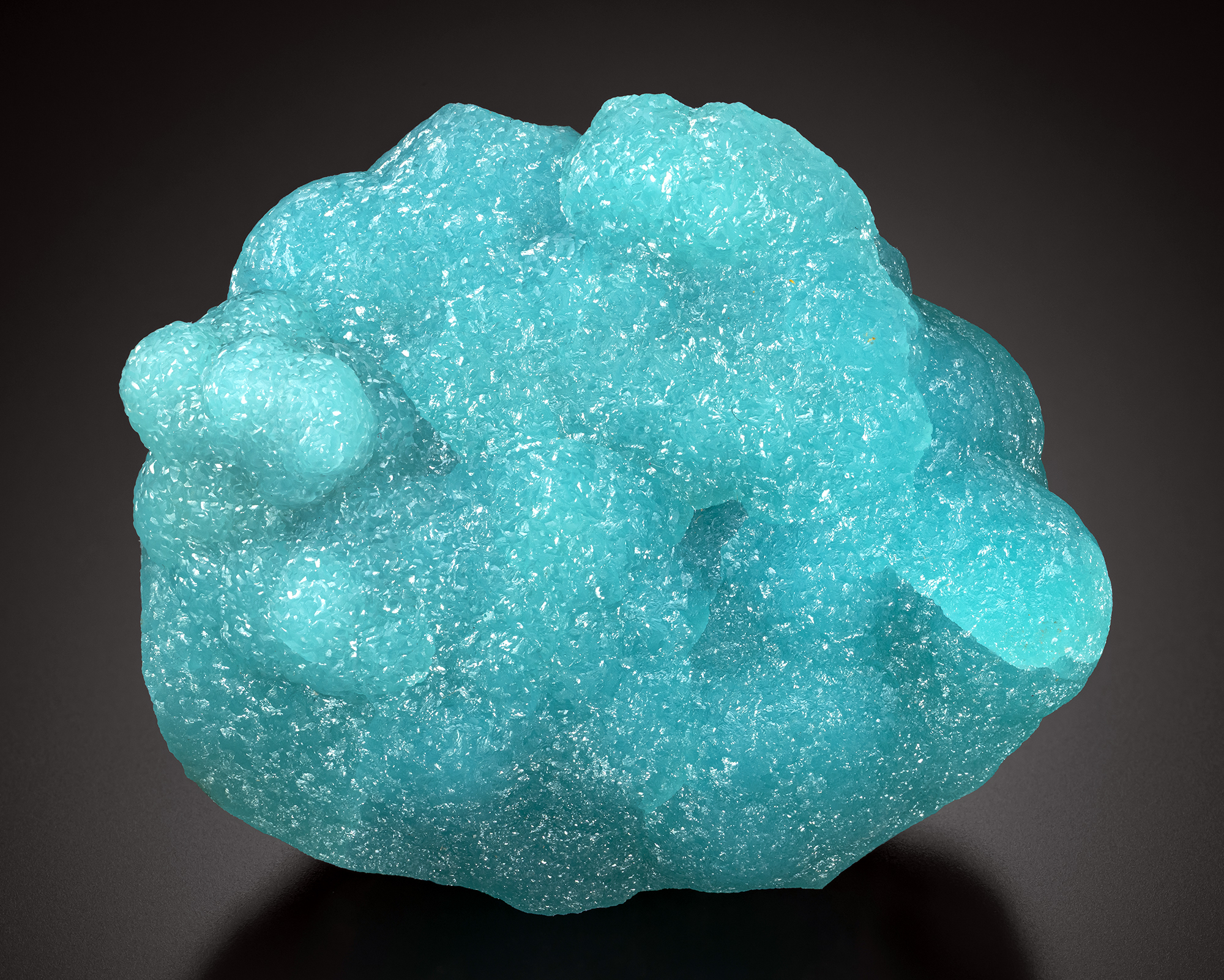
Sparkly blue smithsonite. Size 5 cm. Spirifer collection. Photo by László Kupi.
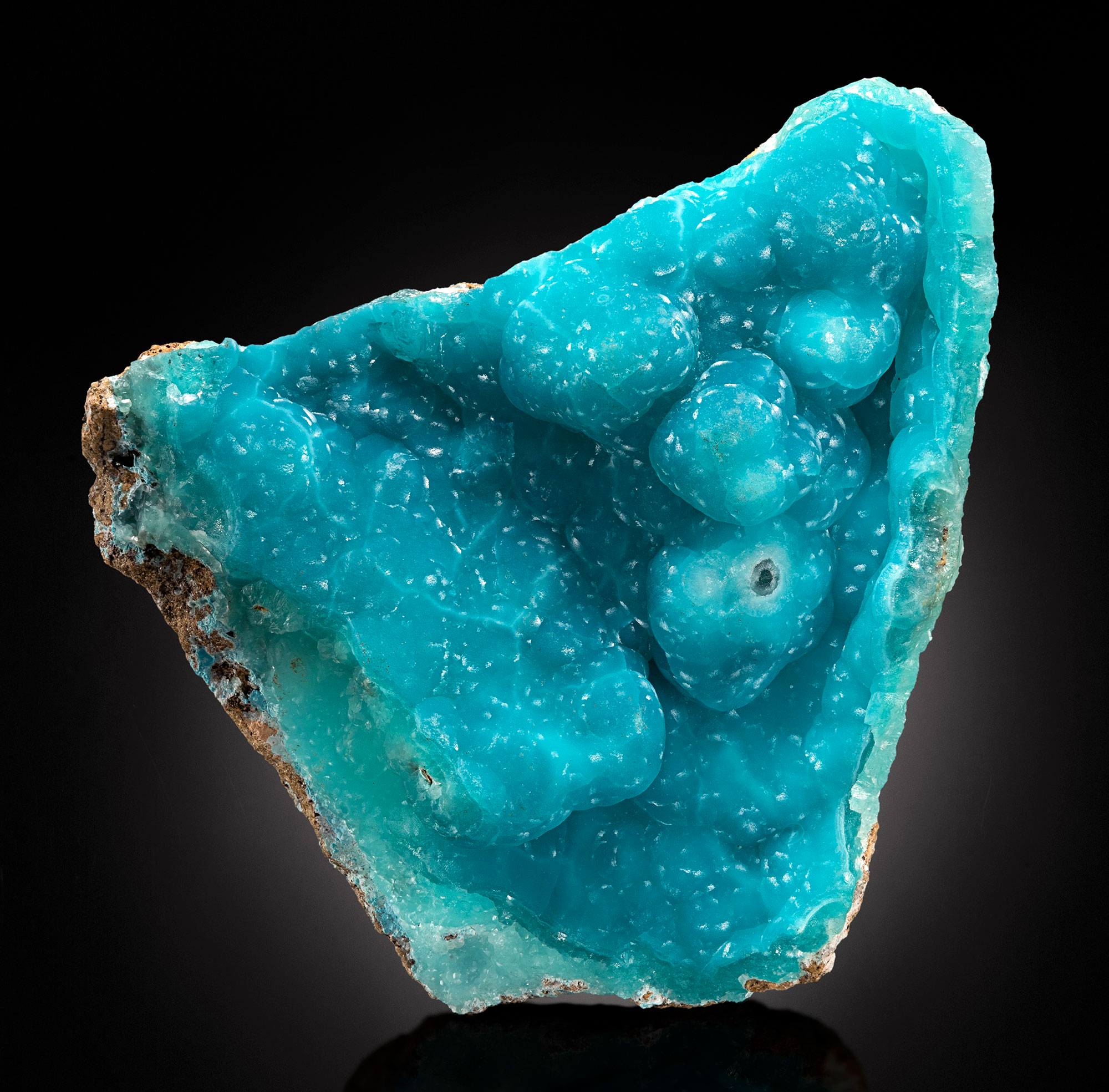
Blue smithsonite with satin luster. Size 11 cm. Spirifer collection. Photo by Mark Mauthner.
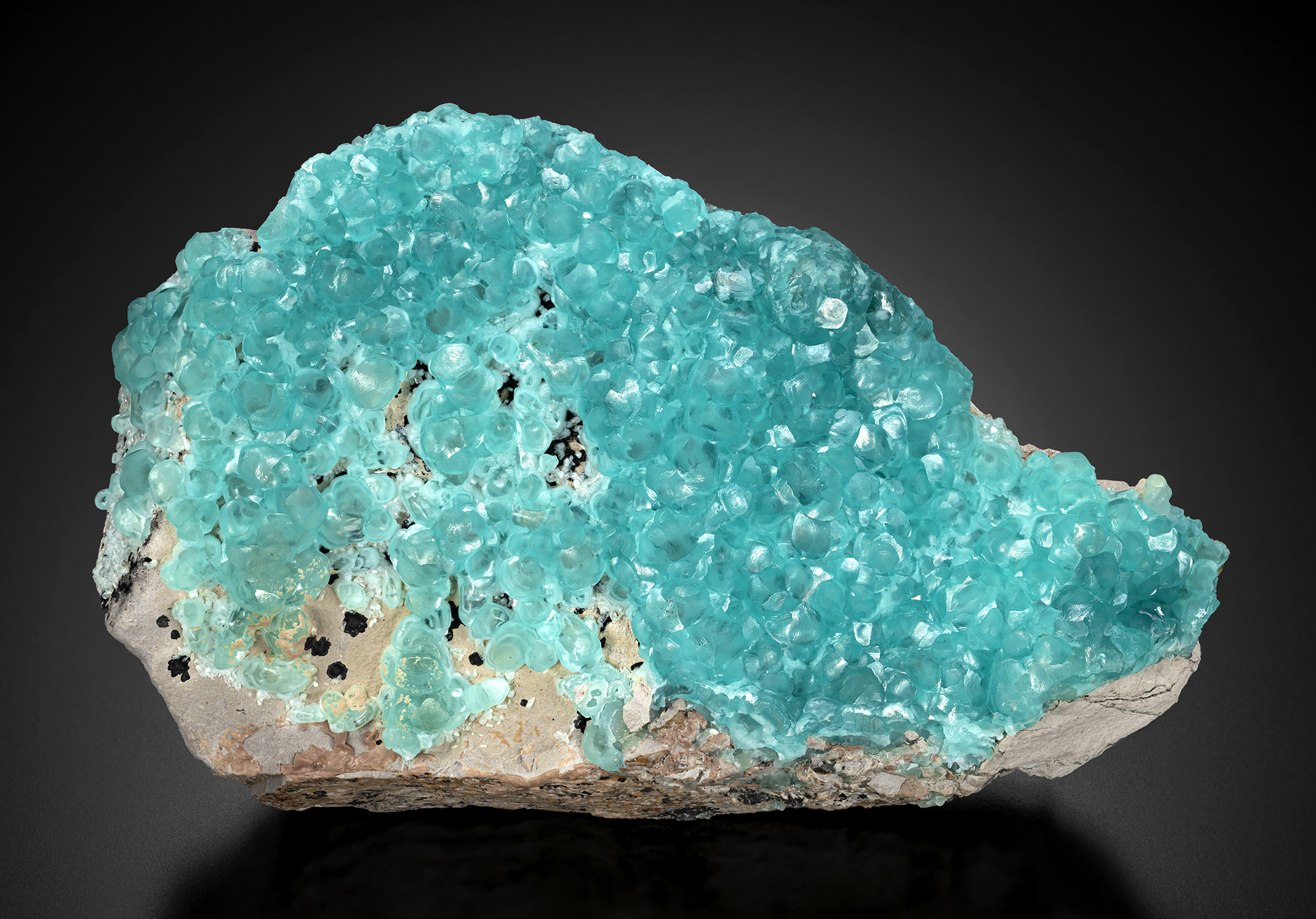
Lustrous blue smithsonite. Size 6.8 cm. Spirifer collection. Photo by László Kupi.
Video of bluish smithsonite with a “wet” luster. Spirifer collection.
In 2020–2021, the first large group of high-quality smithsonite specimens was collected from the mine. Among several hundred specimens, blue to green shades predominated, and they were frequently associated with aurichalcite. Most specimens display mammillary to botryoidal surfaces, sometimes with an attractive satin luster.
A small but very notable find took place in 2022, when a handful of thumbnail- to miniature-sized specimens were recovered. These specimens exhibited a previously unknown, deep blue coloration for the mine, combined with exceptional luster on small botryoidal aggregates. Unfortunately, following the exhaustion of this single pocket, no further specimens of this type were found.
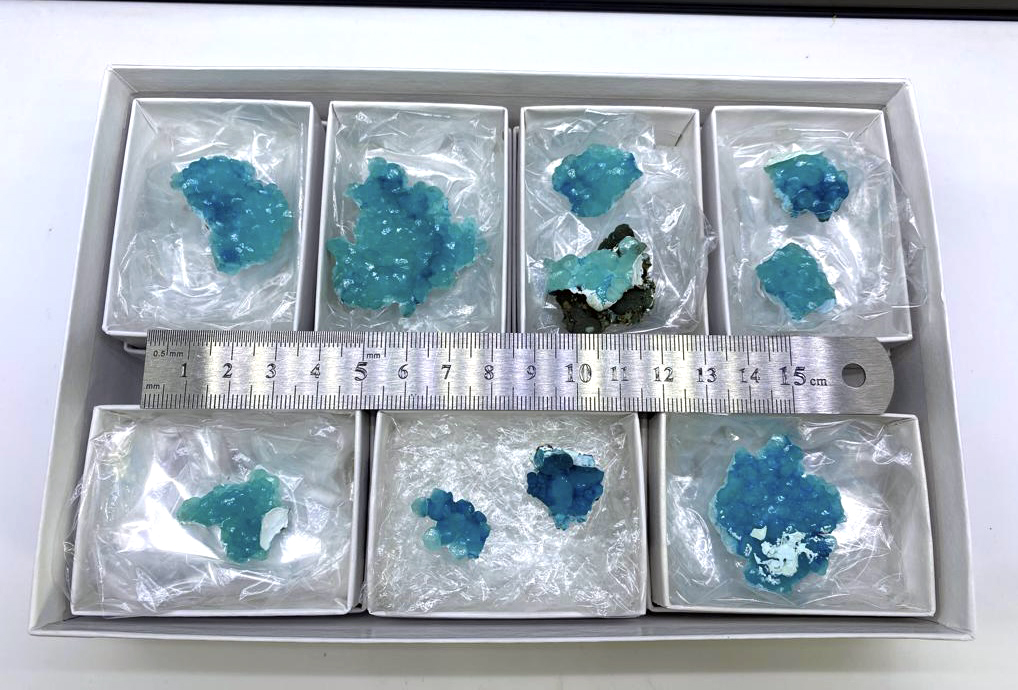
Group of the finest specimens from the 2022 find of very lustrous blue smithsonite with aurichalcite.
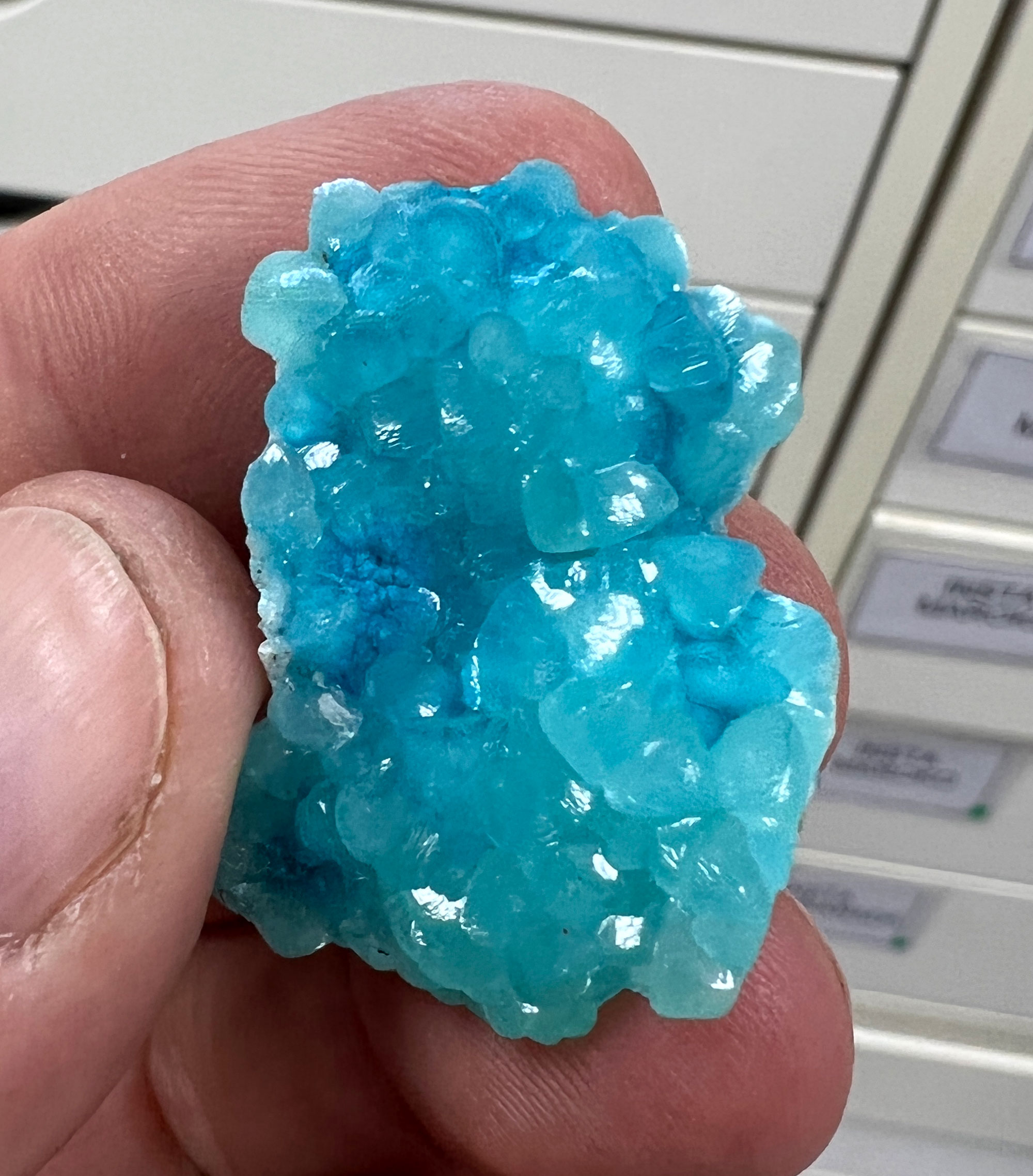
One of the specimens from this small find.
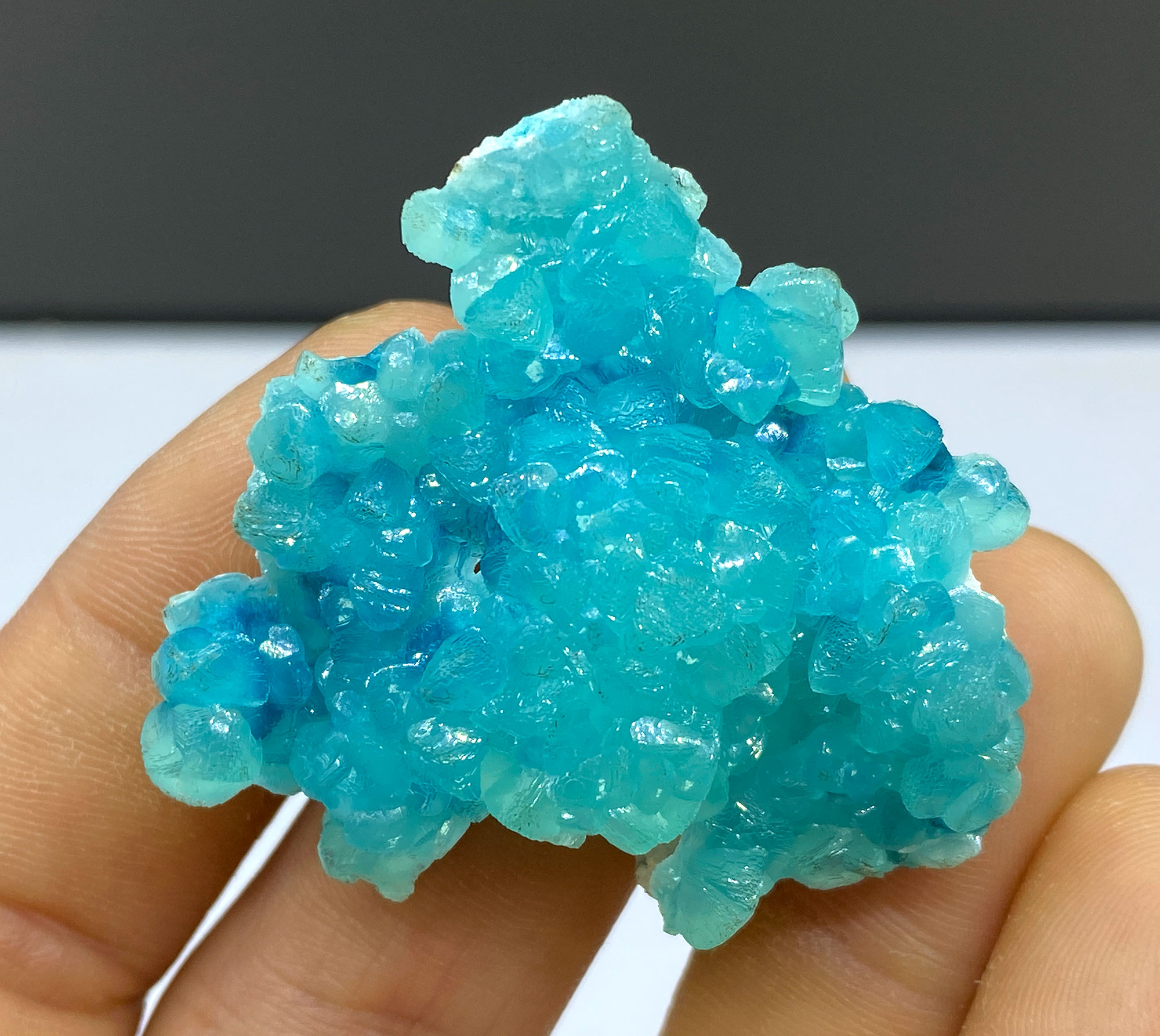
Another specimen from this small find.
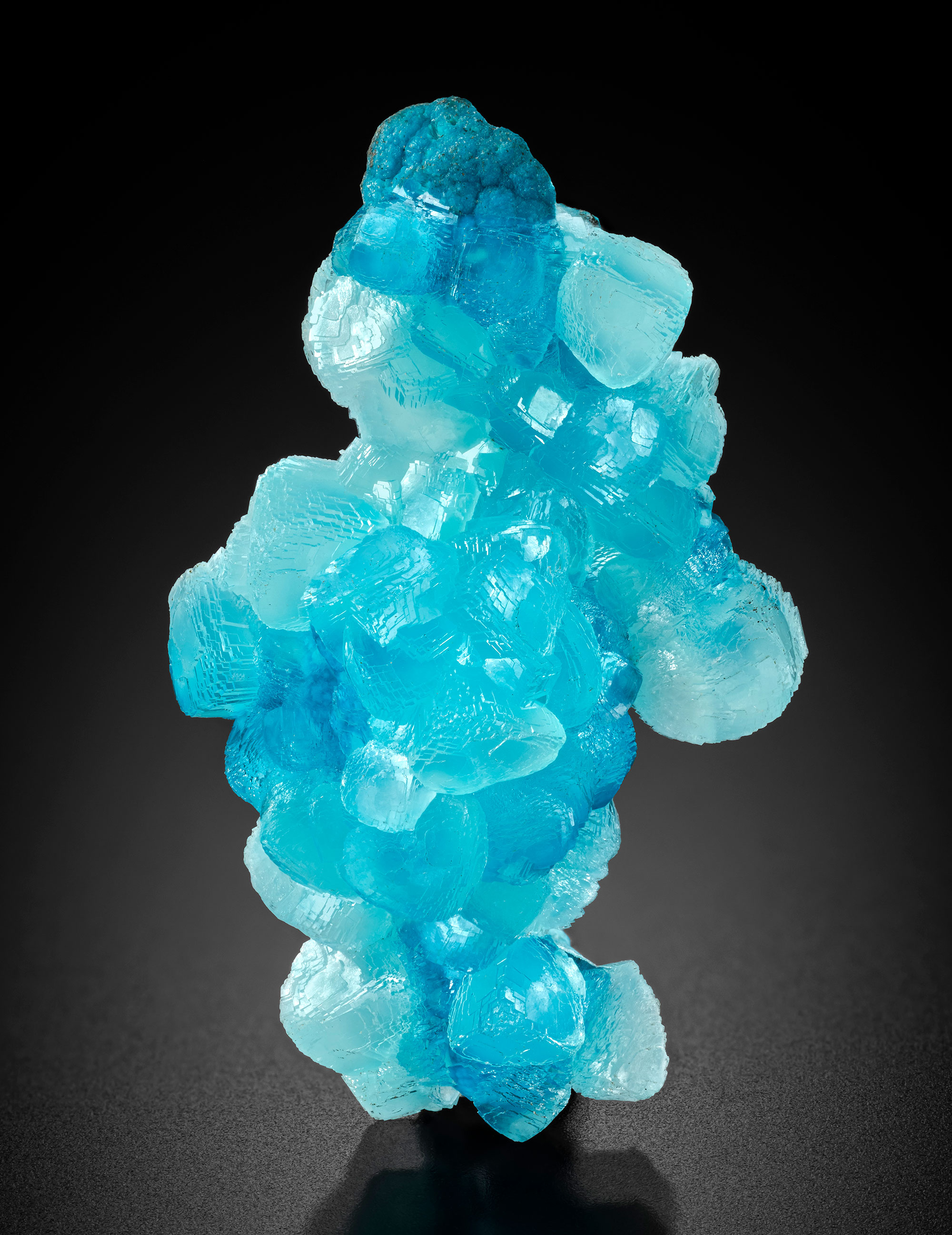
Another blue smithsonite with aurichalcite from this small find. Size 2.6 cm. Joanna Praszkier collelction. Photo by László Kupi.
Another noteworthy find occurred in 2022, when a larger zone containing thick, layered botryoidal smithsonite was discovered. Although the surfaces of the aggregates were not particularly aesthetic, the intense colors and substantial thickness of the layers allowed the production of attractive slabs. Some smithsonite layers are interbedded with aurichalcite and, locally, even azurite.
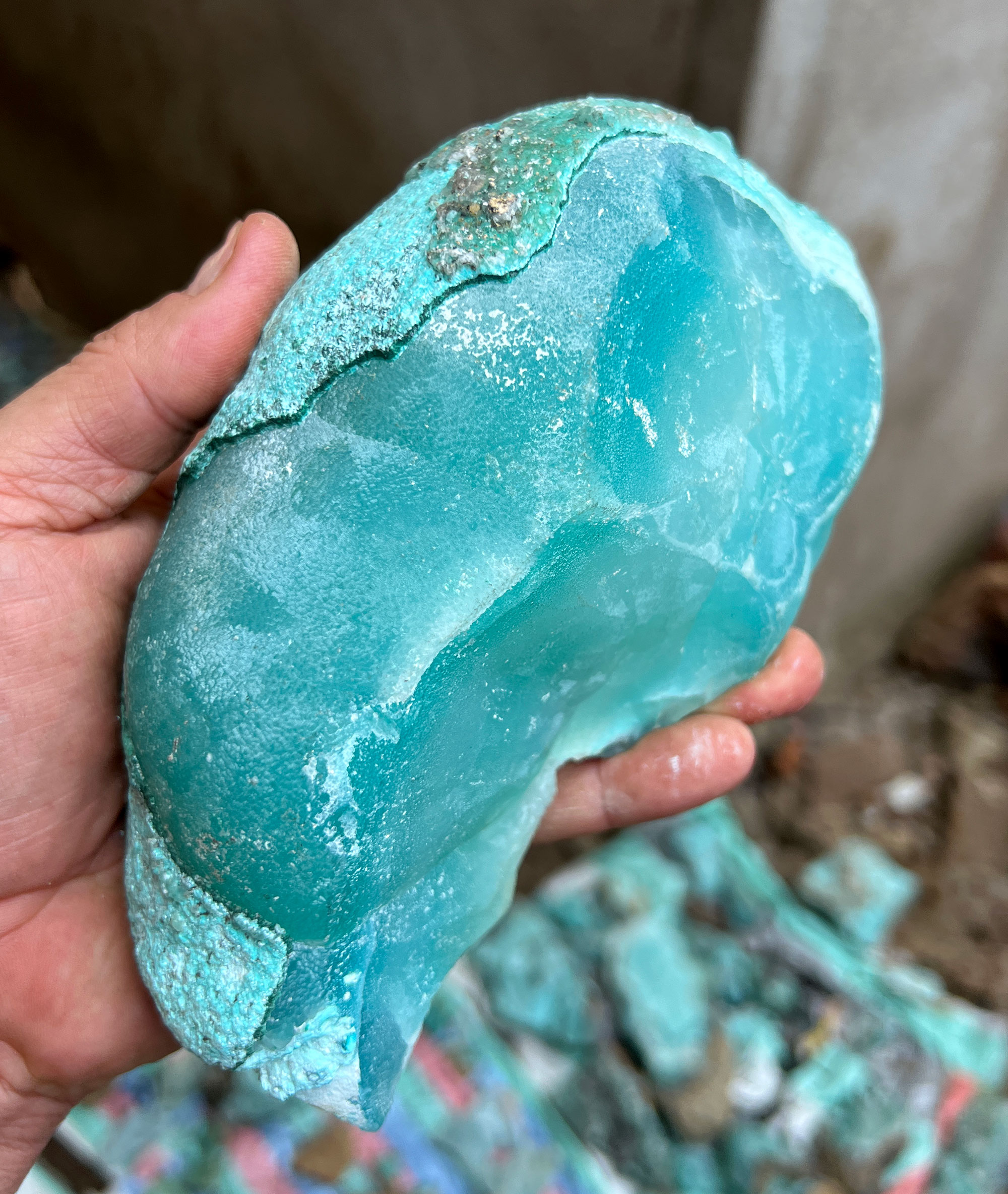
Rough specimen of thick botryoidal smithsonite with aurichalcite from the 2022 find. Such specimens revealed excellent color and patterns after polishing.
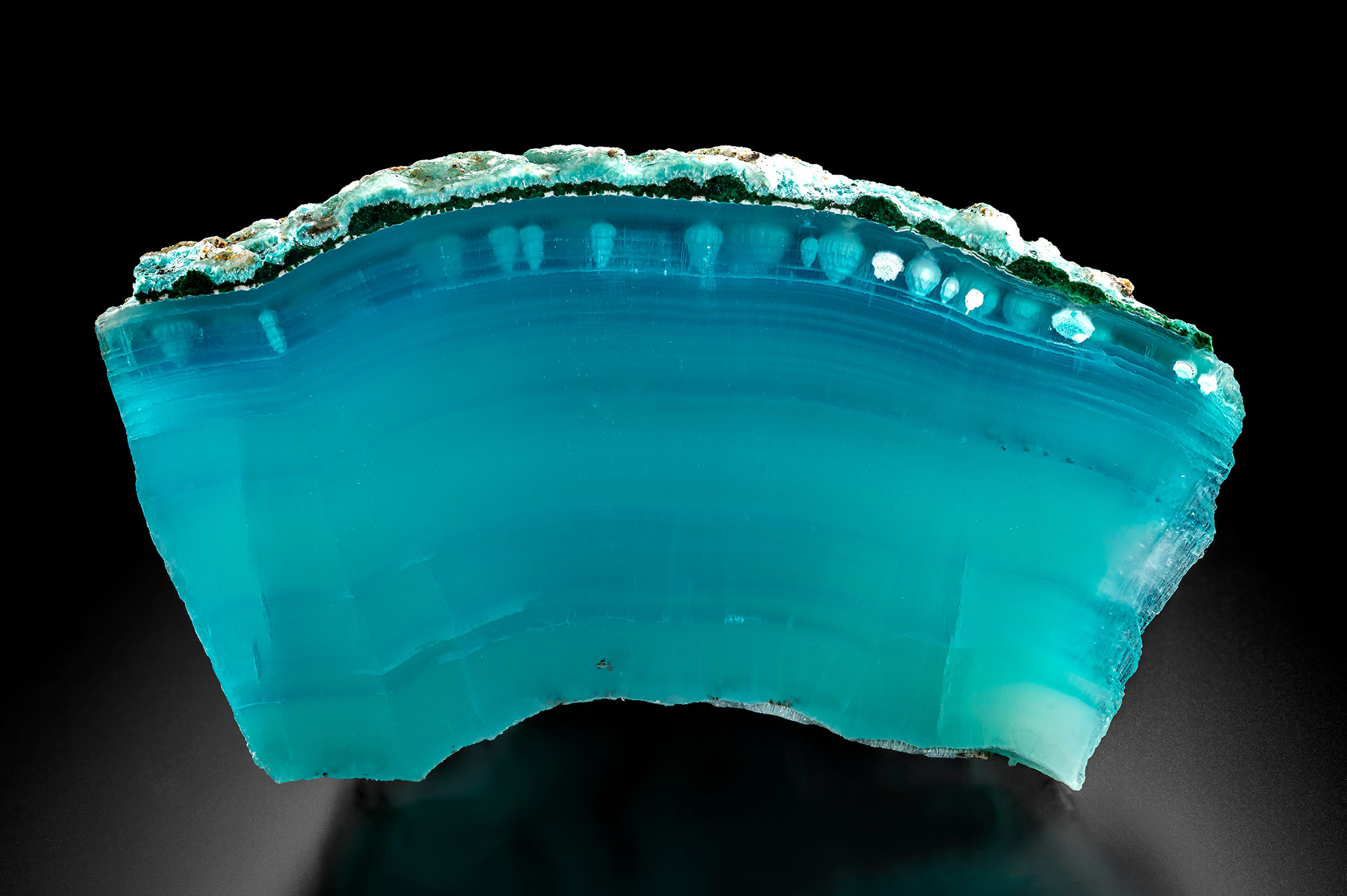
Polished specimen of deep blue smithsonite with aurichalcite. Size 9.6 cm. Spirifer collection. Photo by László Kupi.
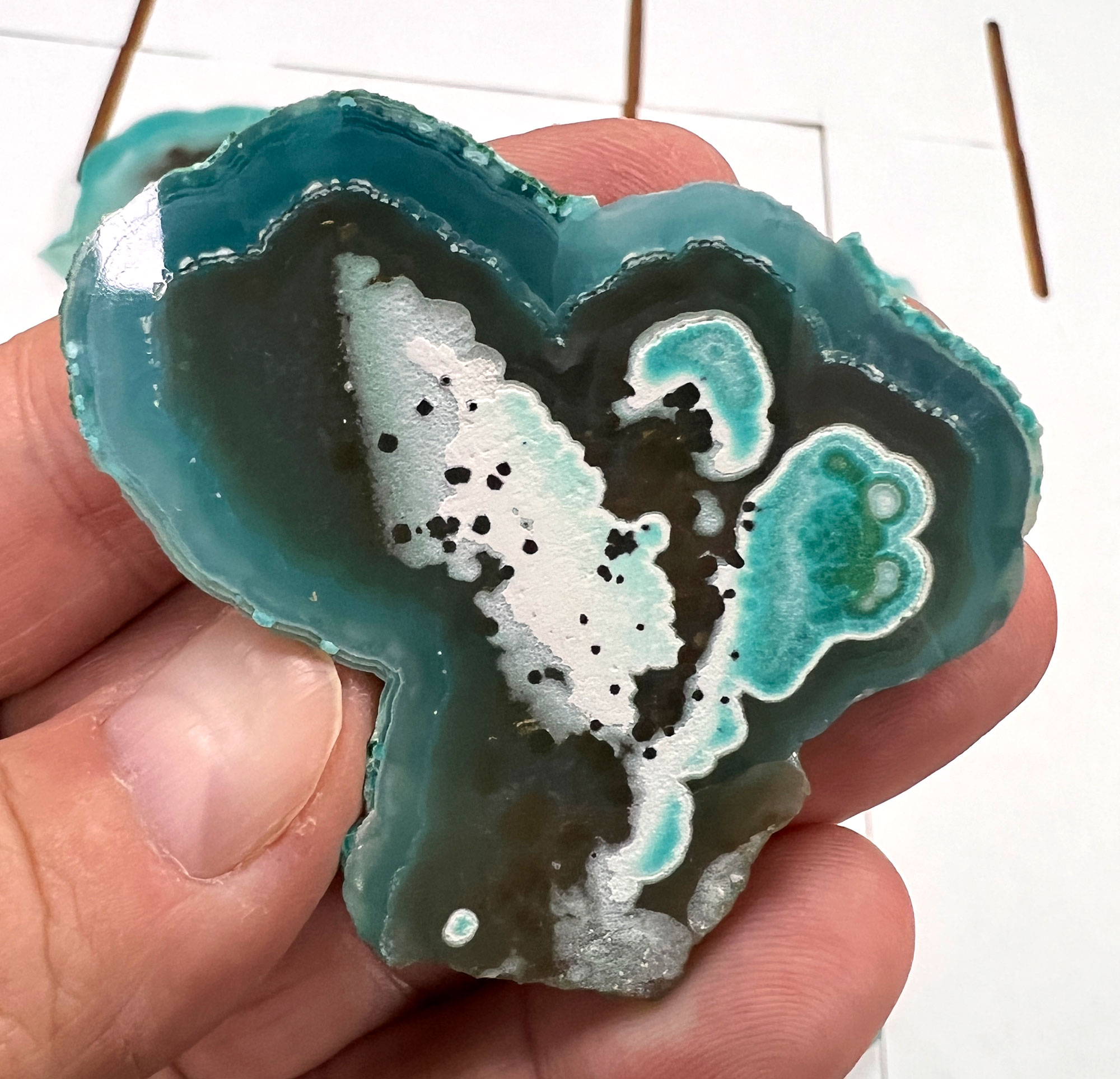
Polished specimen of smithsonite with aurichalcite.
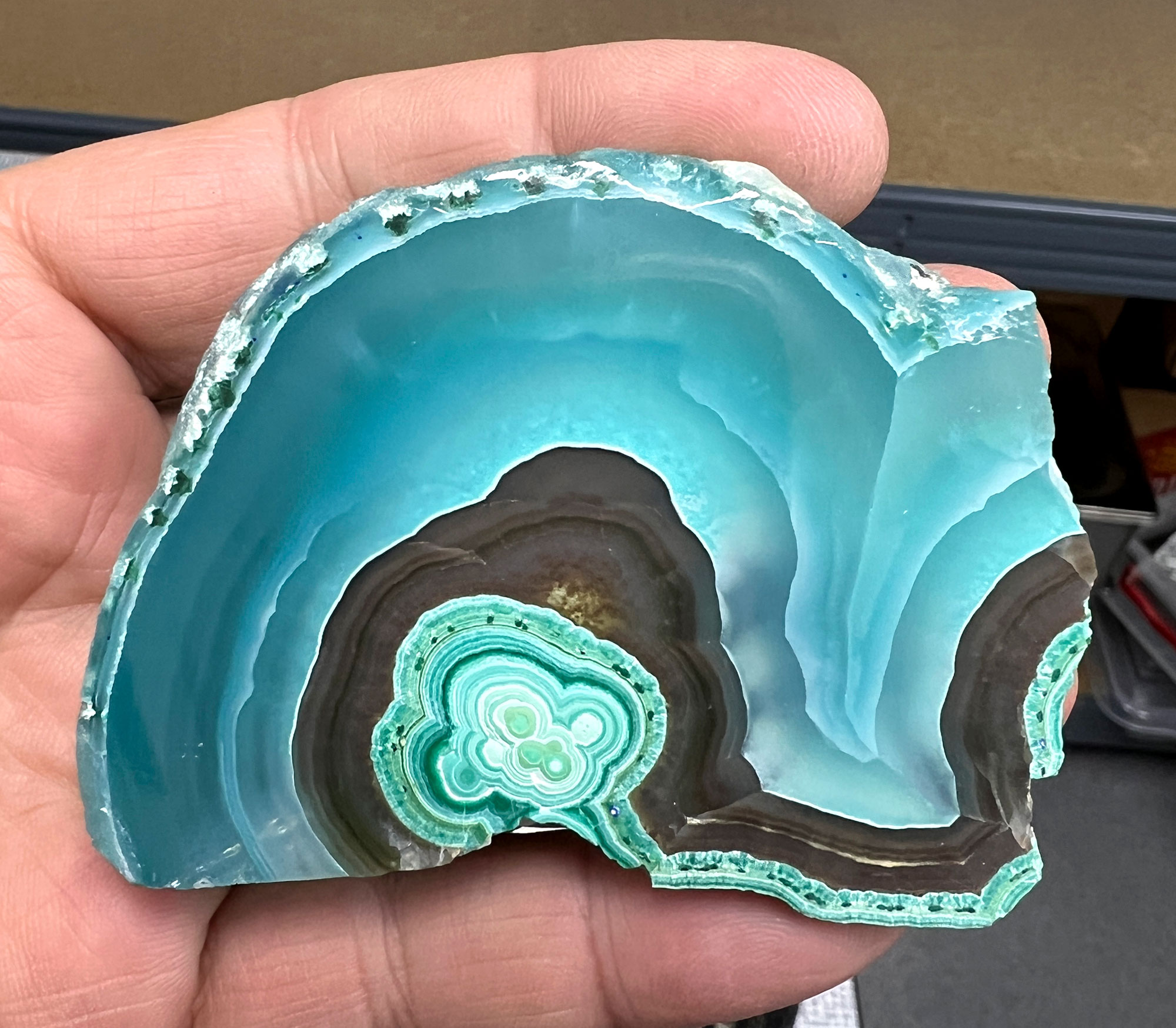
Polished specimen of blue smithsonite with aurichalcite. Size 7 cm. Spirifer collelction.
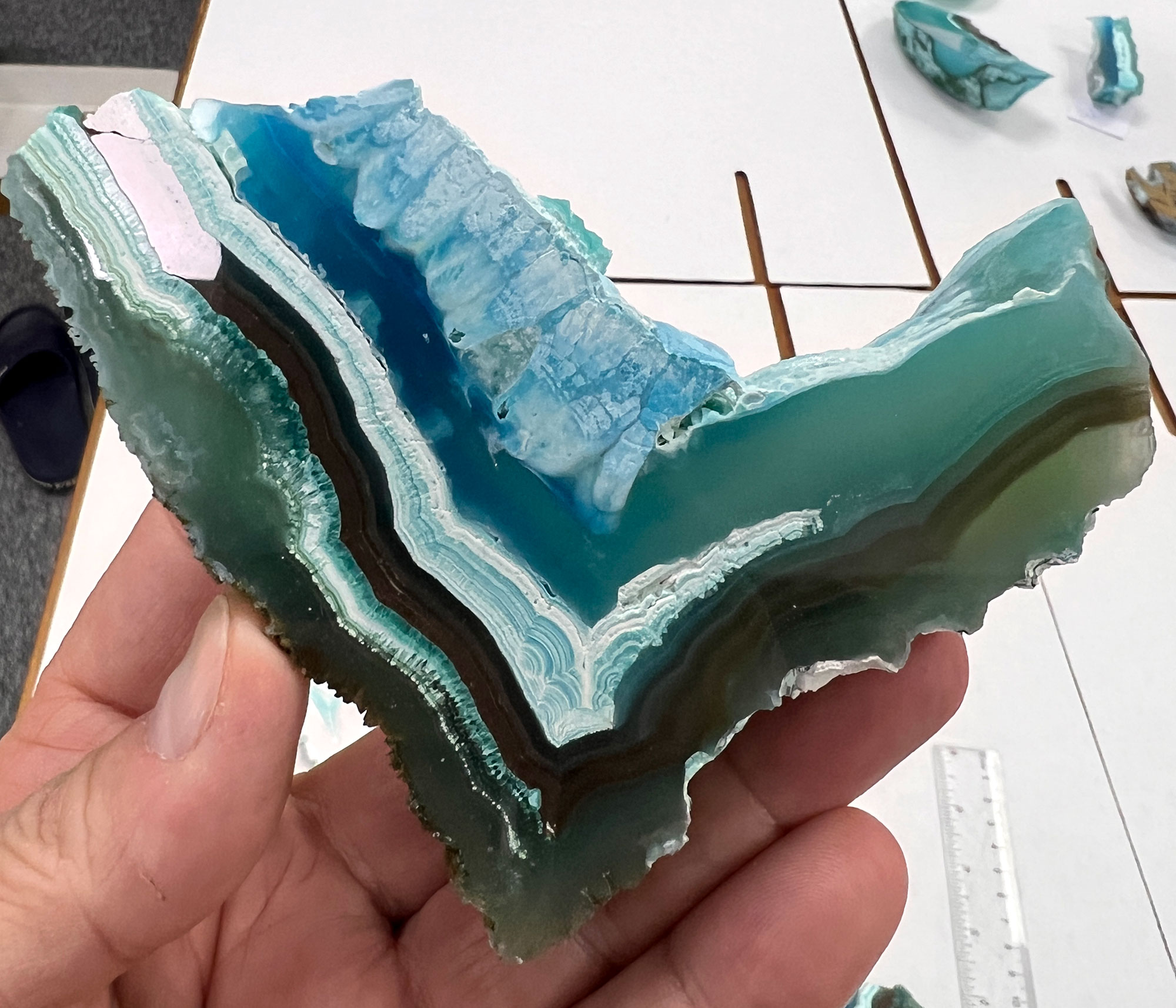
Polished specimen of blue smithsonite with aurichalcite.
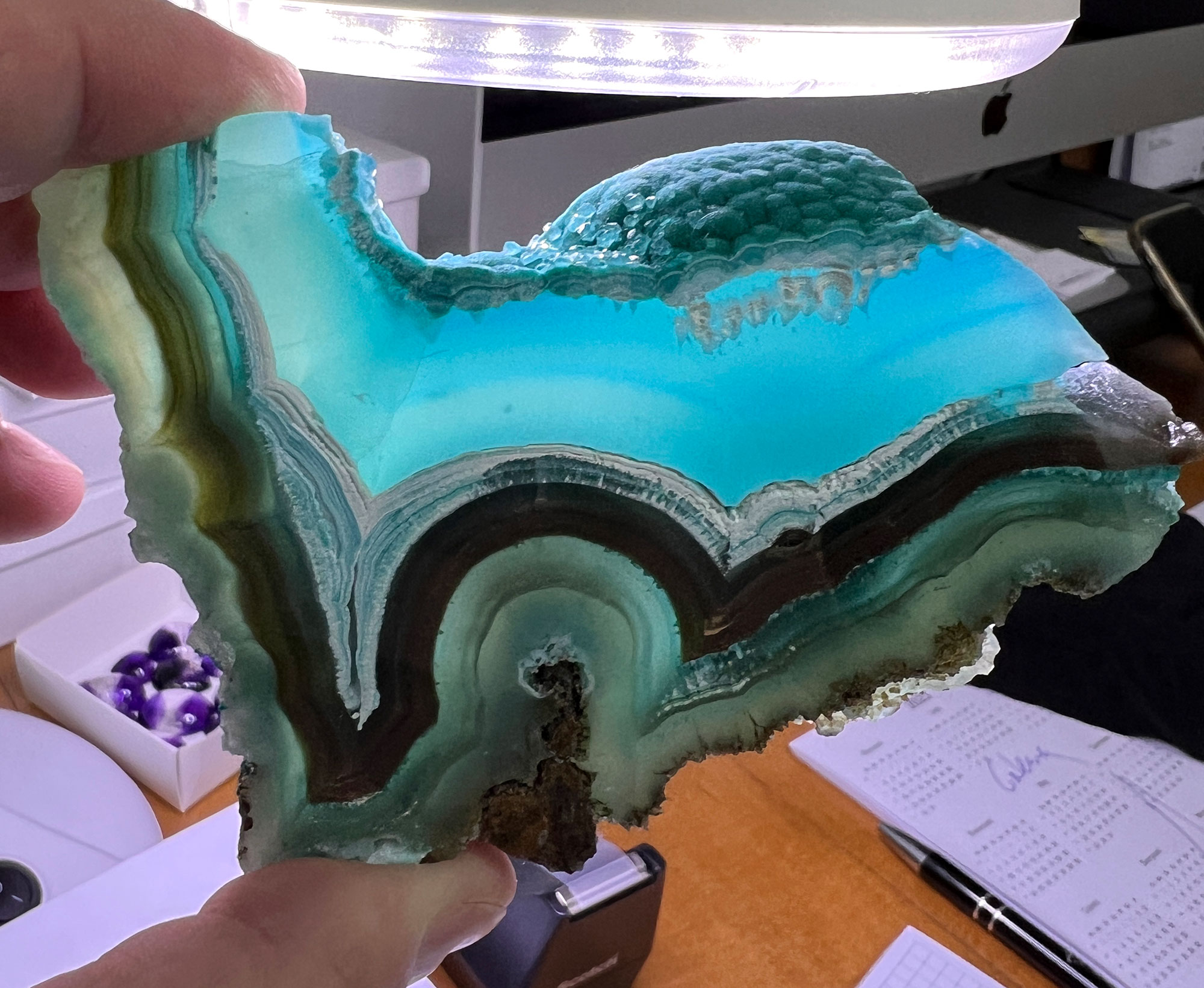
Polished specimen of blue smithsonite with aurichalcite.
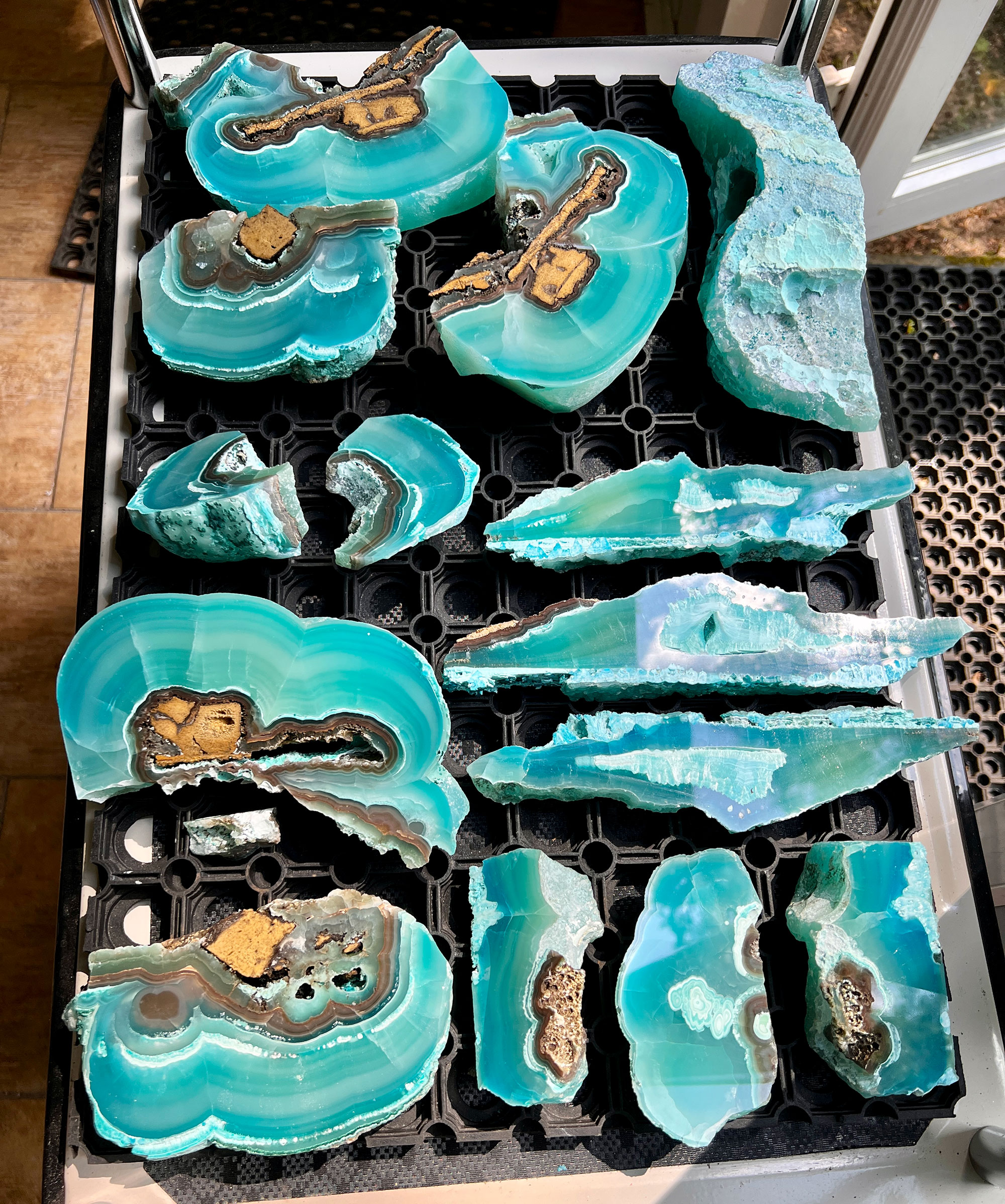
Group of the largest polished specimens of blue smithsonite with aurichalcite from the find.
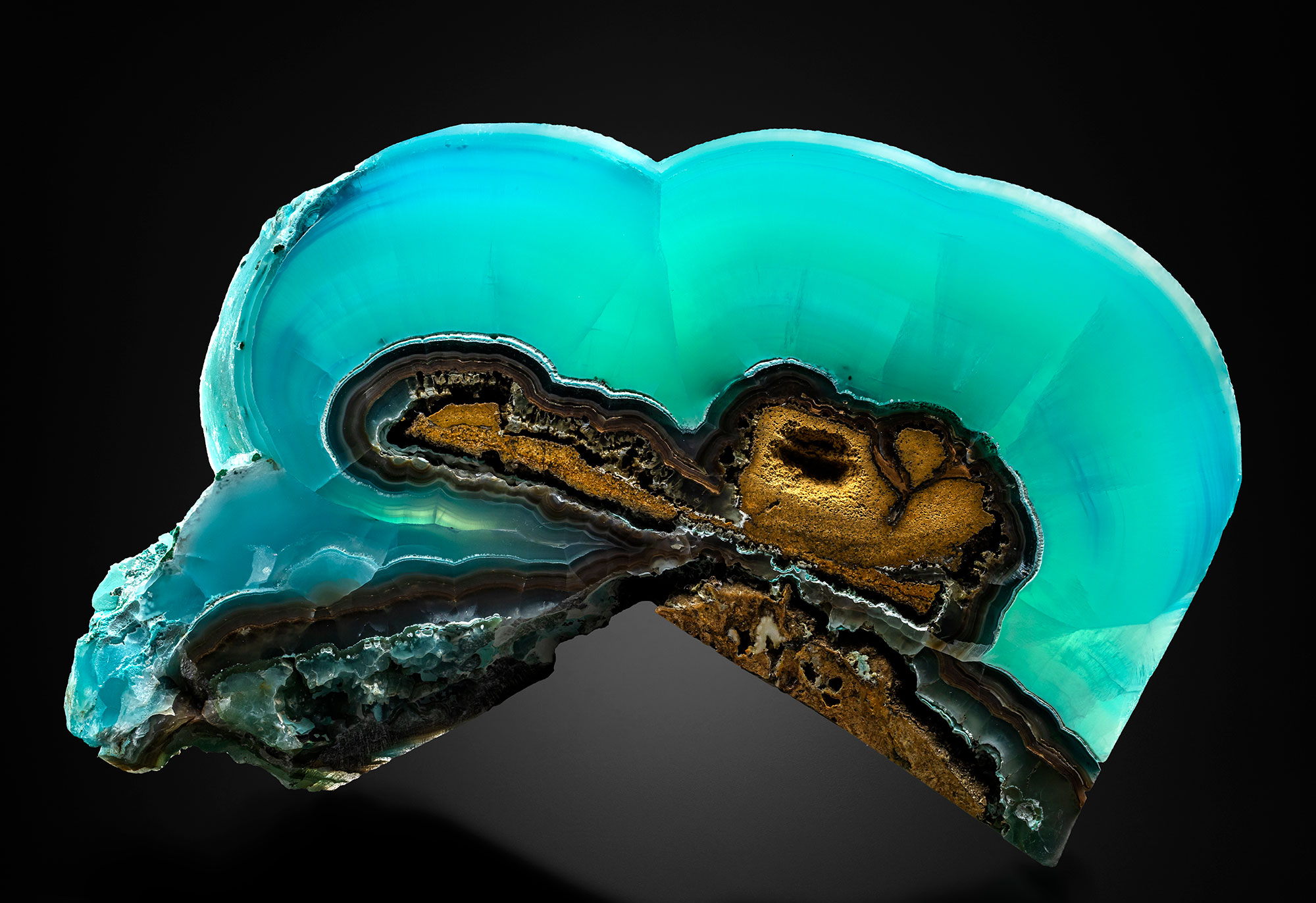
Large polished specimen of bluish-green smithsonite with aurichalcite. Size 22 cm. Spirifer collection. Photo by László Kupi.
From around 2022, Yanga Koubenza also began producing malachite specimens associated with small white cerussite “snowflakes” – very similar to specimens previously recovered from the nearby Palabanda quarry. The principal differences between the two occurrences lie in the slightly darker coloration of the malachite from Yanga Koubenza and the smoother surface of its aggregates. In contrast, malachite from Palabanda is characterized by a more vivid green color and a distinctly “hairy” surface texture.
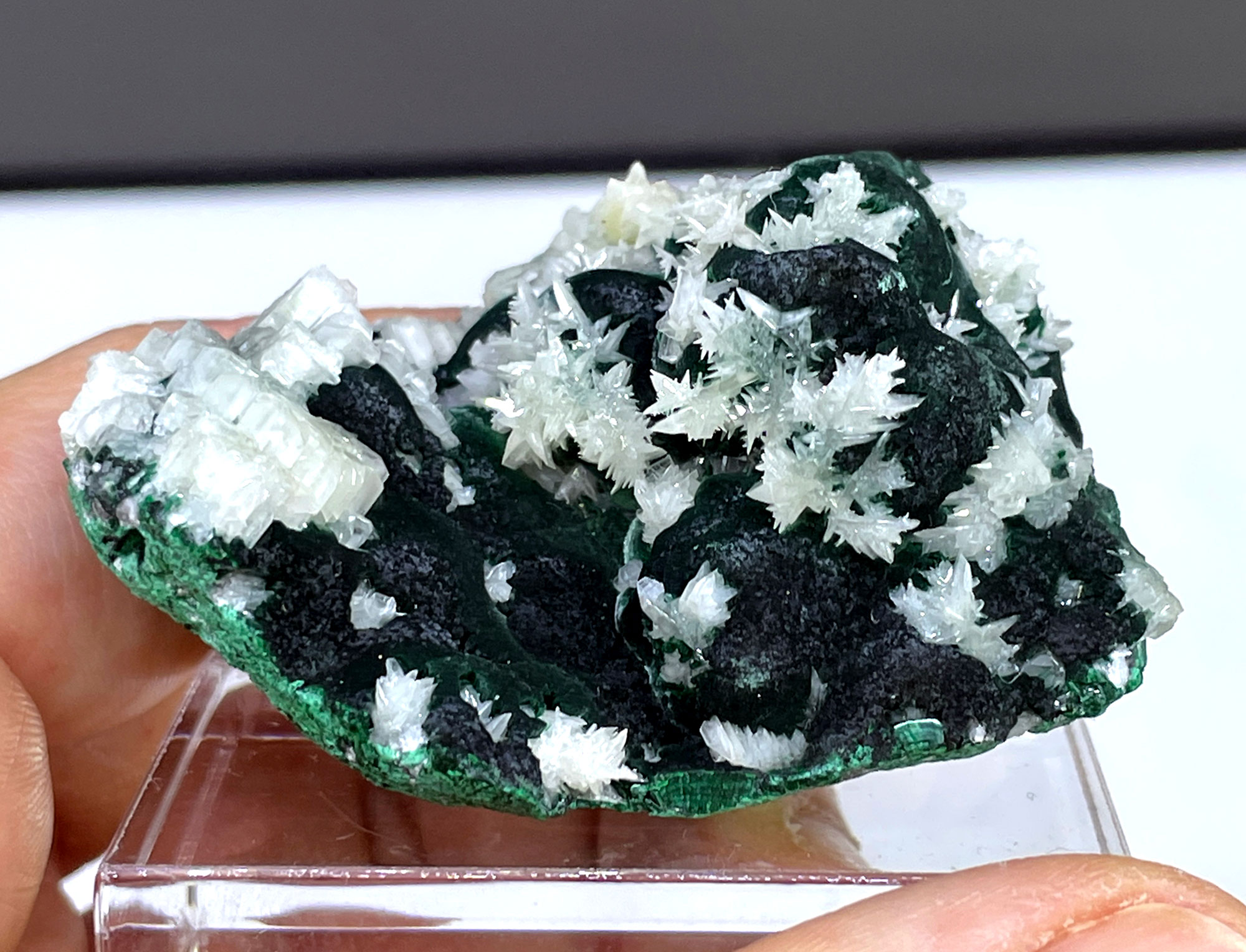
Classic example of cerussite "snowflakes" on malachite from Yanga Koubenza.
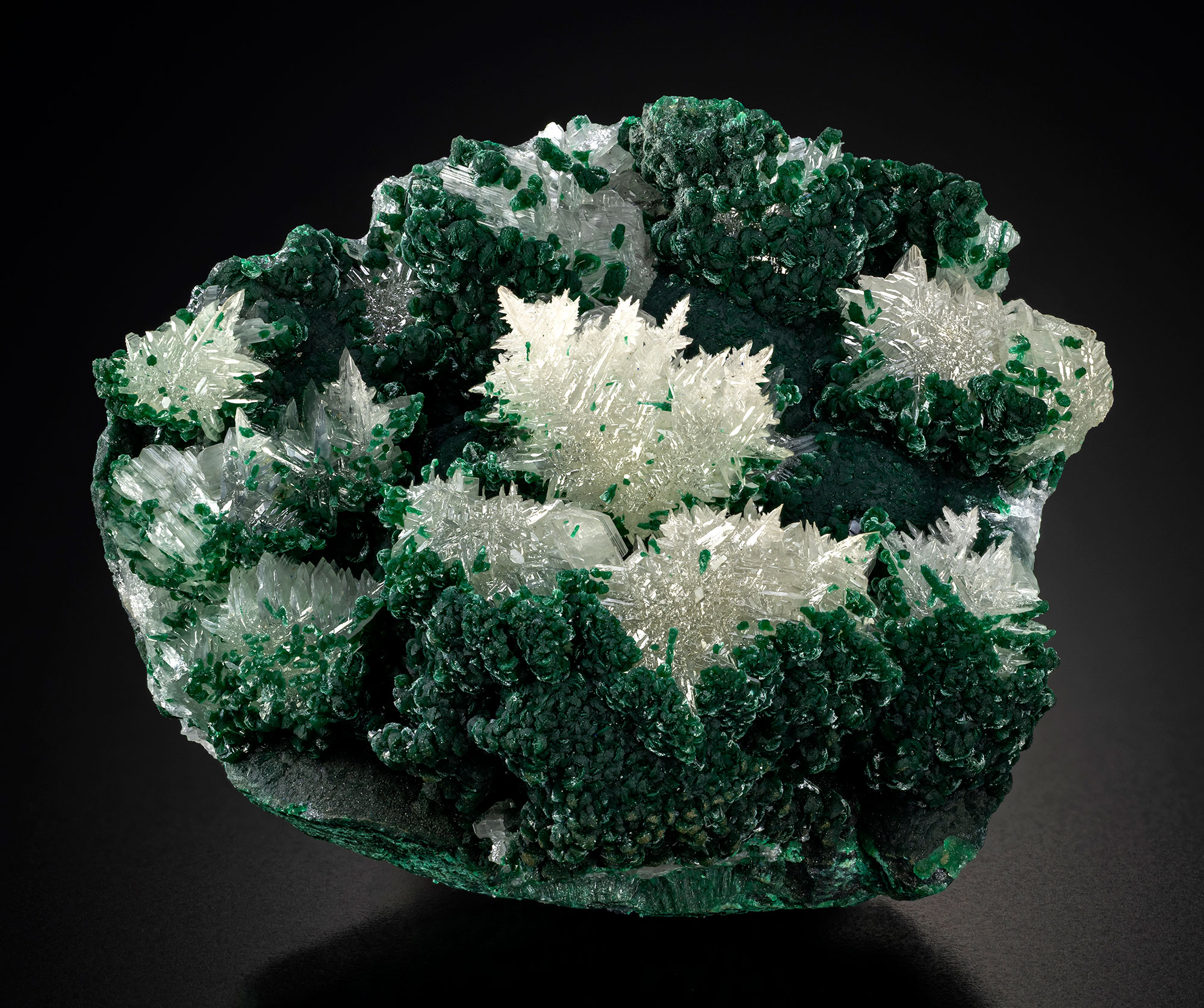
Specimen of cerussite “snowflakes” with malachite from a small find in 2024. Size 3.5 cm. Photo by László Kupi.
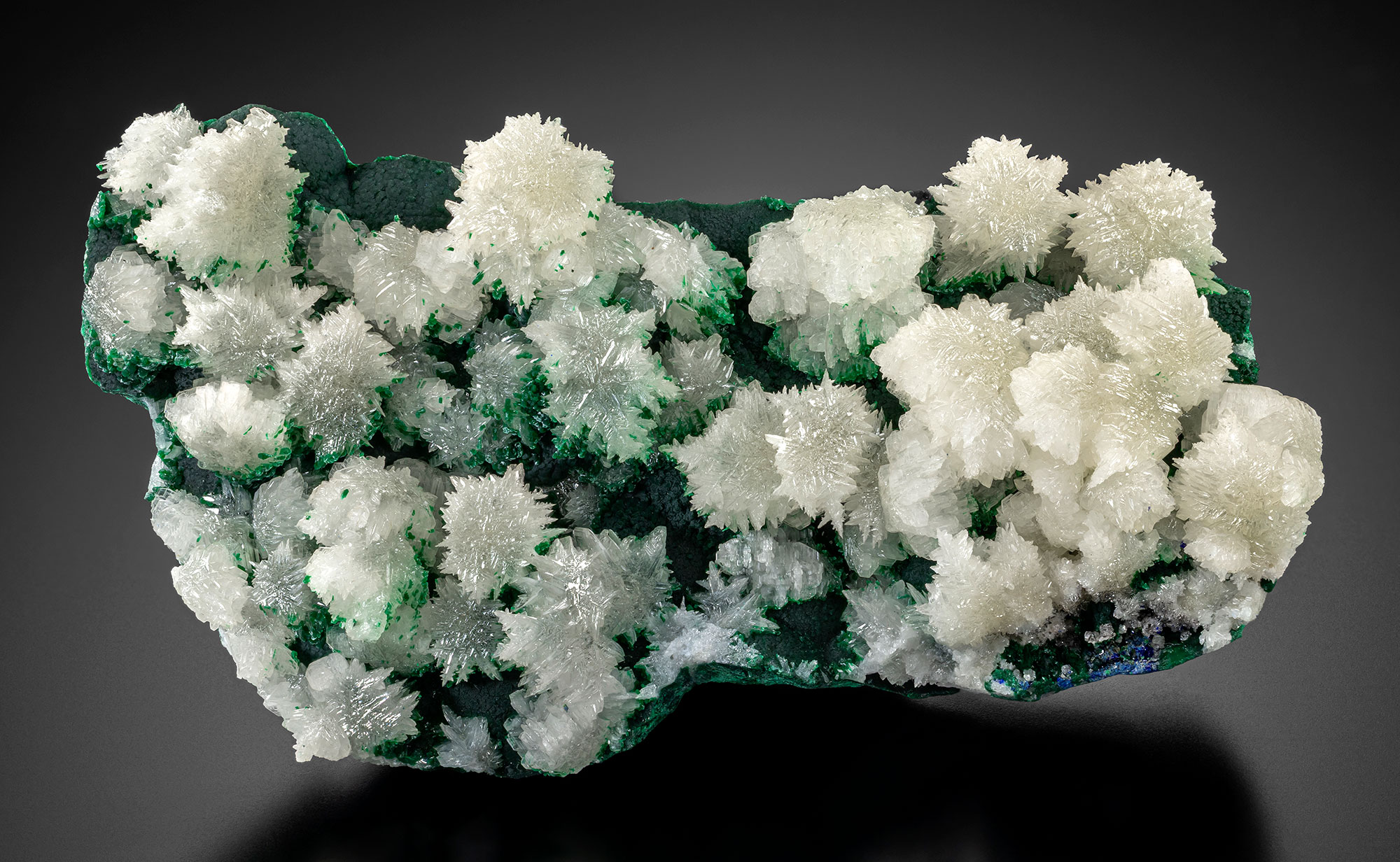
Specimen of cerussite “snowflakes” with malachite from a small find in 2024. Size 7.6 cm. Spirifer collection. Photo by László Kupi.
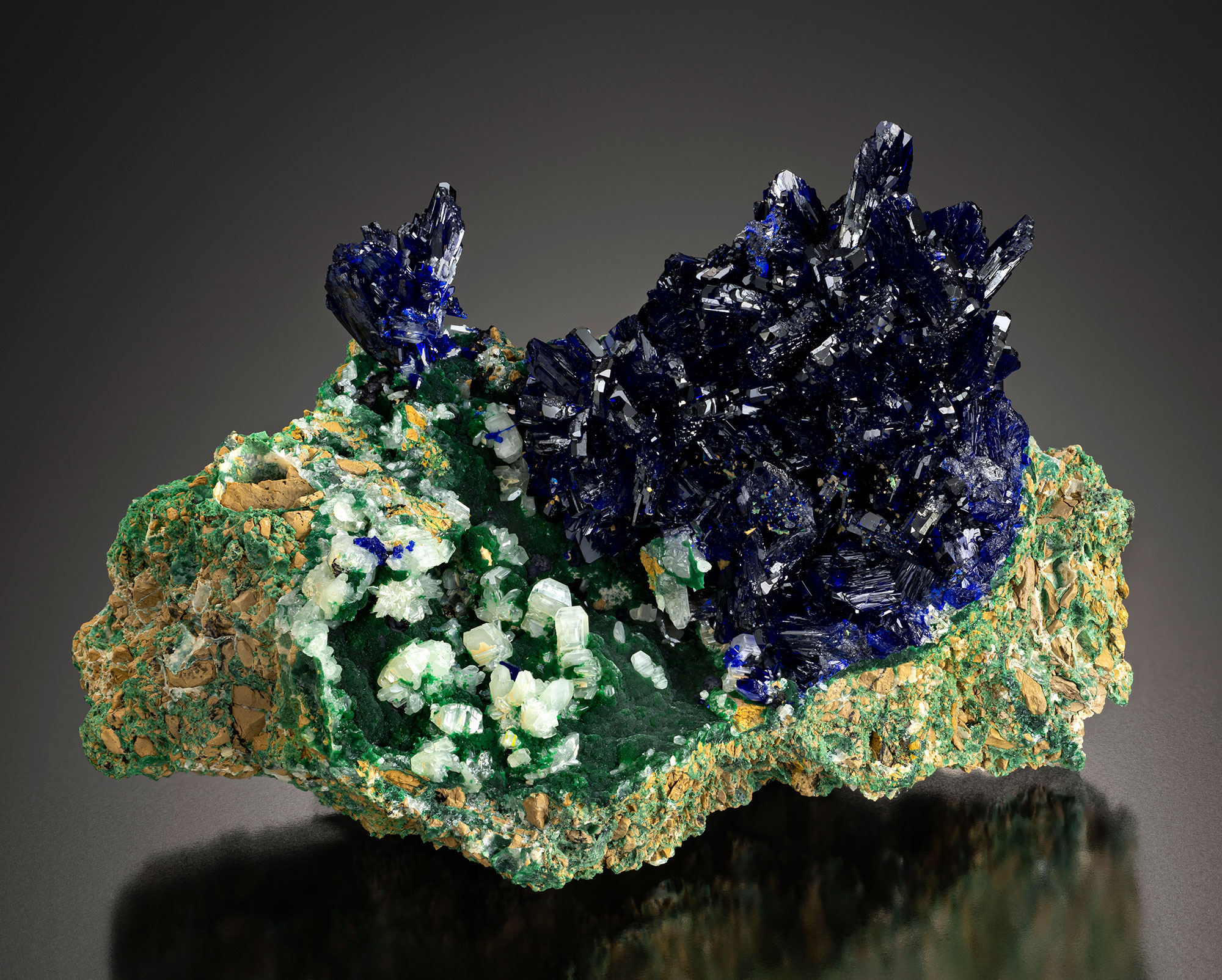
Specimen of cerussite “snowflakes” on malachite with azurite crystals. Size 3.8 cm. Photo by László Kupi.
In 2024, a group of distinctive specimens composed of azurite, malachite, and rosasite—locally accompanied by cerussite and smithsonite crystals—growing on colorless smithsonite coatings was recovered.
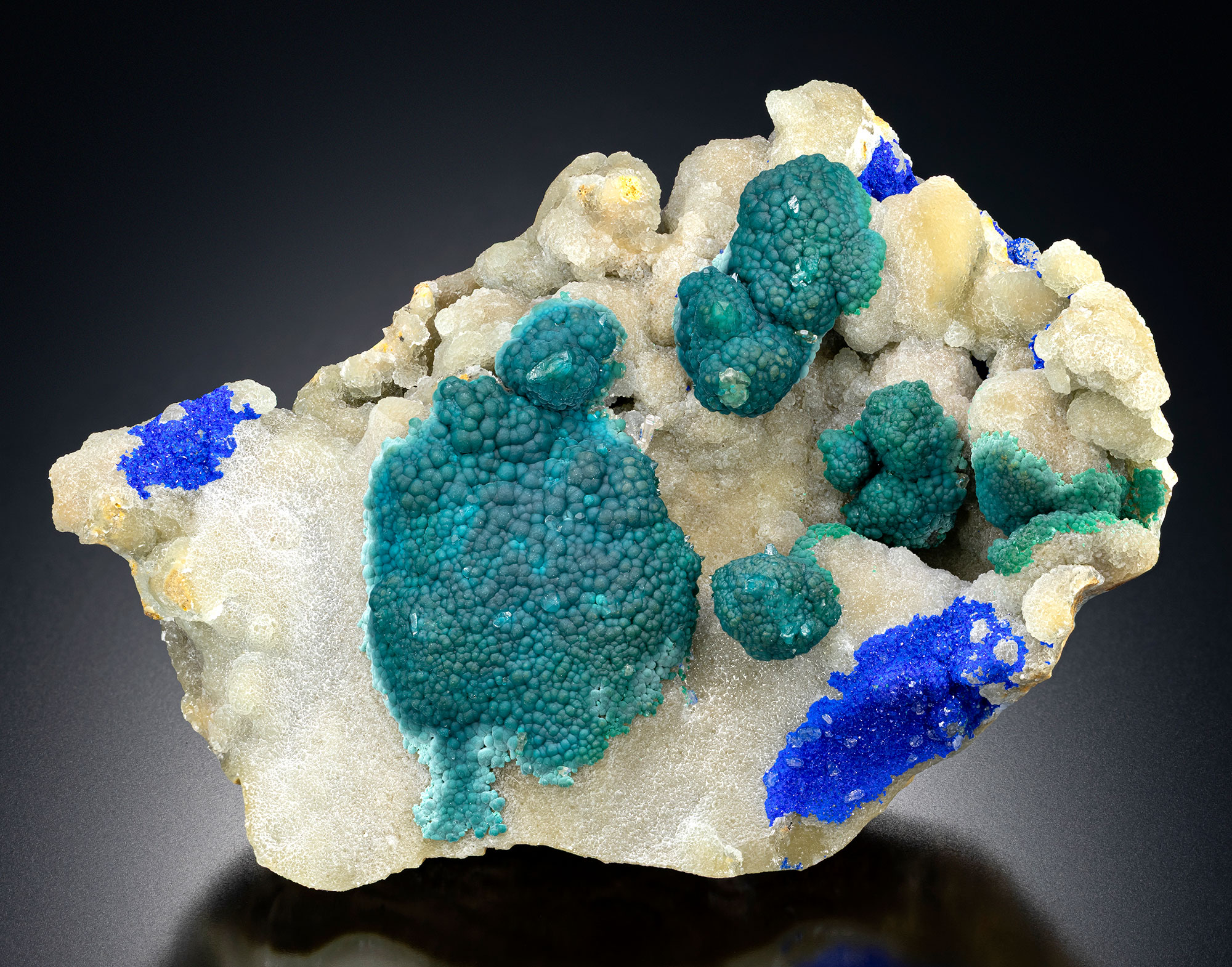
Rosasite and azurite on smithsonite. Size 6.5 cm. Photo by László Kupi.
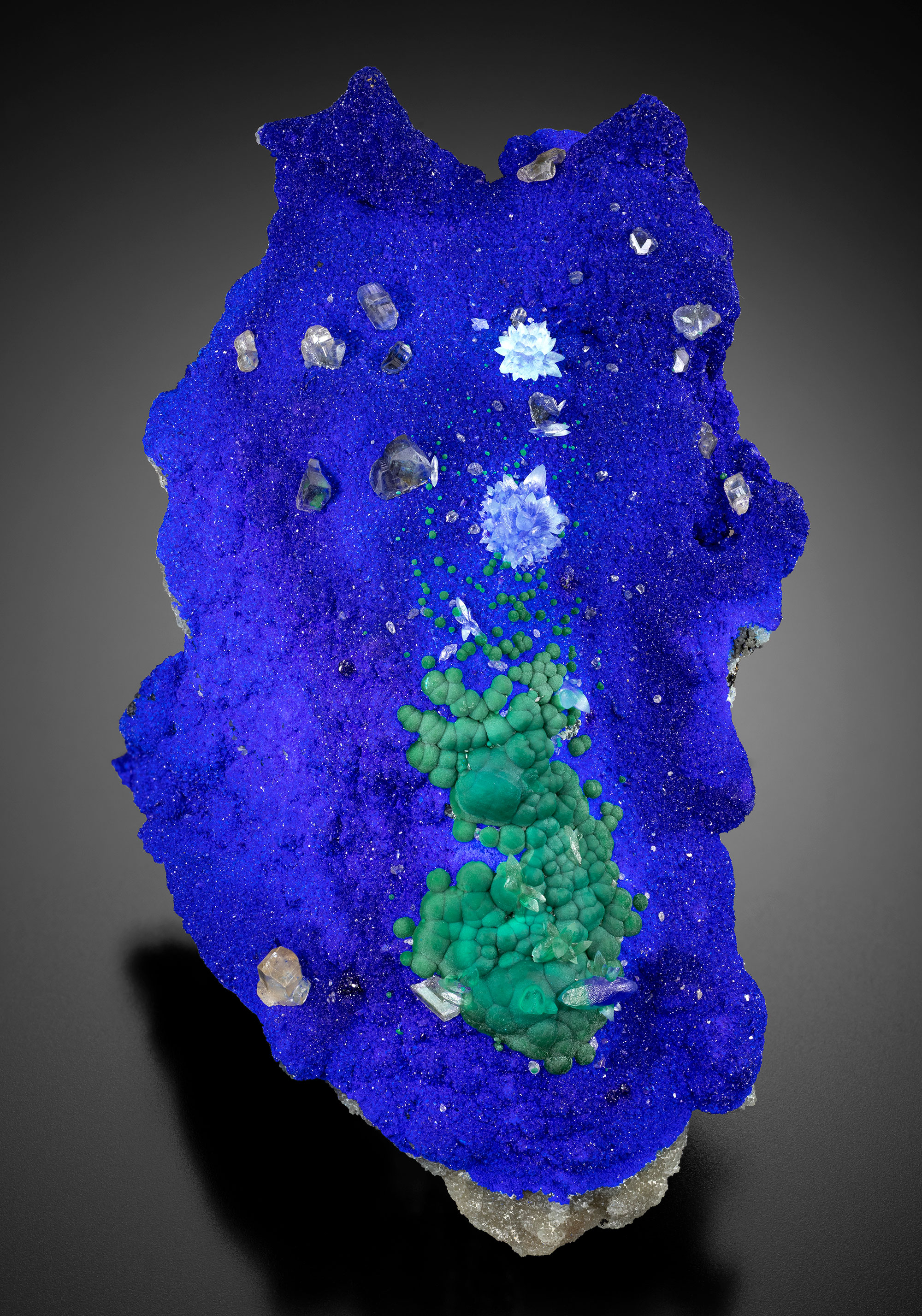
Rosasite with cerussite and smithsonite crystals on smithsonite. Size 6.6 cm. Spirifer collection. Photo by László Kupi.
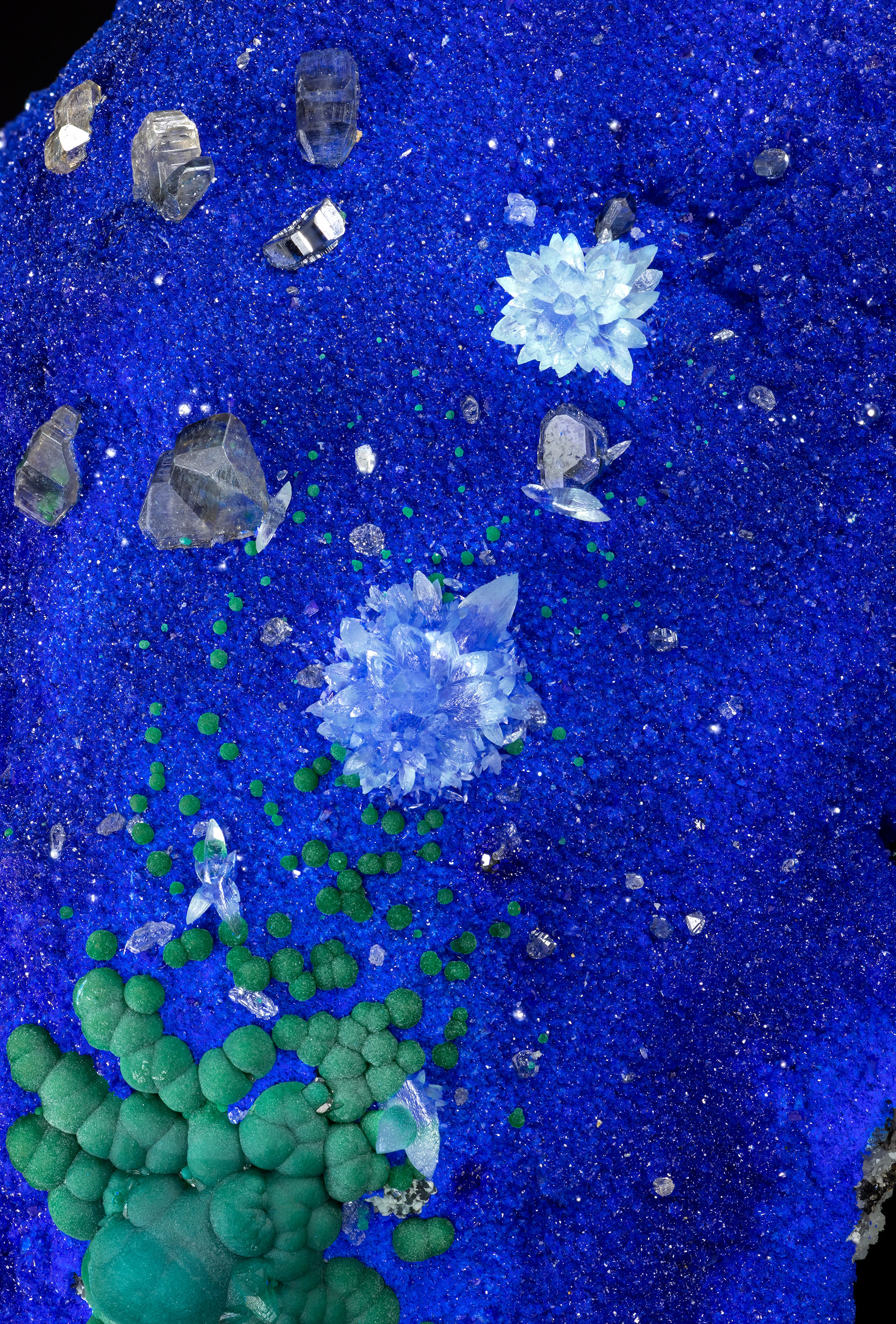
Close-up photo of the specimen shown above. FOV 3.5 cm. Spirifer collection. Photo by László Kupi.
Another very noticeable find took place in 2024, when a zone containing cerussite “snowflakes” on azurite and malachite was intersected. Specimens from this find are characterized by striking white cerussite “snowflakes” scattered across drusy, sparkling azurite and/or malachite “carpets,” and the majority of them resemble a “Kairoo Night” style—dark navy-blue, glittering azurite adorned with cerussite “stars.” In most cases, the cerussite twins are white to beige in color, with only rare examples being completely transparent. Twin sizes typically range from 0.5 to 1 cm, although some reach up to 2 cm.
However, impressive as these discoveries were, they are undoubtedly surpassed by a spectacular mimetite find that also occurred in 2024.
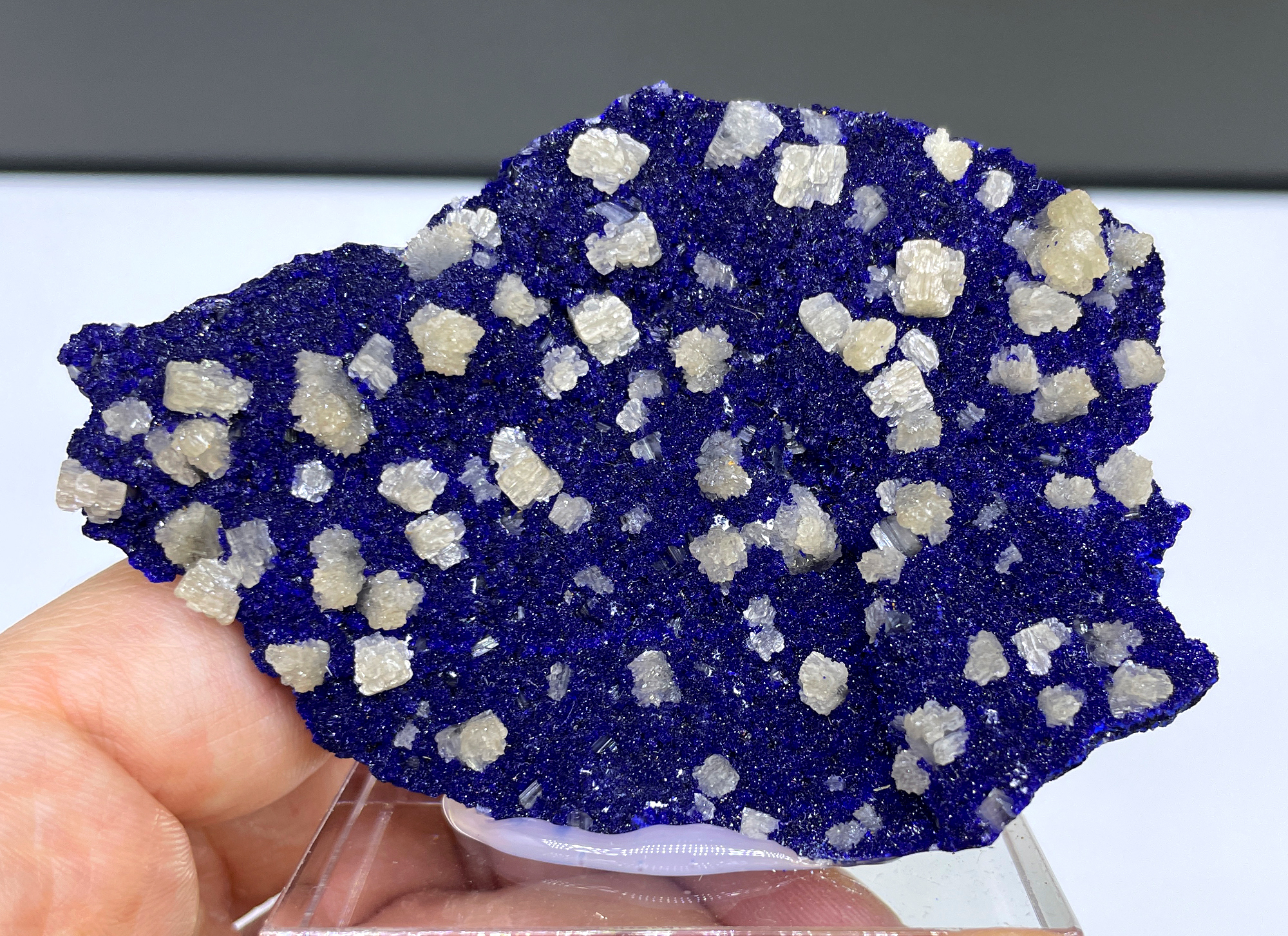
Sparkly drusy azurite with cerussite "snowflakes".
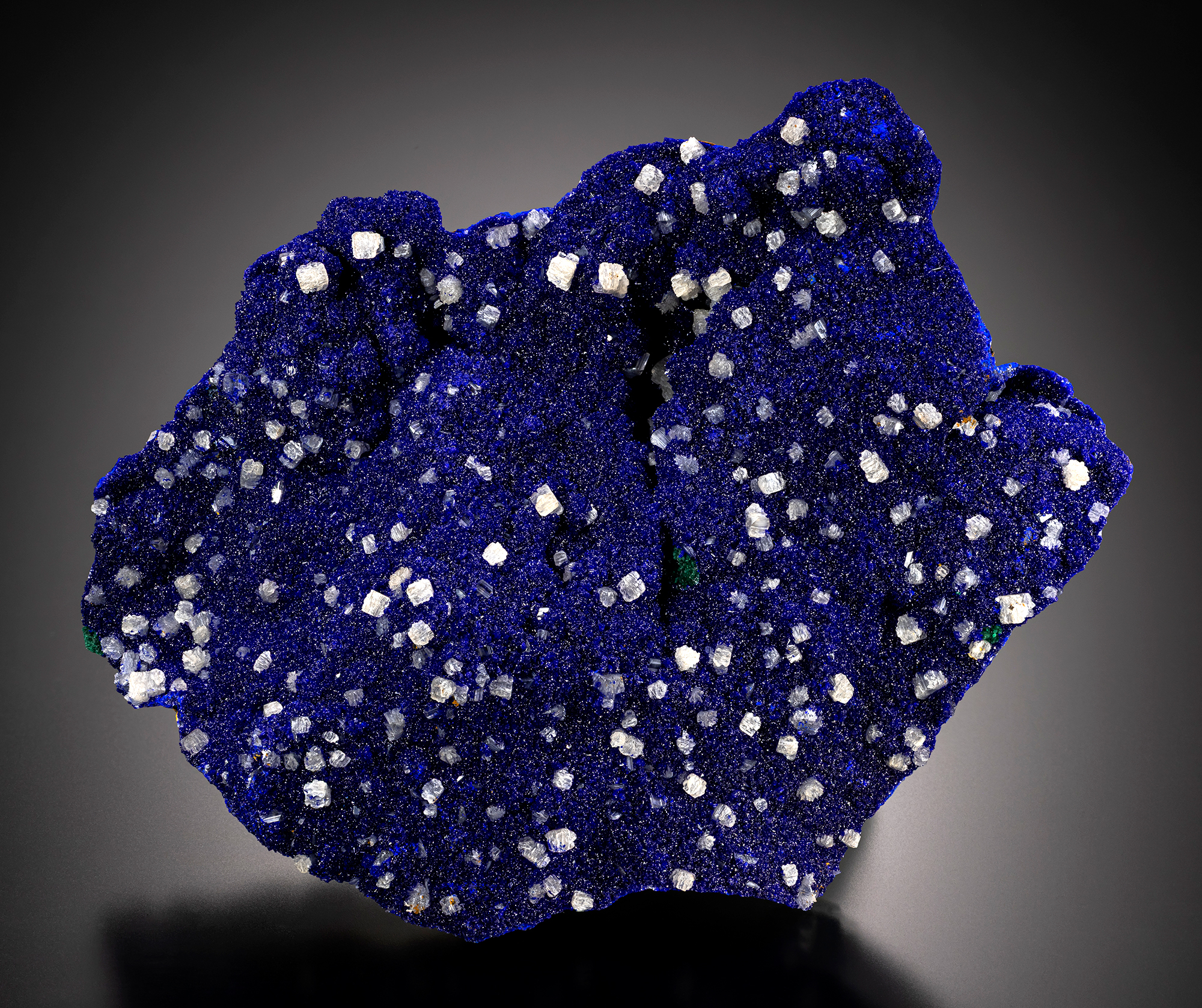
Sparkly drusy azurite with cerussite "snowflakes". Size 11 cm. Spirifer collection. Photo by László Kupi.
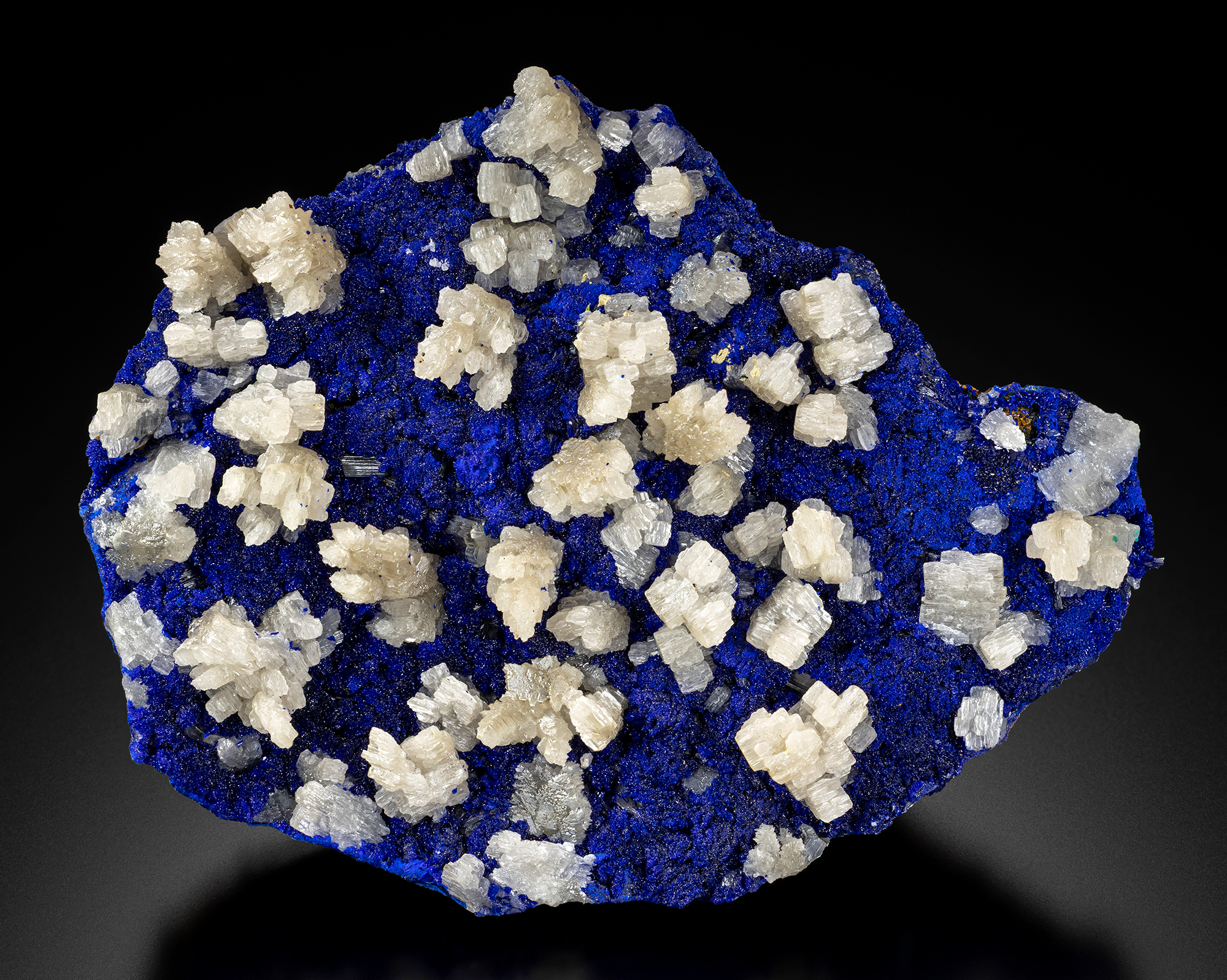
Sparkly drusy azurite with cerussite "snowflakes". Size 6.4 cm. Spirifer collection. Photo by László Kupi.
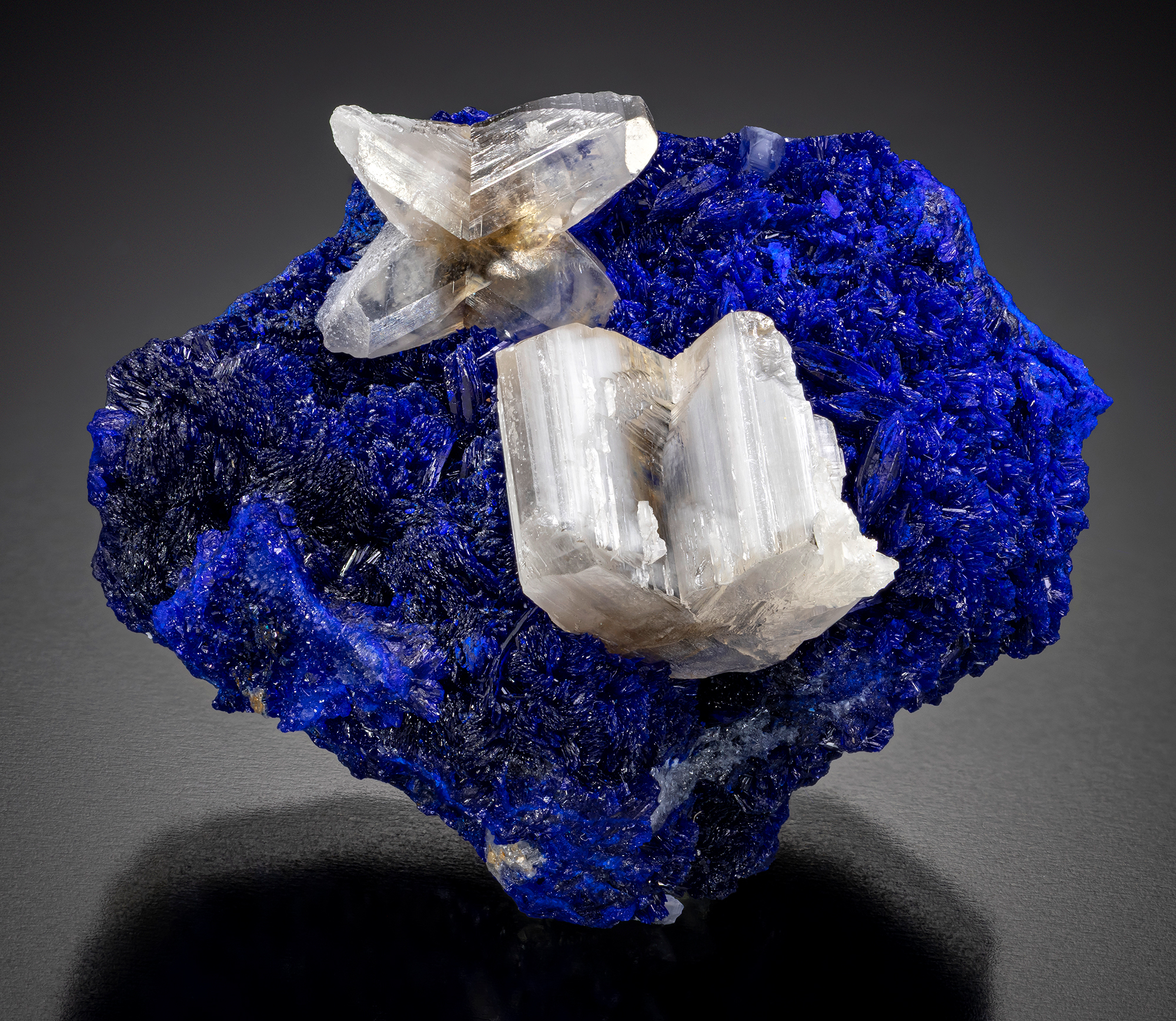
Twinned cerussite crystals on sparkly azurite. Size 3 cm. Joanna Praszkier collection. Photo by László Kupi.
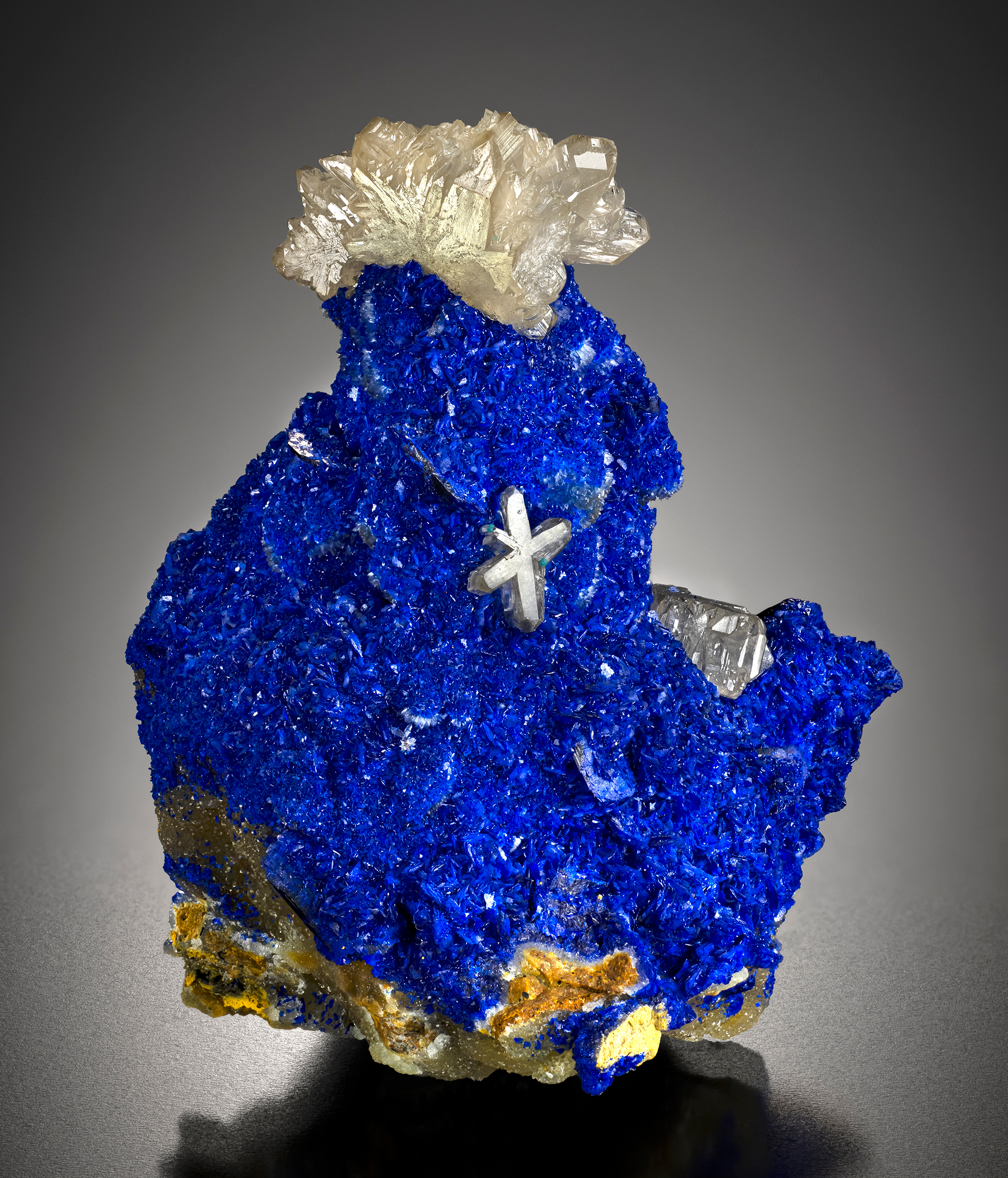
Twinned cerussite crystals on azurite. Size 4 cm. Photo by László Kupi.
Video of twinned cerussite on azurite on smithsonite.
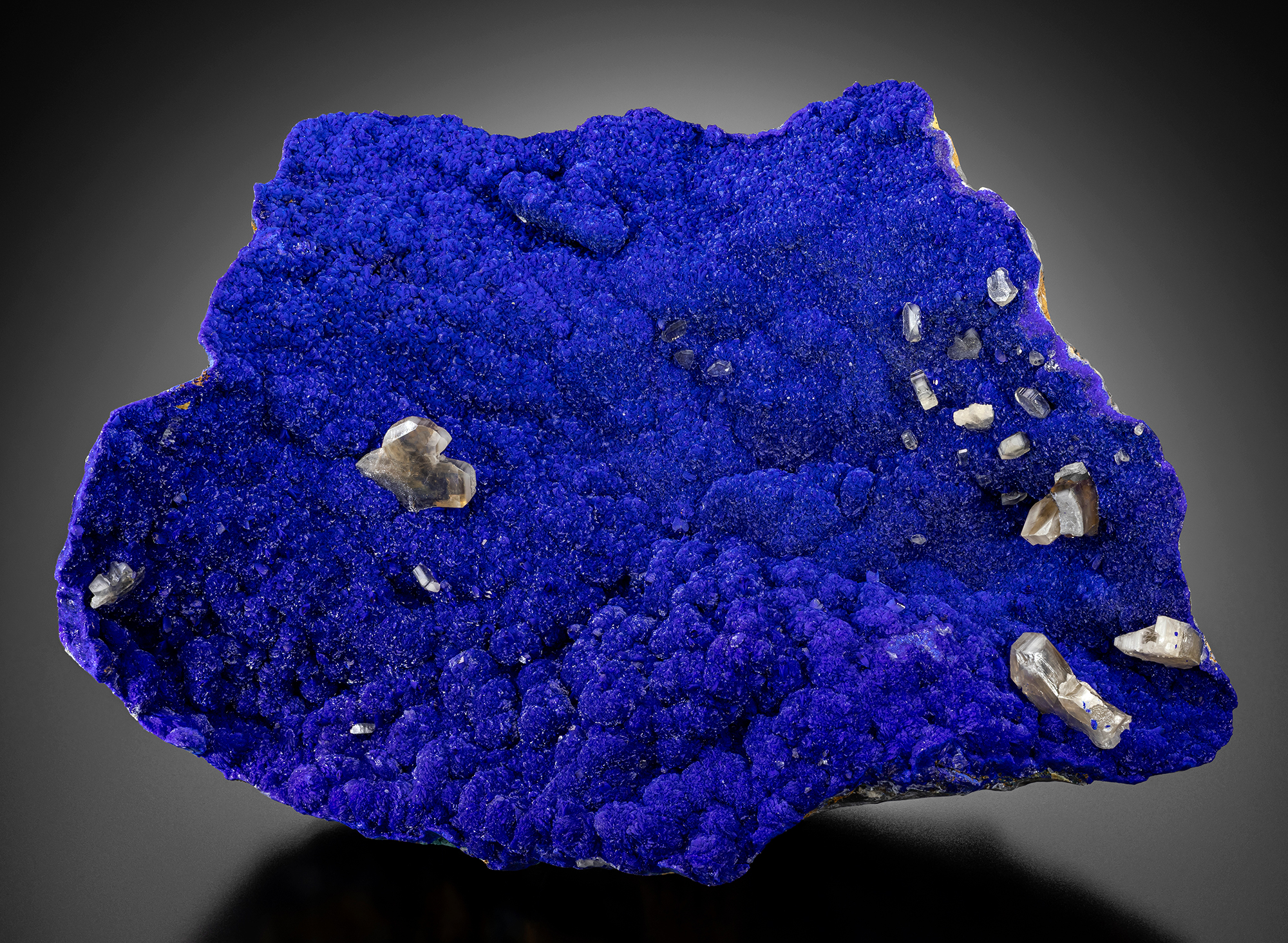
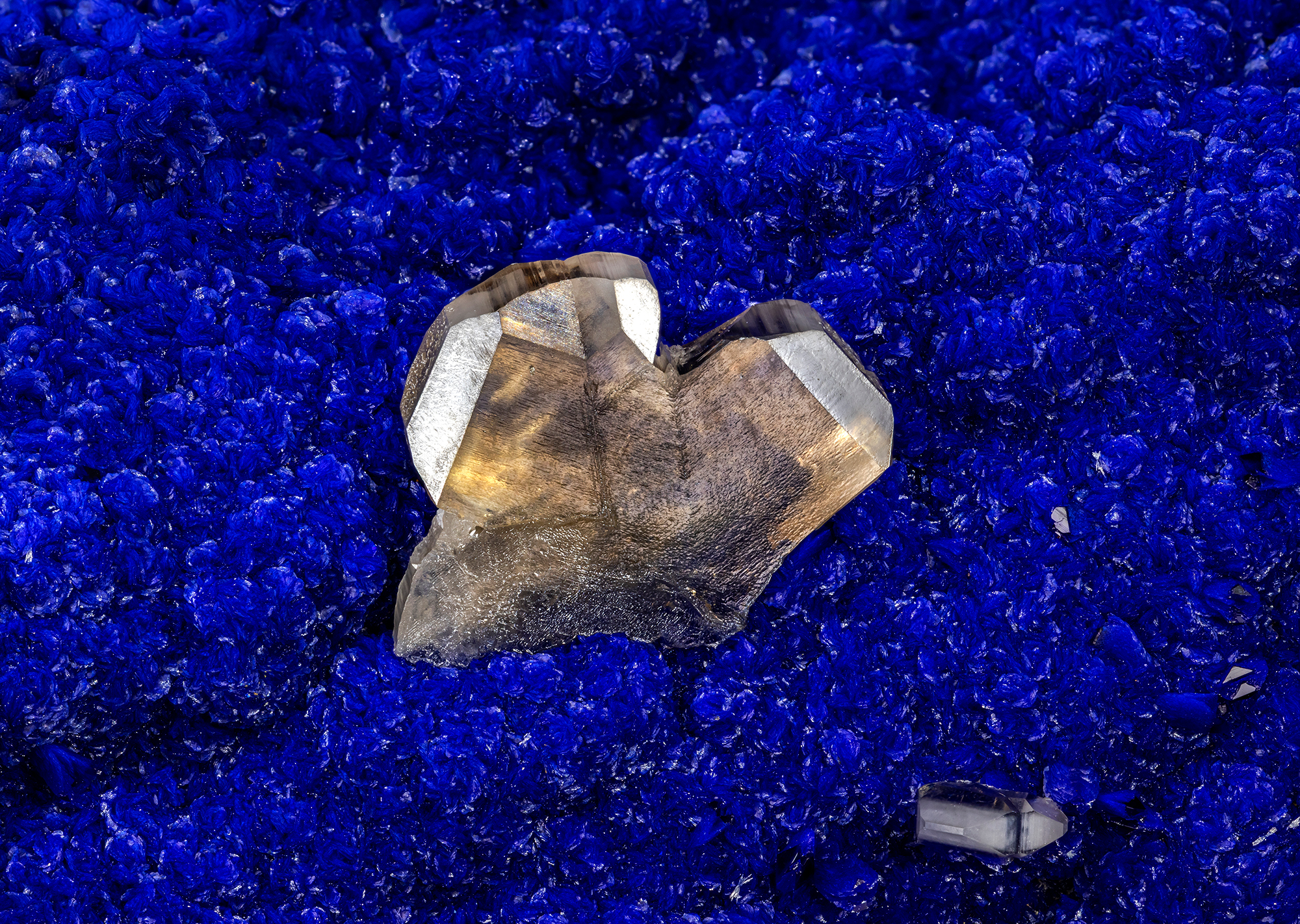
Electric-blue azurite with a relatively large (for the find) cerussite twin—whole specimen and close-up. Size of the specimen 11.2 cm. Spirifer collection. Photo by László Kupi.
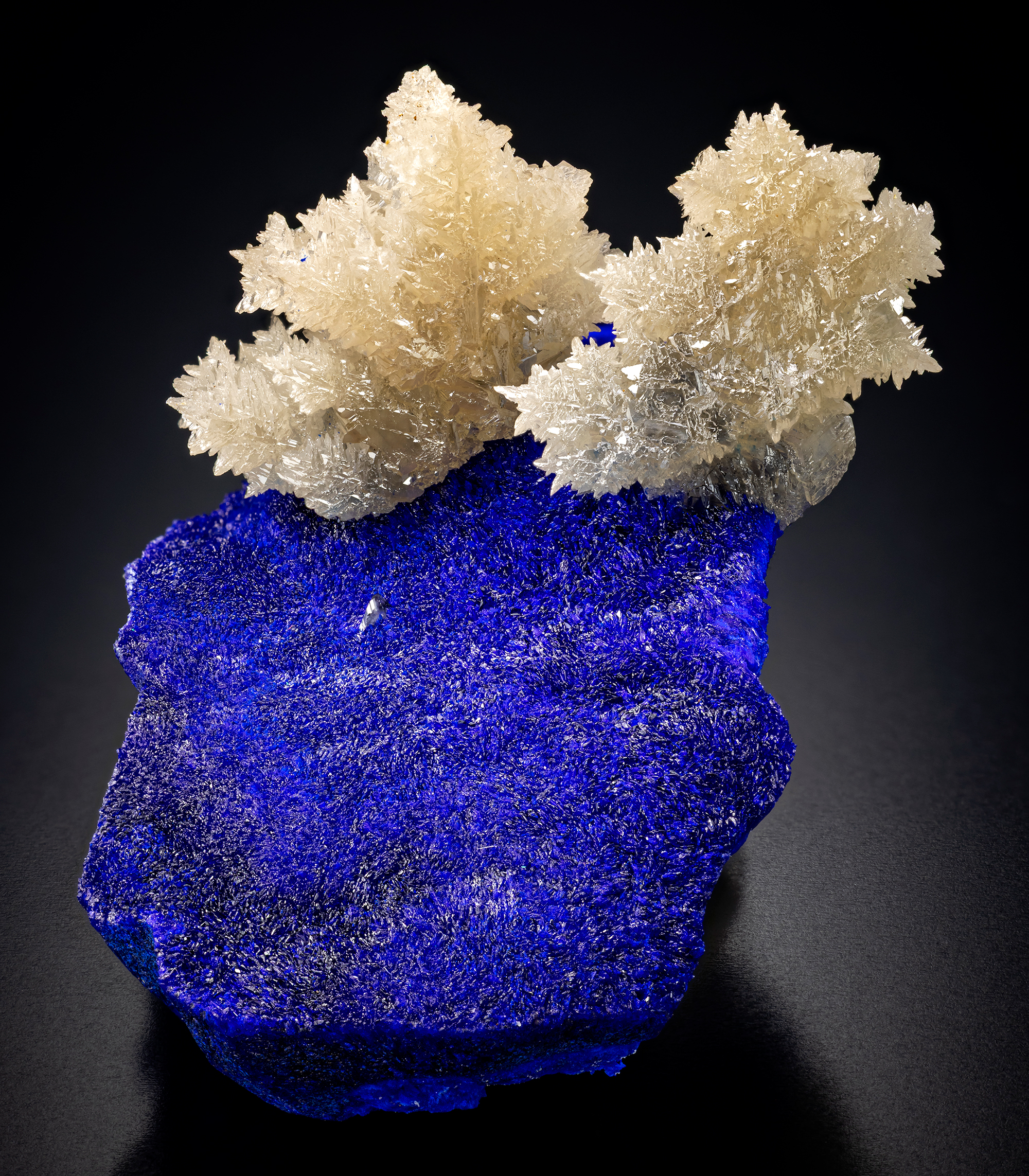
Cerussite “snowflakes” on sparkly azurite. Size 3.5 cm. Joanna Praszkier collection. Photo by László Kupi.
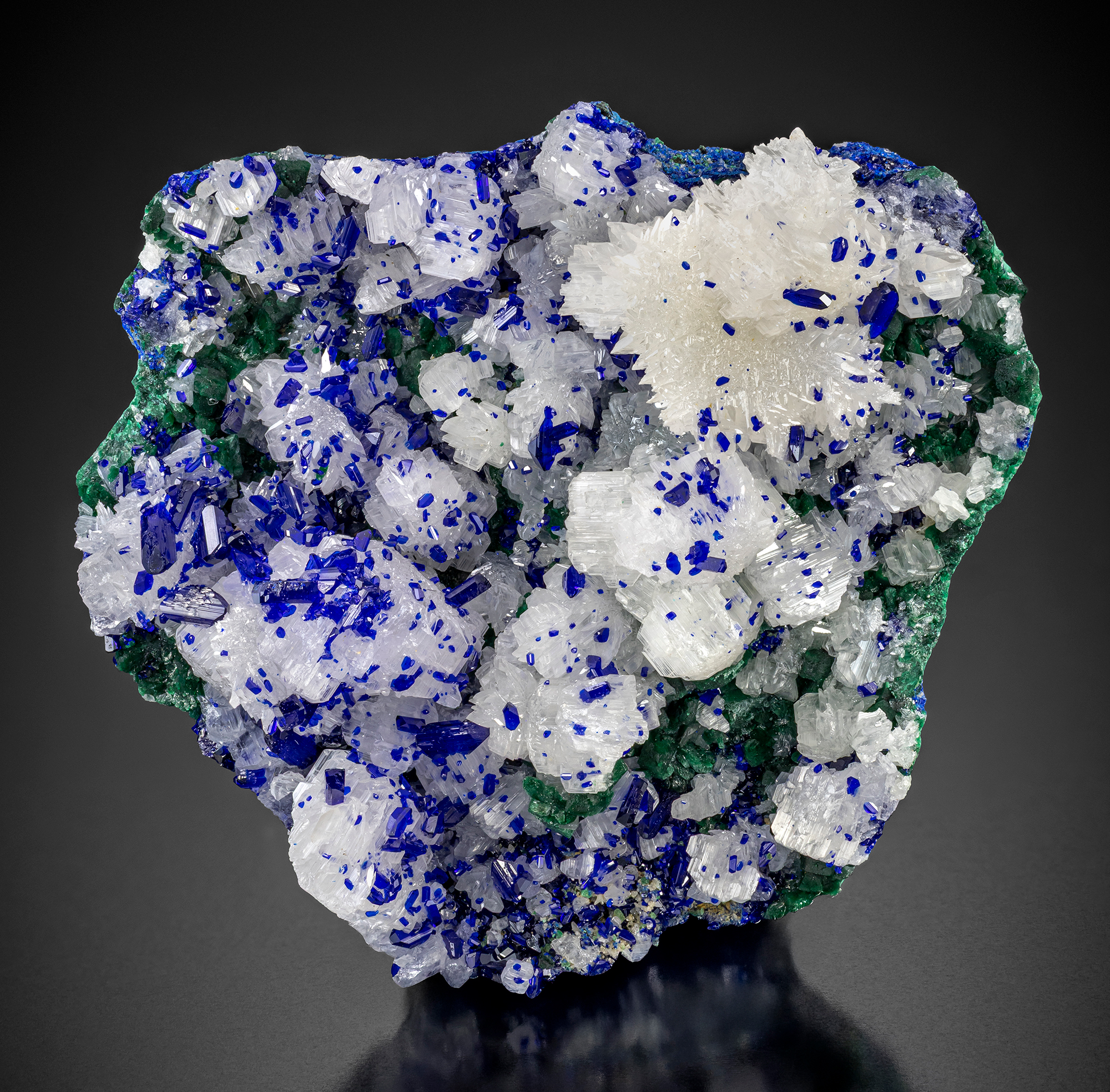
Azurite crystals growing on twinned cerussites on malachite. Size 5.5 cm. Photo by László Kupi.
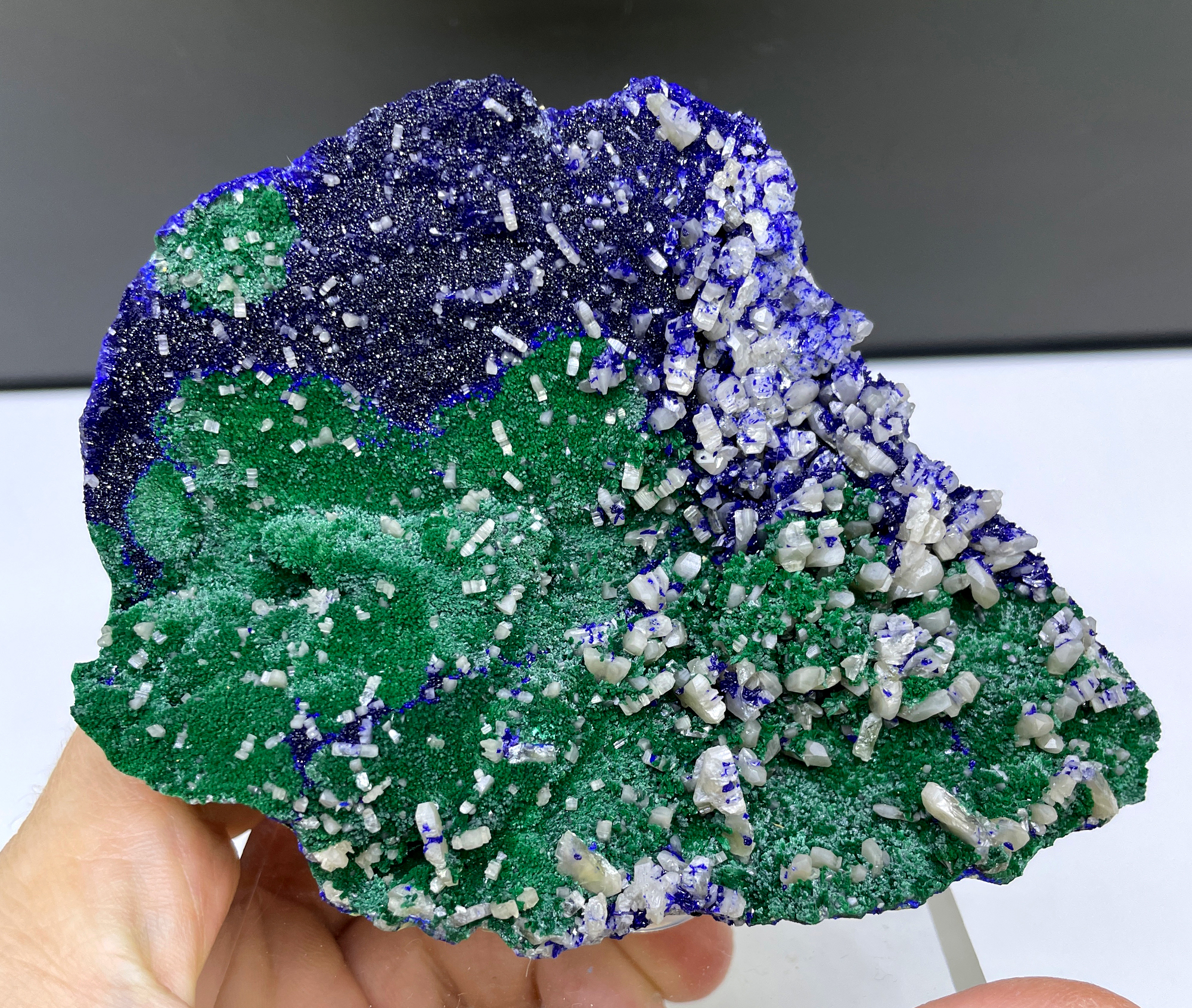
Twinned cerussites growing on azurite and malachite.
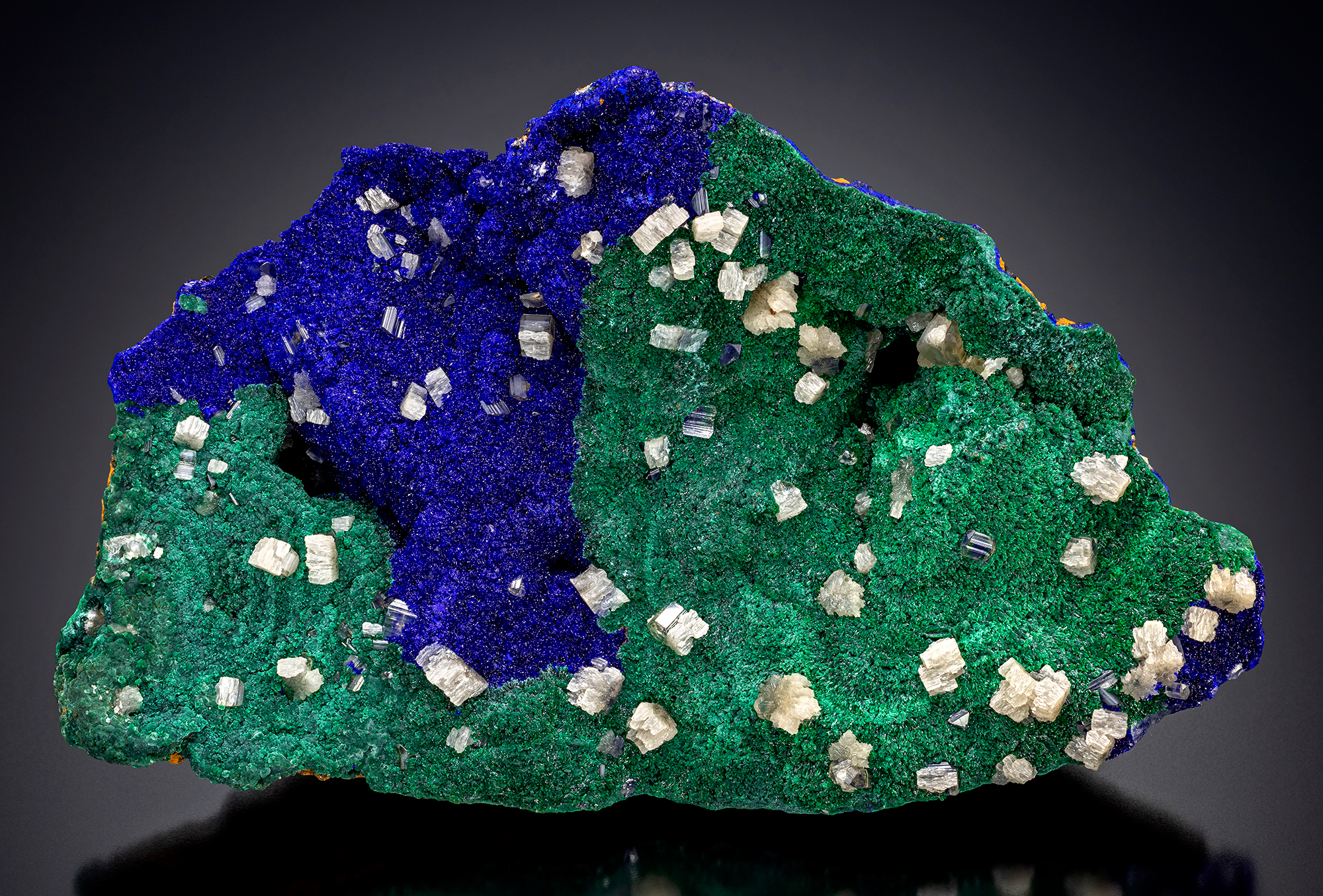
Twinned cerussites growing on azurite and malachite. Size 10.5 cm. Spirifer collection. Photo by László Kupi.
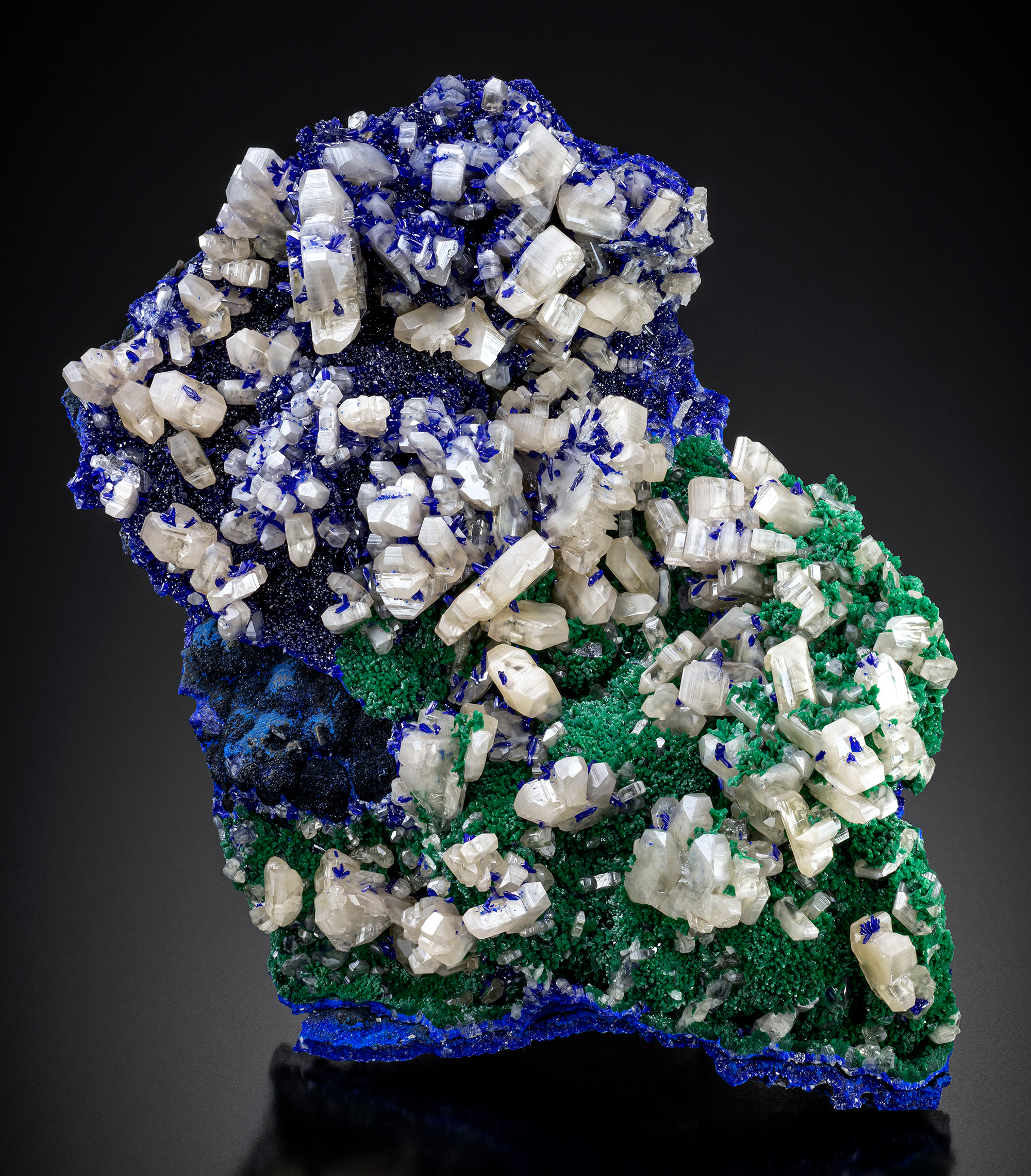
Twinned cerussites with azurite growing on malachite. Size 8.5 cm. Photo by László Kupi.
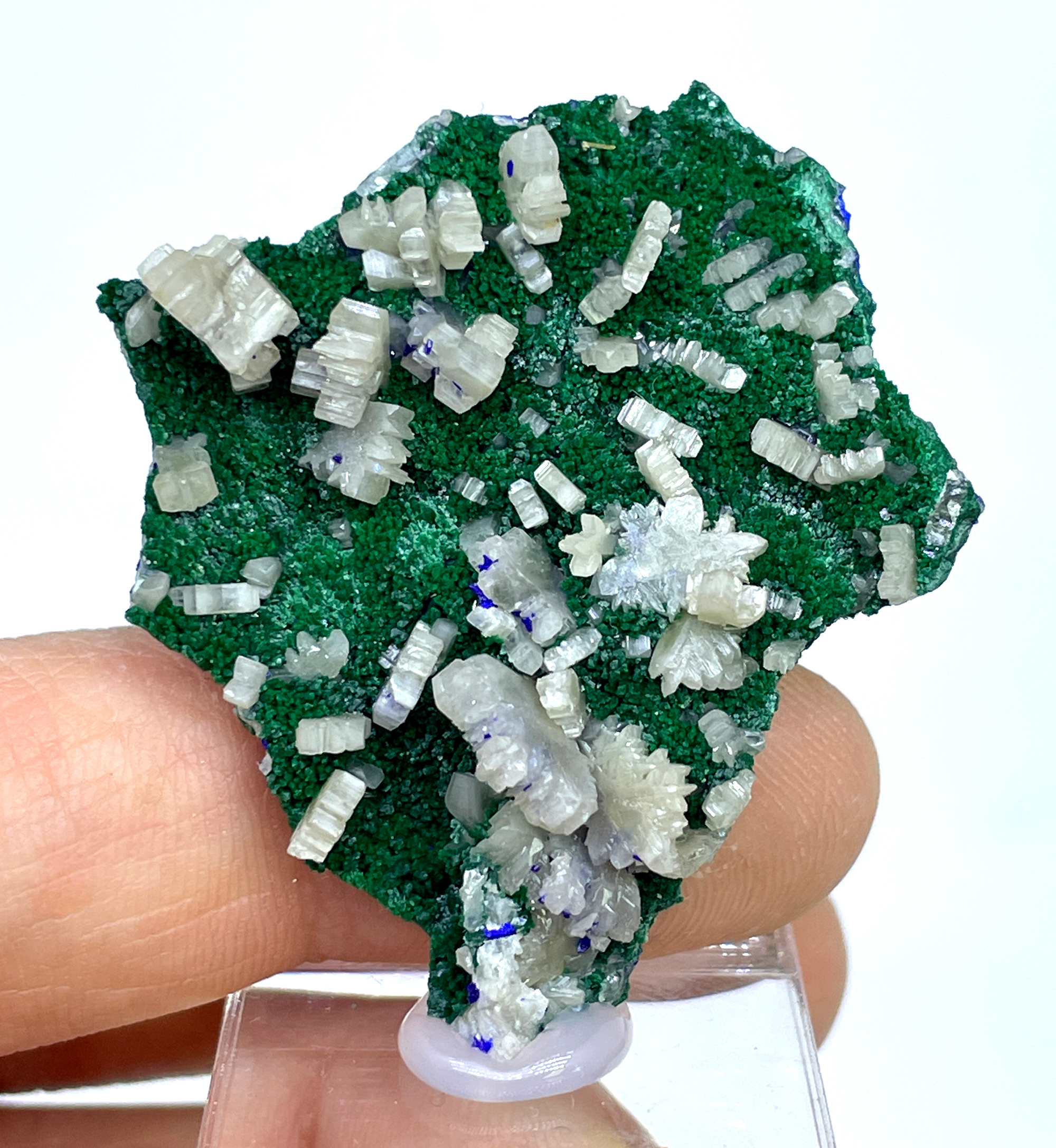
Twinned cerussites on malachite.
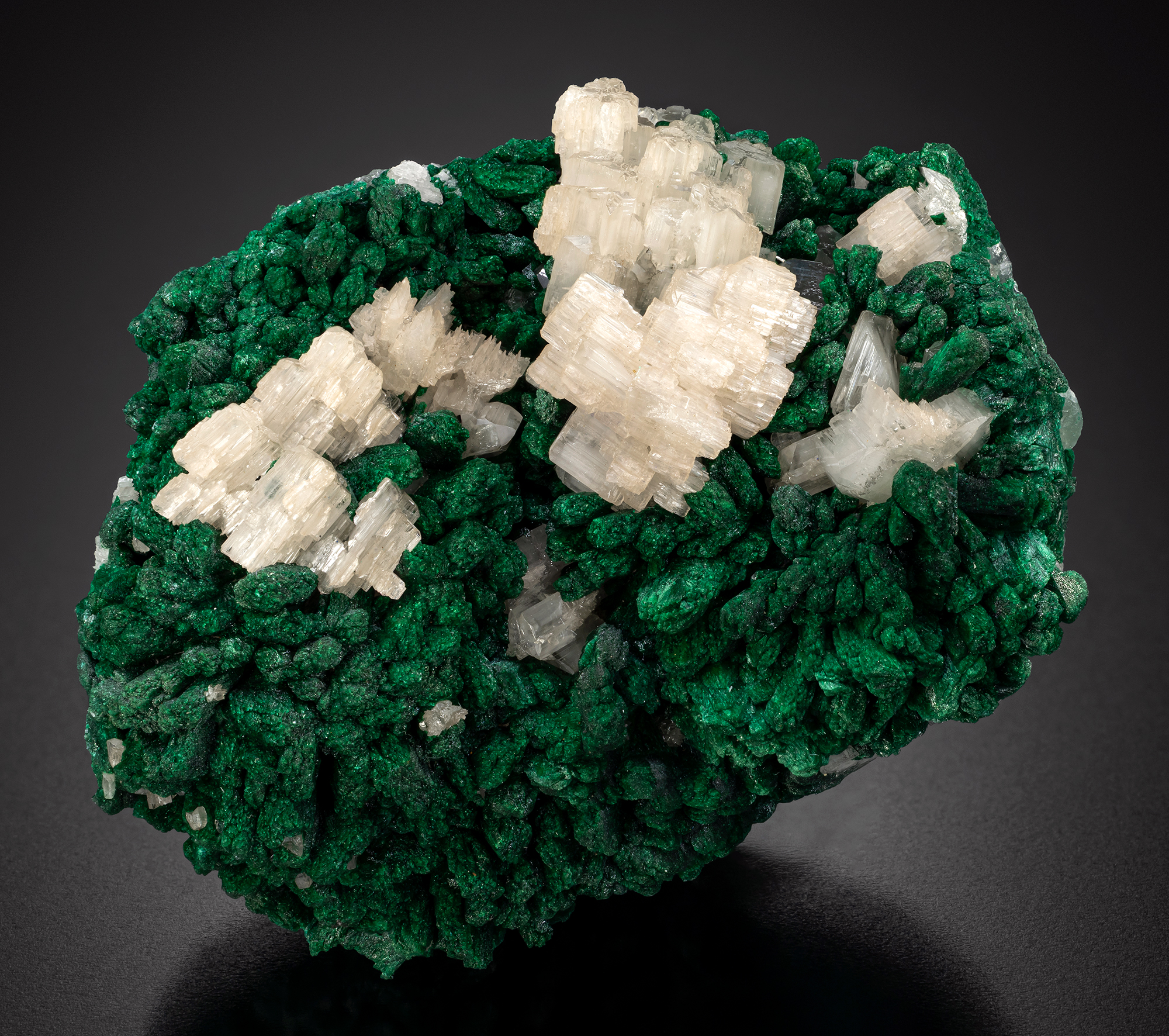
Twinned cerussites on malachite. Size 4.5 cm. Photo by László Kupi.
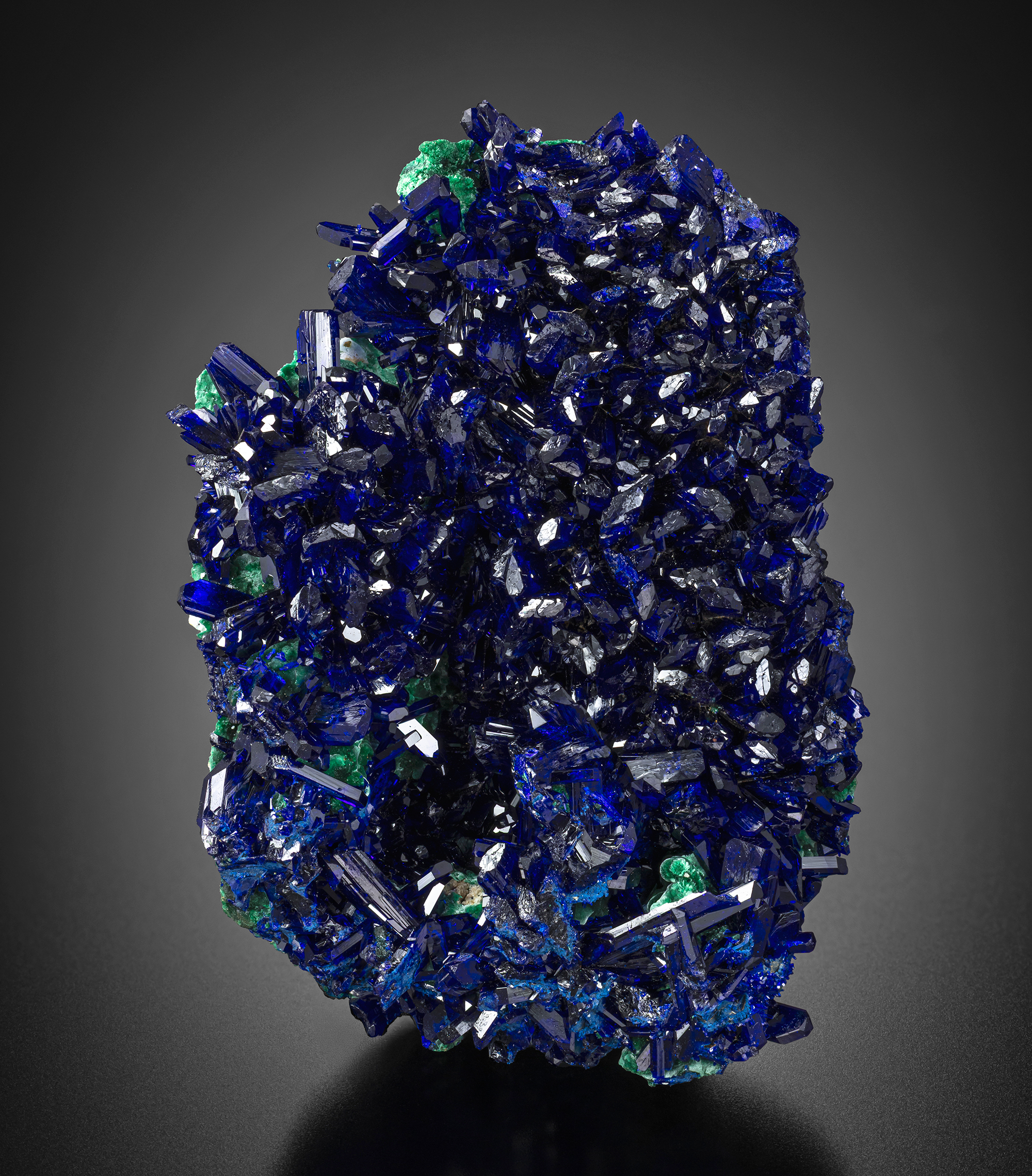
Besides the distinctive finds, the Yanga Koubenza quarry is a source of many “one-of-a-kind” specimens, which occur as single pieces or in very small groups. Well-crystallized azurite shown in the photograph. Size 5.1 cm. Spirifer collection. Photo by László Kupi.
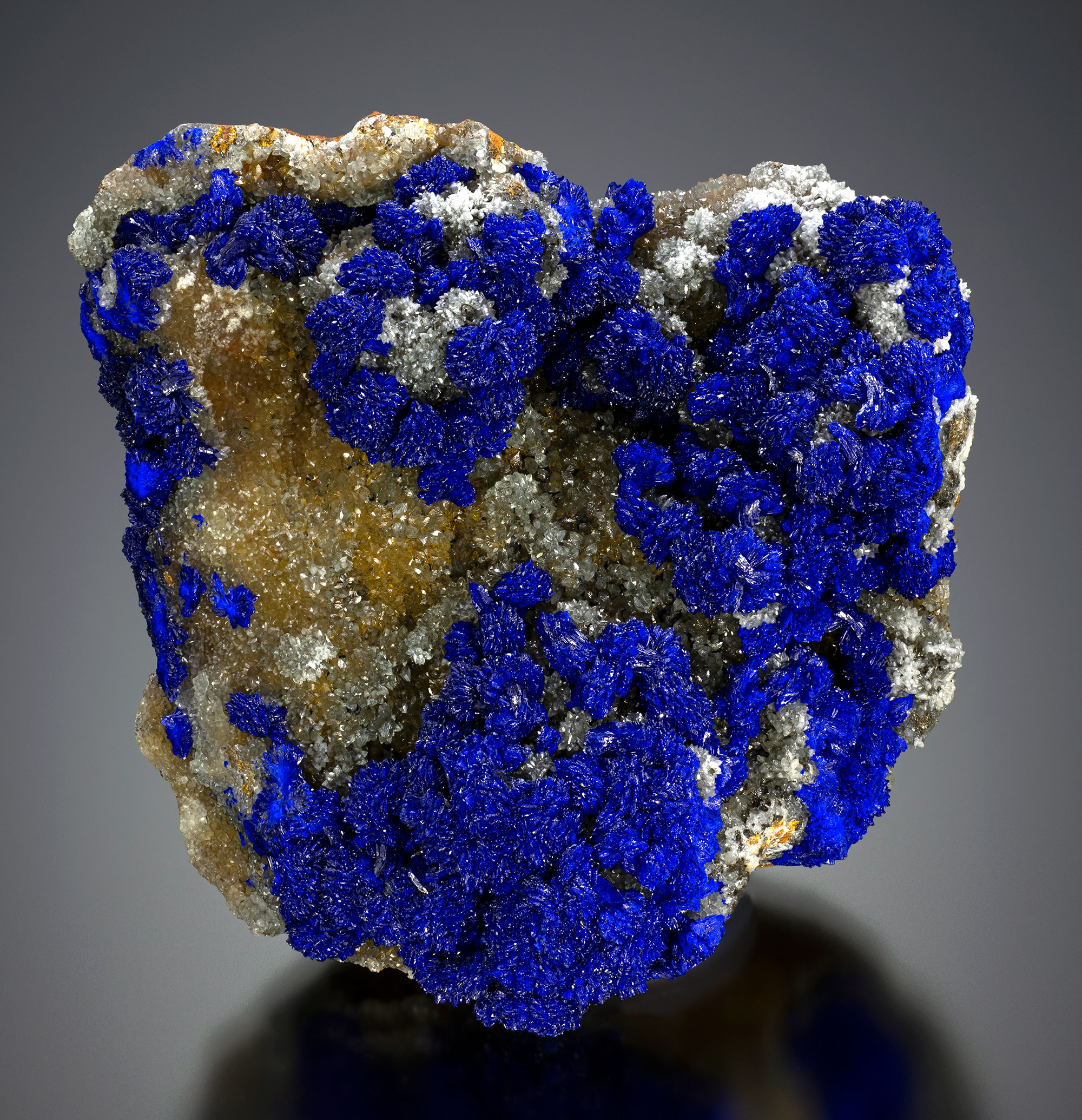
Besides the distinctive finds, the Yanga Koubenza quarry is a source of many “one-of-a-kind” specimens, which occur as single pieces or in very small groups. Azurite on smithsonite shown in the photograph. Size 7.5 cm. Spirifer collection. Photo by László Kupi.
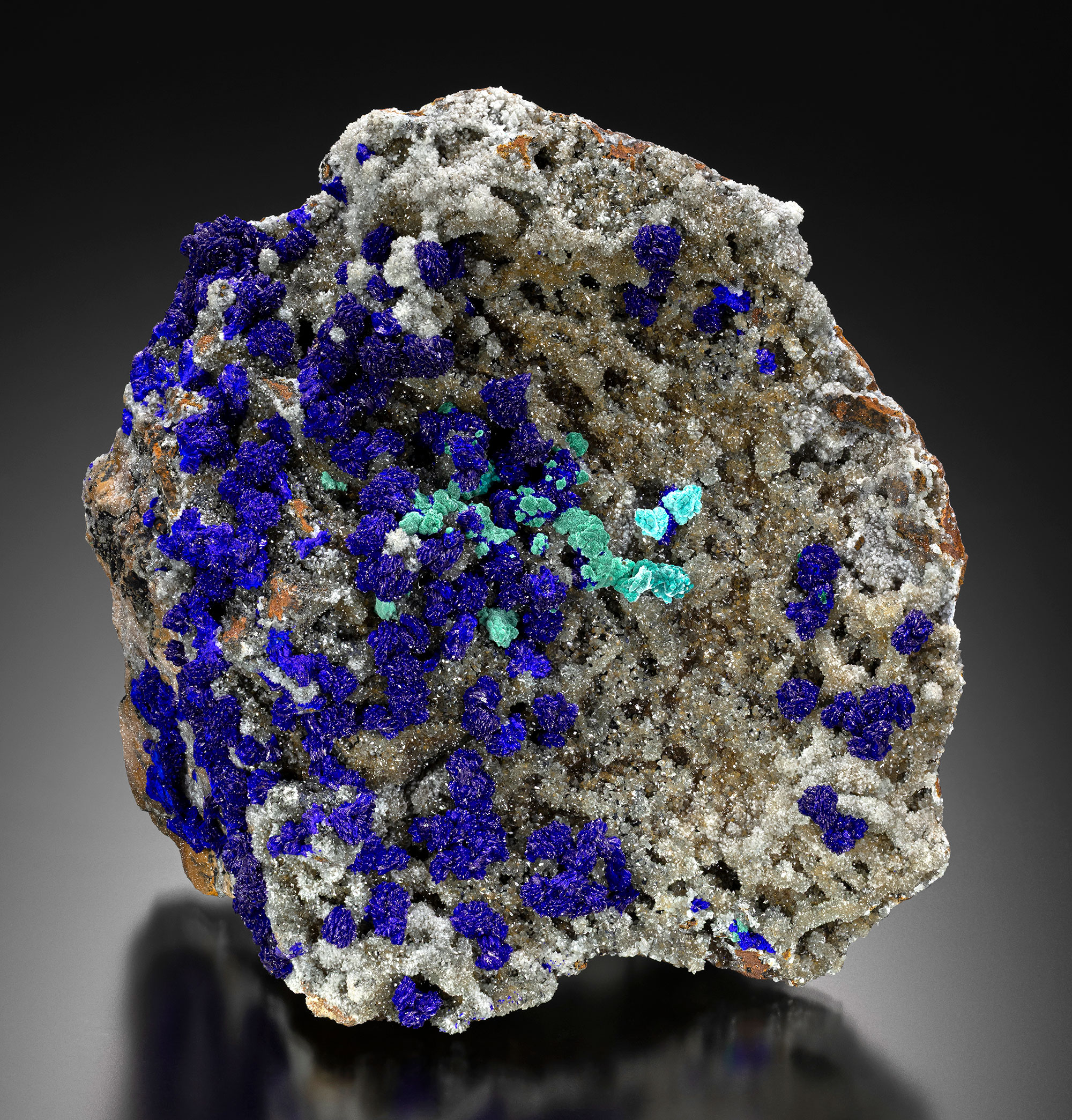
Besides the distinctive finds, the Yanga Koubenza quarry is a source of many “one-of-a-kind” specimens, which occur as single pieces or in very small groups. Azurite with aurichalcite on smithsonite shown in the photograph. Size 9.8 cm. Spirifer collection. Photo by László Kupi.
,-Mfouati,-Mfouati-District,-Bouenza-Department,-Republic-of-the-Congo_49mm.jpg)
Besides the distinctive finds, the Yanga Koubenza quarry is a source of many “one-of-a-kind” specimens, which occur as single pieces or in very small groups. Azurite sphere growing on smithsonite, shown in the photograph. Size 4.9 cm. Spirifer collection. Photo by László Kupi.
,-Mfouati,-Mfouati-District,-Bouenza-Department,-Republic-of-the-Congo_42mm.jpg)
Malachite with cerussite. Size 4.2 cm. Photo by László Kupi.
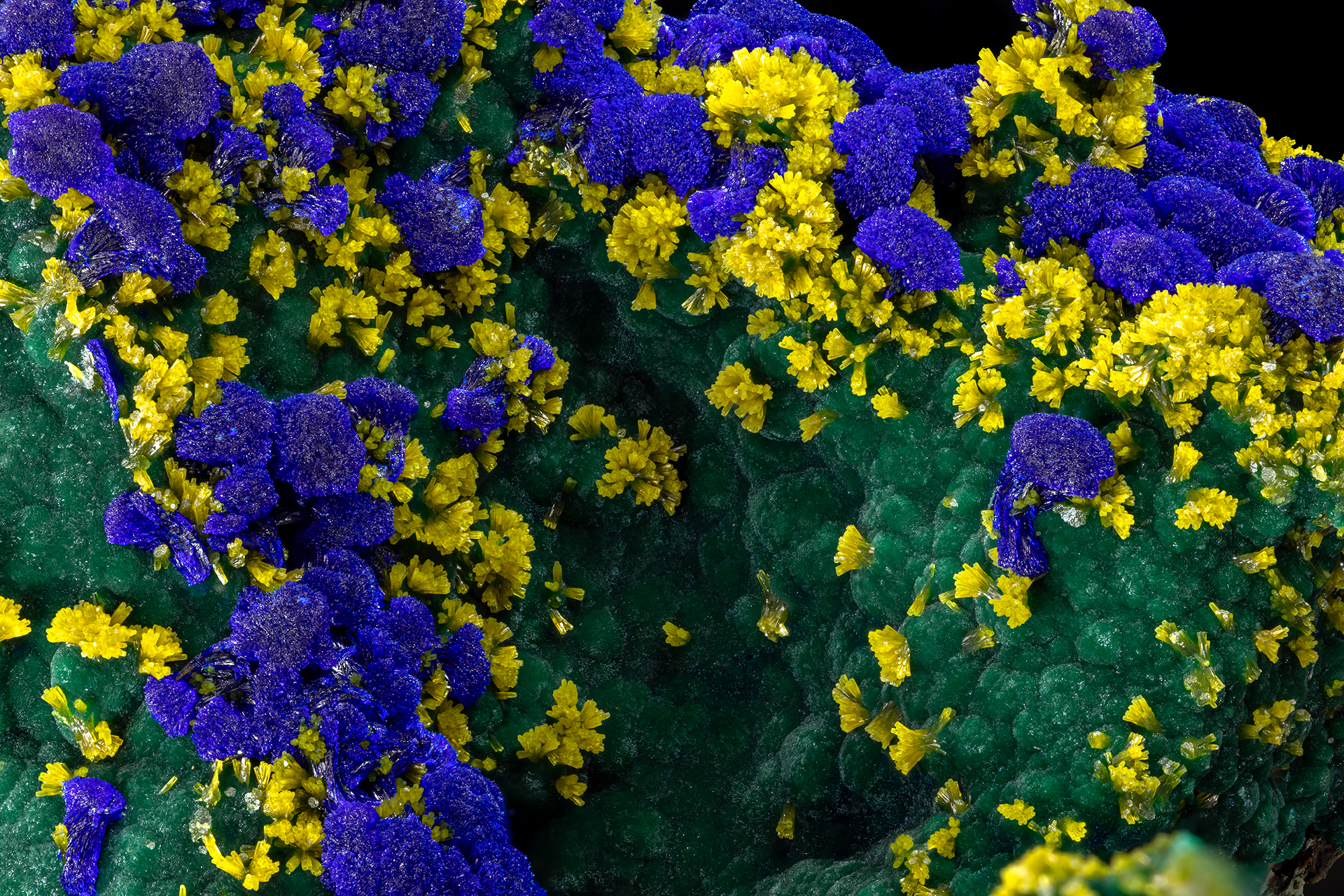
Close-up photo of the incredible combination of pyromorphite, azurite, and malachite. FOV 3 cm. Photo by László Kupi.
.jpg)
Pyromorphite from earlier finds in the Yanga Koubenza quarry. Size 4.2 cm. Spirifer collection. Photo by László Kupi.
,-Mfouati,-Mfouati-District,-Bouenza-Department,-Republic-of-the-Congo_44mm.jpg)
Pyromorphite on malachite from earlier finds in the Yanga Koubenza quarry. Size 4.4 cm. Spirifer collection. Photo by László Kupi.
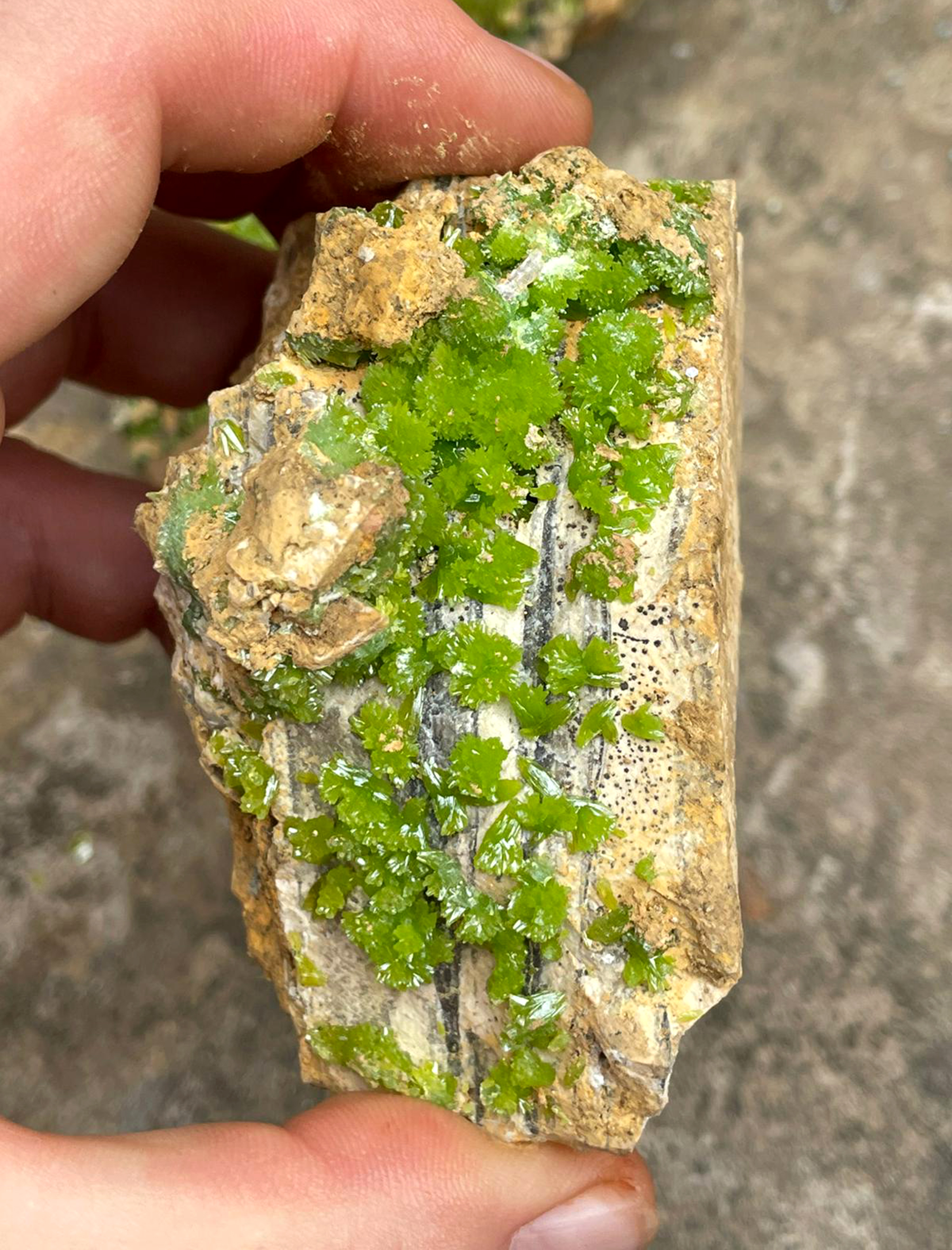
Specimen from a recent pyromorphite find (late 2025).
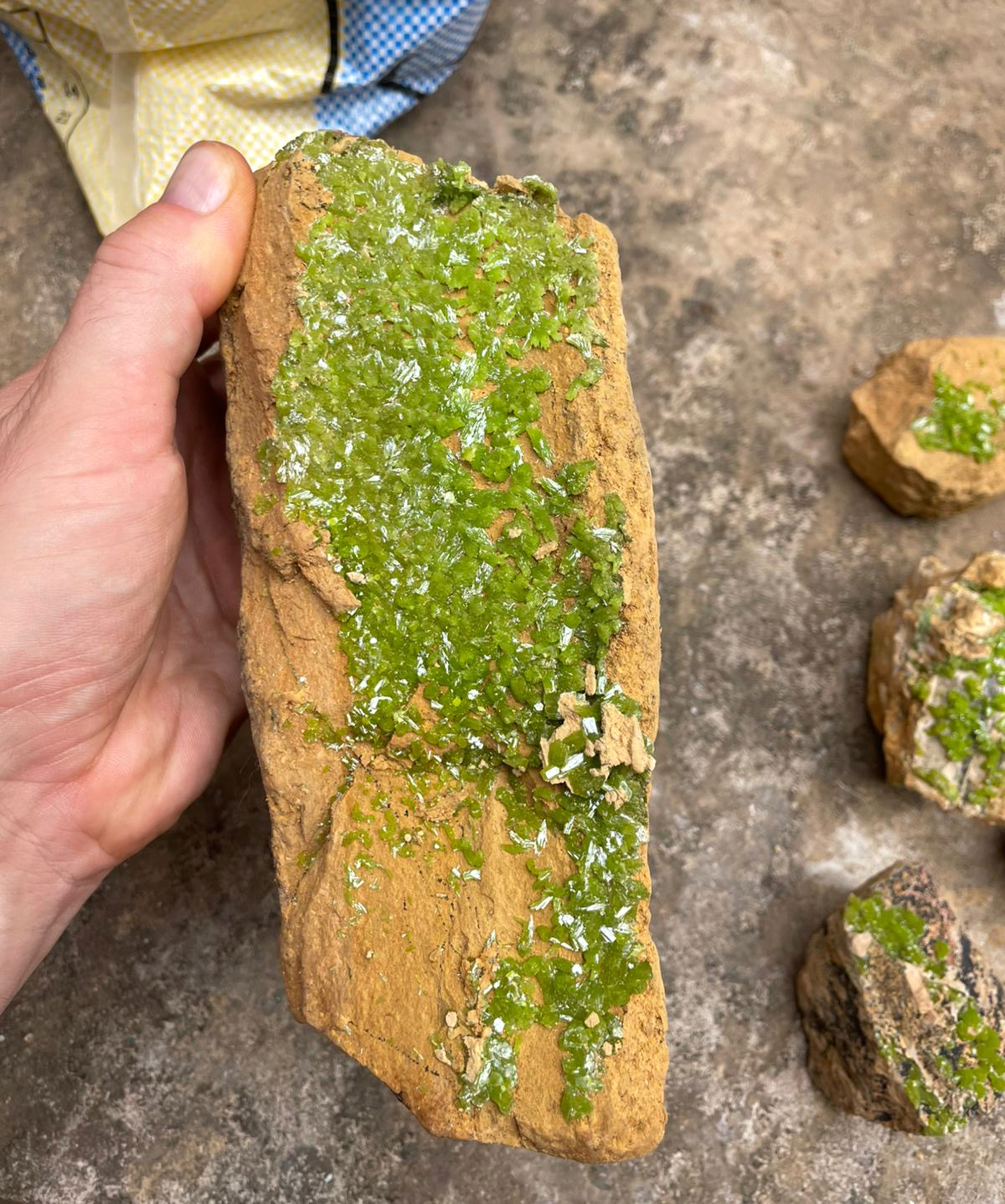
Specimen from a recent pyromorphite find (late 2025).
MIMETITE BONANZA
The first mimetite specimens from Yanga Koubenza were noted during our research as late as 2022–2023. At the beginning, these were small and insignificant finds. Over time, a few scarce specimens began to appear that showed higher quality. The true “Mimetite Bonanza” occurred in 2024. Notably, this species had never been reported previously, even in extensive studies of the deposit, which strongly supports the conclusion that mimetite occurs only very locally within the Yanga Koubenza deposit.
The Mimetite Bonanza zone was relatively small and was intersected during mine development work in the western part of the deposit. The productive area was limited in extent, measuring only a few dozen meters in width, and was built predominantly by “rusty” gossans and residual deposits. The host rock was typically earthy and crumbly limonite, locally transitioning into relatively solid hematite (sic!).
The character of the Mimetite Bonanza find was closely correlated with the general style of mineralization in the Yanga Koubenza deposit. Mineralization occurred in several small zones characterized by a high density of numerous relatively small pockets. Due to the layered nature of the host rock, these pockets were generally small, flat, and very narrow. In some cases, slightly larger pockets had collapsed and were filled with brecciated fragments of matrix, which were subsequently overgrown on all sides by mimetite and associated mineral species.
A distinctive feature of this find is the exceptionally high diversity of mimetite crystal habits, including variations in shape, color, and morphology, as well as differences in paragenesis between individual pocket groups (see details below). Such a degree of diversity is unknown from any other mimetite occurrence worldwide.
Unfortunately, the narrow and small nature of the pockets generally did not allow sufficient space for the development of larger crystals or larger surfaces to be covered by them. The majority of recovered specimens are therefore relatively small, with only a few exceptions—plates measuring 20–30 cm covered with mimetite. These larger pieces were often damaged or locally intergrown with matrix over significant portions of their surfaces. In addition, difficult collecting conditions resulted in many specimens being recovered with substantial damage. Consequently, extensive trimming and division into smaller pieces were necessary during specimen preparation. As a result, most specimens are of thumbnail to small cabinet size, and only a very limited number of larger specimens in good condition were preserved.
The mimetite zone produced specimens for several months, after which further finds of mimetite at Yanga Koubenza became very scarce. During this relatively short period, several thousand specimens were collected; however, the vast majority were heavily damaged or of low quality. From the total material, only a few hundred specimens can be considered higher quality, with just a few dozen regarded as truly outstanding. Owing to the exceptional diversity described above, many of these represent unique or nearly unique examples of specific crystal habits or paragenetic associations
The future potential for good specimens remains uncertain, although there is a reasonable chance that renewed mining activity in the same area may intersect additional mimetite-rich zones.
The first specimens from Mimetite Bonanza find reached the mineral market in 2024, brought by Congolese dealers to the Sainte-Marie-aux-Mines show, followed by a small number of specimens appearing at the Tucson Show in 2025. Spirifer Minerals worked intensively to secure the majority of the find; however, due to lengthy export procedures, sea transport, and specimen preparation, nearly two years elapsed before the full scale and quality of the discovery could be presented. The Tucson Show 2026 marked the official premiere of the Mimetite Bonanza find.
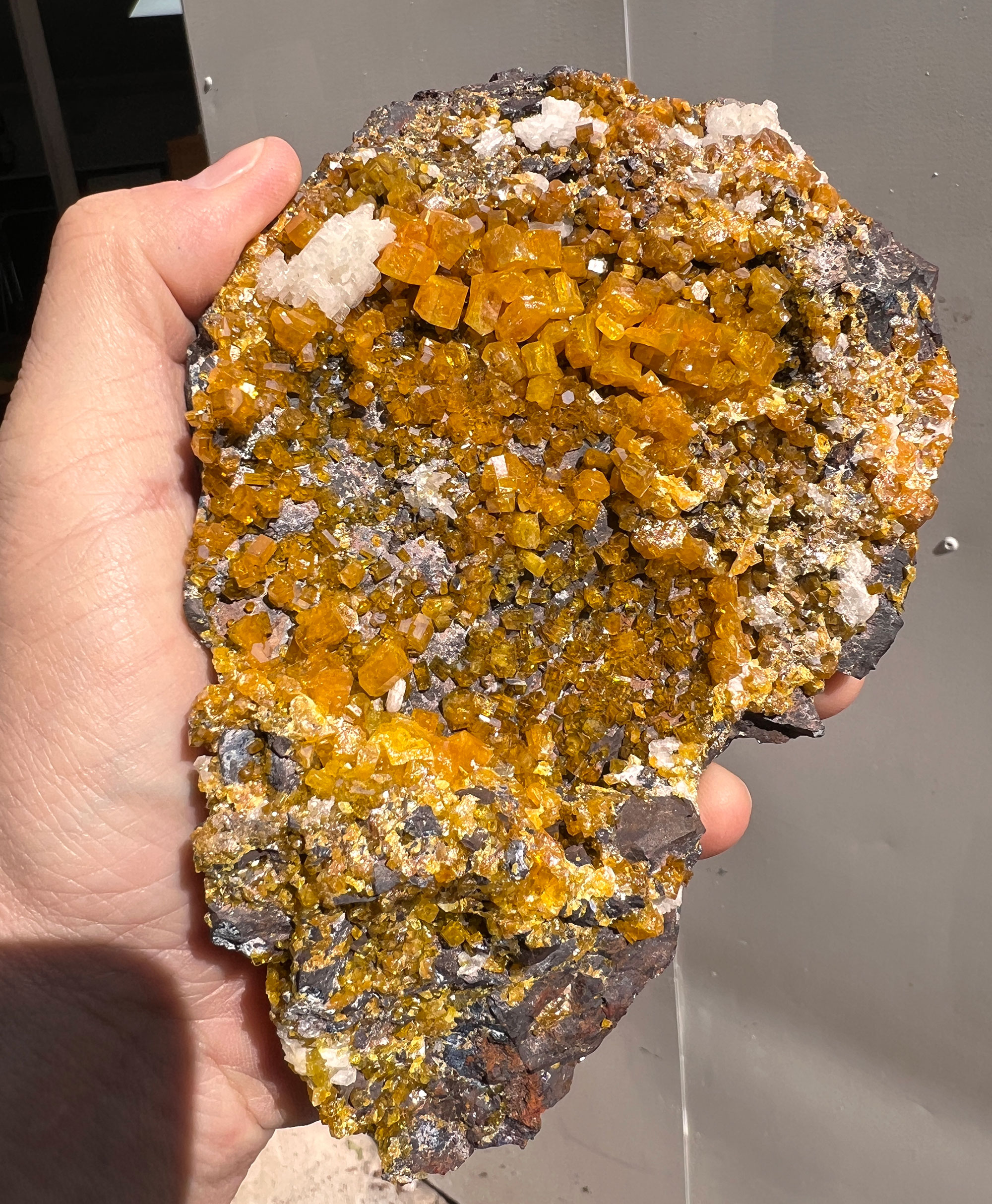
The majority of specimens from the mimetite find were damaged or attached to large fragments of host rock and required extensive trimming.
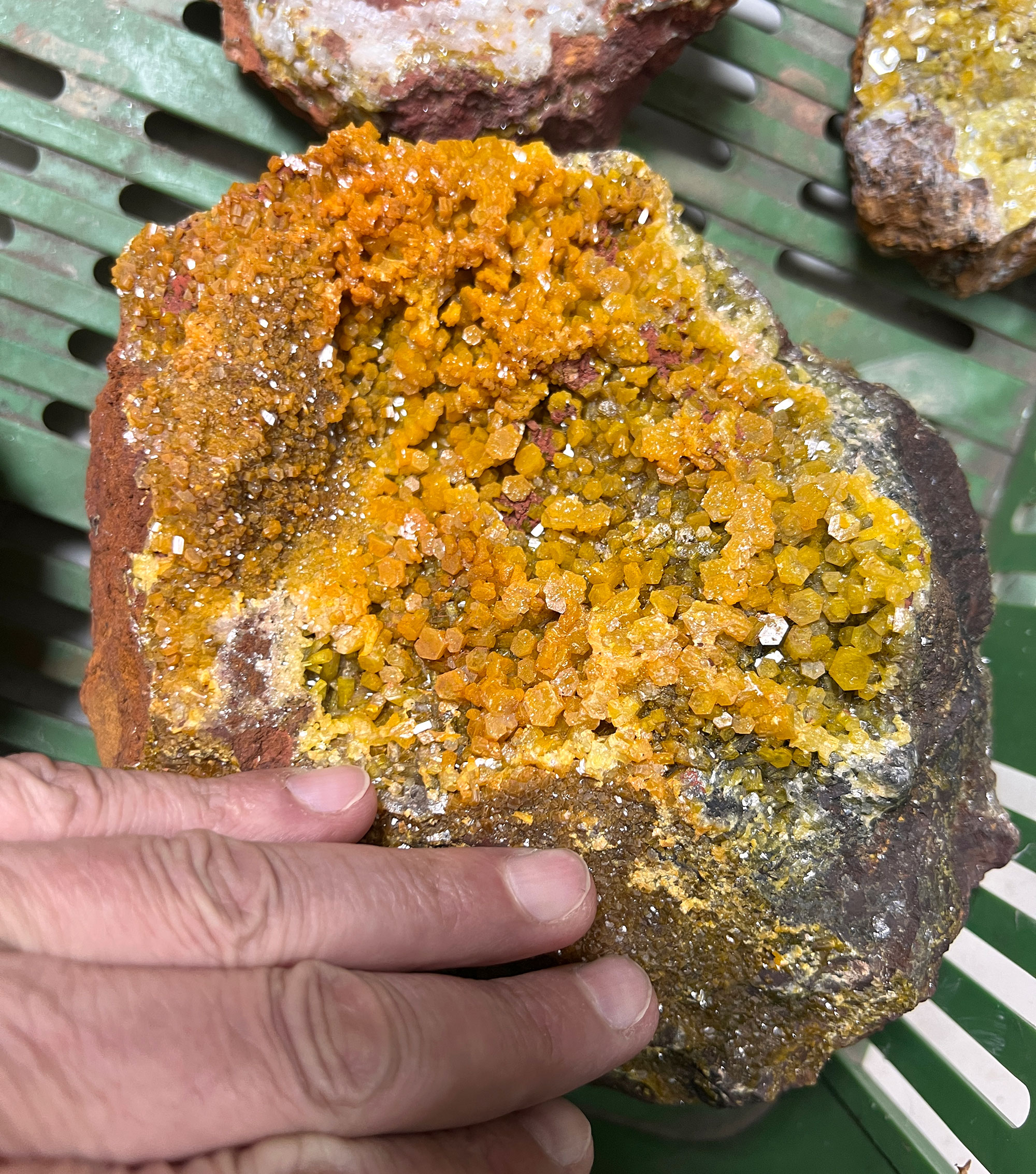
The majority of specimens from the mimetite find were damaged or attached to large fragments of host rock and required extensive trimming.
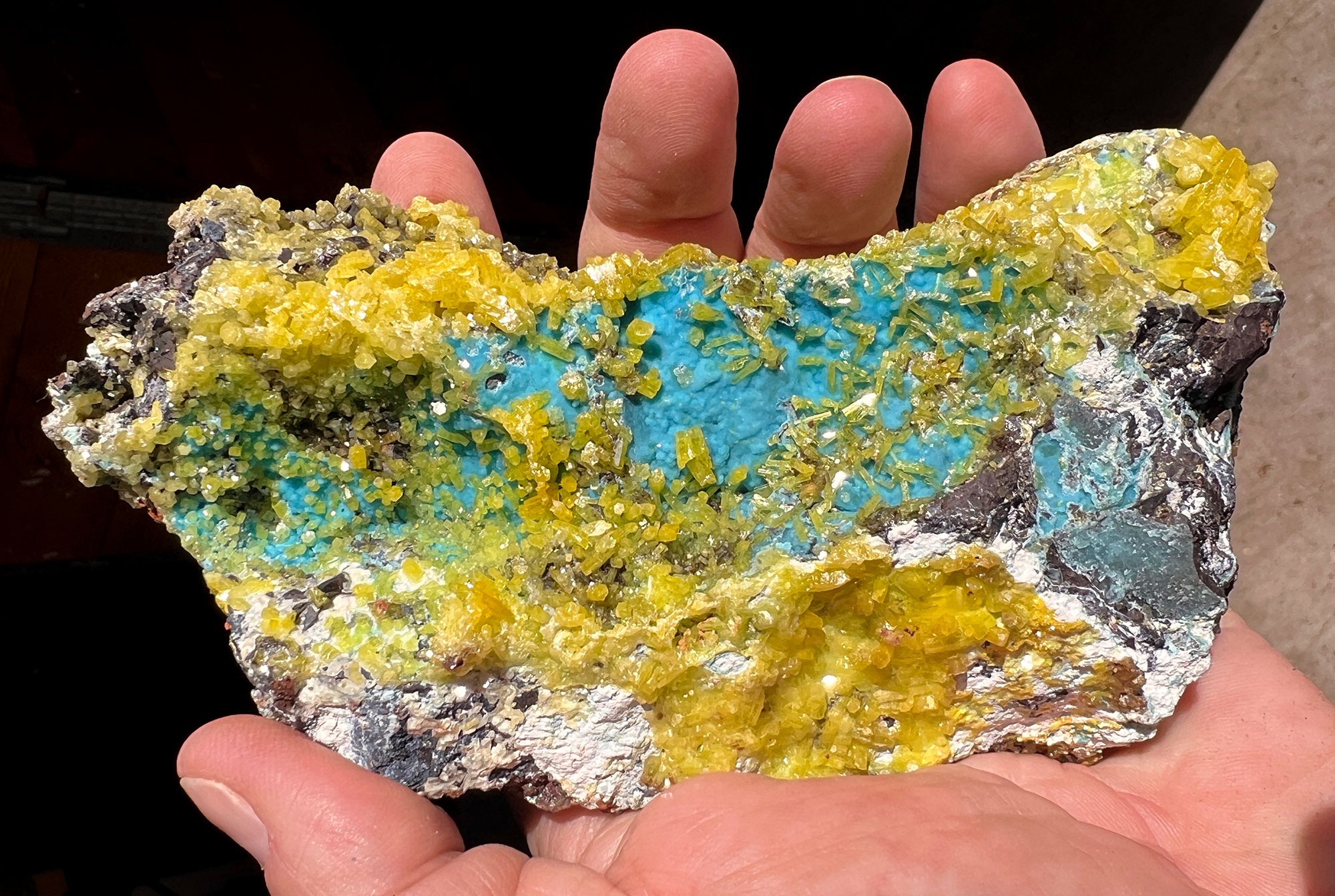
The same specimen in rough form after unpacking in our laboratory ...
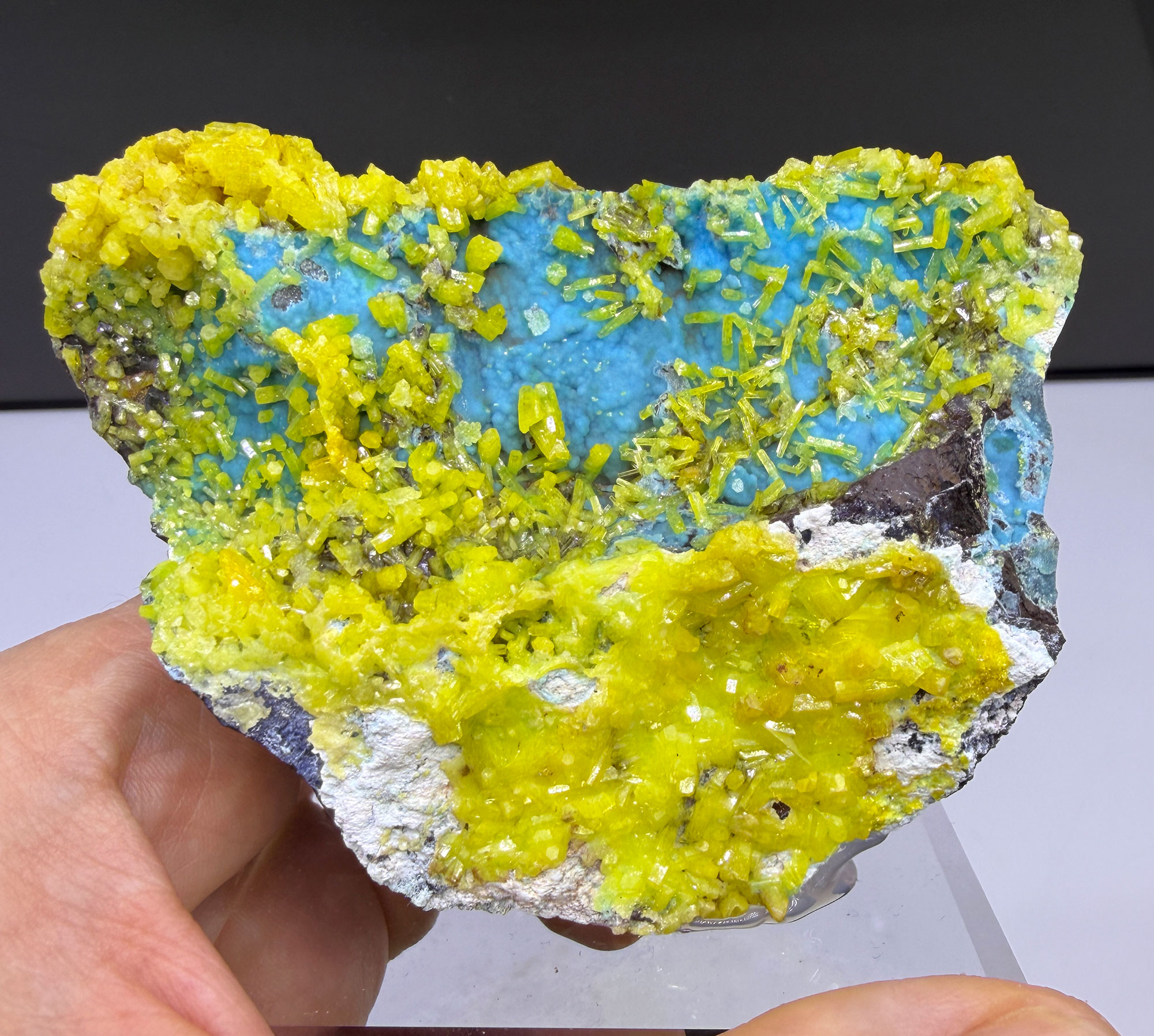
… and after trimming and cleaning.
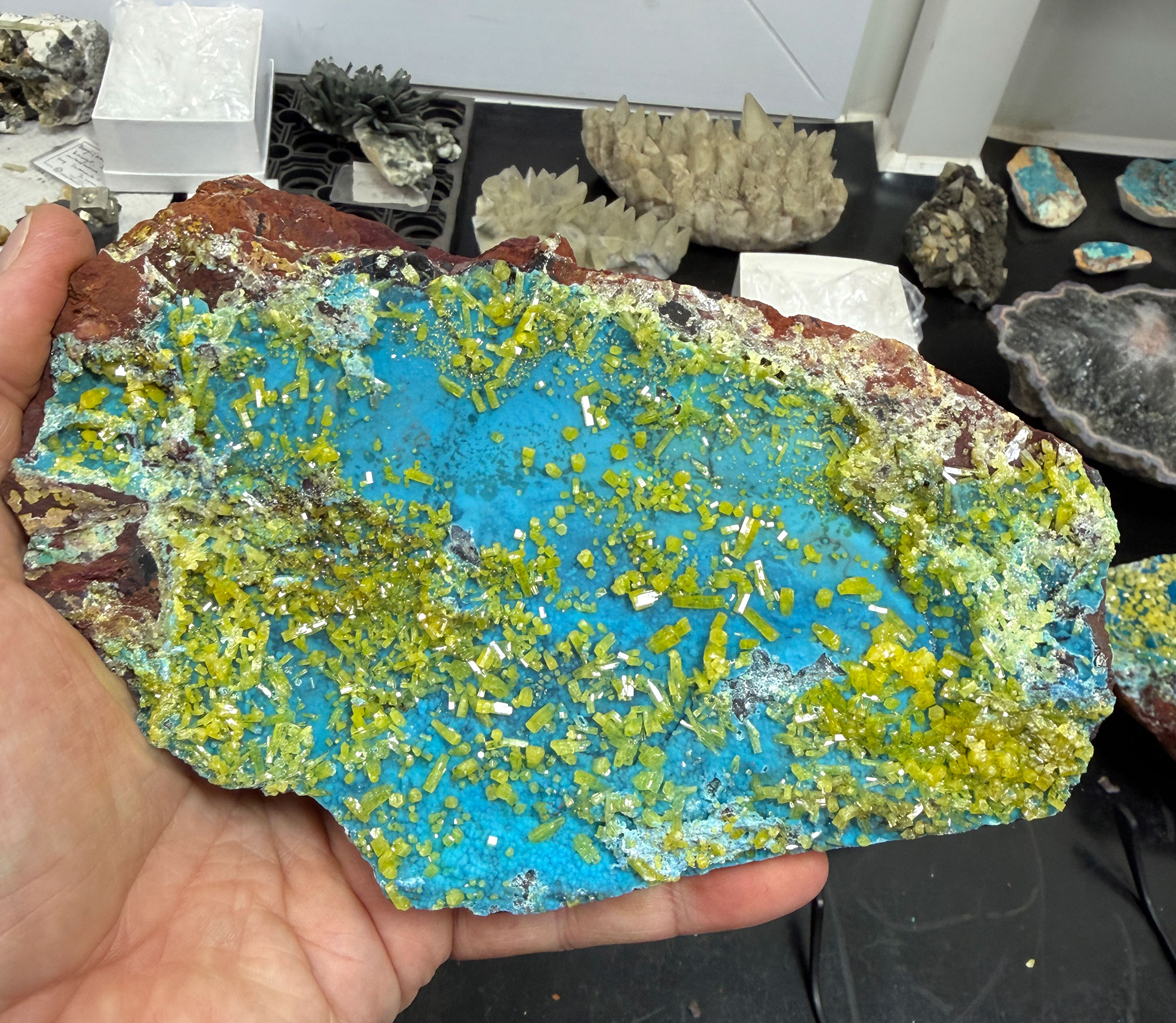
Some of the good specimens, due to damage, had to be split into several smaller but more perfect pieces. Shown here is an example of mimetite on philipsbornite with damage in the central part of the specimen.
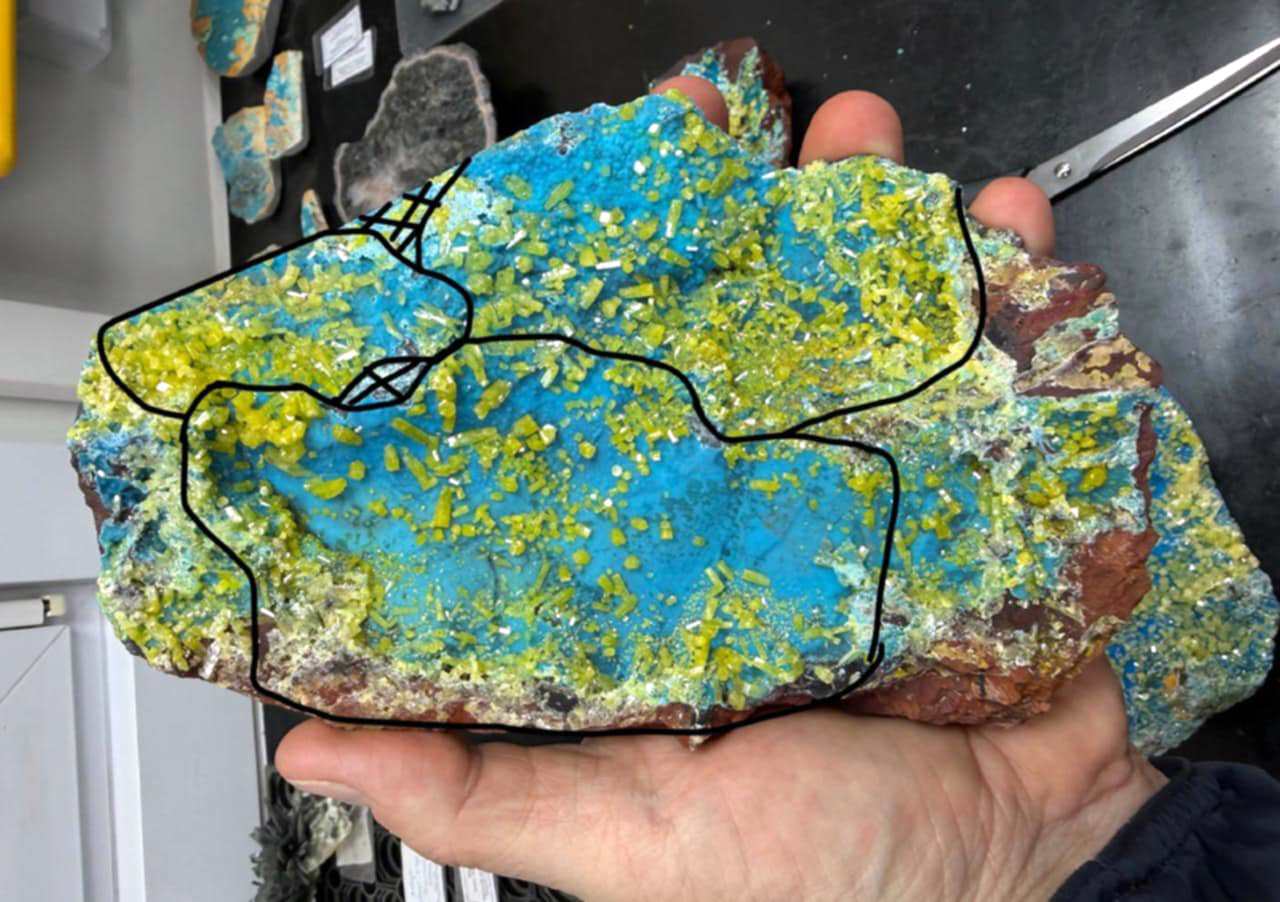
After careful analysis, a trimming plan was prepared.
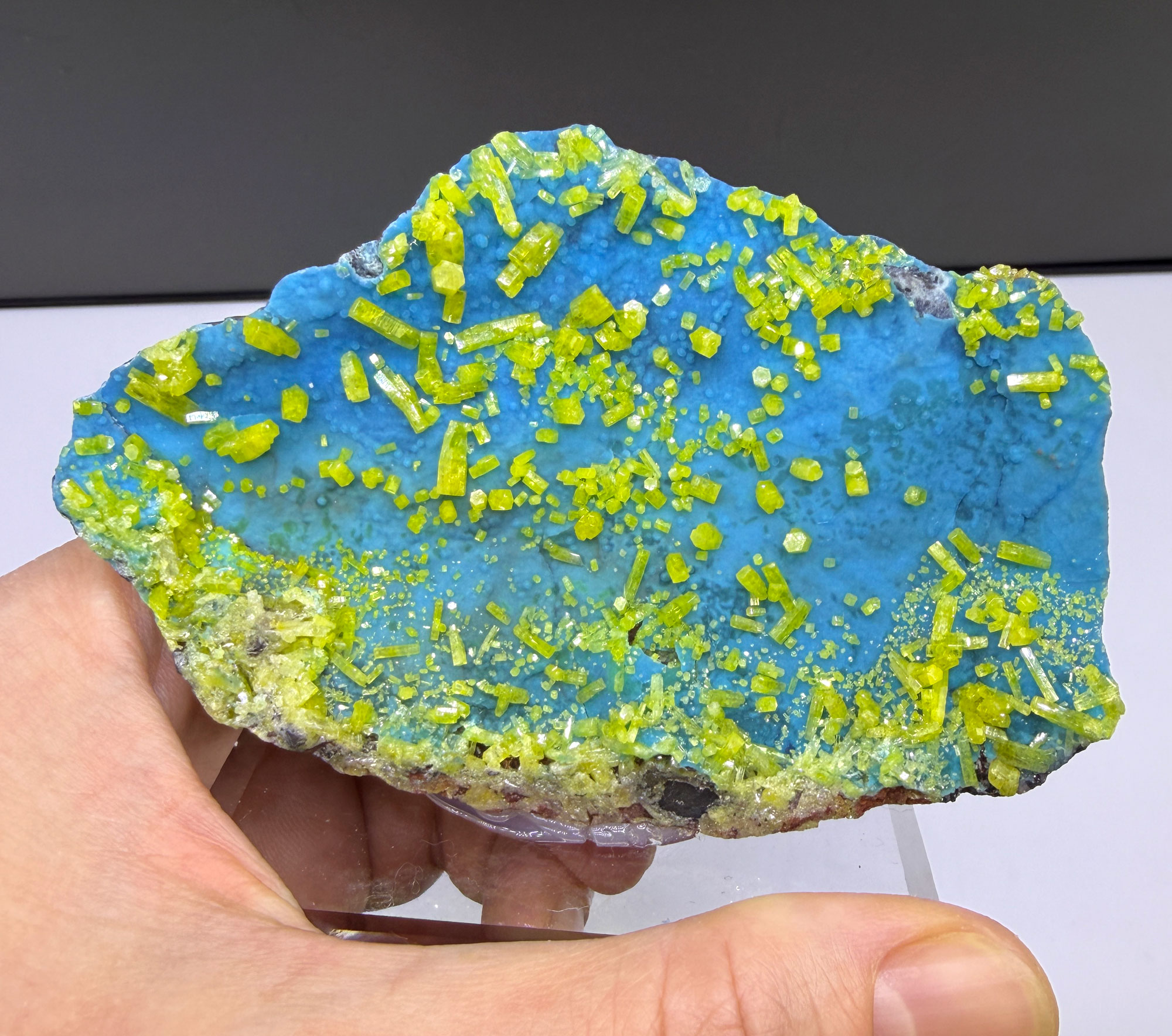
And here is the result of the trimming—one of the finished specimens.
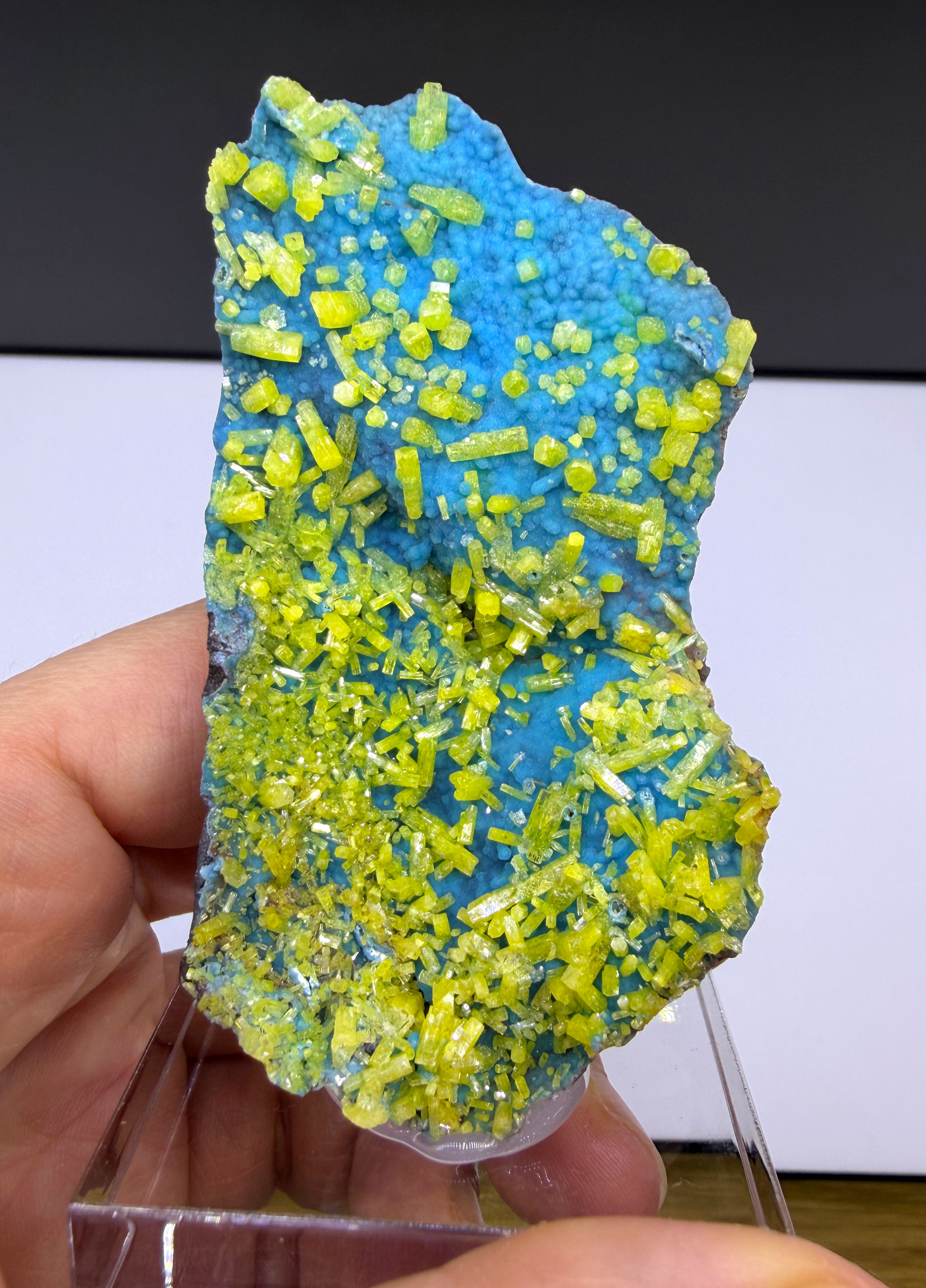
And one more finished specimen from the trimming of the piece shown above.
MINERAL ASSEMBLAGE OF THE MIMETITE BONANZA
The list of mineral species identified from the Mimetite Bonanza find is relatively short; however, it includes several highly unusual parageneses as well as world-class examples of certain species. Based on analytical work carried out by Eligiusz Szełęg and collaborators at the Silesian University, the following species have been confirmed so far: cerussite, clay minerals, duftite (represented by the largest crystals of this species known worldwide), mimetite, philipsbornite (among the finest specimens of this species known), and pyromorphite. Although the total number of species is limited, the assemblage is nevertheless remarkable when compared with other mimetite localities worldwide that are known for producing high-quality specimens. If mining activity returns to the mimetite zone, there is good potential for additional species to be discovered.
The most abundant and clearly dominant mineral in the zone is mimetite, which in most cases occurs as a solitary species. It is present in numerous crystal habits and color varieties and occurs in at least two generations. The most common associated minerals with mimetite are cerussite and duftite. Cerussite occurs with several different mimetite habits, most commonly overgrowing mimetite crystals; in some cases, however, a second generation of mimetite is observed growing on cerussite. Duftite occurs almost exclusively in association with tabular yellow or orange mimetite.
Mimetite and pyromorphite never occur together within the find, which is consistent with observations from other occurrences worldwide. Pyromorphite appears to occur in a slightly different zone within the same mining area and is found almost exclusively as a solitary species.
Philipsbornite has so far been observed exclusively in hematite-rich host rock and is usually associated only with mimetite, with at least two distinct generations of mimetite recognized in these associations. Most commonly, mimetite overgrows philipsbornite; however, cases are also observed in which philipsbornite overgrows an older generation of mimetite, or in which both generations of mimetite occur on a single specimen. Philipsbornite locally also forms partial pseudomorphs after mimetite. In a few examples, philipsbornite is associated with mimetite together with duftite crystals.
At the current stage of research, it is not possible to establish a definitive growth sequence for the mineral assemblage, as most of the species do not directly co-occur within the same pockets.
Cerussite PbCO3
Cerussite is a relatively common species in the Yanga Koubenza quarry, including within the mimetite zone. It occurs exclusively as twins of varying complexity, ranging from reticulated flat “snowflake” forms to very complex three-dimensional twins with differing degrees of elongation. The size of the twins ranges from a few millimeters up to 3 cm in exceptional cases.
Cerussite from the mimetite find is almost exclusively white in color, with only minor occurrences of gemmy, colorless crystals, and it commonly exhibits good luster.
Most commonly, cerussite grows on yellow mimetite; more rarely, it is overgrown by a late-stage, gemmy variety of mimetite.
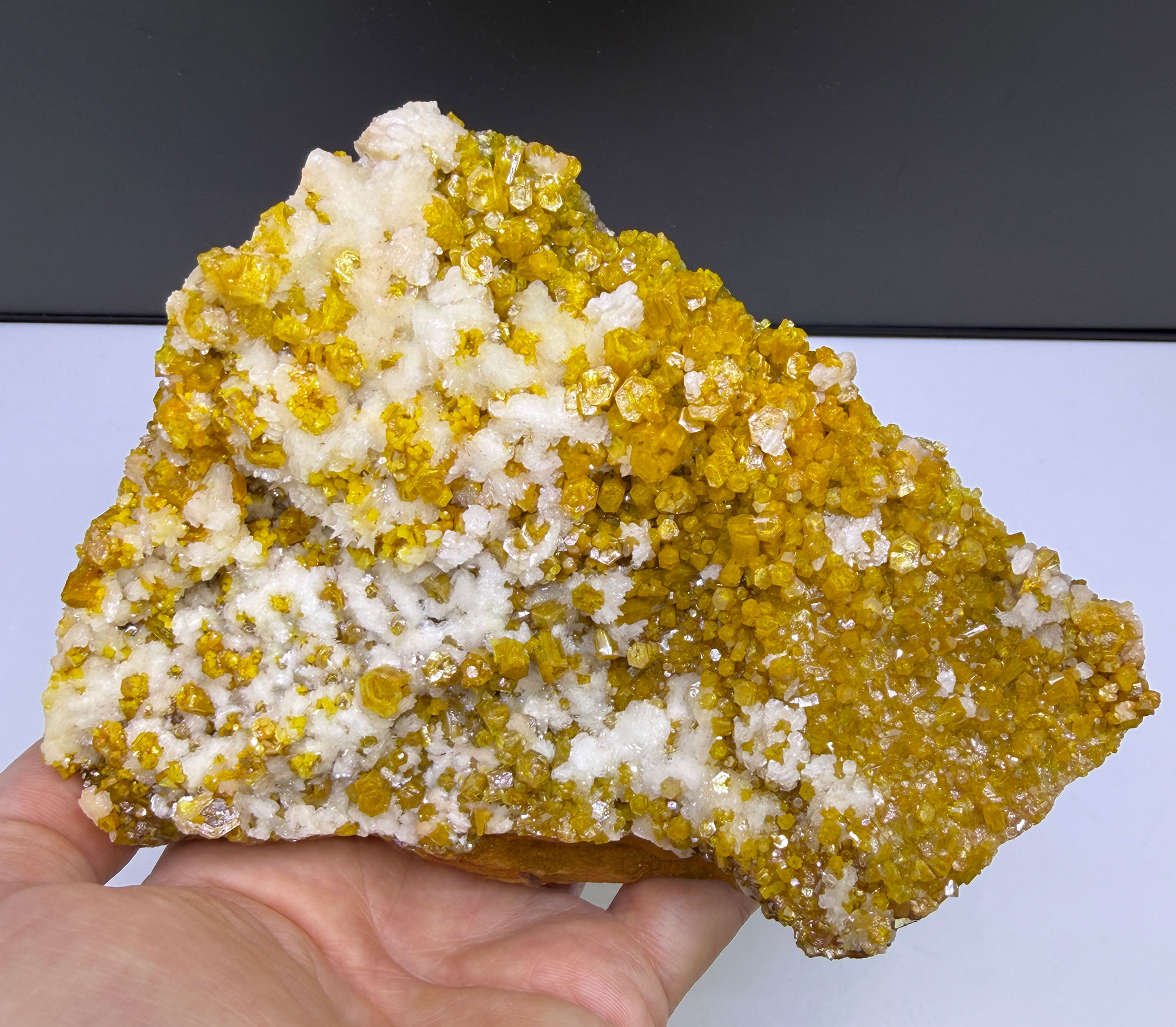
Mimetite partly overgrown by aggregates of twinned cerussite crystals.
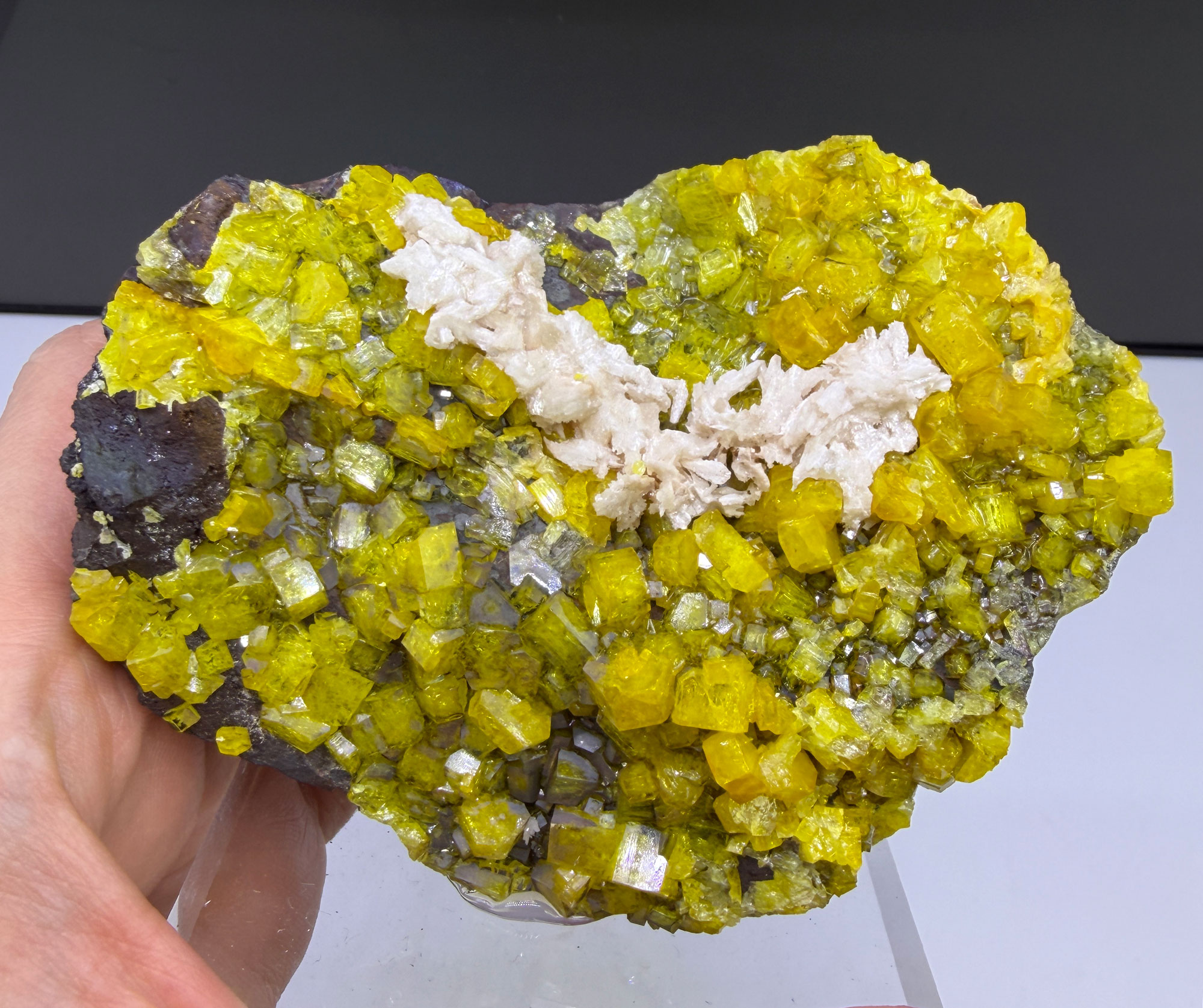
Mimetite with aggregates of cerussite.
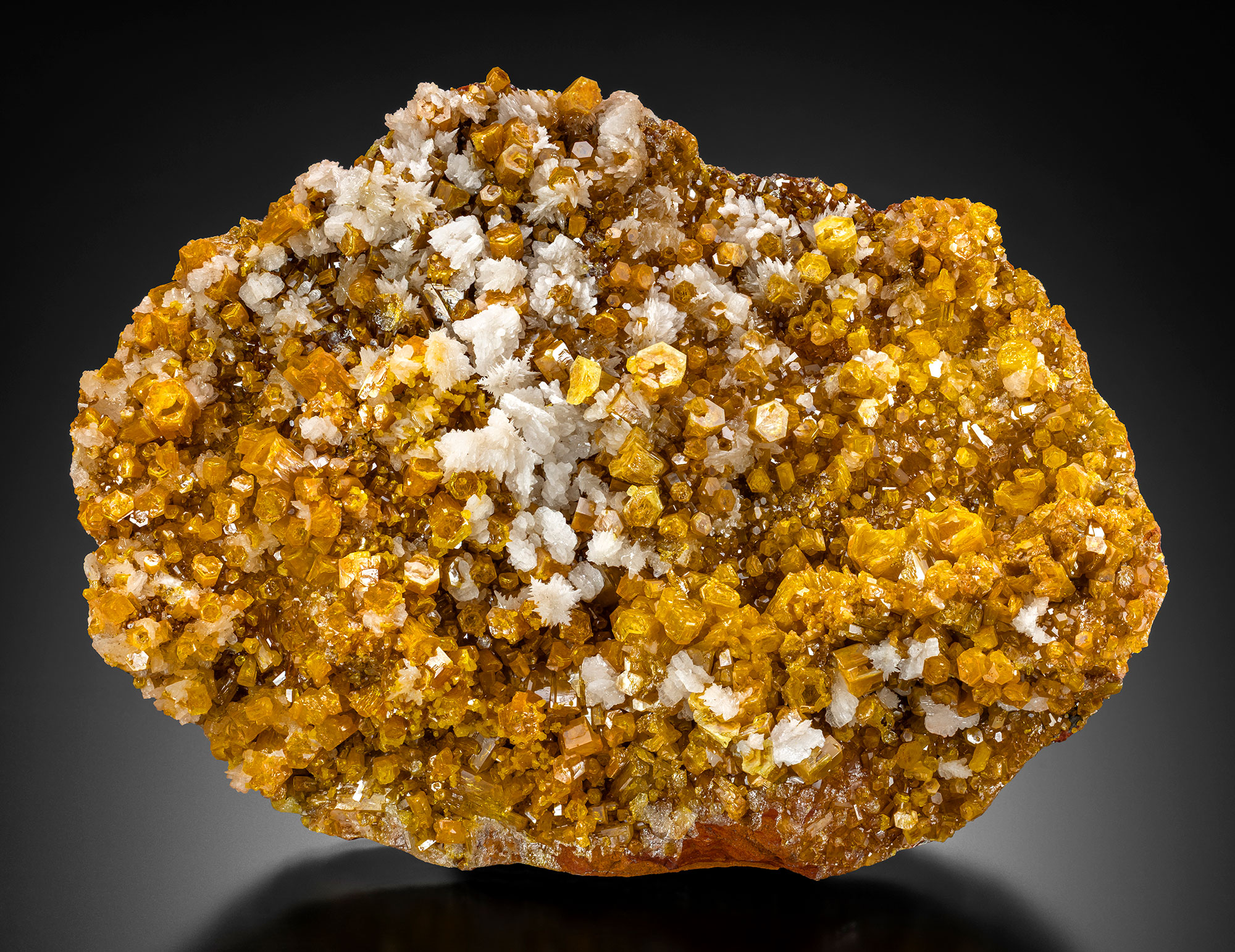
Specimen with hopper mimetite crystals and twinned cerussite crystals. Size 13,5 cm. Photo by László Kupi.
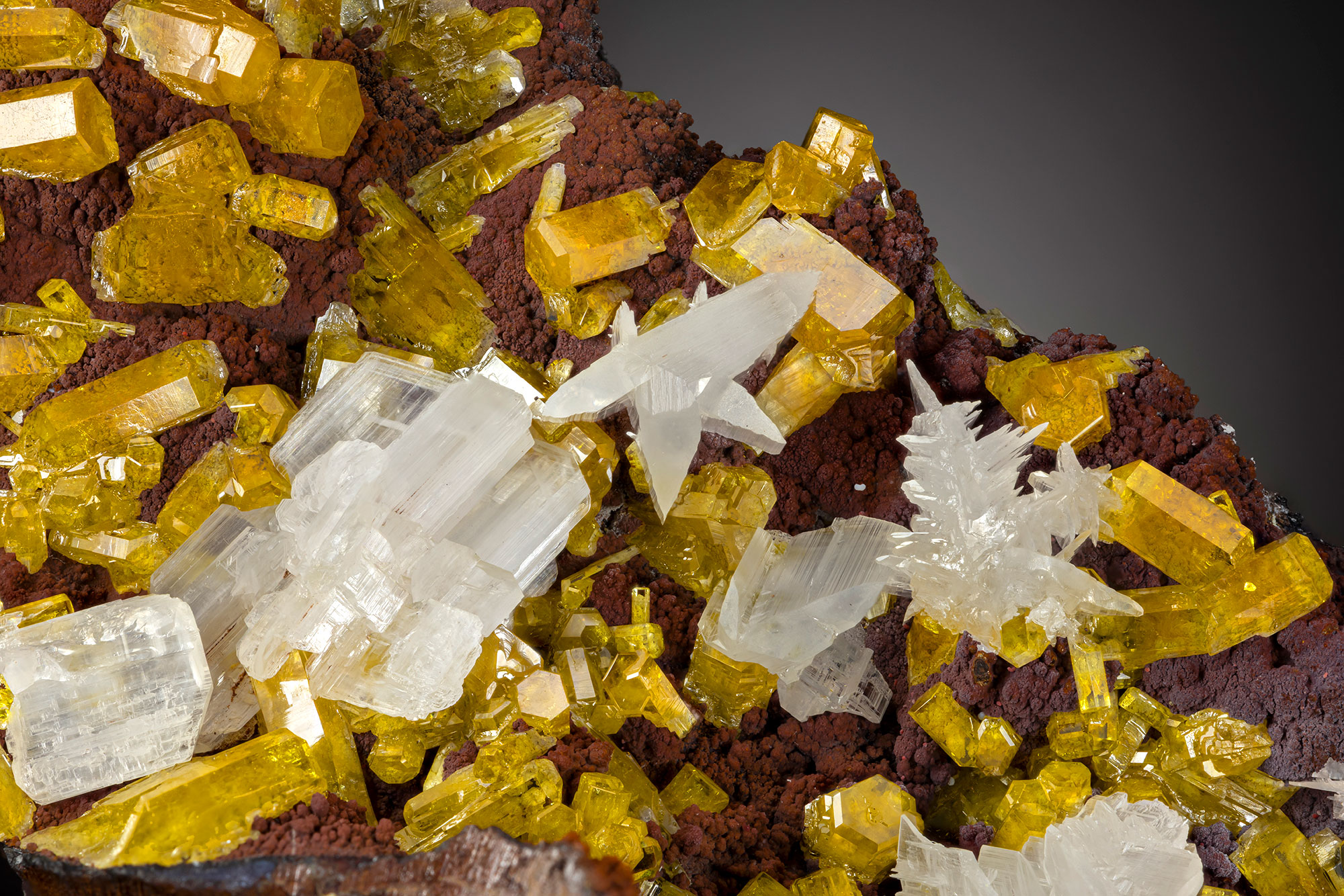
Close-up of the specimen with mimetite and twinned cerussite crystals. FOV 4 cm. Photo by László Kupi.
Video of the specimen showing twinned cerussite crystals growing on mimetite.
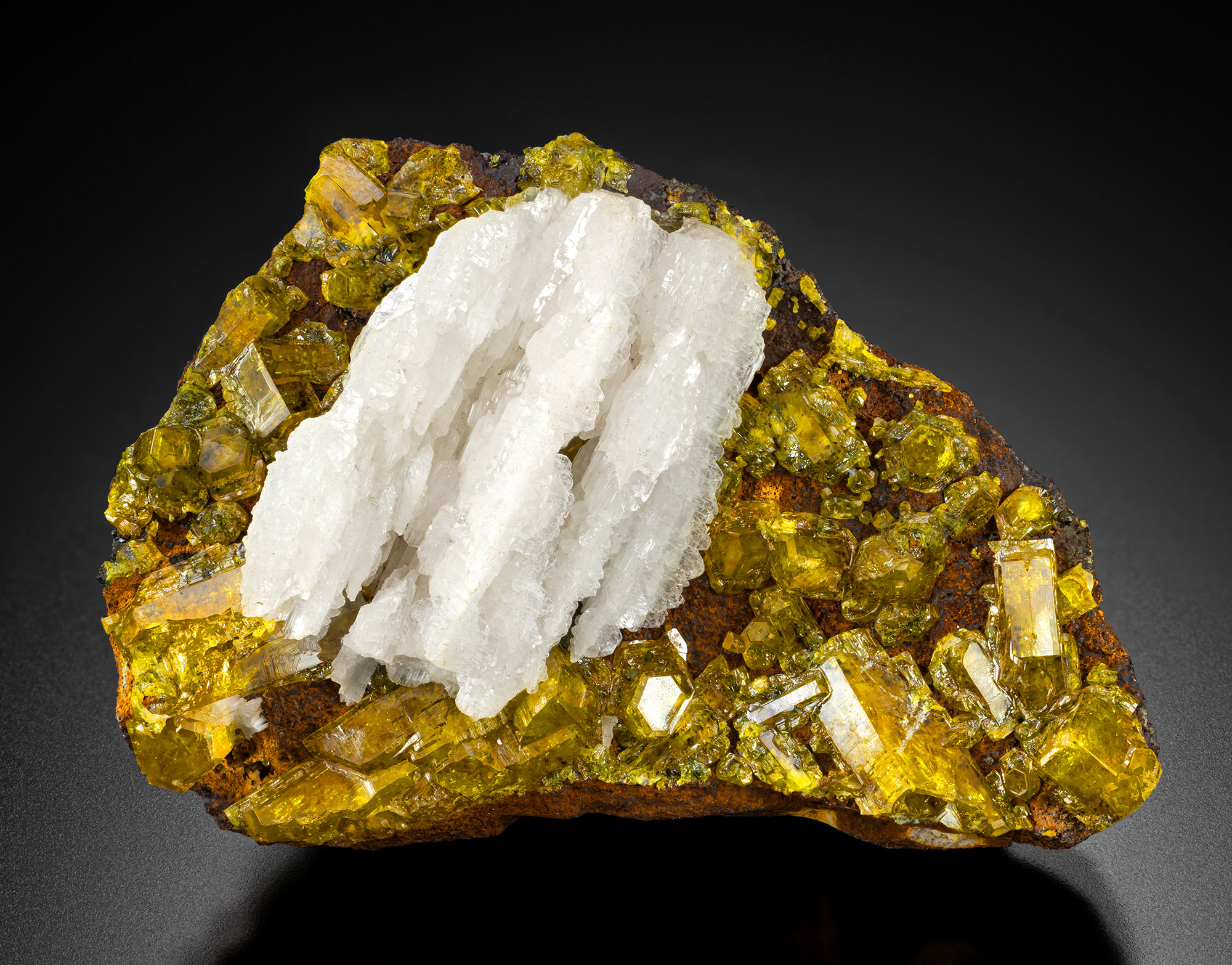
Complex twinned cerussite growing on mimetite. Size 3.6 cm. Photo by László Kupi.
,-Mfouati,-Mfouati-District,-Bouenza-Department,-Republic-of-the-Congo_30x20x15mm.jpg)
“Snowflake” twin of cerussite on matrix. Size 3 cm. Joanna Praszkier collection. Photo by László Kupi.
Clay minerals
On some specimens, the matrix between mimetite crystals is coated with a white, earthy crust. At an early stage, this material was thought to be hydrozincite, which would be a reasonable in such a mineral assemblage. Unfortunately, further analyses did not confirm this hypothesis, revealing the white “powder” to be just clay minerals. Nevertheless, these coatings provide an attractive visual contrast to the other species on some specimens.
Duftite PbCu(AsO4)(OH)
Duftite is a relatively common species occurring at many localities worldwide. It is almost always present as microcrystalline “dust,” thin coatings, or botryoidal aggregates. Well-formed crystals visible to the naked eye are practically unknown for this species. The presence of sharp, well-developed automorphic duftite crystals at the Mimetite Bonanza find in Yanga Koubenza is therefore one of the features that makes this find special.
Crystals of duftite from the mimetite zone display a habit known from microcrystals of the species – pseudo-octahedral, slightly elongated, with gently curved faces. The largest well-formed crystals from the find reach up to 4 mm in size, which is exceptionally large for the species. These crystals are nearly black, with dark olive-green highlights, whereas smaller crystals are noticeably lighter in color, showing more vivid green shades.
The best of the well-developed duftite crystals from the mimetite zone in Yanga Koubenza are consistently associated with the tabular morphotype of yellow to orange mimetite. Duftite crystals grow either directly on the matrix or on mimetite crystals. Coatings of smaller duftite crystals are also frequently associated with some gem-quality mimetites and other morphotypes. A few specimens were also observed in which well-formed duftite crystals are completely enclosed within mimetite.
Less crystallographically distinct duftite occurs mainly as inclusions within certain complex mimetite crystals, imparting a green coloration to them.
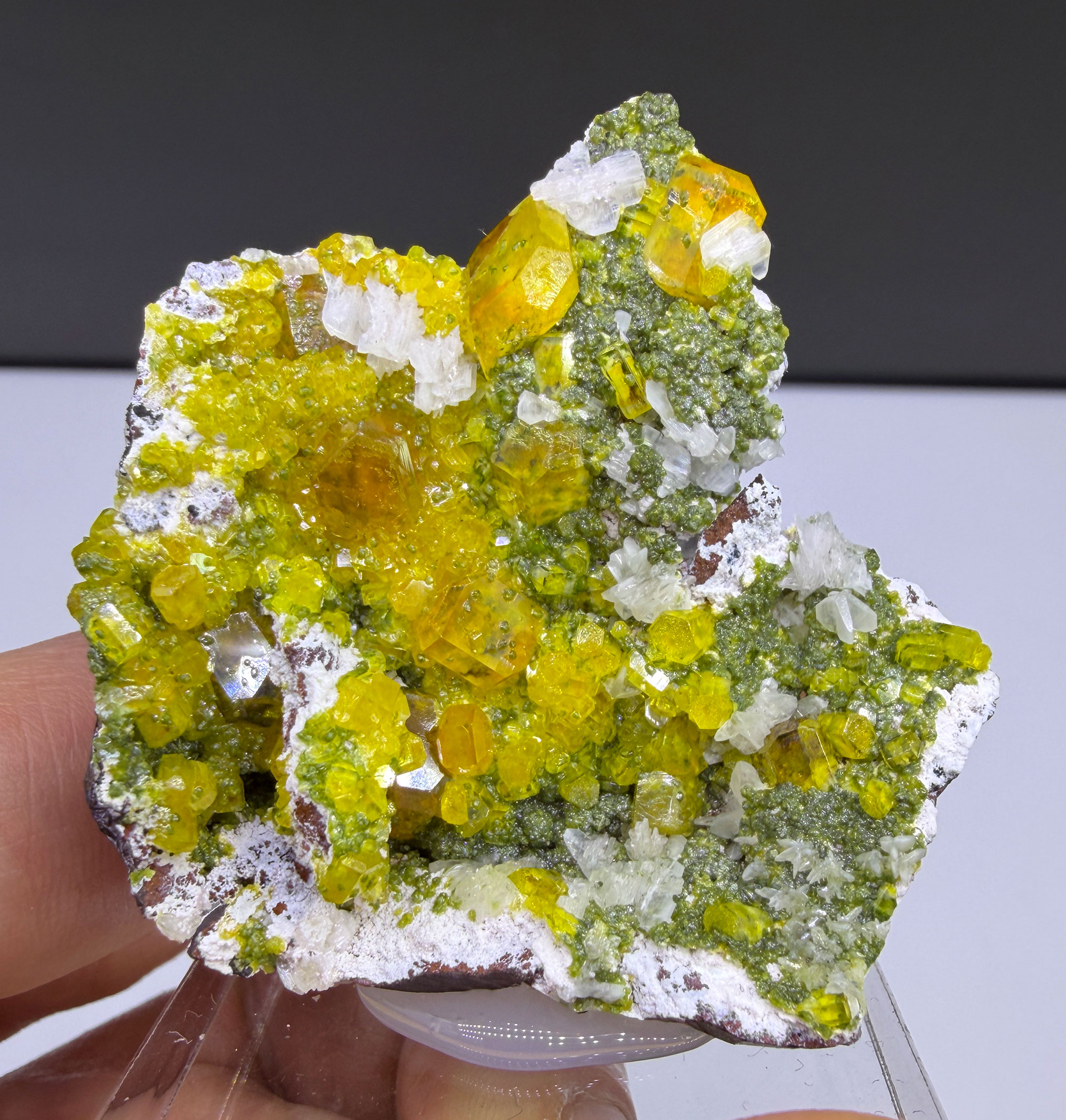
Specimen of mimetite with duftite and twinned cerussites. Size 5.5 cm.
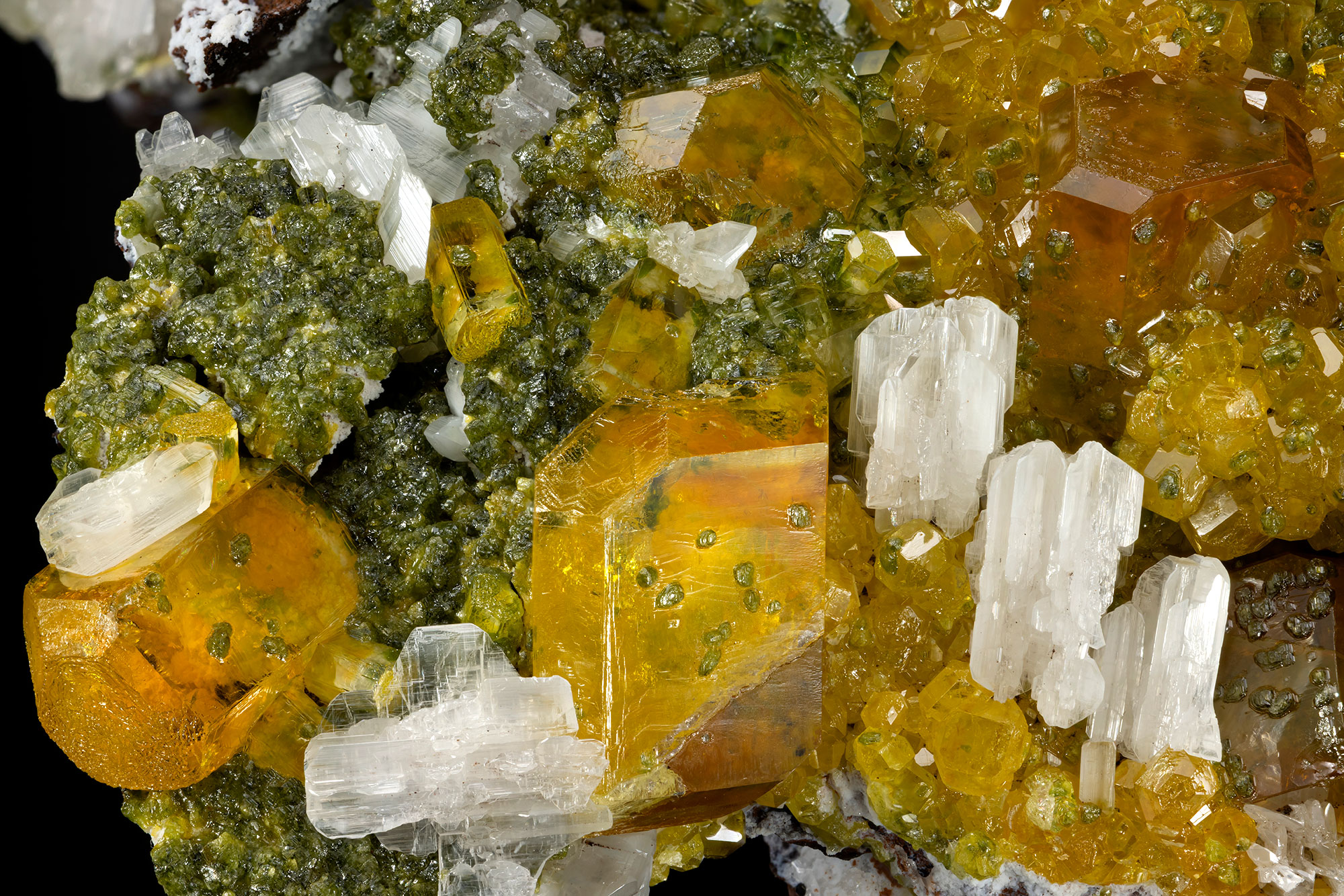
Close-up of the specimen shown above, showing duftite growing on mimetite associated with twinned cerussite crystals. FOV 3 cm. Photo by László Kupi.
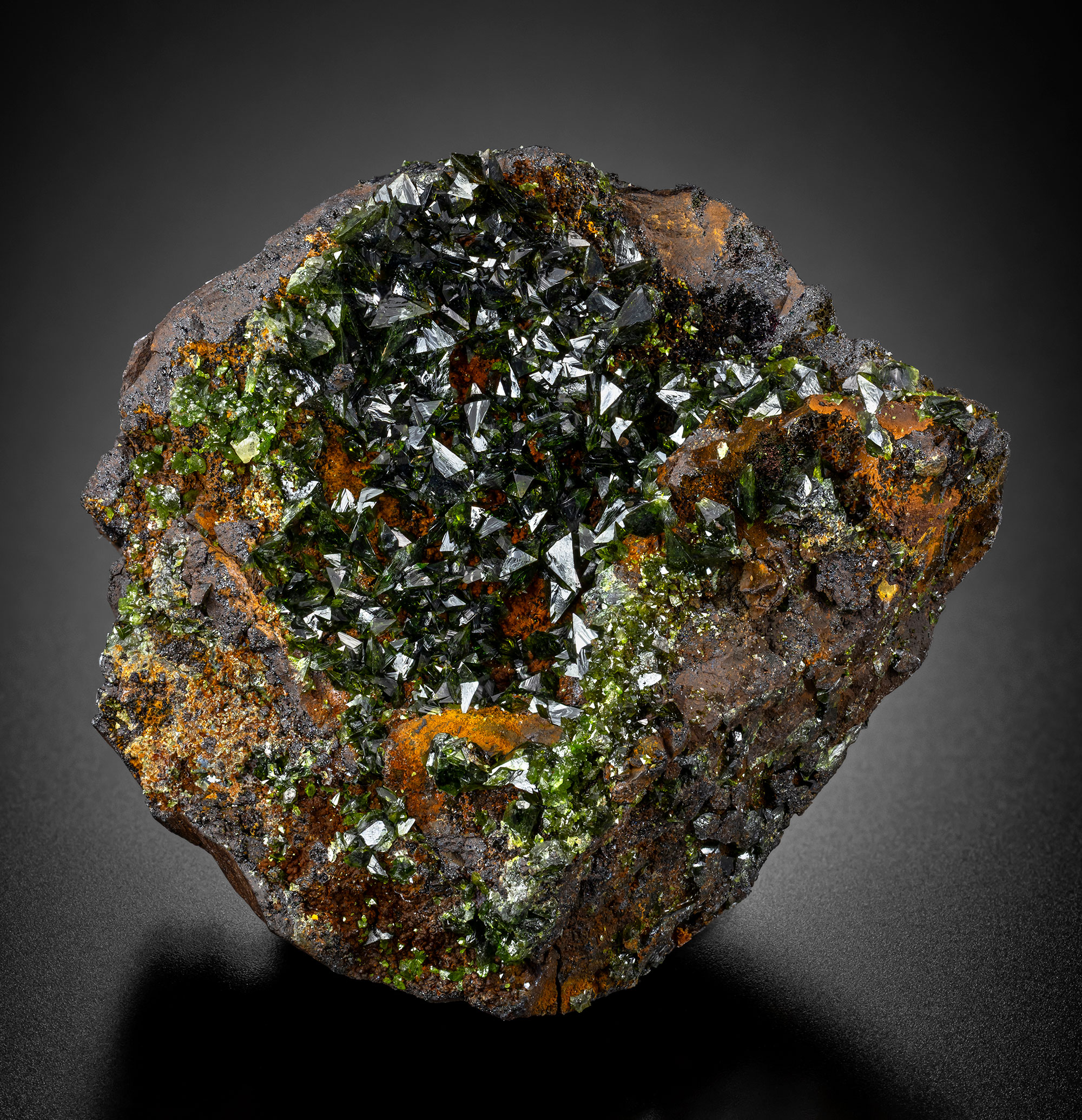
Specimen with unusually large duftite crystals for the species. Size 3.5 cm. Photo by László Kupi.
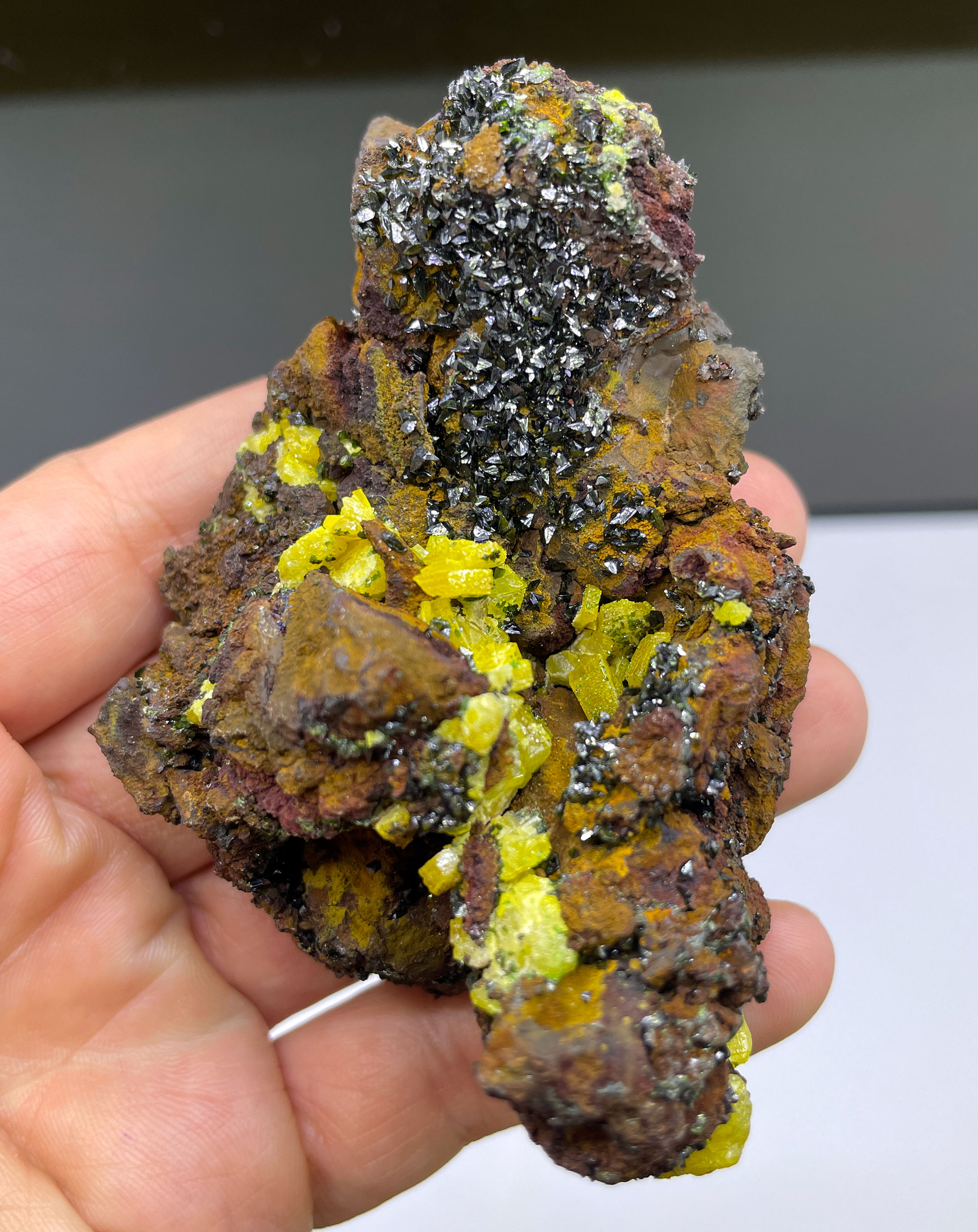
Specimen with unusually large duftite crystals for the species, associated with yellow mimetite. MIM Museum collection.
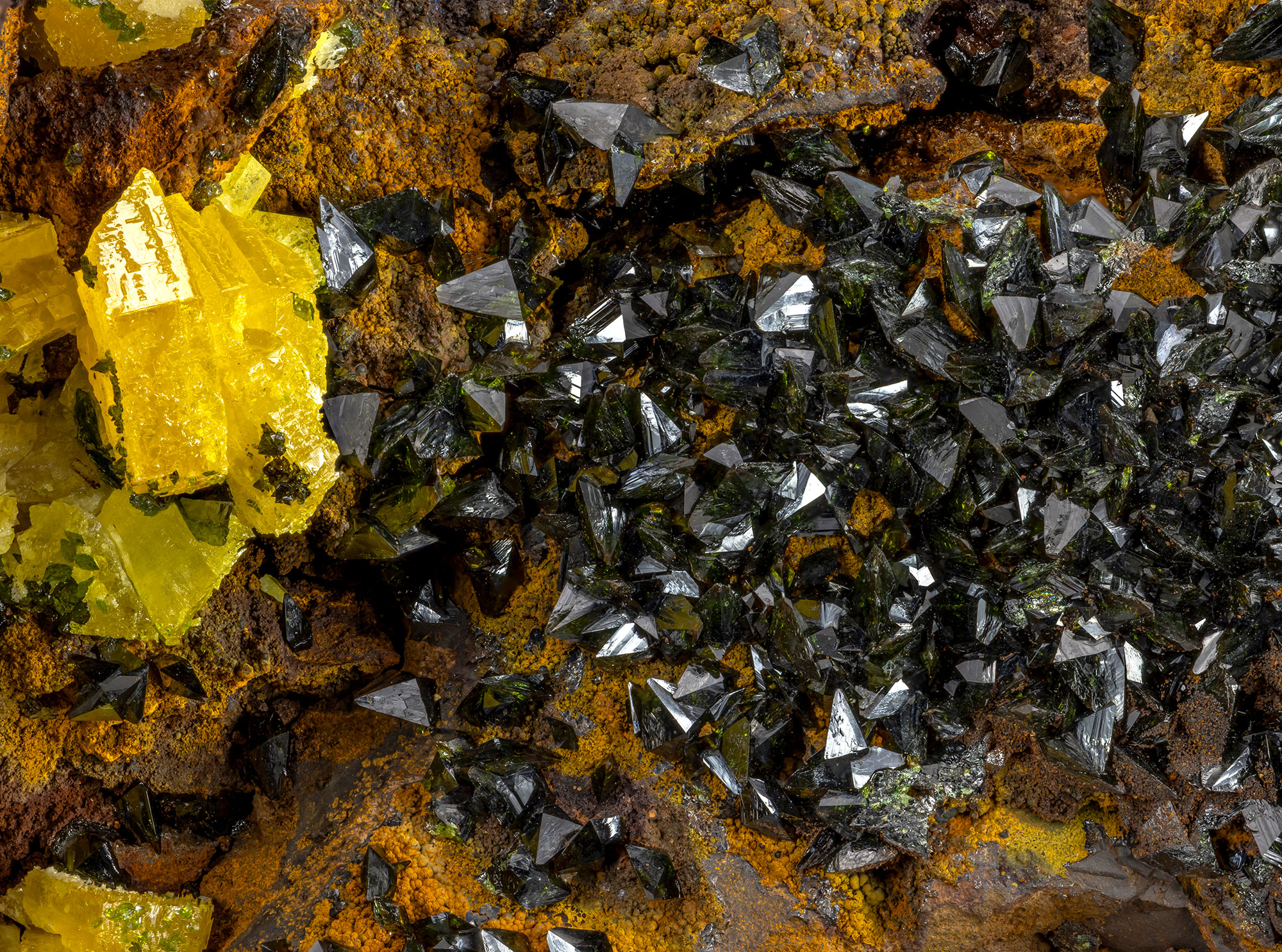
Close-up of the specimen shown above, with duftite crystals associated with yellow mimetite. FOV 3.5 cm. Photo by László Kupi.
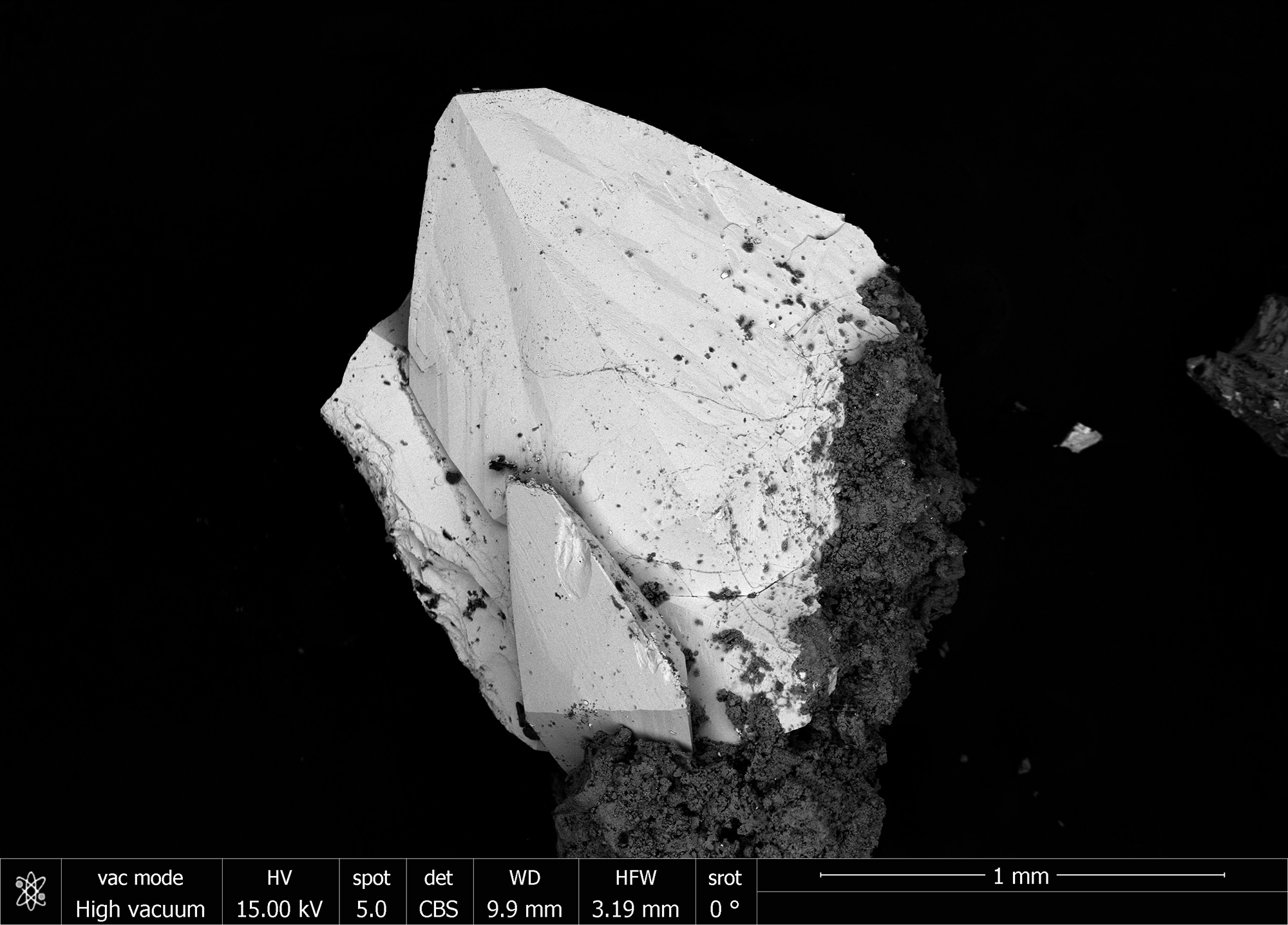
Scanning electron microscope image of a duftite crystal.
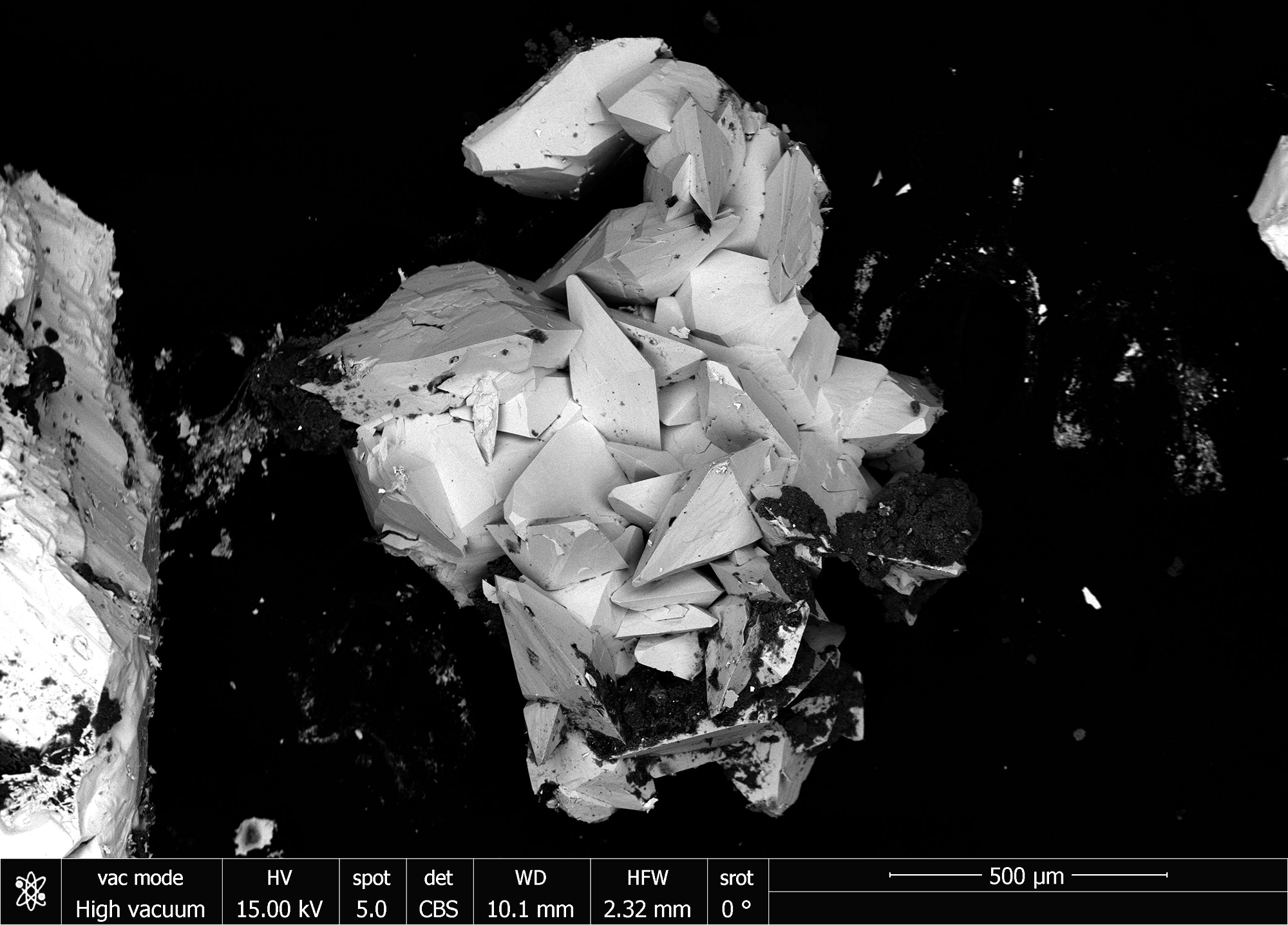
Scanning electron microscope image of a duftite crystals.
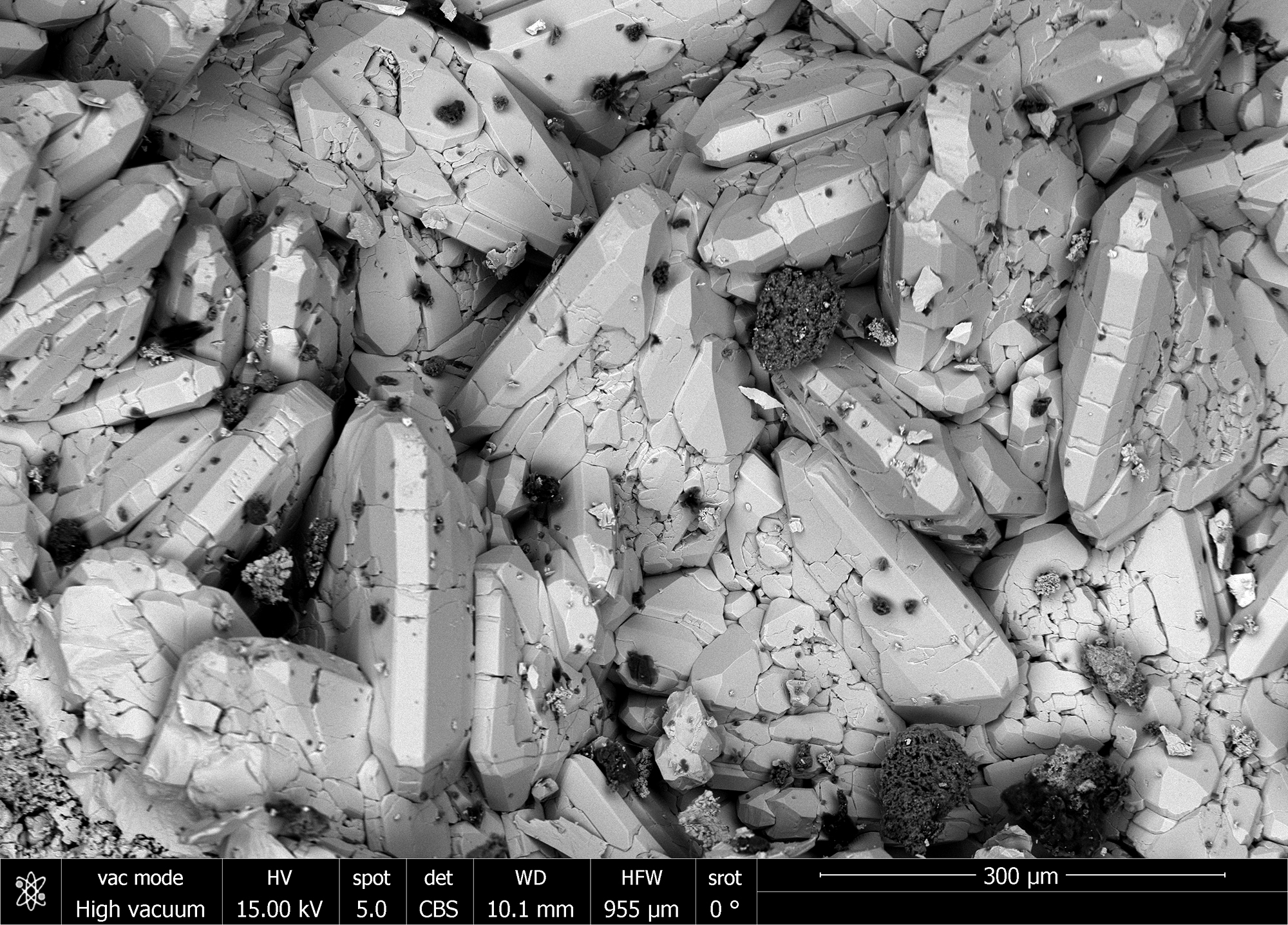
Scanning electron microscope image of a duftite crystals.
Mimetite Pb5(AsO4)3Cl
Mimetite is a species known from several localities in the Republic of the Congo, being even abundant in some of them. However, it was reported from the Yanga Koubenza quarry for the first time during the “Mimetite Bonanza” find. As far as is known, its occurrence there is restricted to a single, small zone within the mine.
Probably the most important feature of the “Mimetite Bonanza” find, which distinguishes it from all other occurrences of this species worldwide, is the extraordinary diversity of crystal habits—expressed in crystal shapes and colors—as well as associations with other rare minerals.
A detailed description of all observed variations would exceed the intended scope of this text; therefore, the author has chosen to generalize and focus on the most important features.
From a collector’s point of view, perhaps the most exciting aspect of the find is the presence of well-sized, completely gem, flawless, and well-formed mimetite crystals. Prior to this discovery, such material was known from only a single occurrence worldwide—the so-called “Gem Pocket” from the Tsumeb mine, Namibia. Gem mimetites from Yanga Koubenza ranges in size from a few millimeters up to 2 cm. These crystals are typically perfectly transparent, completely flawless, and exhibit excellent luster.
Their colors vary widely, from vivid orange and orange-yellow through bright yellow to yellowish-green. Most of the gem crystals display pyramidal faces on the terminations (in addition to the dominant pinacoid), a feature uncommon among other habits observed in the find. Crystals of this type are typically short prismatic to tabular, with the pinacoid strongly dominating over the prism faces.
In some cases, the crystals are so transparent that the matrix is visible through them, and a few specimens exhibit well-defined internal phantoms. Gem-quality mimetite crystals are frequently associated with duftite and, more rarely, with cerussite.
Only a very small number of high-quality gem mimetite specimens were recovered, with the vast majority being heavily damaged. Nevertheless, the exceptional quality of the material provided what is probably the first opportunity ever to produce faceted mimetite gemstones. These cut stones were prepared by William Kosnar of Mineral Classics; the largest exceed 1 ct and display an outstanding yellow color.
Other mimetite morphotypes from the find show a wide diversity of forms and colors. The most common colors range from reddish-brown through reddish-orange and yellowish-orange to strong yellow, pale yellow, and green. Overall, the coloration is strong and vivid.
Crystal habits vary from strongly elongated prismatic, almost acicular forms, through dominant short prismatic crystals, to quite common thin tabular. They usually display only prism and pinacoid faces, with small pyramidal faces occurring more rarely. The crystals can be grouped in a wide variety of aggregate styles, including drusy coatings, rosettes (restricted to tabular habits), and isolated individual crystals scattered on matrix.
Mimetite crystals from the find also exhibit numerous growth features. Relatively common are classic hopper crystals (characteristic of the species), showing various degrees of skeletal development. Some hopper crystals also display scepter growth, where a second generation of more gem mimetite overgrows the termination of an earlier crystal. Additional growth features observed on some specimens include split growth, parallel growth, and particularly noteworthy dendritic growth, which is both unusual for the species and worthy of special attention.
Dendritic aggregates of mimetite occur occasionally as isolated, small, flat growths on the matrix, characterized by distinct dendritic branching. Much more frequently, however, dendritic growth develops around larger crystals. In most cases, these larger crystals are surrounded by an aureole of a very thin, often translucent layer of secondary mimetite. This phenomenon occurs in several mimetite morphotypes, both on “clean” matrix and on drusy duftite.
In the analyzed material, at least two generations of mimetite are present, which may occur together as scepter growth or as dendritic aureoles surrounding more typical crystals. Additionally, two generations can be observed in relation to philipsbornite: in some specimens, philipsbornite partially covers older mimetite crystals and, within the same specimen, is itself overgrown by a younger generation of mimetite. So far, this relationship has been observed only in prismatic mimetite, with the younger generation typically yellow in color and the older generation orange. There are also specimens showing perimorphs after dissolved mimetite crystals, subsequently overgrown by a later generation of mimetite.
The younger generation is usually more gemmy in character.
It is also worth noting that both colors and crystal habits may vary significantly over very short distances within a single pocket.
Mimetite from the “Mimetite Bonanza” can be associated with all other mineral species present in the find, with the exception of pyromorphite. Among the most striking and highly valued specimens—besides the gem crystals—are yellow mimetites growing on intensely blue philipsbornite. Such combinations are unknown from any other locality worldwide.
Unfortunately, only a very small number of specimens featuring vivid blue philipsbornite with yellow mimetite were collected, and most were heavily damaged during recovery, resulting in trimming to much smaller pieces. In total, approximately 20 high-quality combination specimens were saved, including a few reaching or exceeding 10 cm in size.
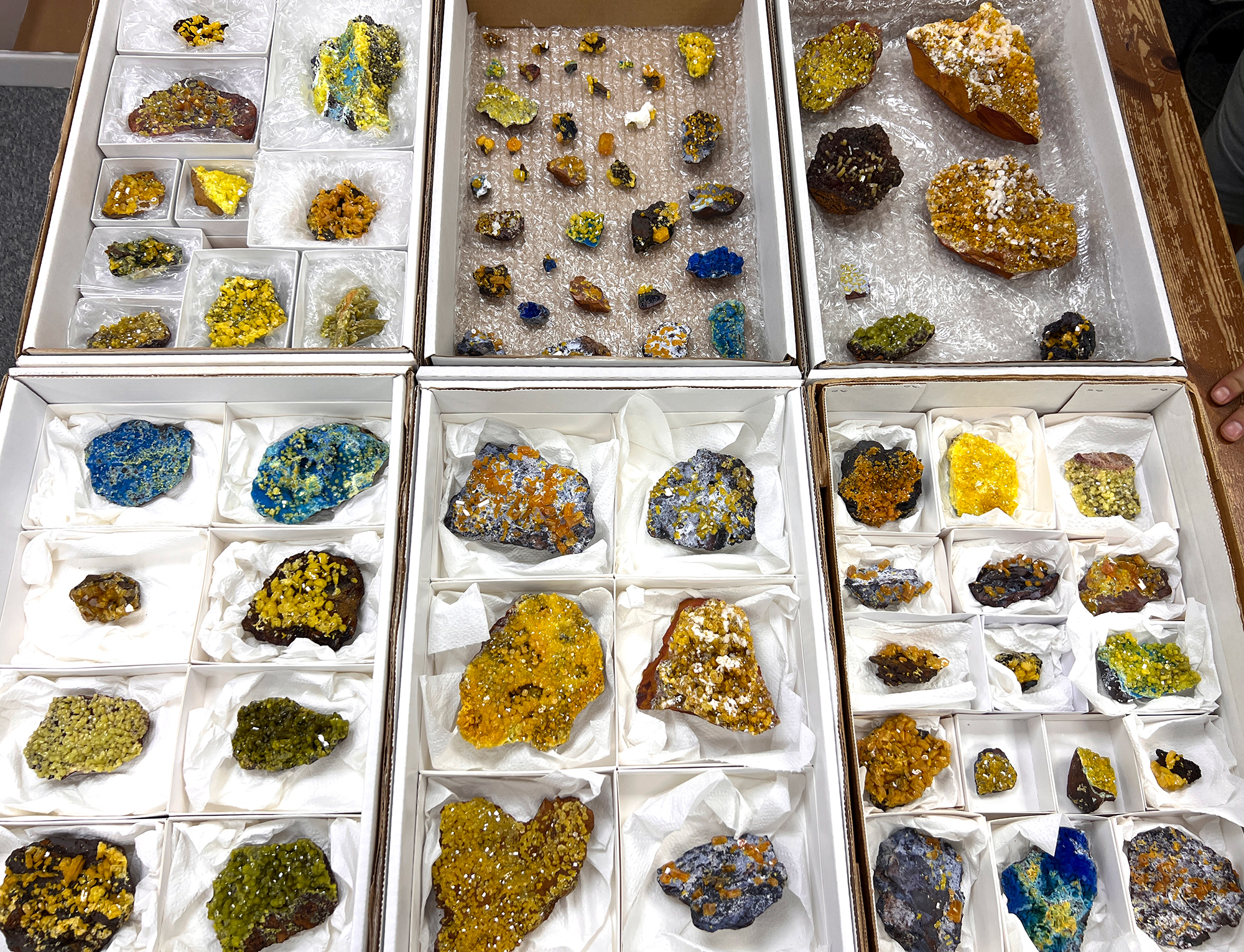
Mimetite from the find represents a very wide range of colors and crystal habits, unknown from other localities worldwide.
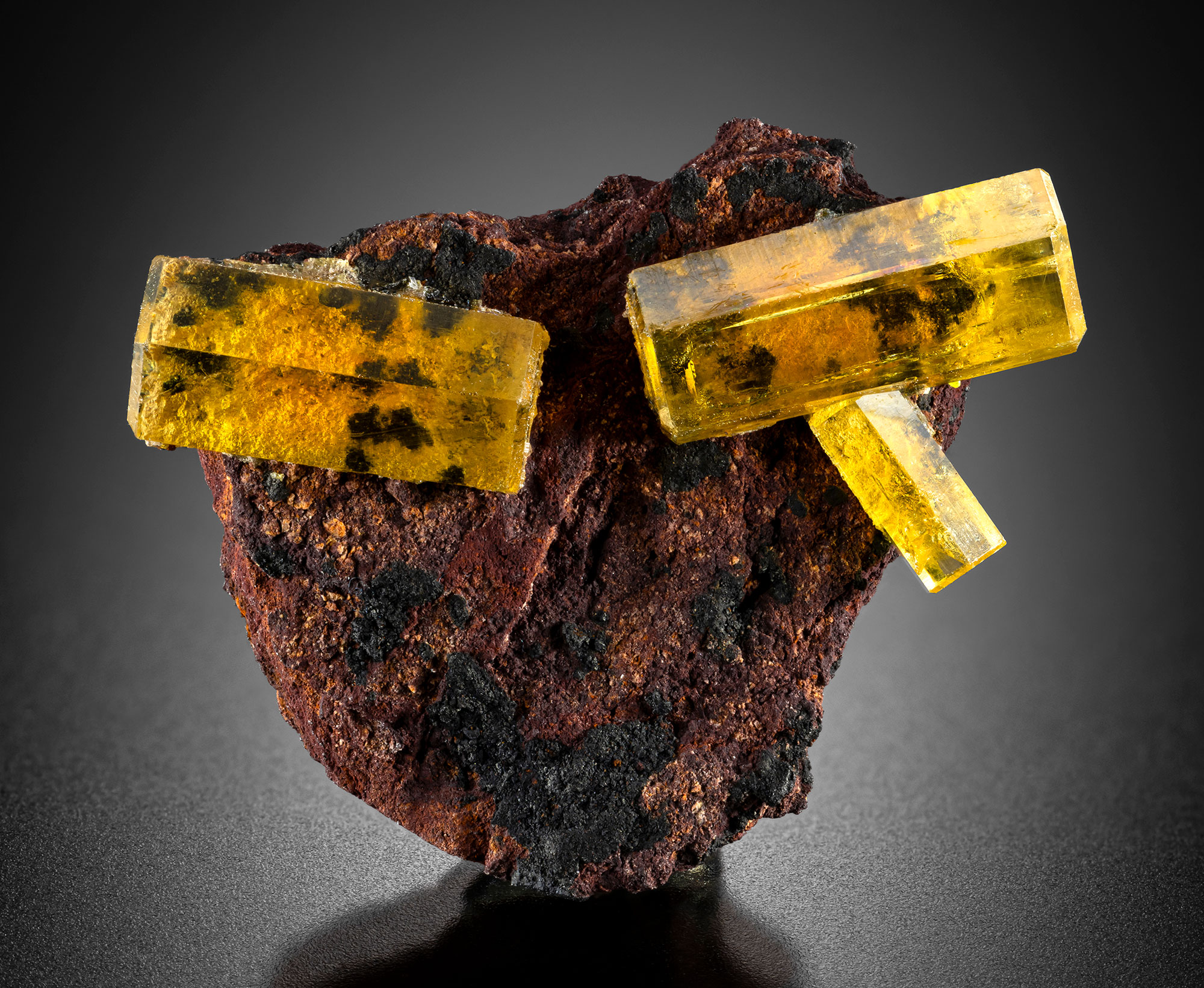
Probably the most prized specimens by collectors, featuring gem-quality mimetite crystals. Unfortunately, these were not numerous in the find, and most were not large.
Size 2 cm. Joanna Praszkier collection. Photo by László Kupi.
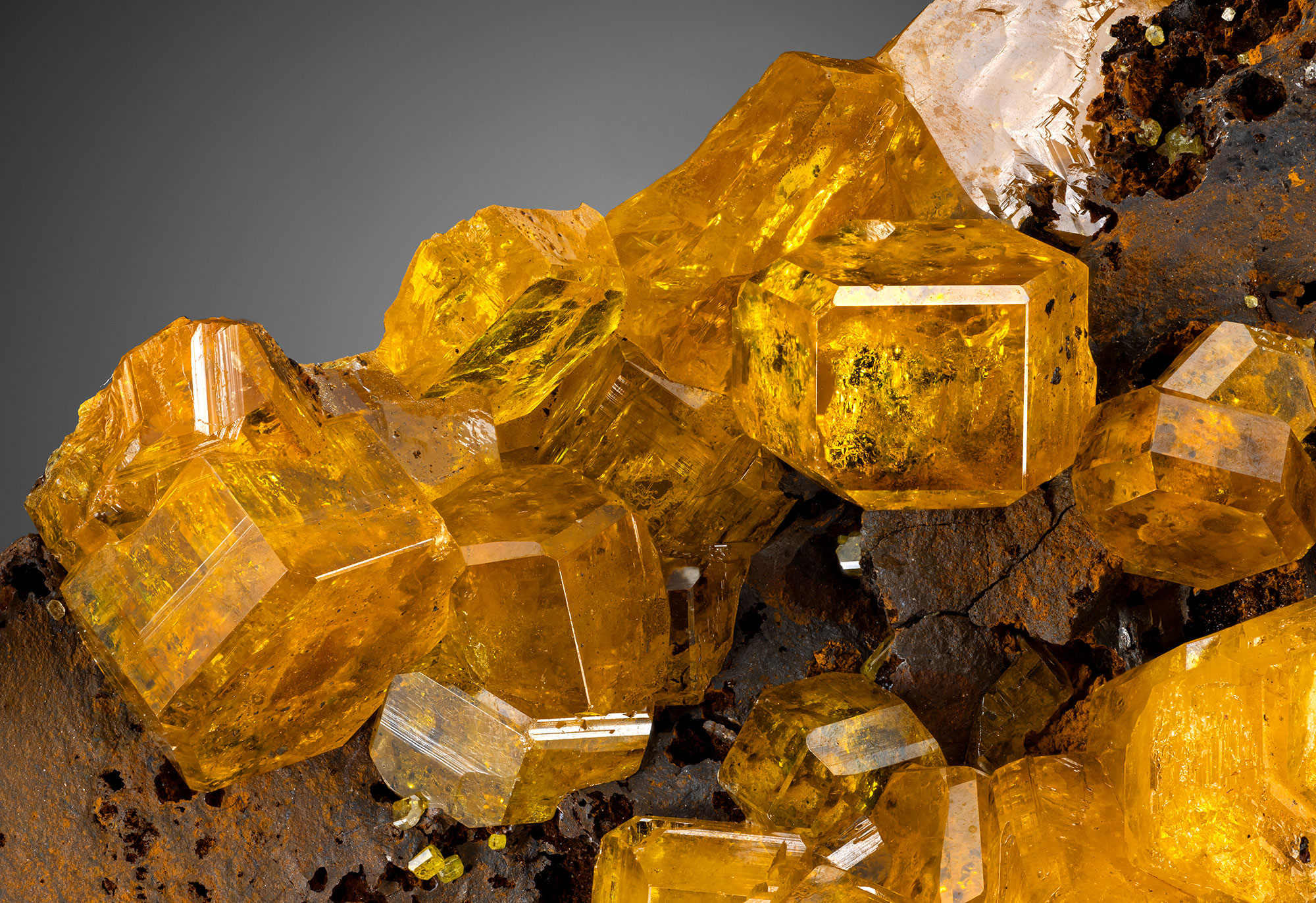
Close-up of the specimen with gemmy mimetite crystals. FOV 3.2 cm. Photo by László Kupi.
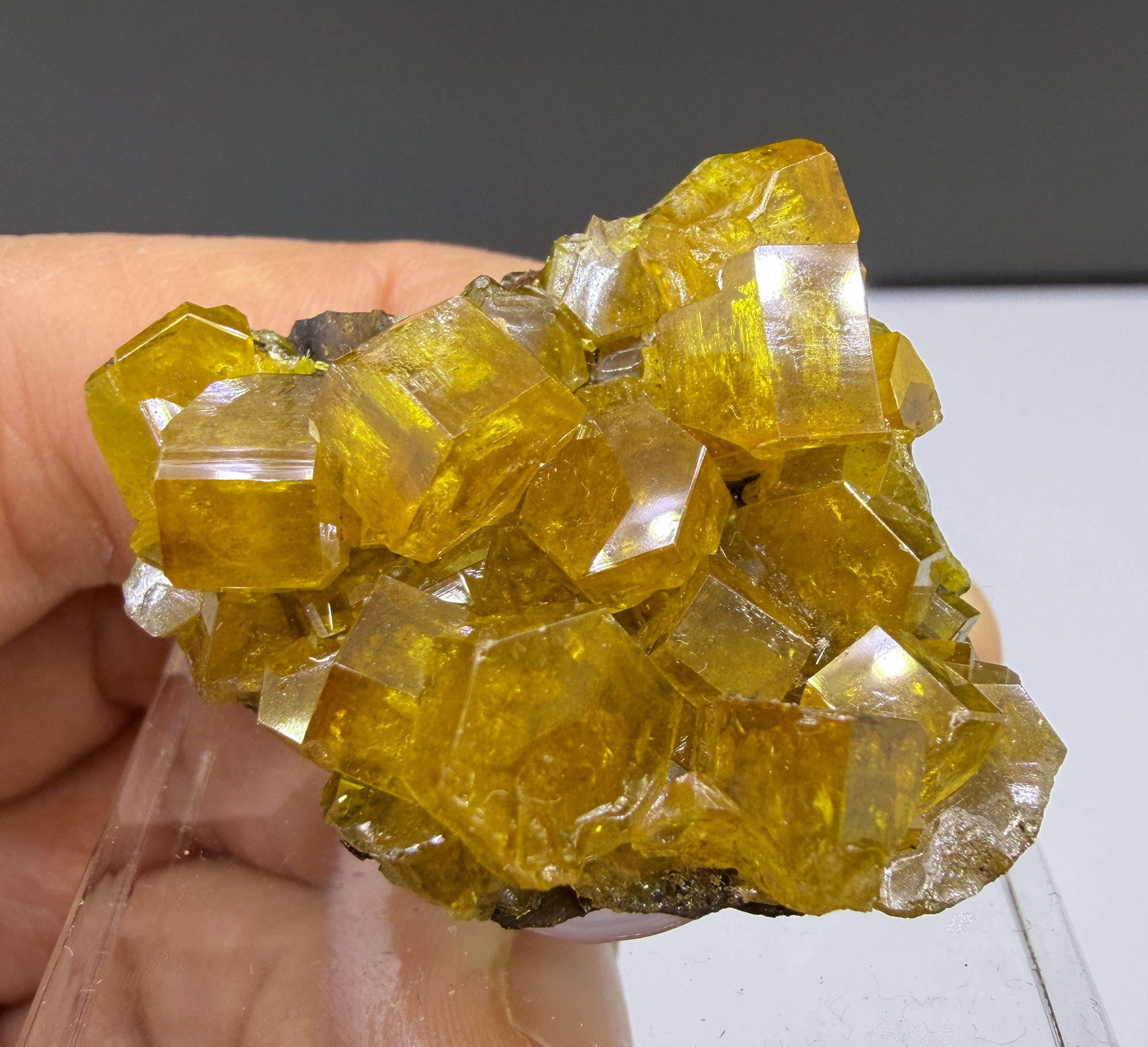
Mimetite specimen with gemmy crystals.
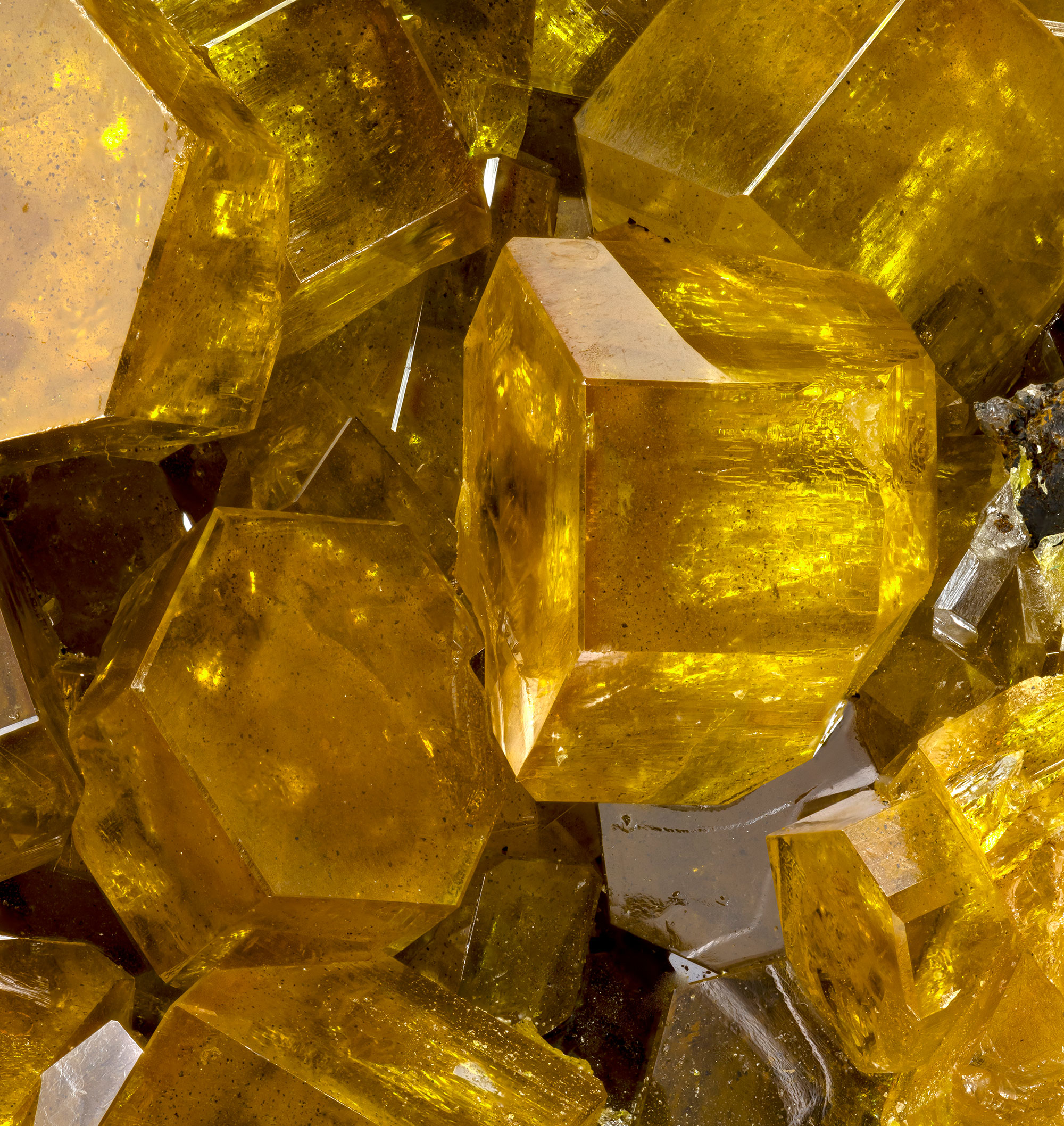
Close-up of the specimen shown above. FOV 2 cm. Photo by László Kupi.
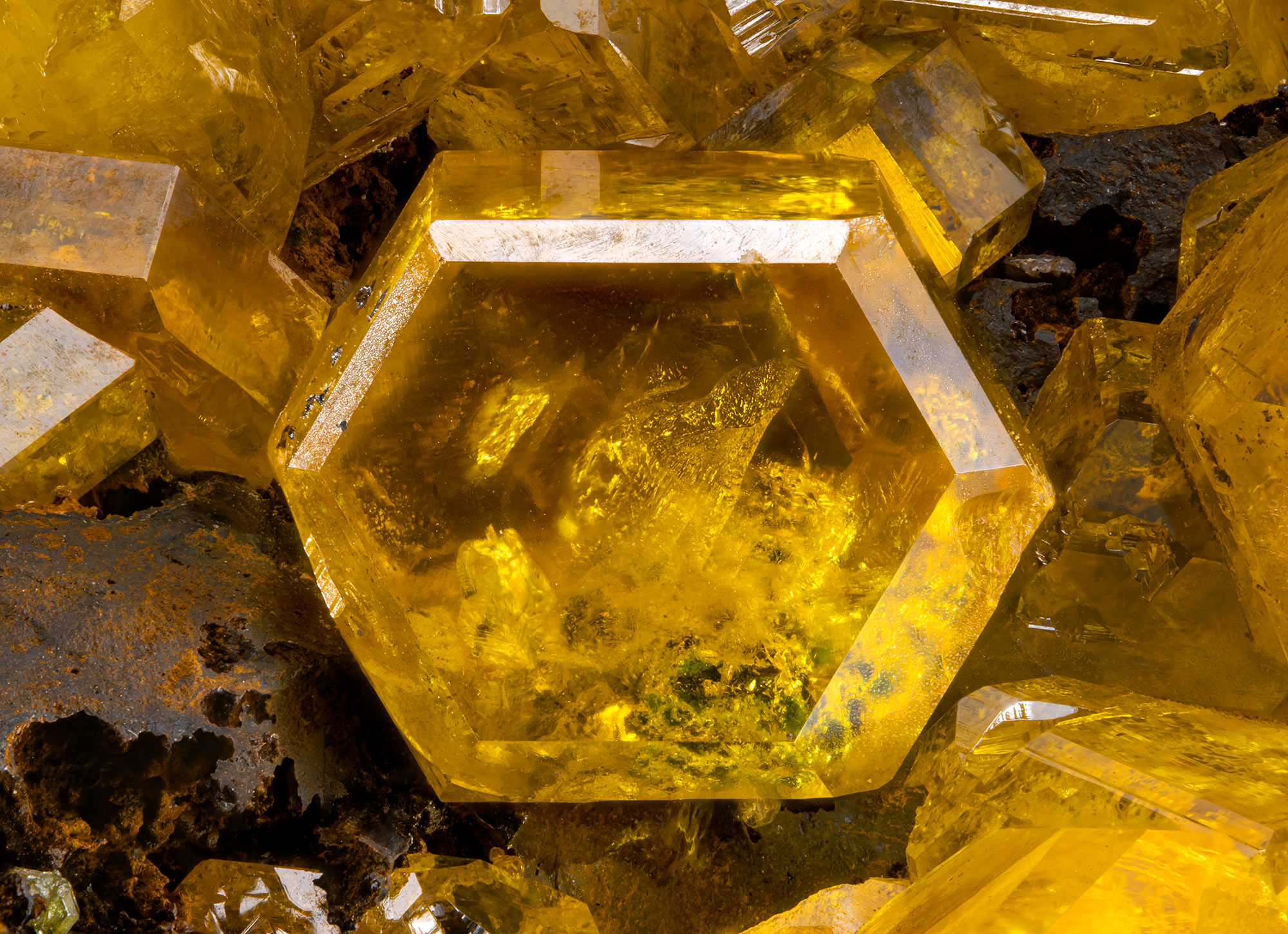
Close-up of another specimen with a gem mimetite crystal. Crystal size: 1.2 cm. Photo by László Kupi.
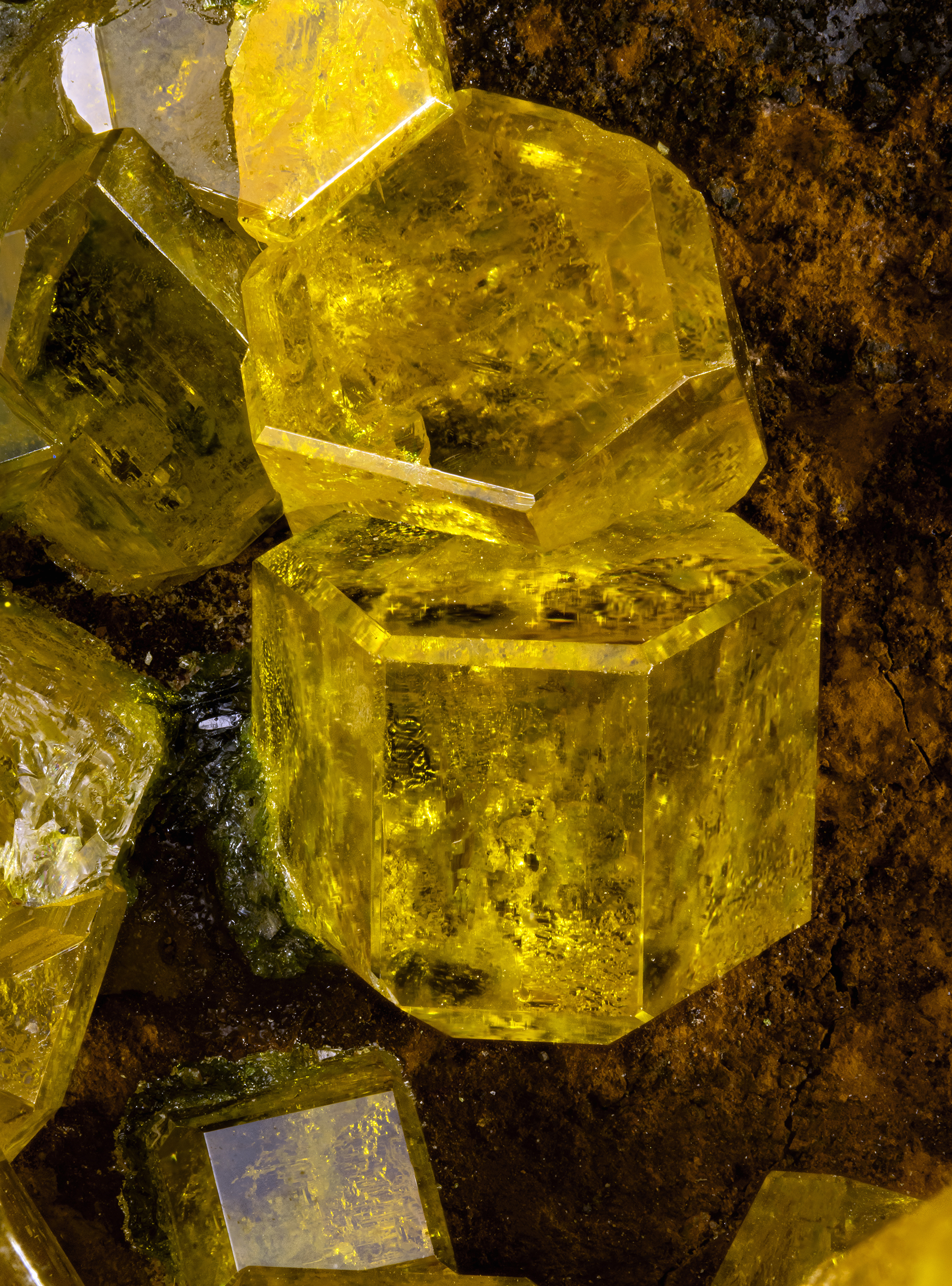
Close-up of a specimen with a gem mimetite crystals. FOV 2 cm. Photo by László Kupi.
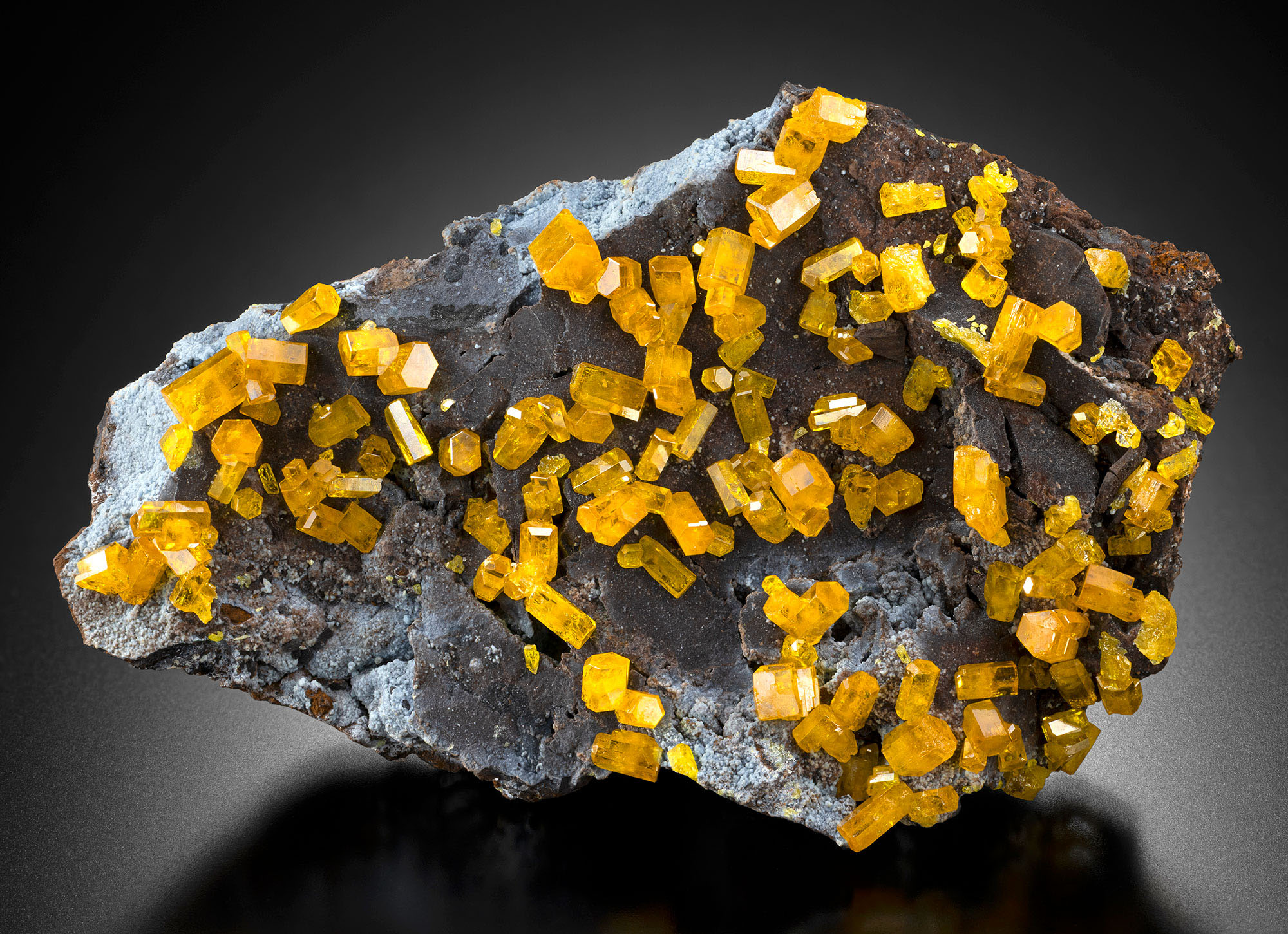
Specimen with a gem mimetite crystals. Size 5.4 cm. Photo by László Kupi.
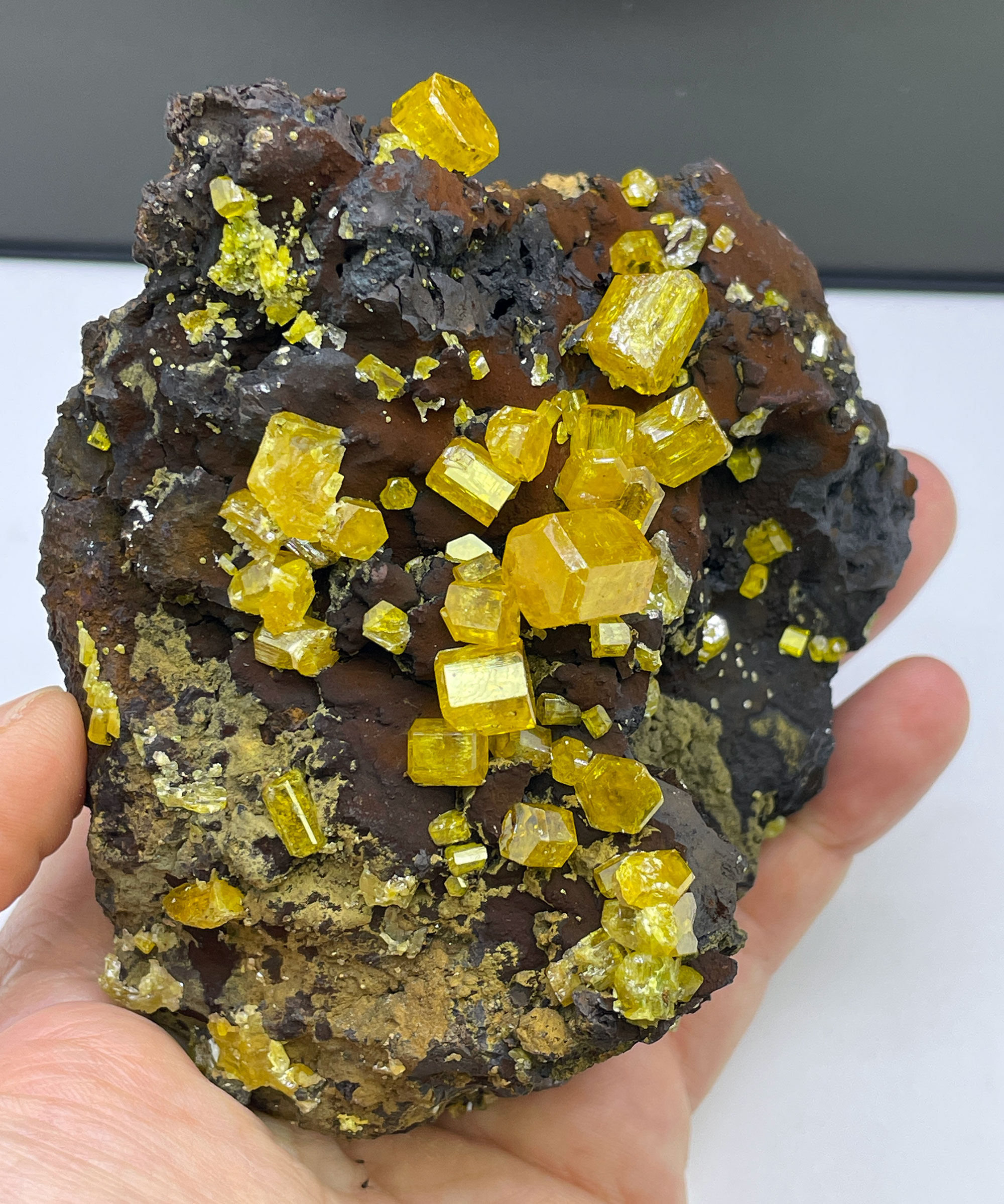
Specimen with gemmy mimetite crystals (before laboratory work).
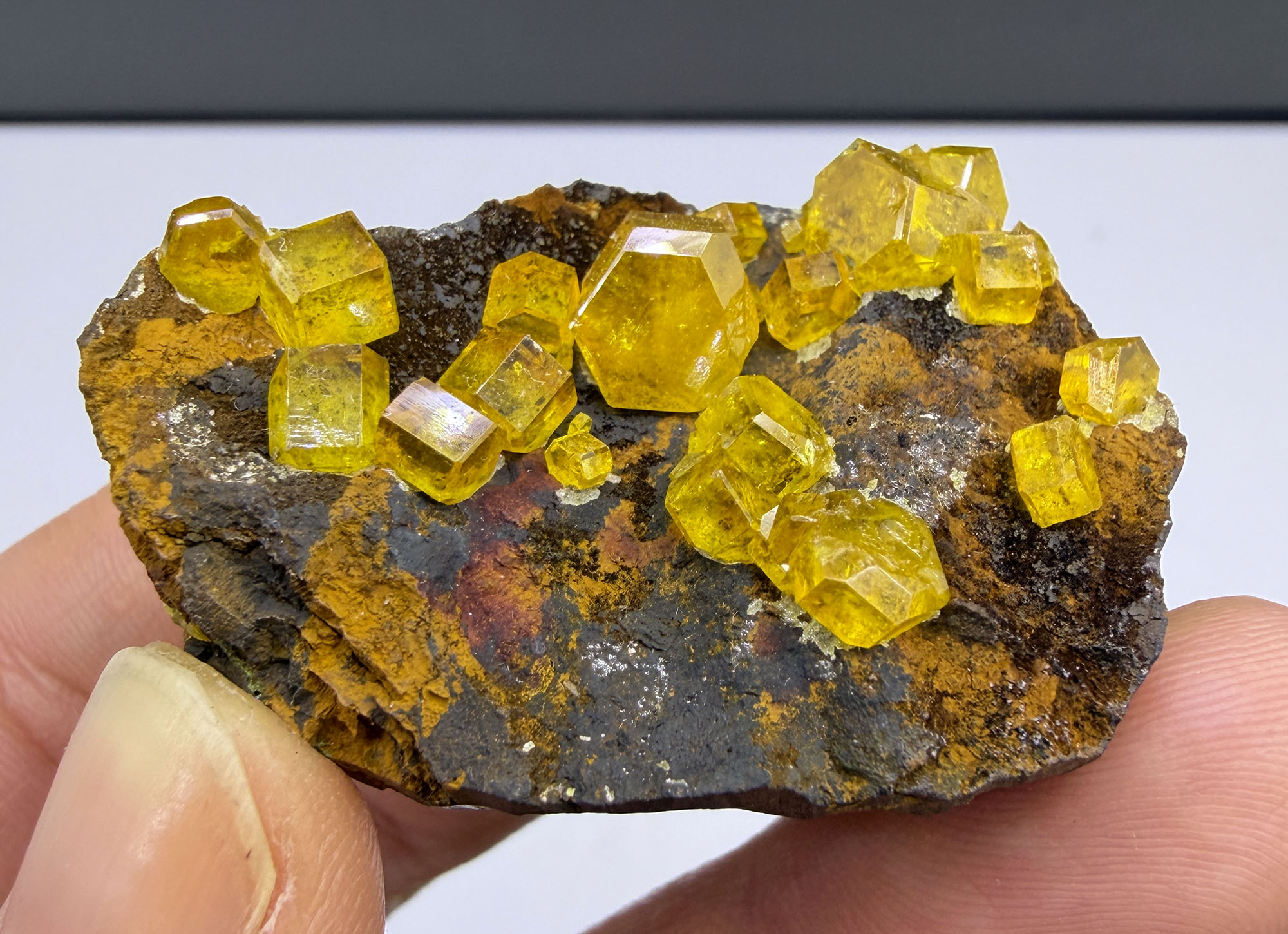
High-quality specimen with gemmy mimetite crystals. Size 4.4 cm.
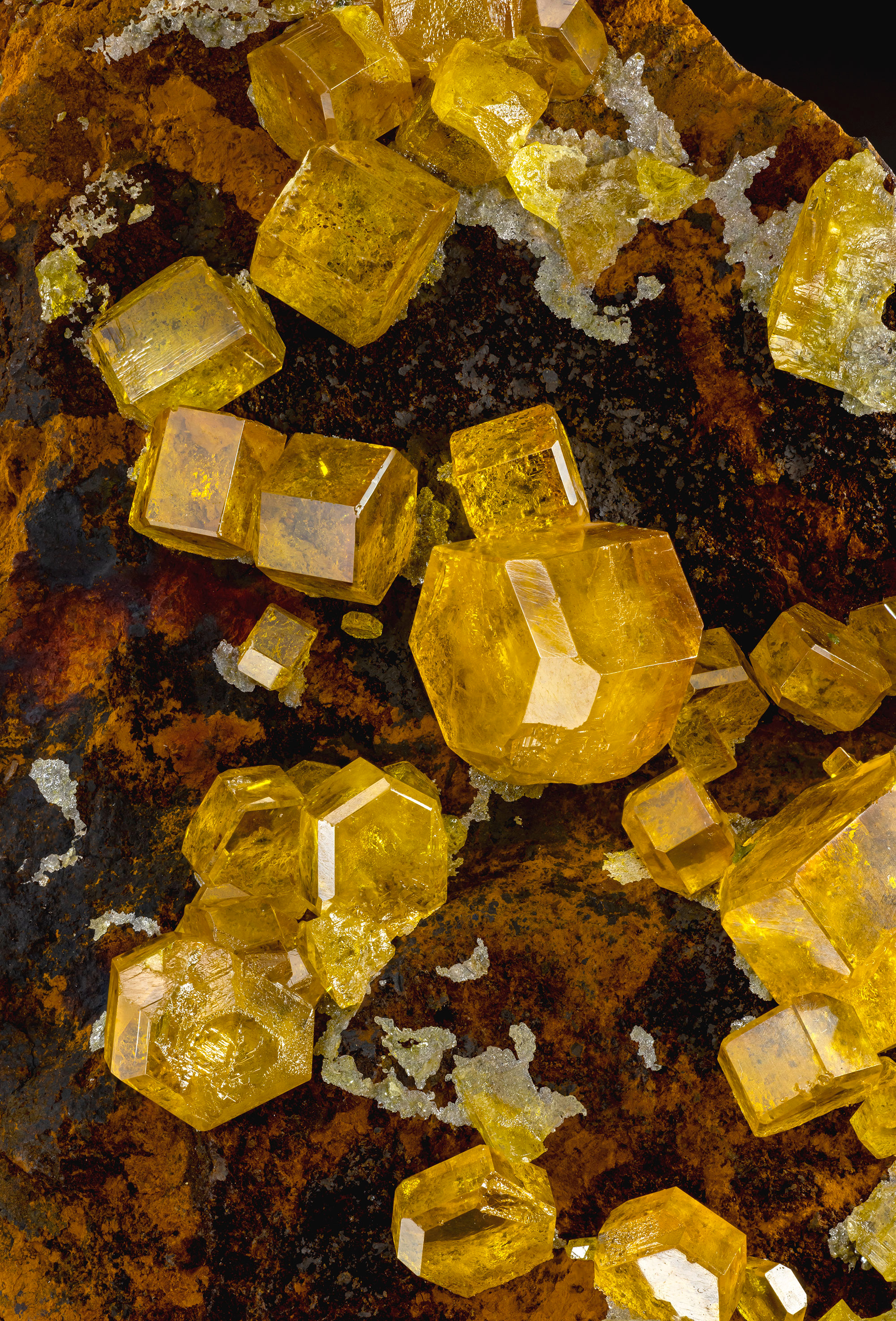
Close-up of a specimen with a gem mimetite crystals. FOV 3 cm. Photo by László Kupi.
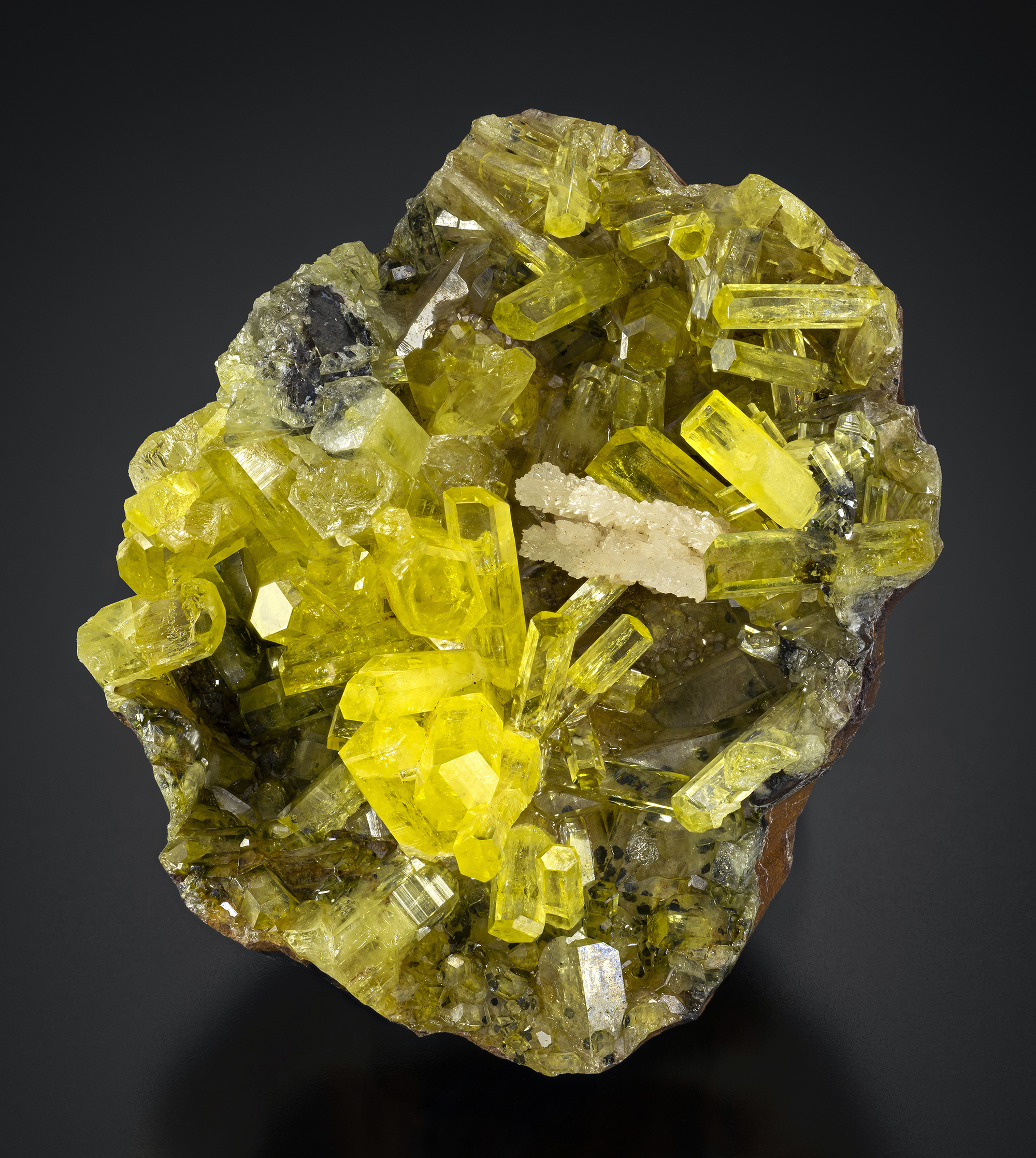
Small but still one of the best yellow gem mimetite specimens (with cerussite) from the find. Size 3.6 cm. Photo by László Kupi.
Video of the specimen shown in the photo above.
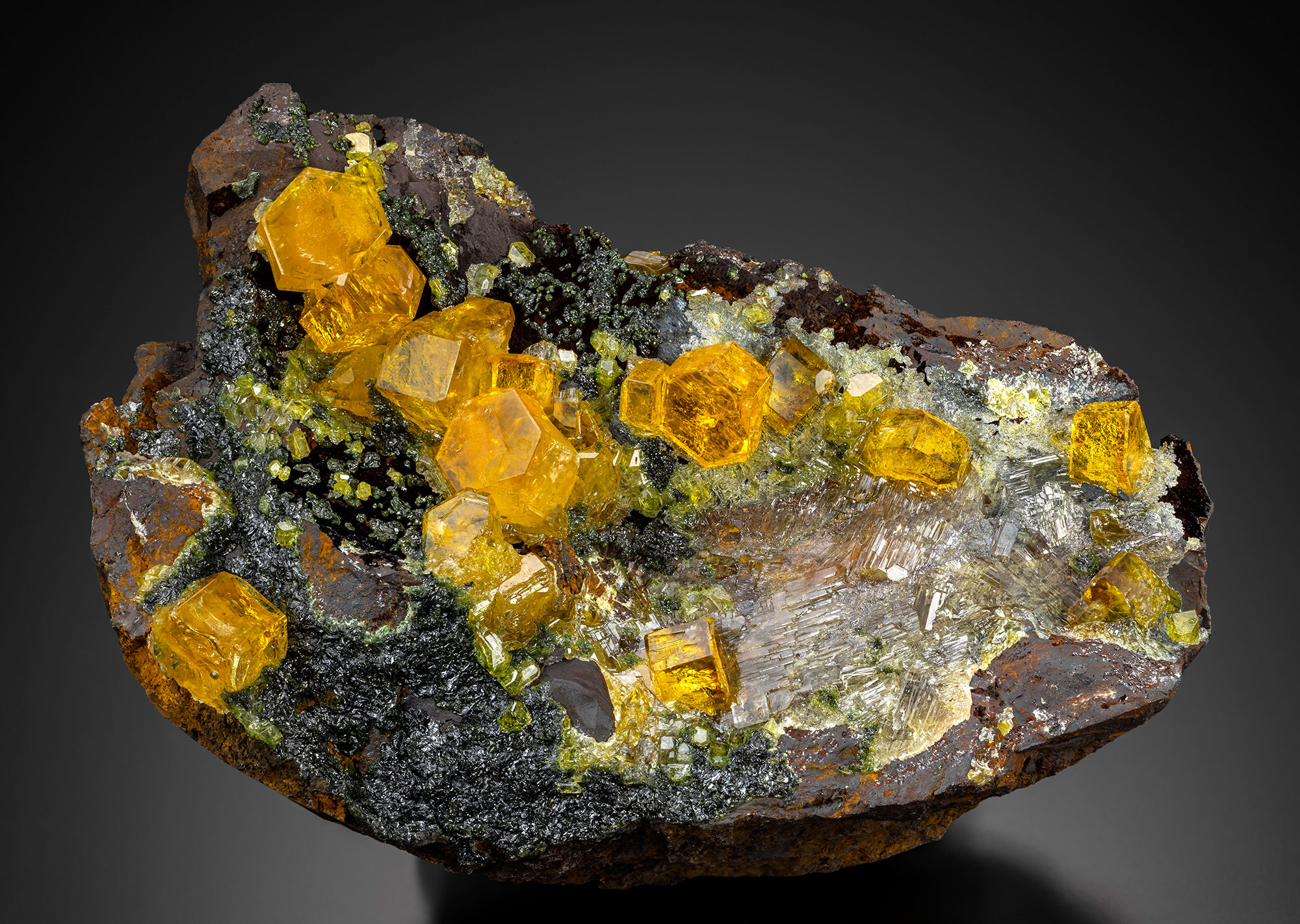
Spectacular specimen of vivid orange, water-clear mimetite crystals growing on unusual flat crystals, with duftite. Size 6.9 cm. Photo by László Kupi.
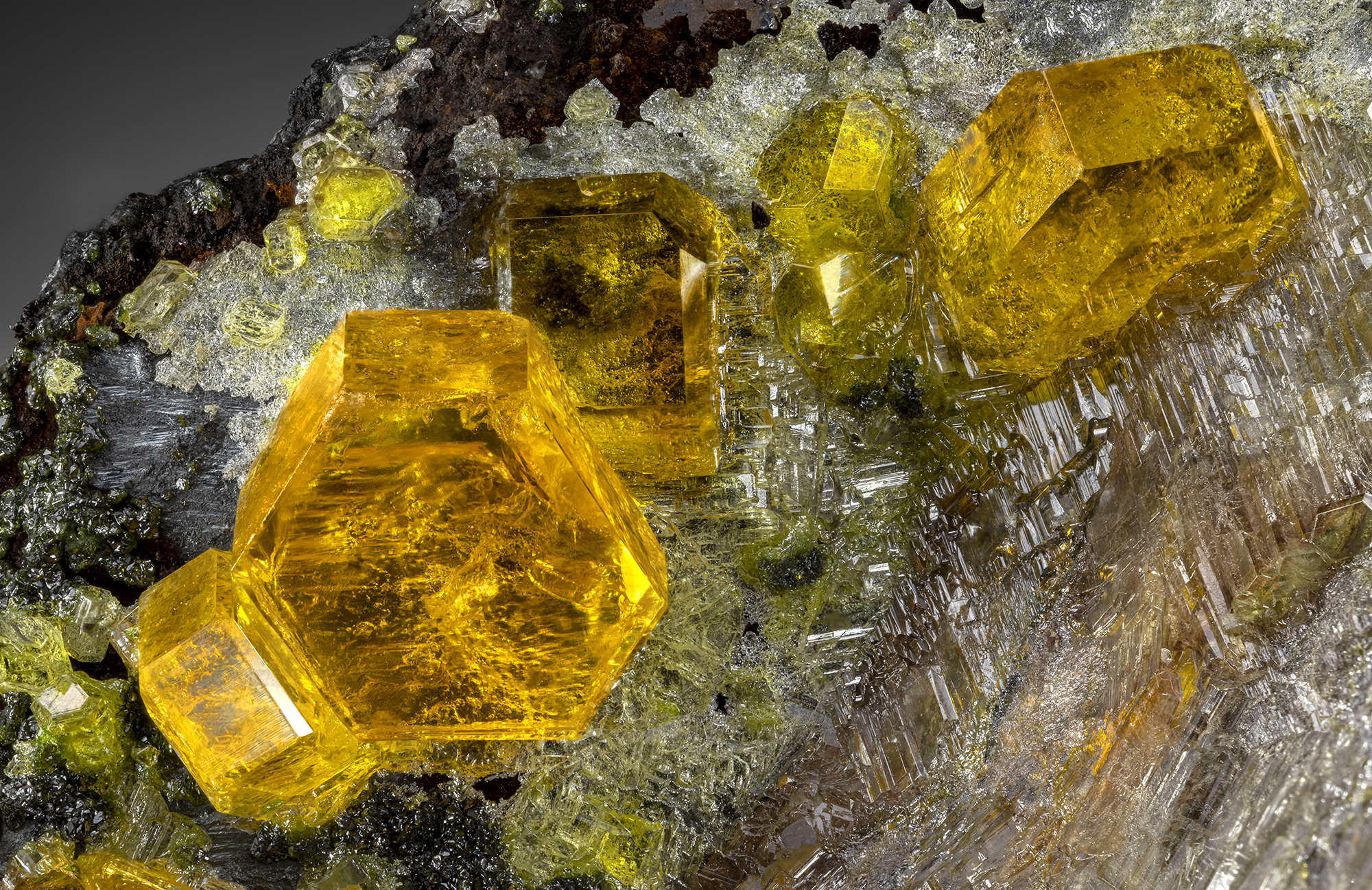
Close-up of the specimen shown above. FOV 3.4 cm. Photo by László Kupi.
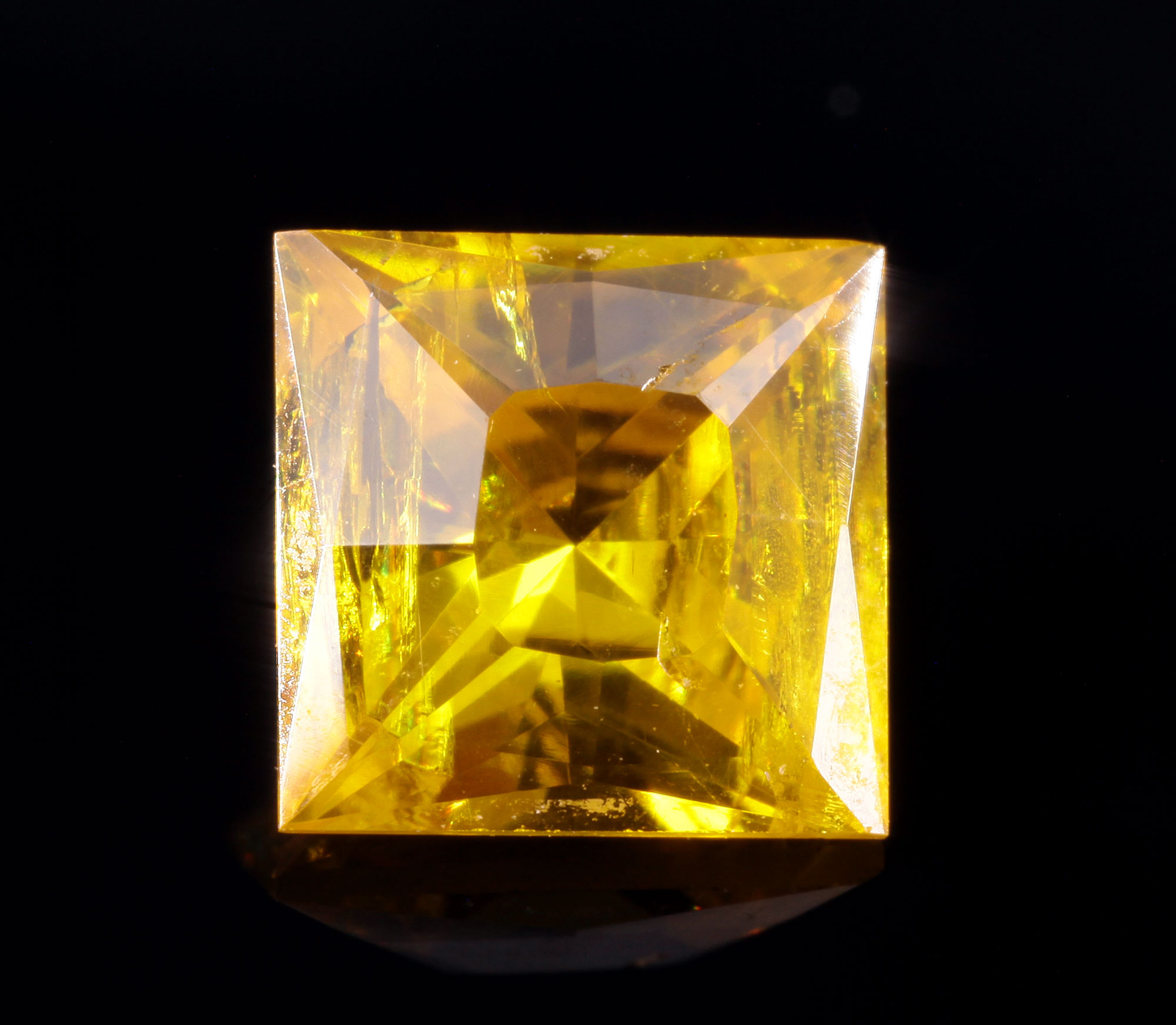
From broken gem crystals, our friends at Mineral Classics (William Kosnar) produced what are probably the world’s best faceted mimetite gemstones.
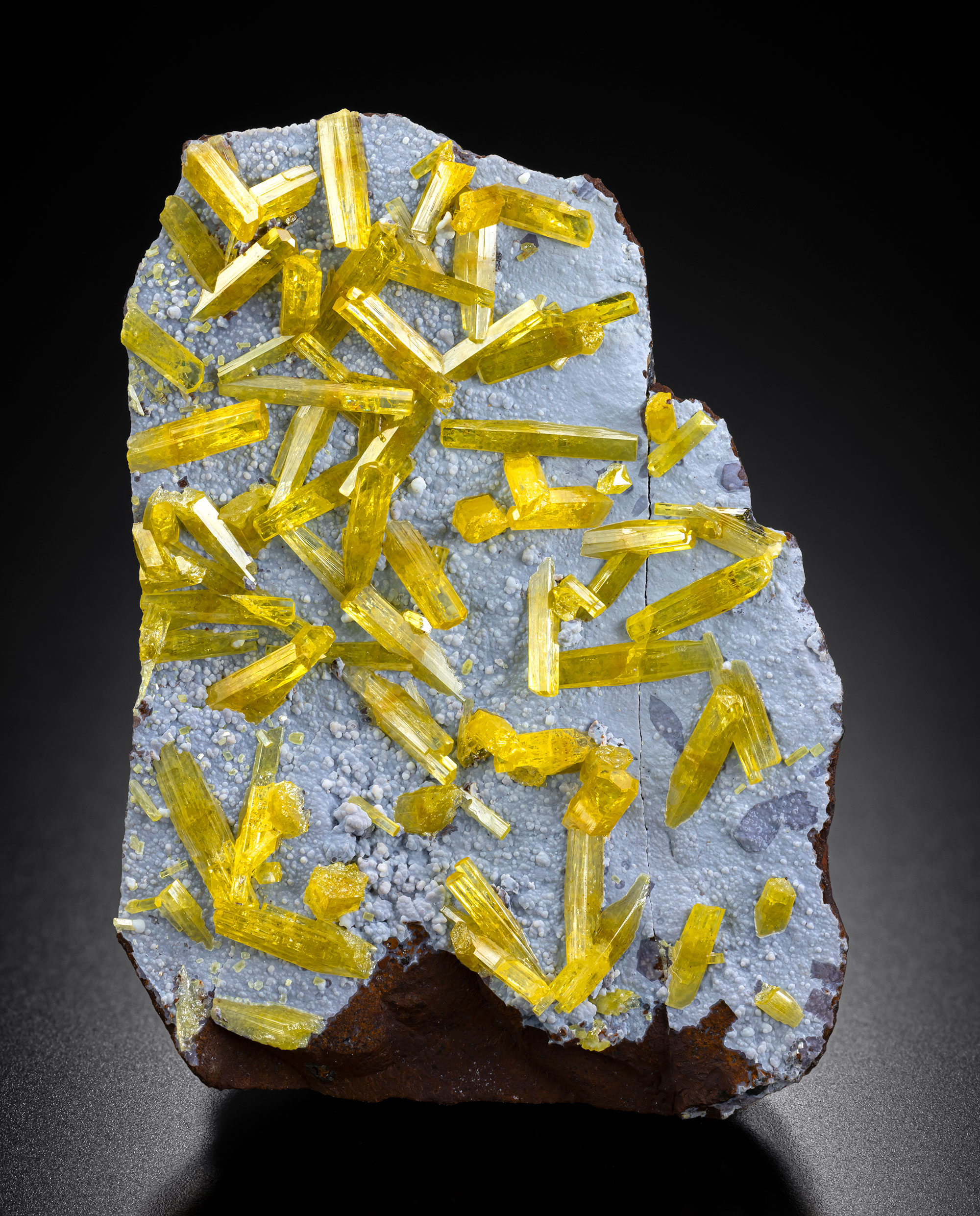
Mimetite crystals from the find show a wide variety of habits. Their shapes range from very elongated prismatic forms …
Size 3.1 cm. Photo by László Kupi.
.jpg)
... through elongated prismatic crystals …
Size 8.5 cm. Photo by László Kupi.
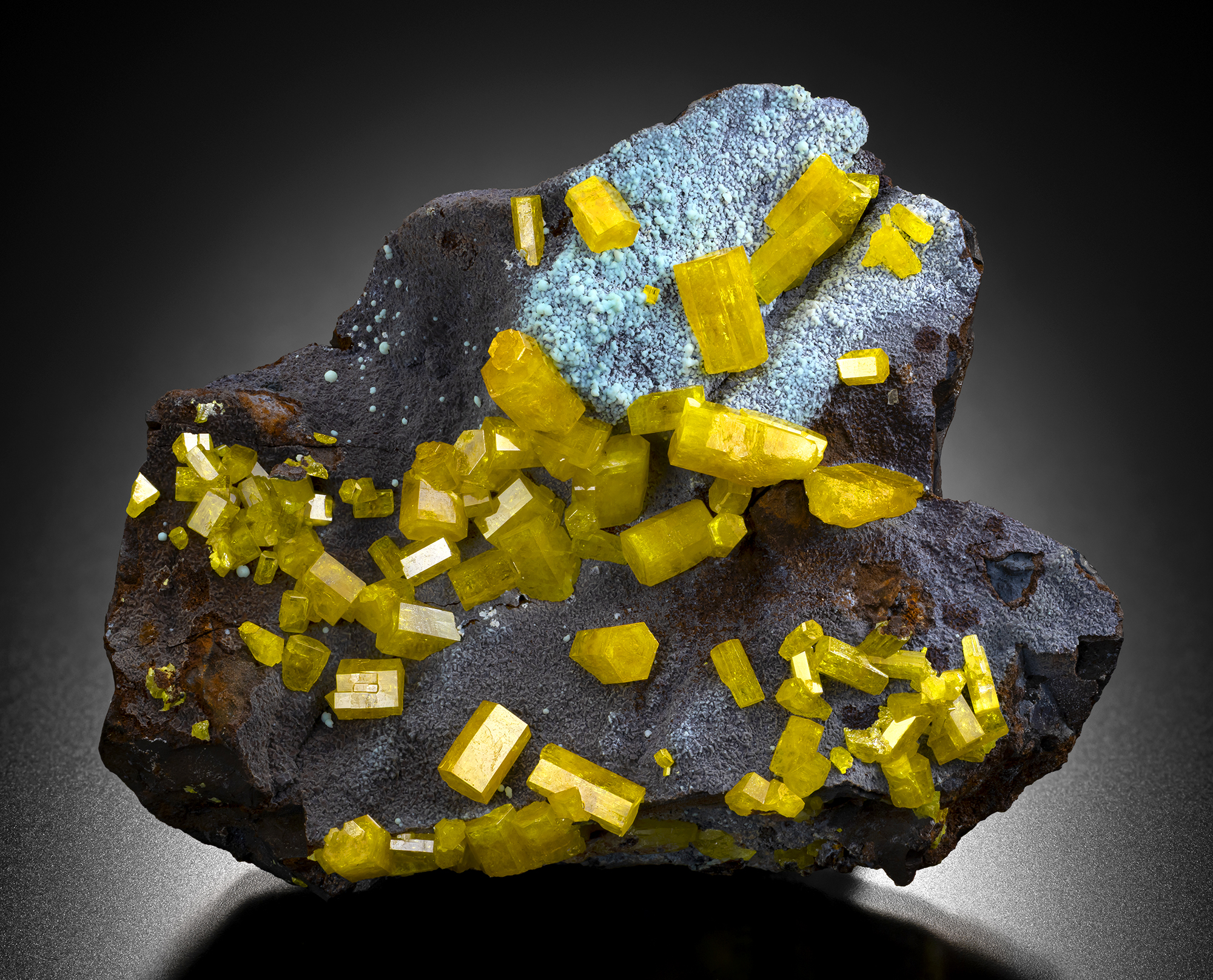
... "regular" prismatic ...
Mimetite with philipsbornite. Size 4.7 cm. Photo by László Kupi.
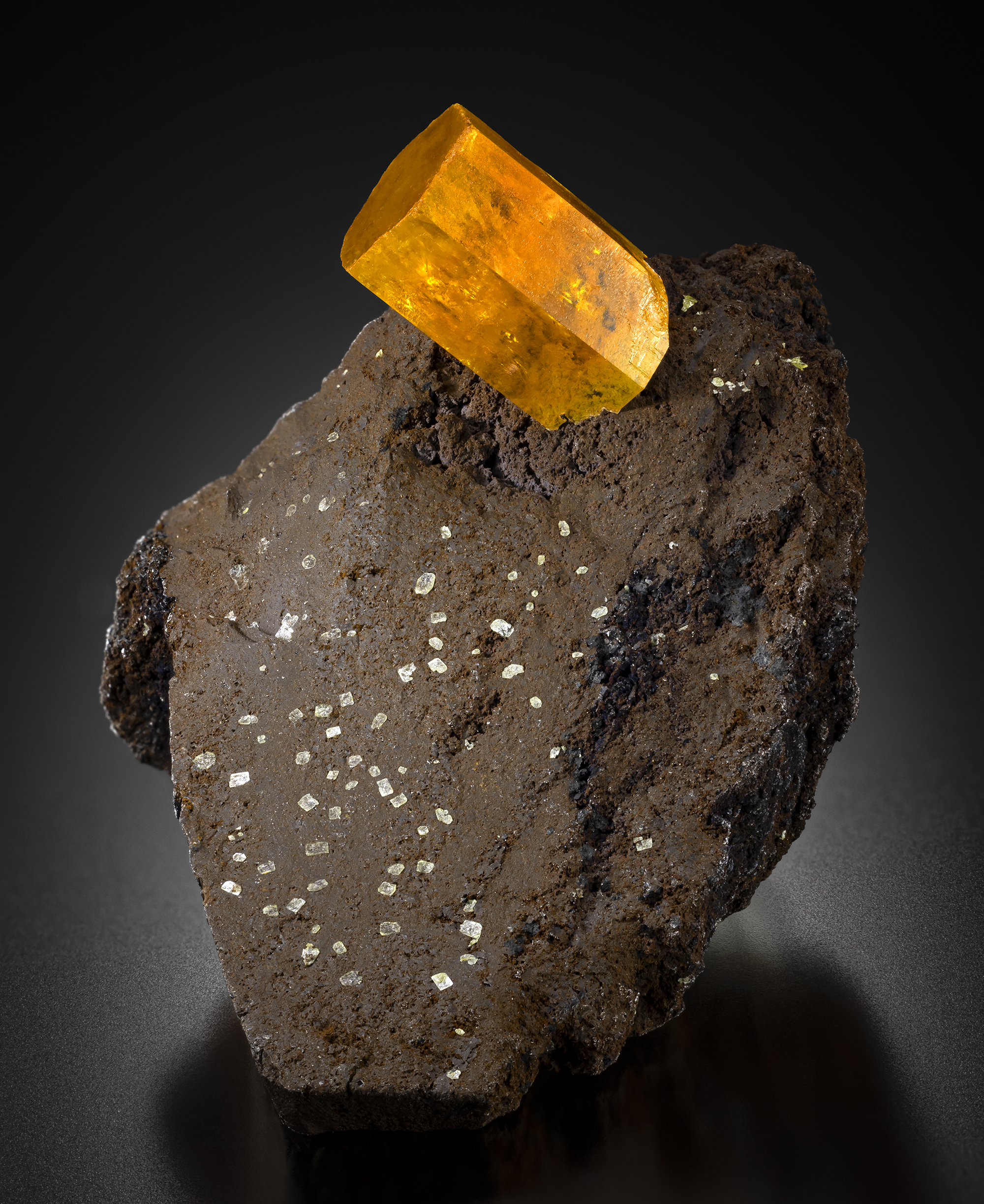
... "short" prismatic ...
Size 3.6 cm. Joanna Praszkier collection. Photo by László Kupi.
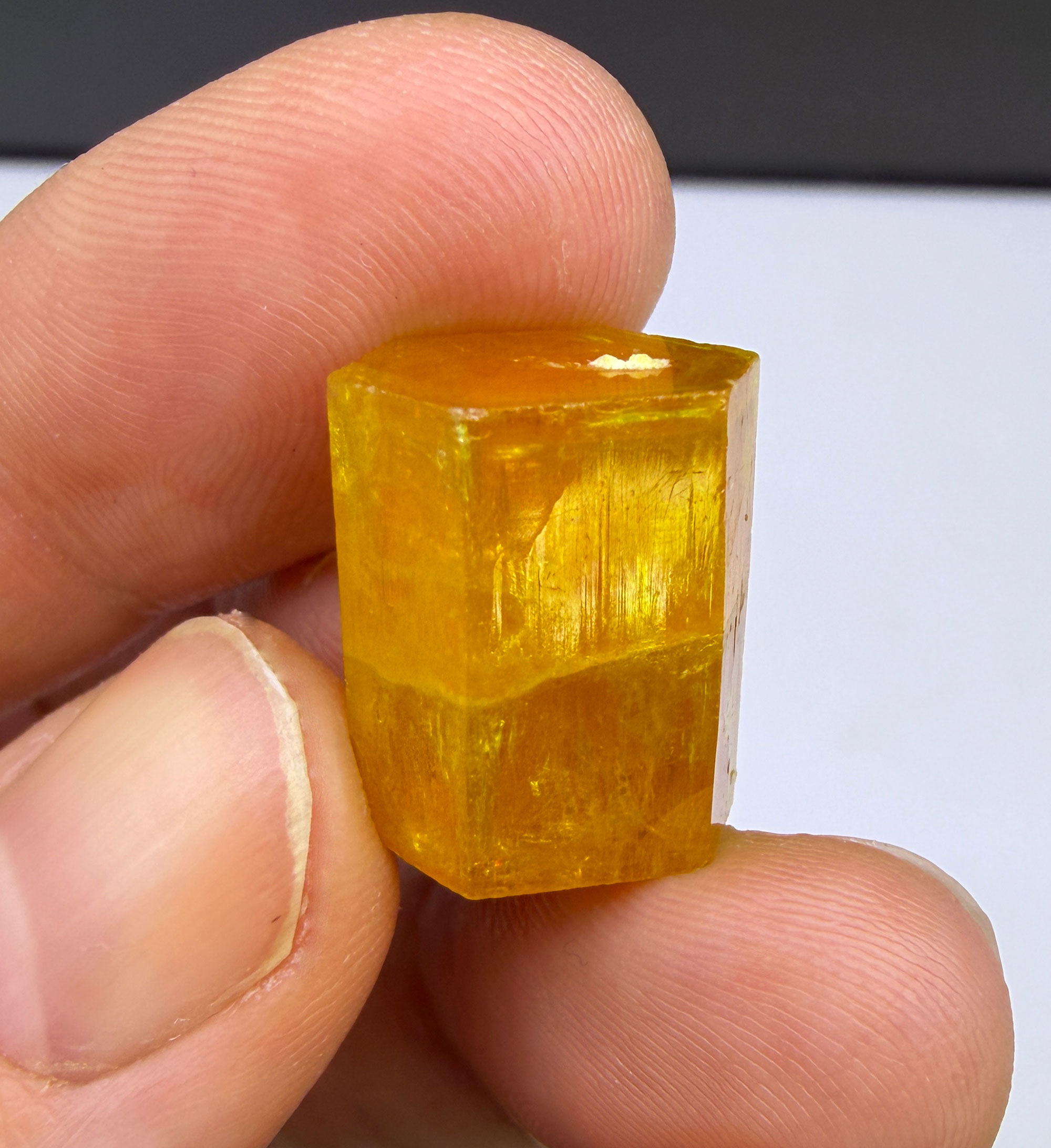
... "short" prismatic ...
Unique, one-of-a-kind full floater mimetite crystal. Size 1.5 cm.
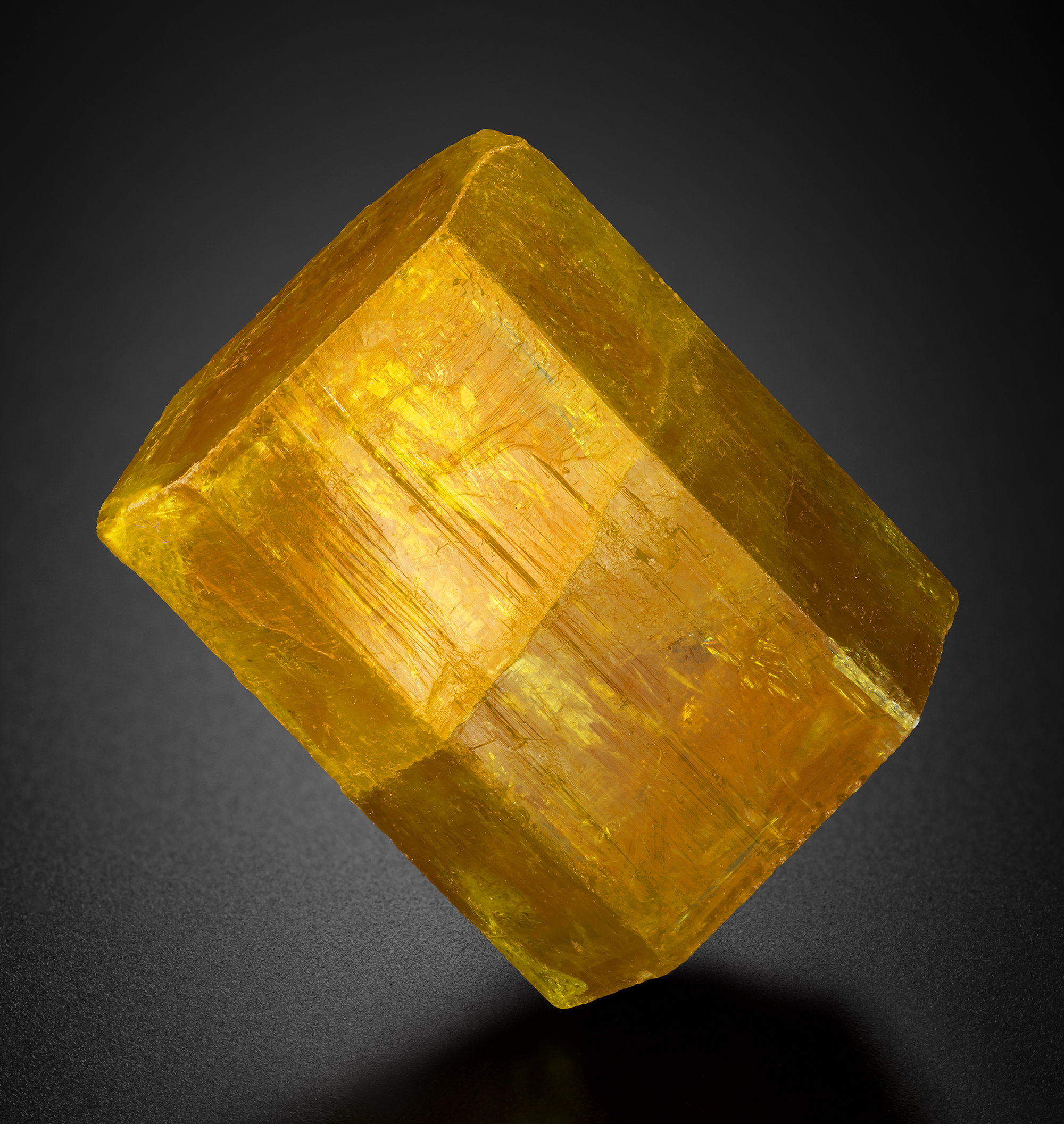
... "short" prismatic ...
The same specimen shown above—a unique, one-of-a-kind full floater mimetite crystal. Size 1.5 cm. Joanna Praszkier collection. Photo by László Kupi.
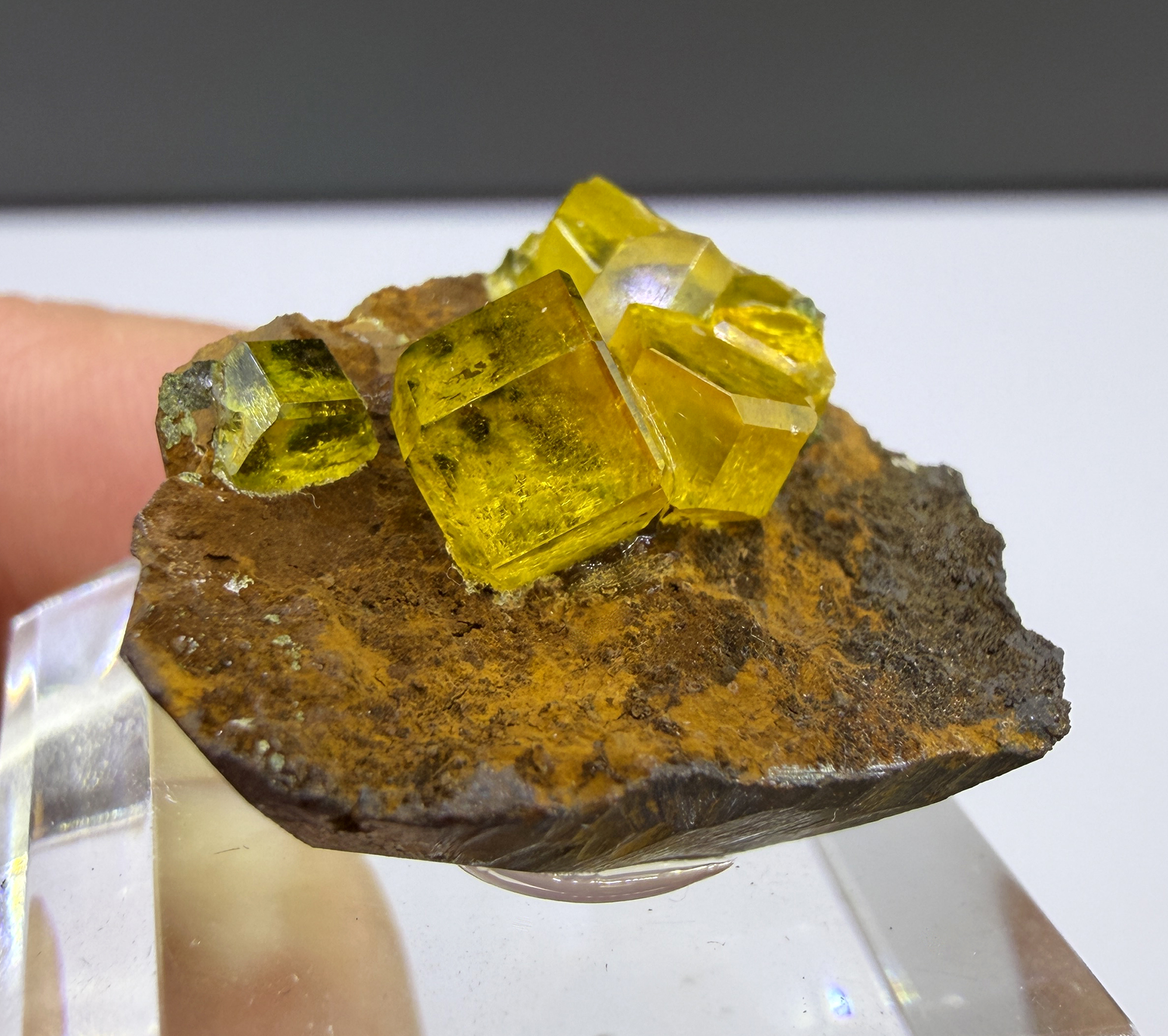
... through blocky ...
Gem mimetites on matrix.
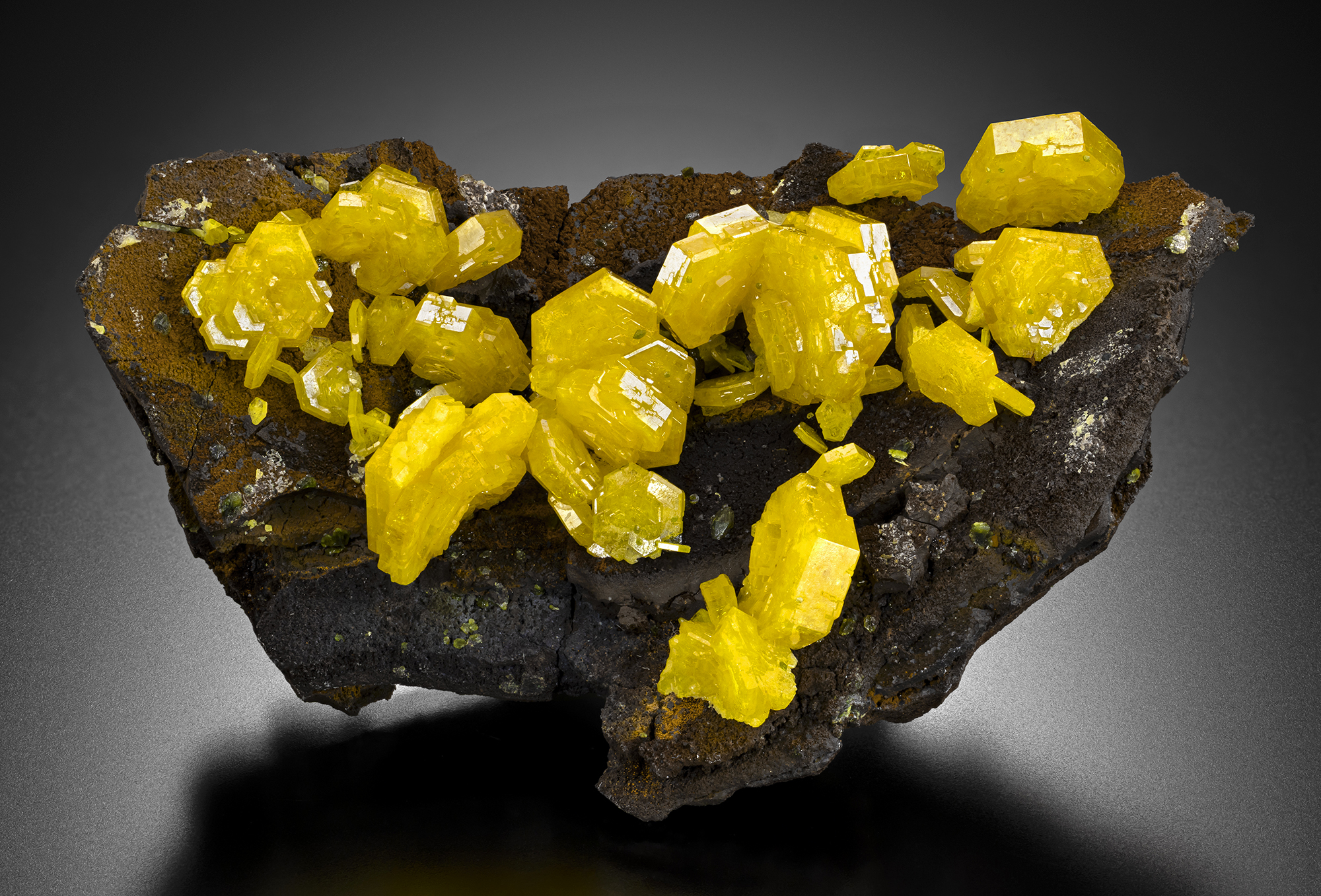
…ending with tabular crystals. Size 5.3 cm. Photo by László Kupi.
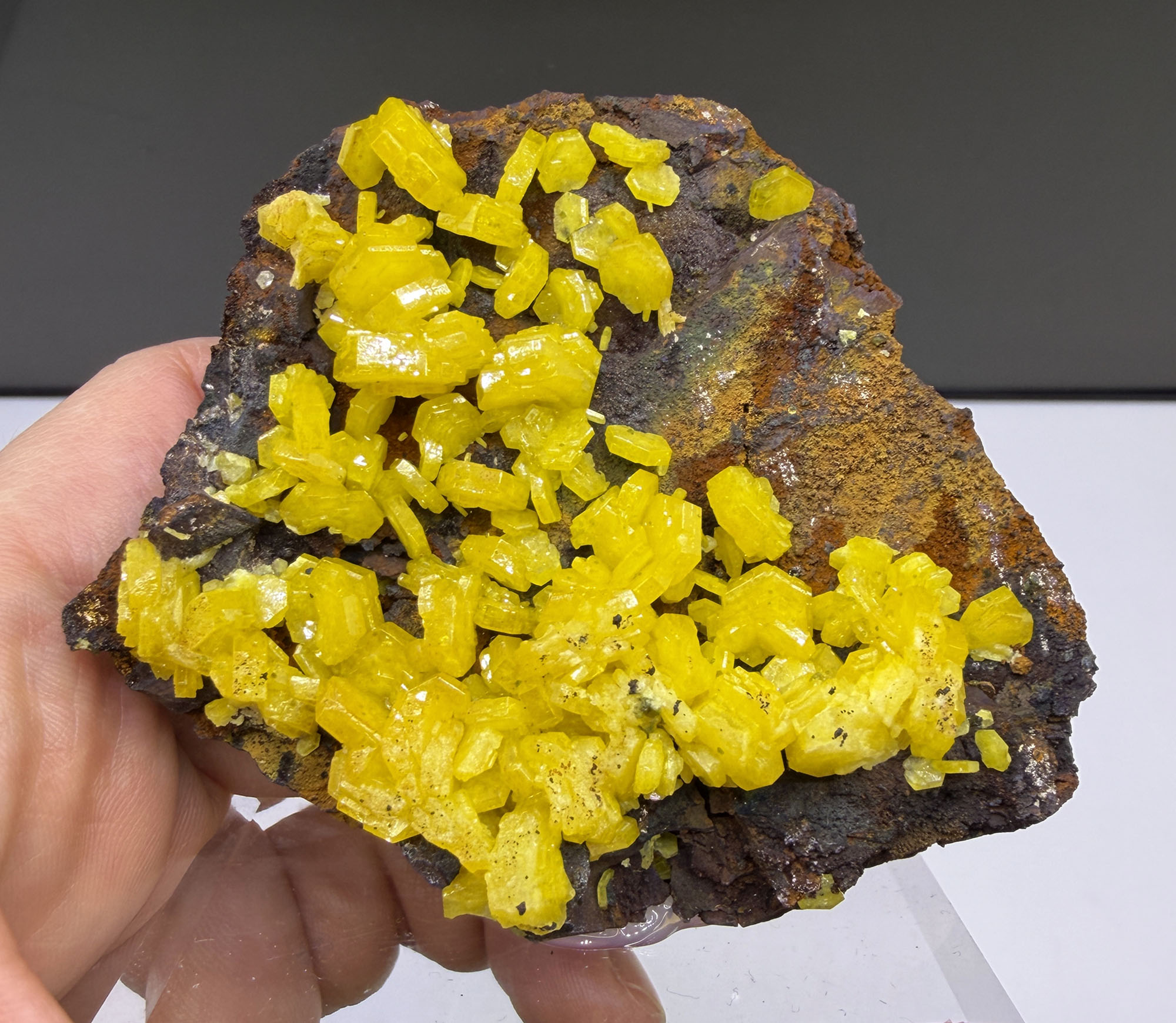
Similar to the crystal shapes, the colors also vary strongly among specimens from this find, ranging from bright yellow…
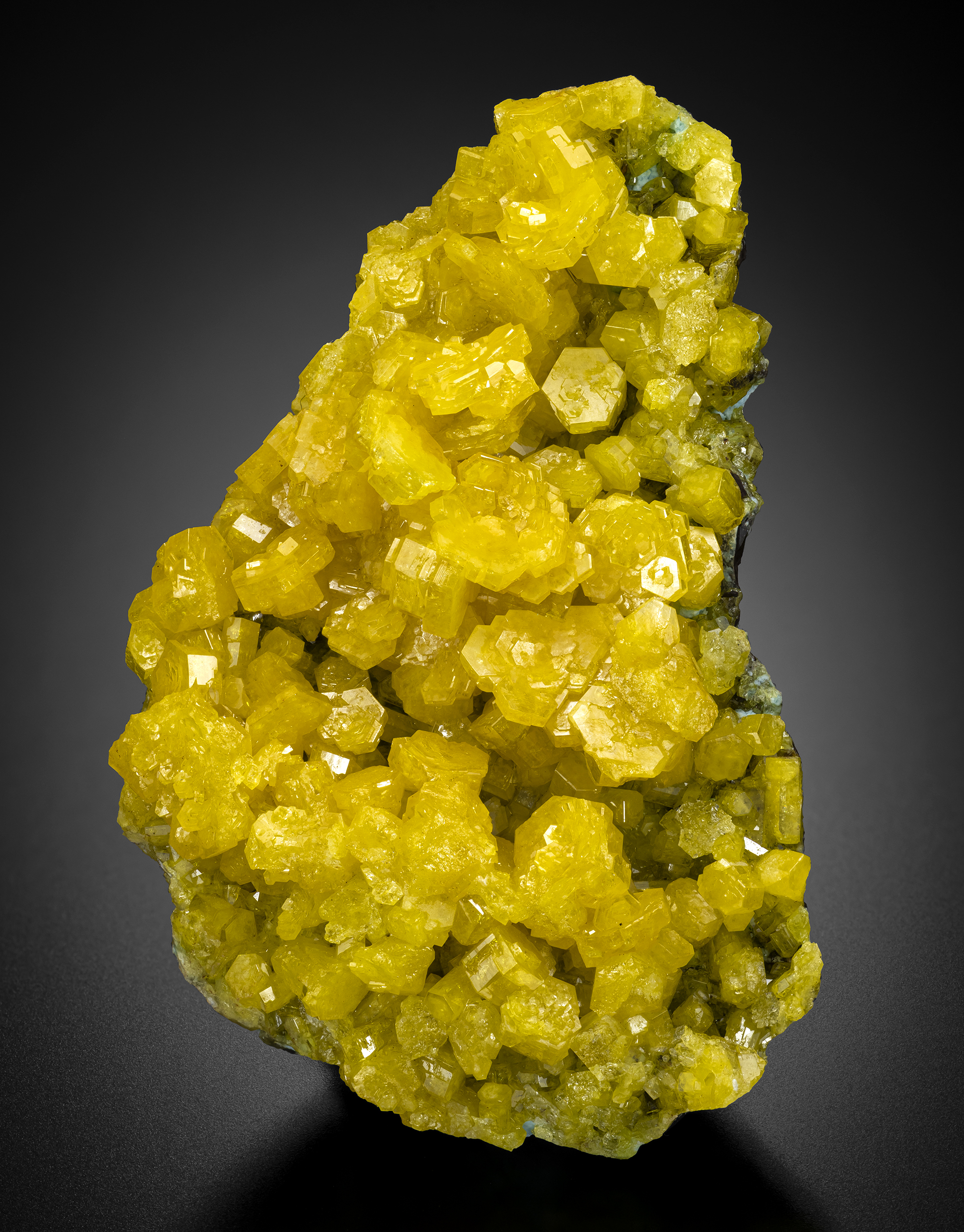
... from bright yellow…
Grzegorz Słowik collection. Size 5.1 cm. Photo by László Kupi.
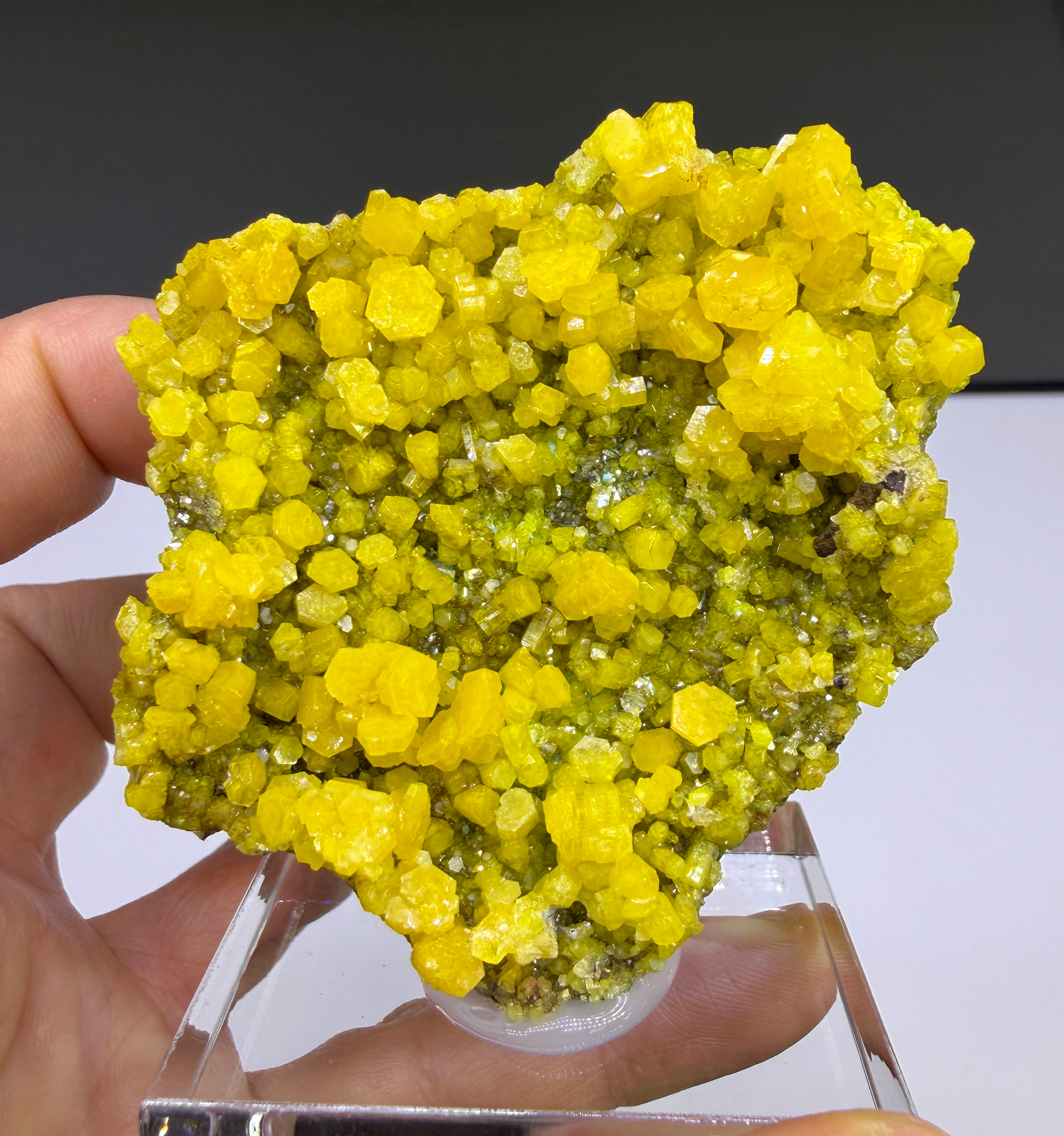
... from bright yellow…
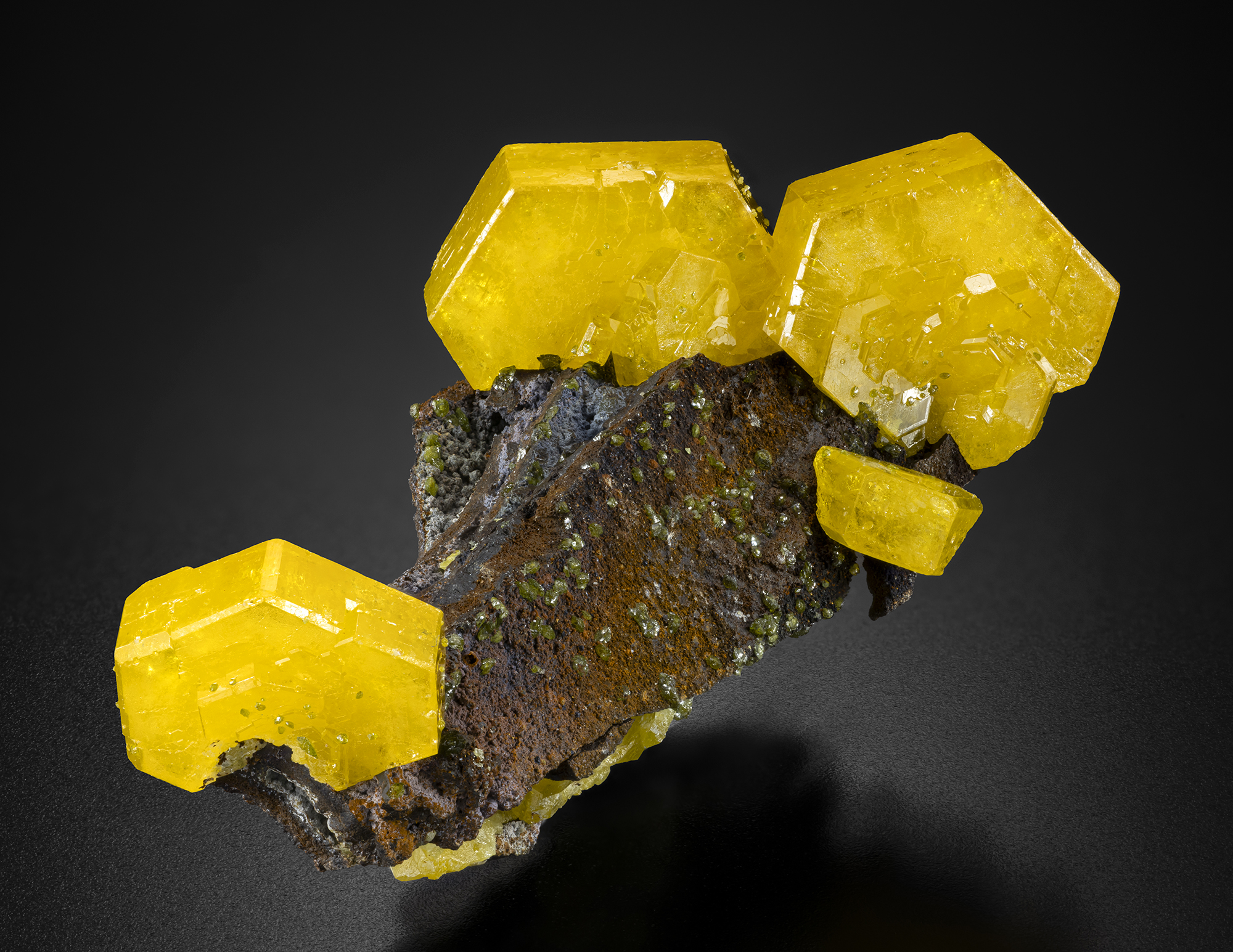
... from bright yellow…
Mimetite with duftite. Size 2.9 cm. Photo by László Kupi.
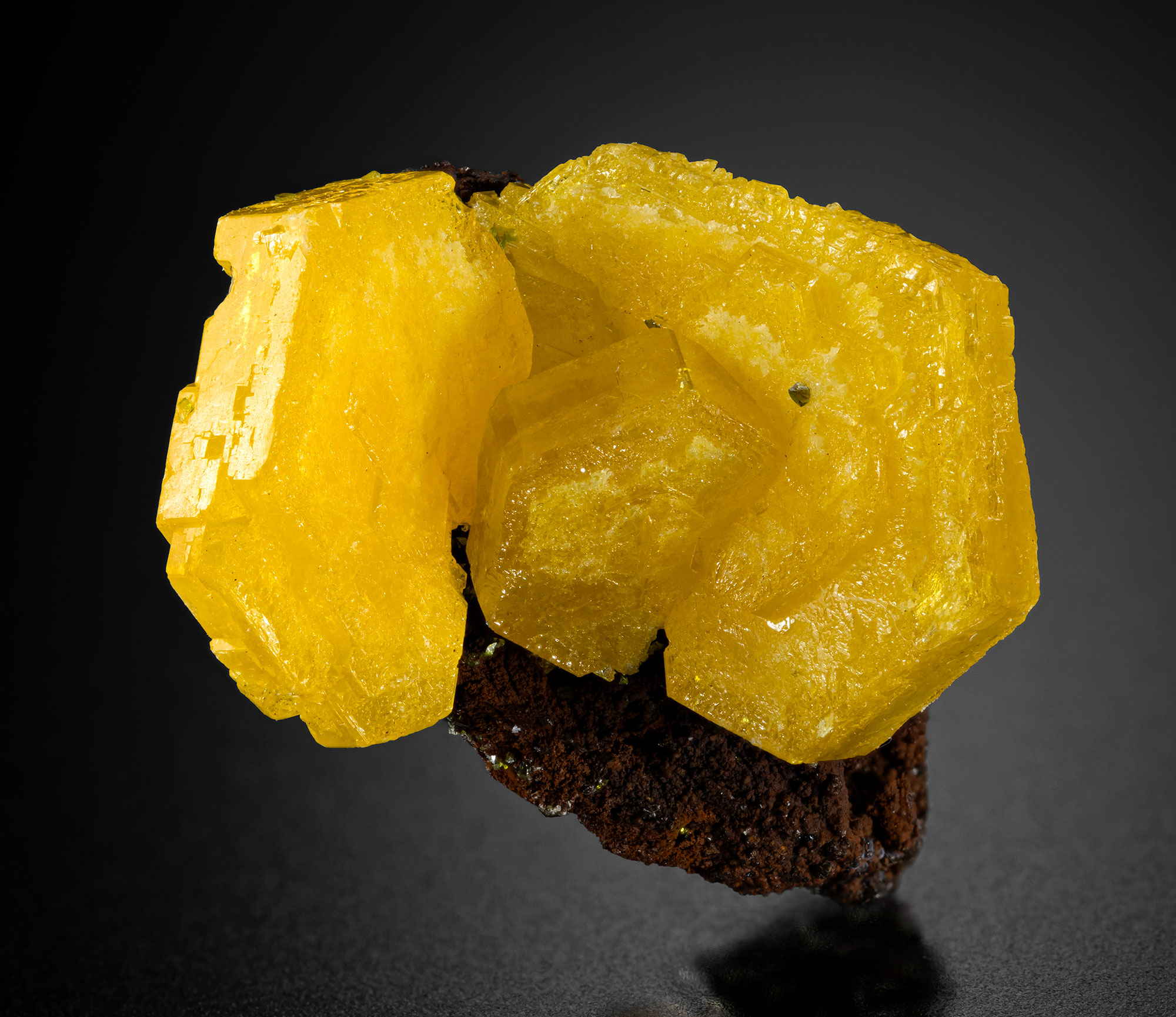
... from yellow…
Mimetite with duftite. Size 1.8 cm. Photo by László Kupi.
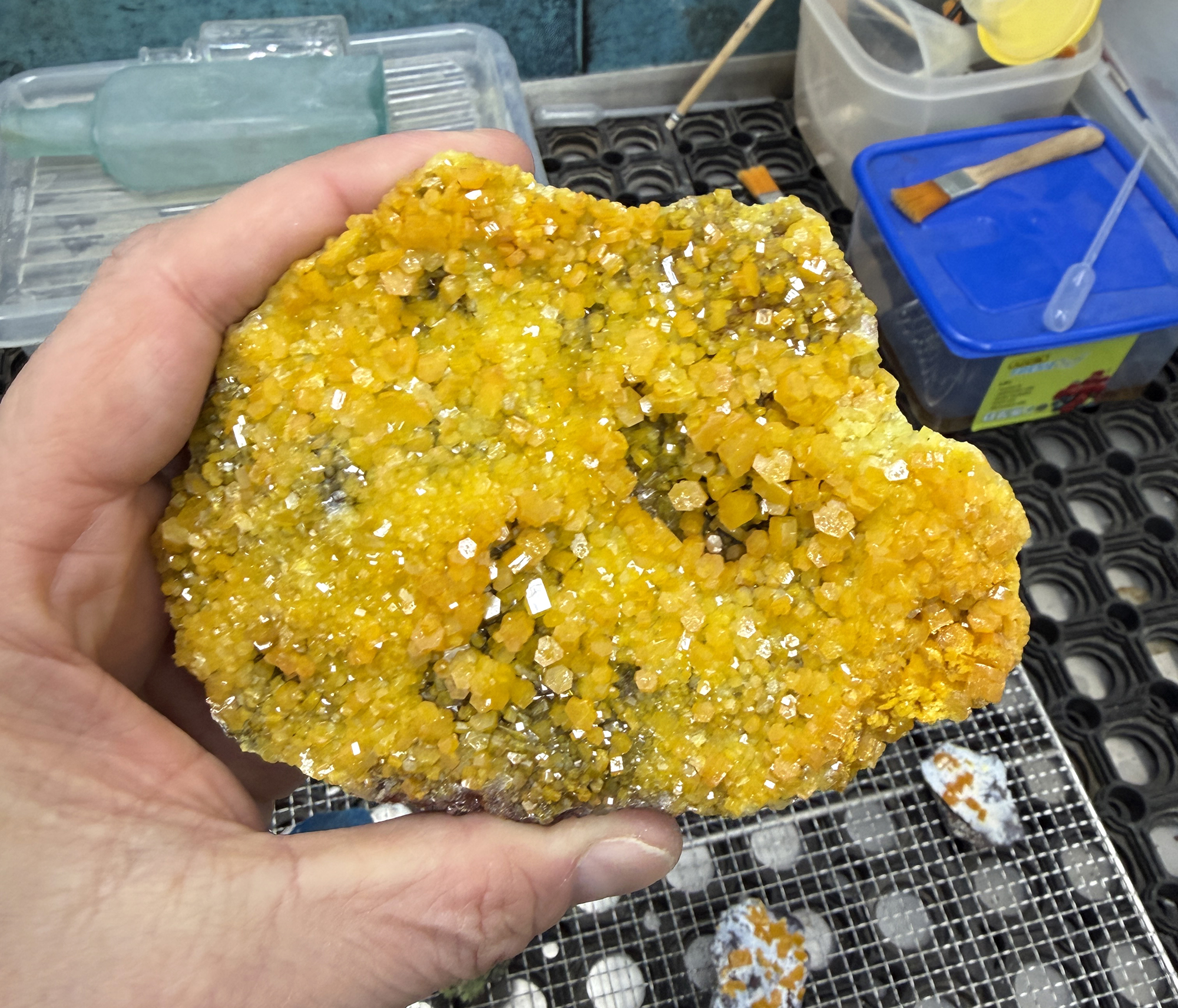
… through orangish-yellow …
… through orangish-yellow …
Mimetite with cerussite.
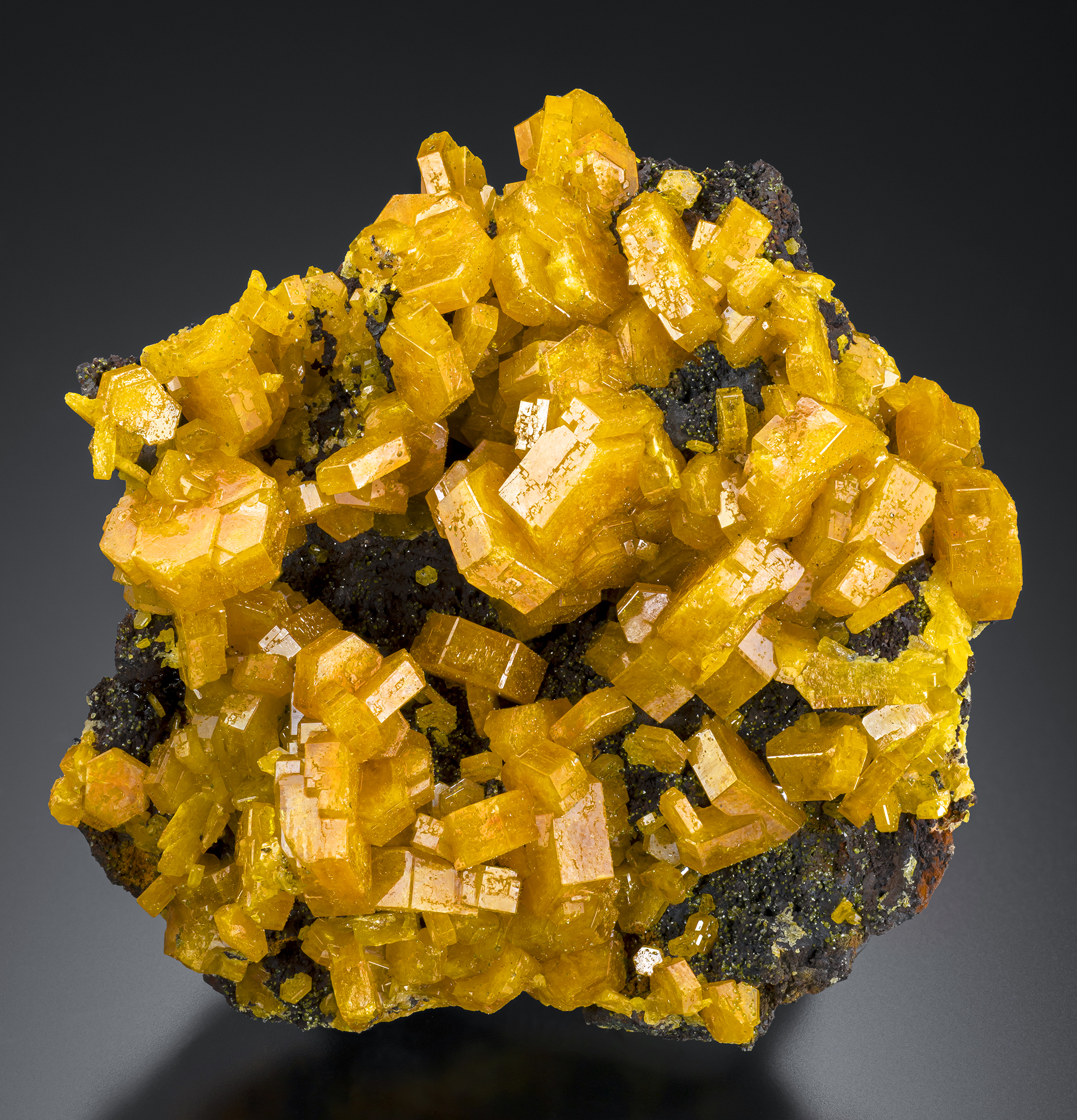
... through orange ...
Mimetite with duftite. Size 6.0 cm. Photo by László Kupi.
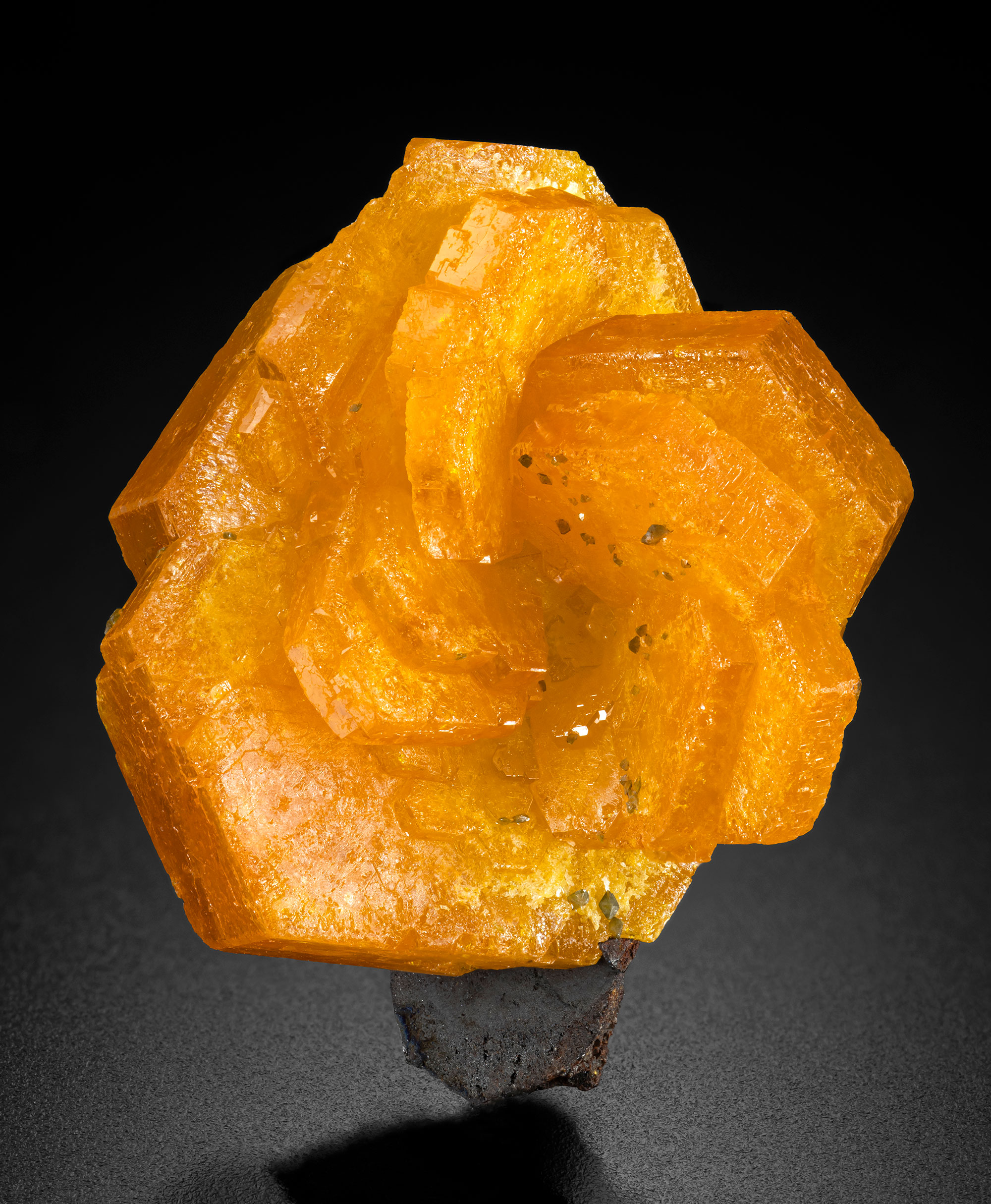
... through orange ...
Mimetite with duftite. Size 1.6 cm. Photo by László Kupi.
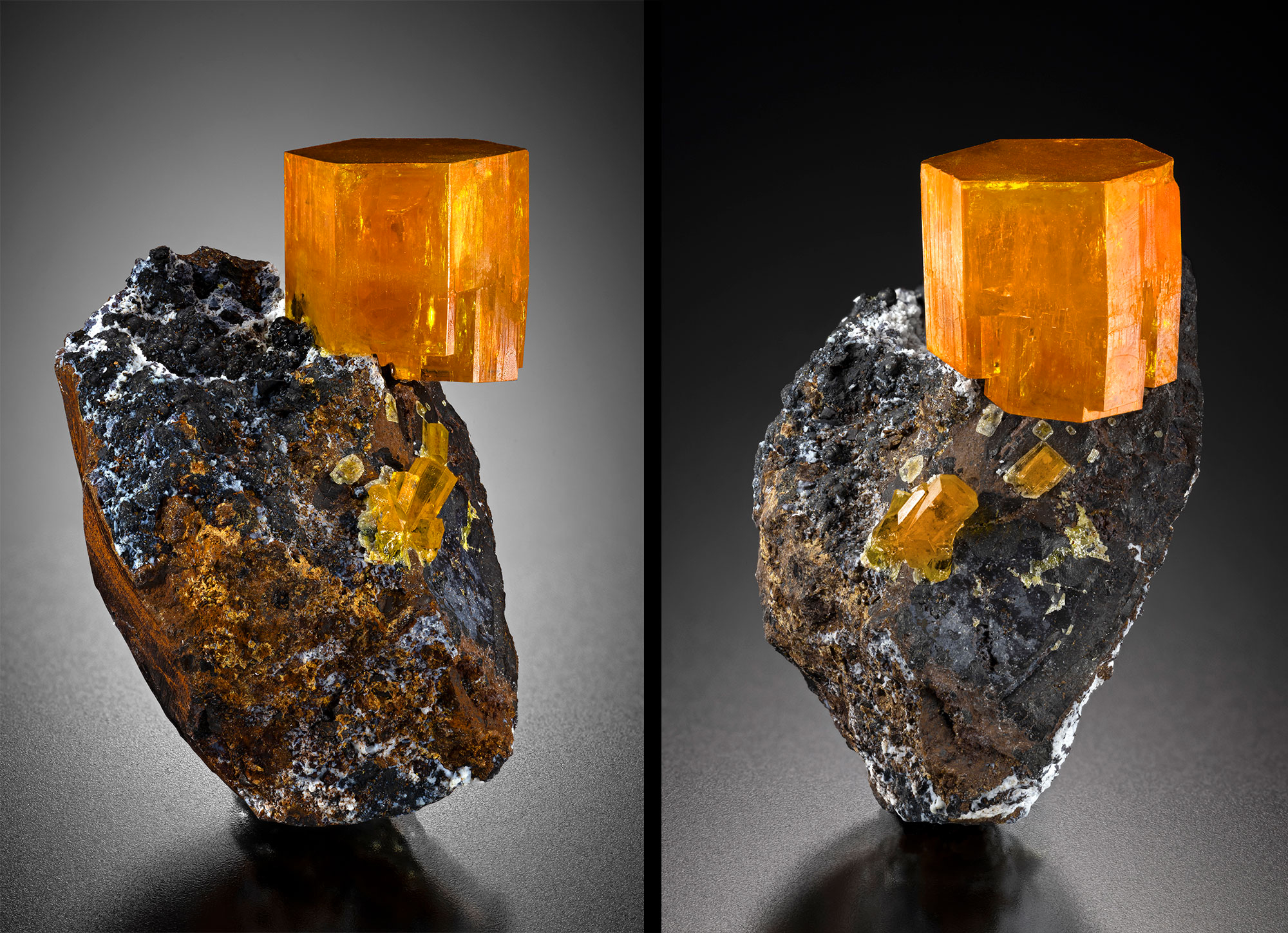
... through reddish-orange ...
Size 2.2 cm. Photo by László Kupi.
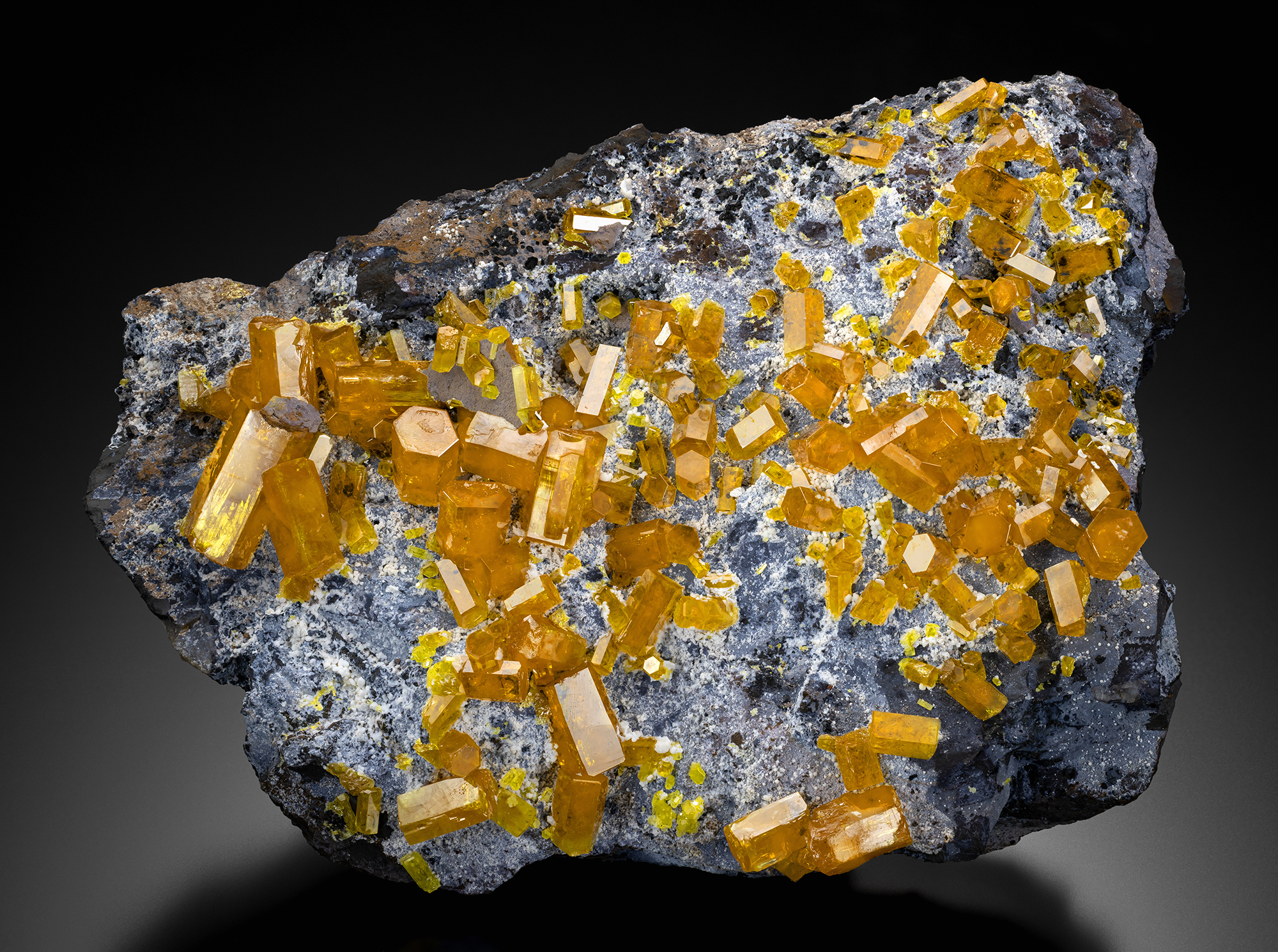
... through reddish-orange ...
Size 11.4 cm. Photo by László Kupi.
.jpg)
…to gemmy, almost red crystals, in this case growing on greenish mimetite of an earlier generation. FOV 2 cm. Photo by László Kupi.
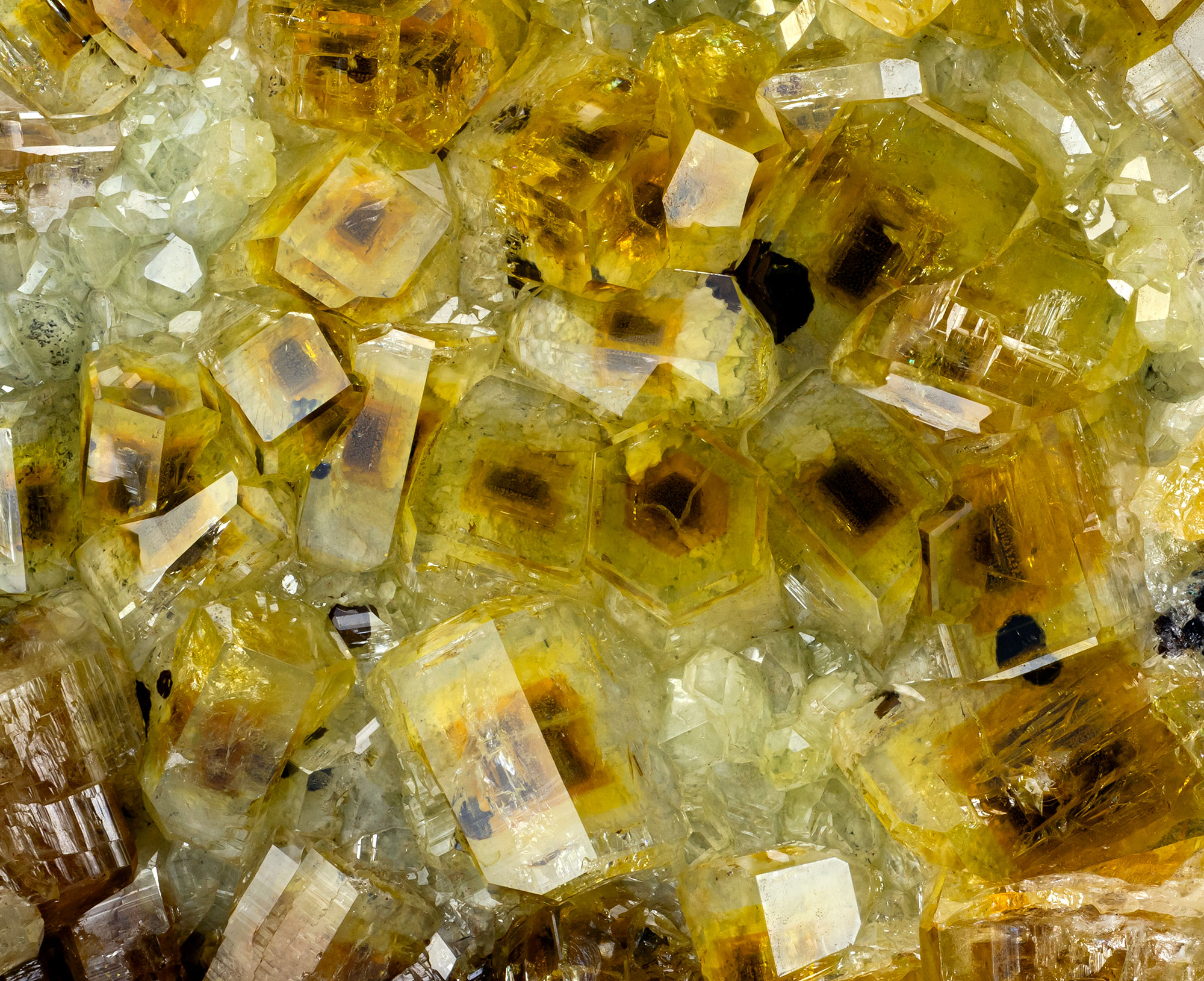
There are also many unusual growth features for the species that are not known from any other locality. Here, well-defined phantoms are clearly visible inside the gem mimetite crystals. FOV 2 cm. Photo by László Kupi.
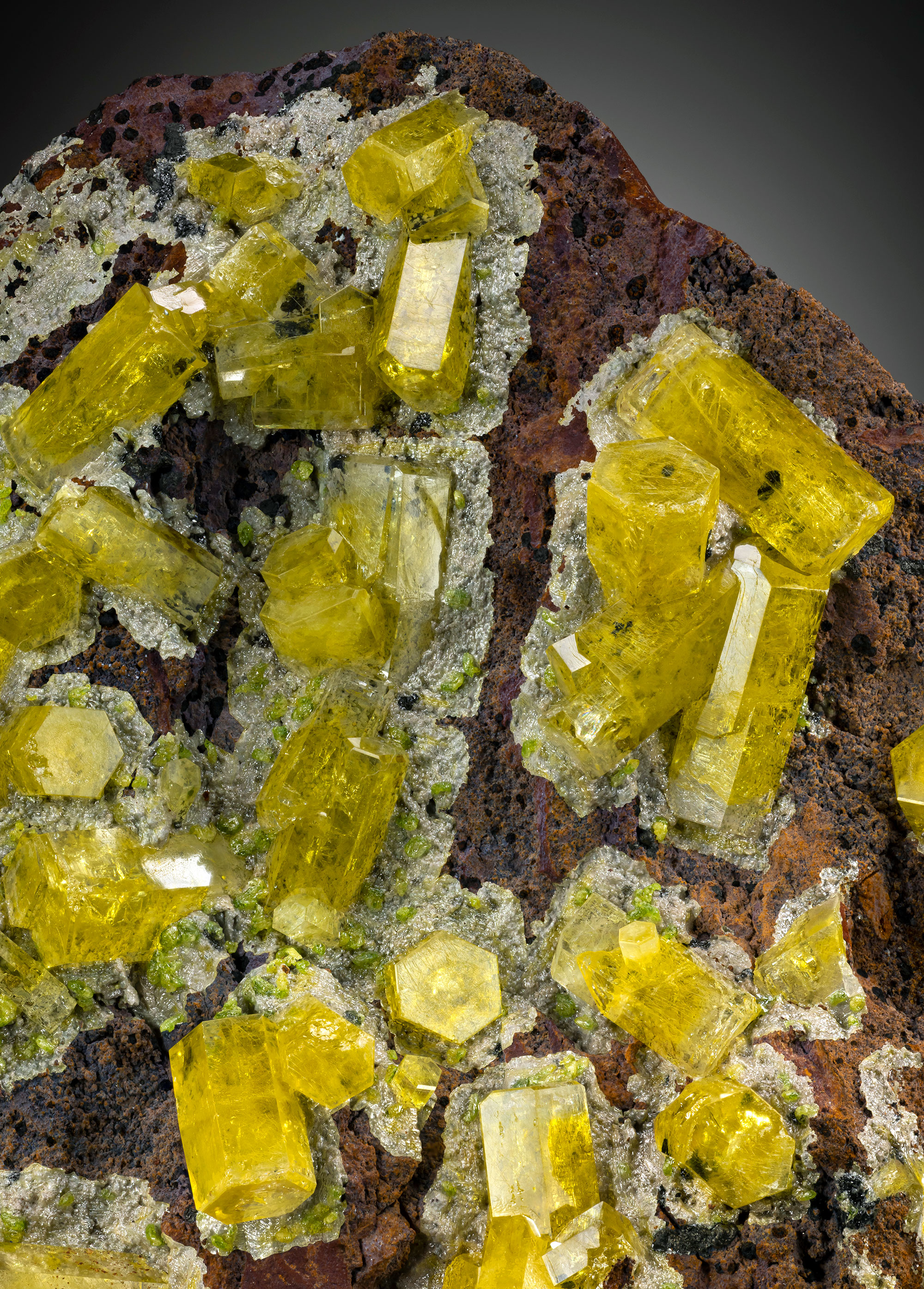
Close-up of the unusual specimen with “regular” mimetite crystals surrounded by an aureole of dendritic crusts, with duftite. FOV 3 cm. Photo by László Kupi.
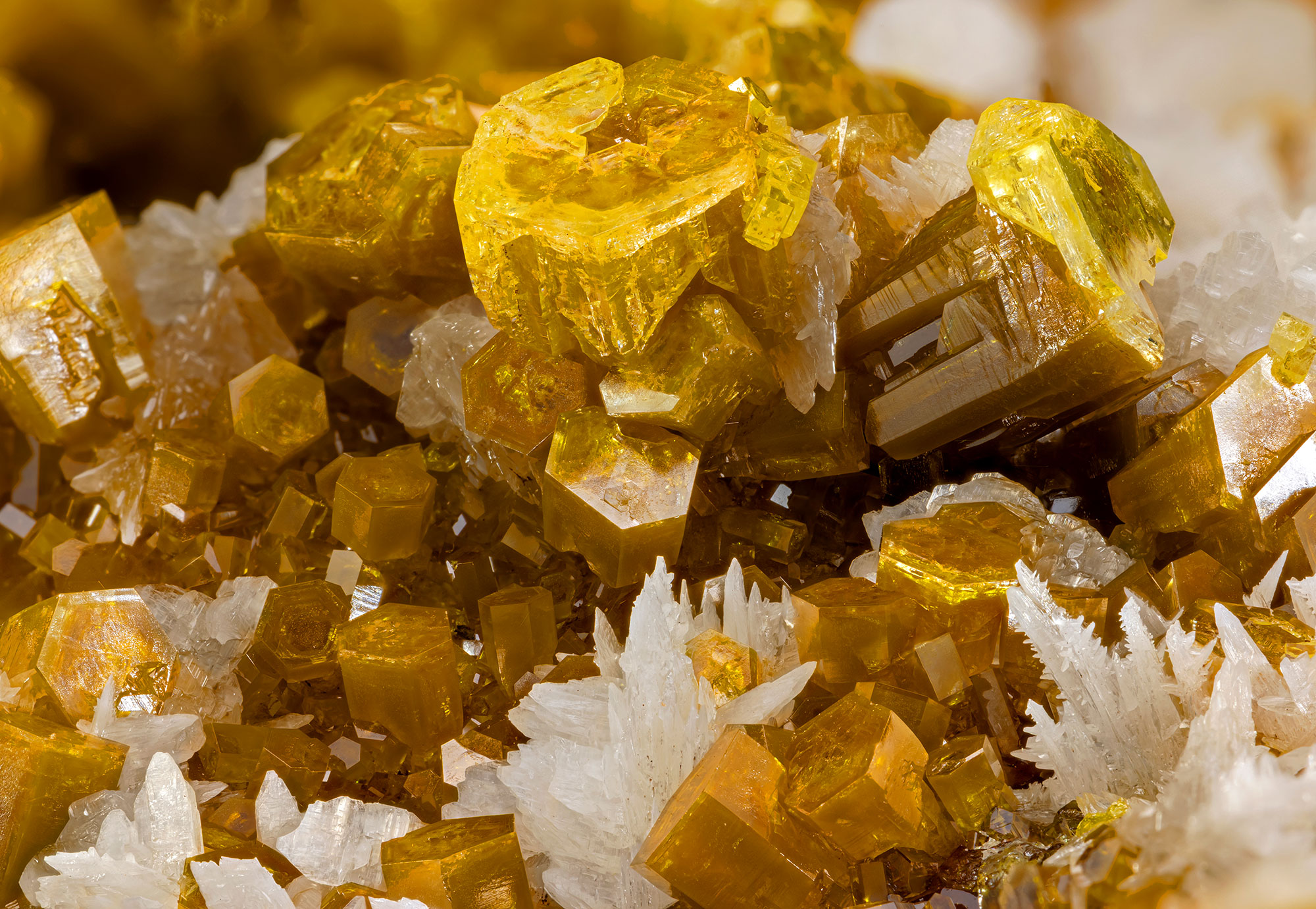
Mimetite scepters on hopper crystals, with cerussite. FOV 3.5 cm. Photo by László Kupi.
,-Mfouati,-Mfouati-District,-Bouenza-Department,-Republic-of-the-Congo_28x20x18mm.jpg)
Within the wide variety of specimen types, mimetite can also grow directly on “naked” host rock. Size 2.8 cm. Photo by László Kupi.
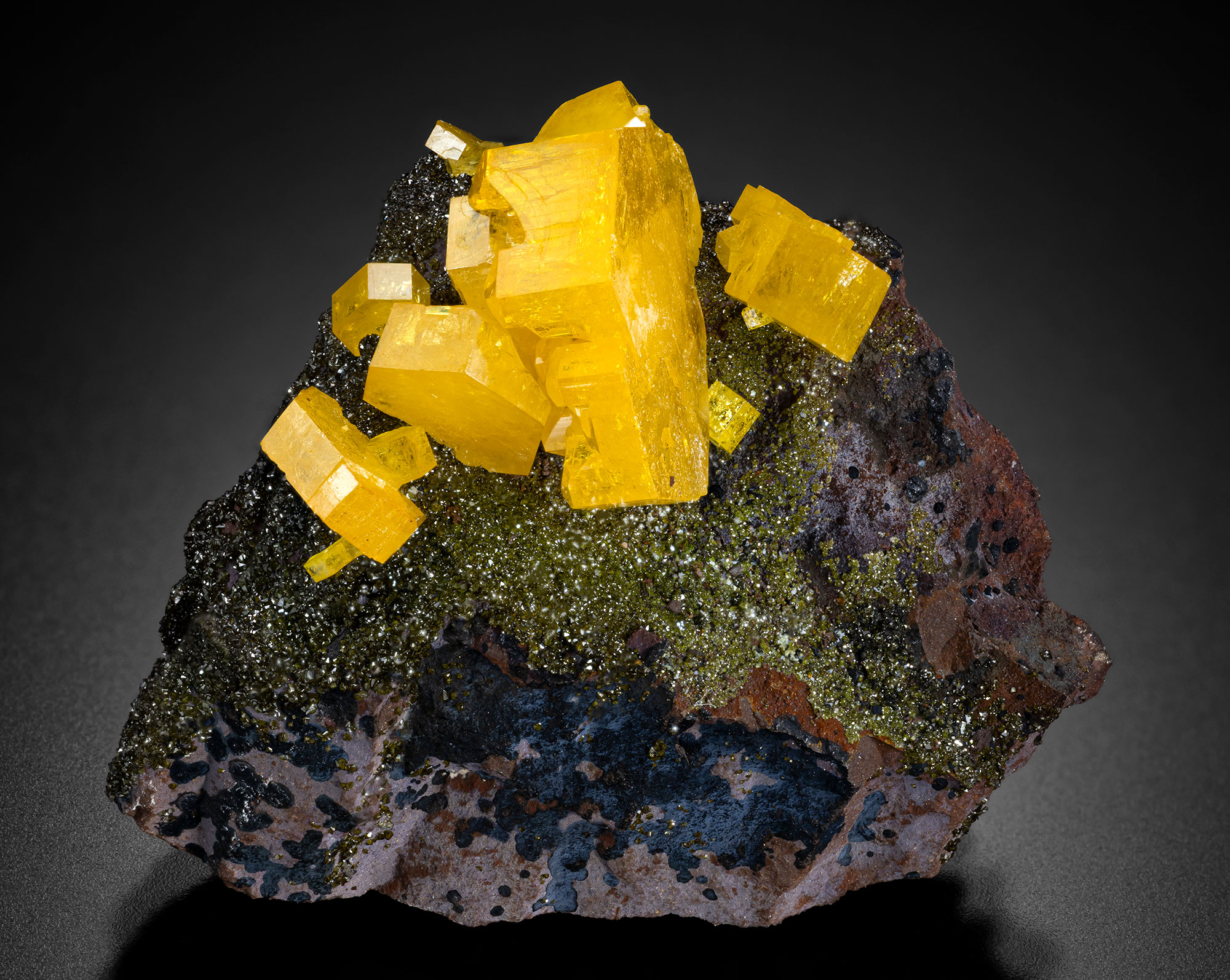
It may also grow on a drusy duftite crust. Joanna Praszkier collection. Size 2.6 cm. Photo by László Kupi.
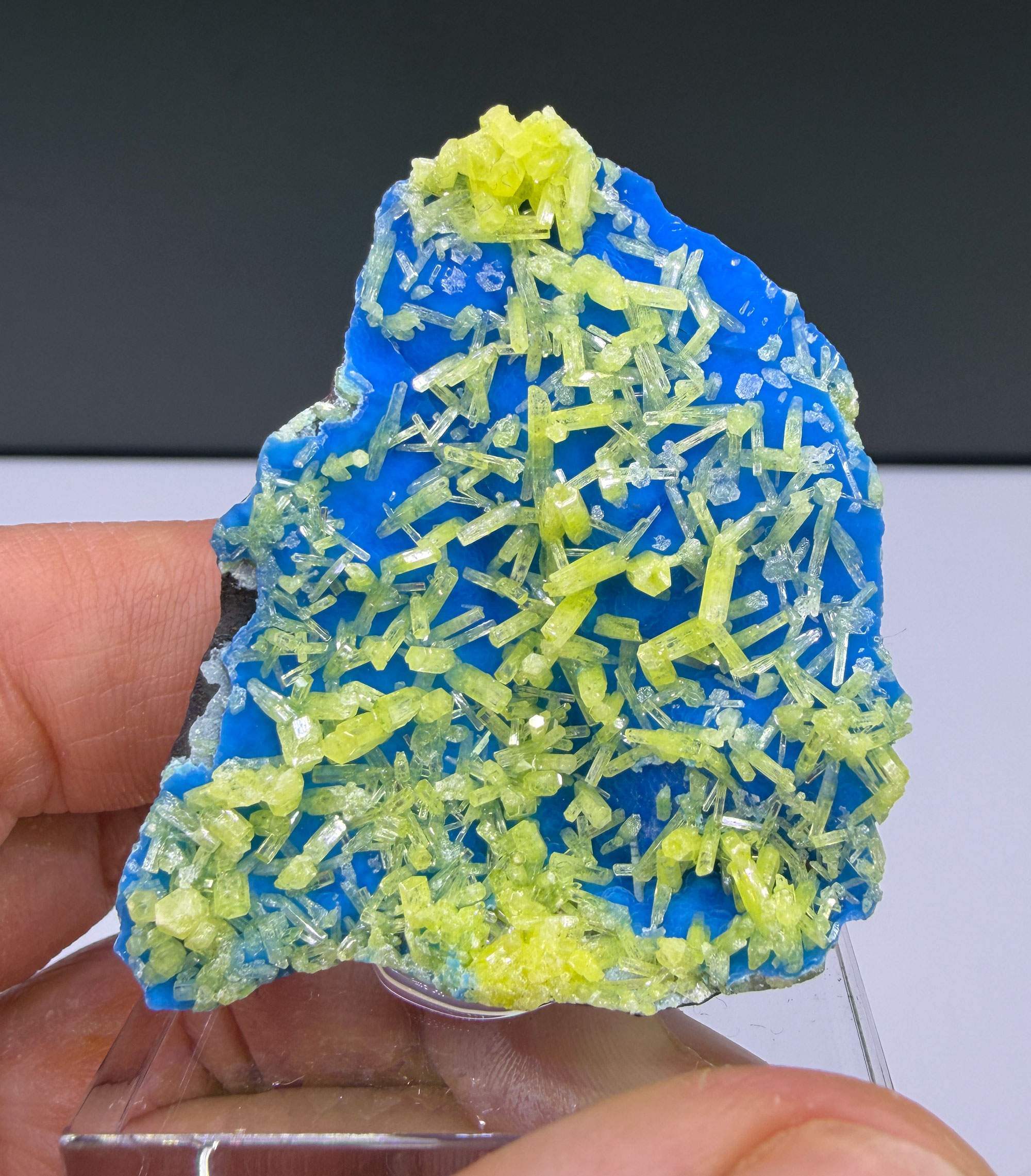
Or, finally, mimetite can grow on vivid blue philipsbornite, which is a unique combination and a signature of the find.
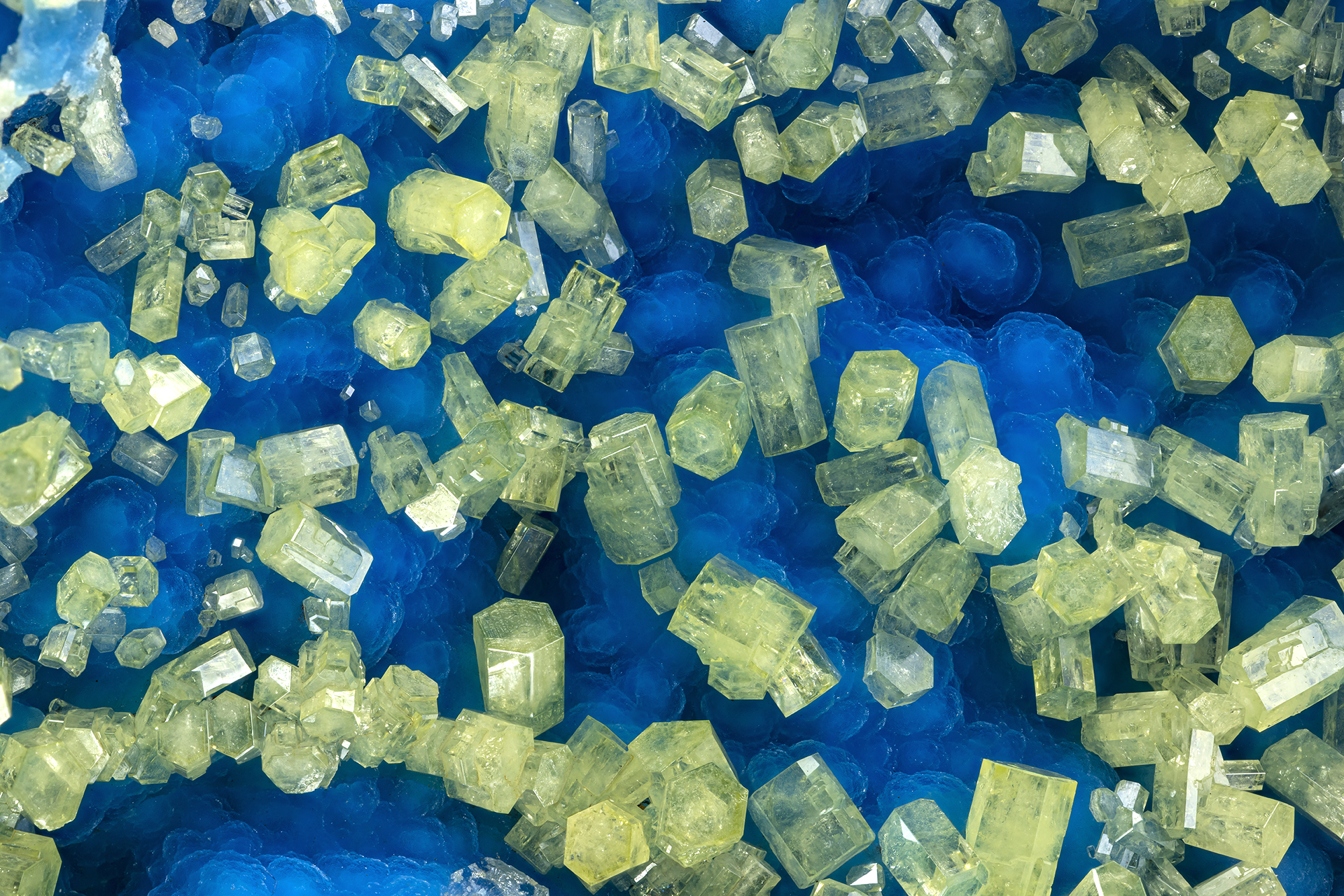
Close-up of a specimen of mimetite growing on philipsbornite—a signature combination of the find. FOV 3 cm. Photo by László Kupi.
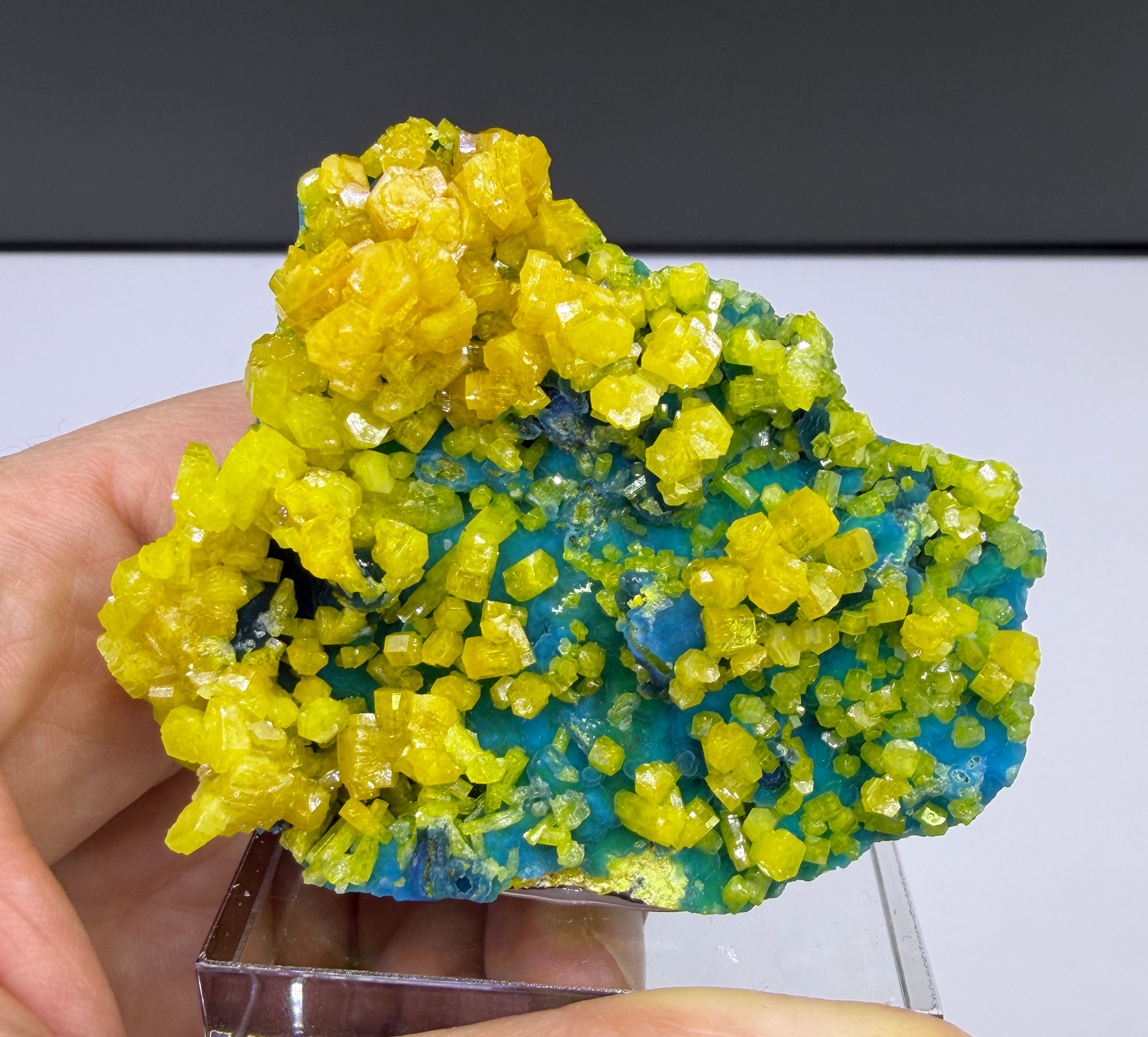
Specimen of mimetite growing on philipsbornite—a signature combination of the find.
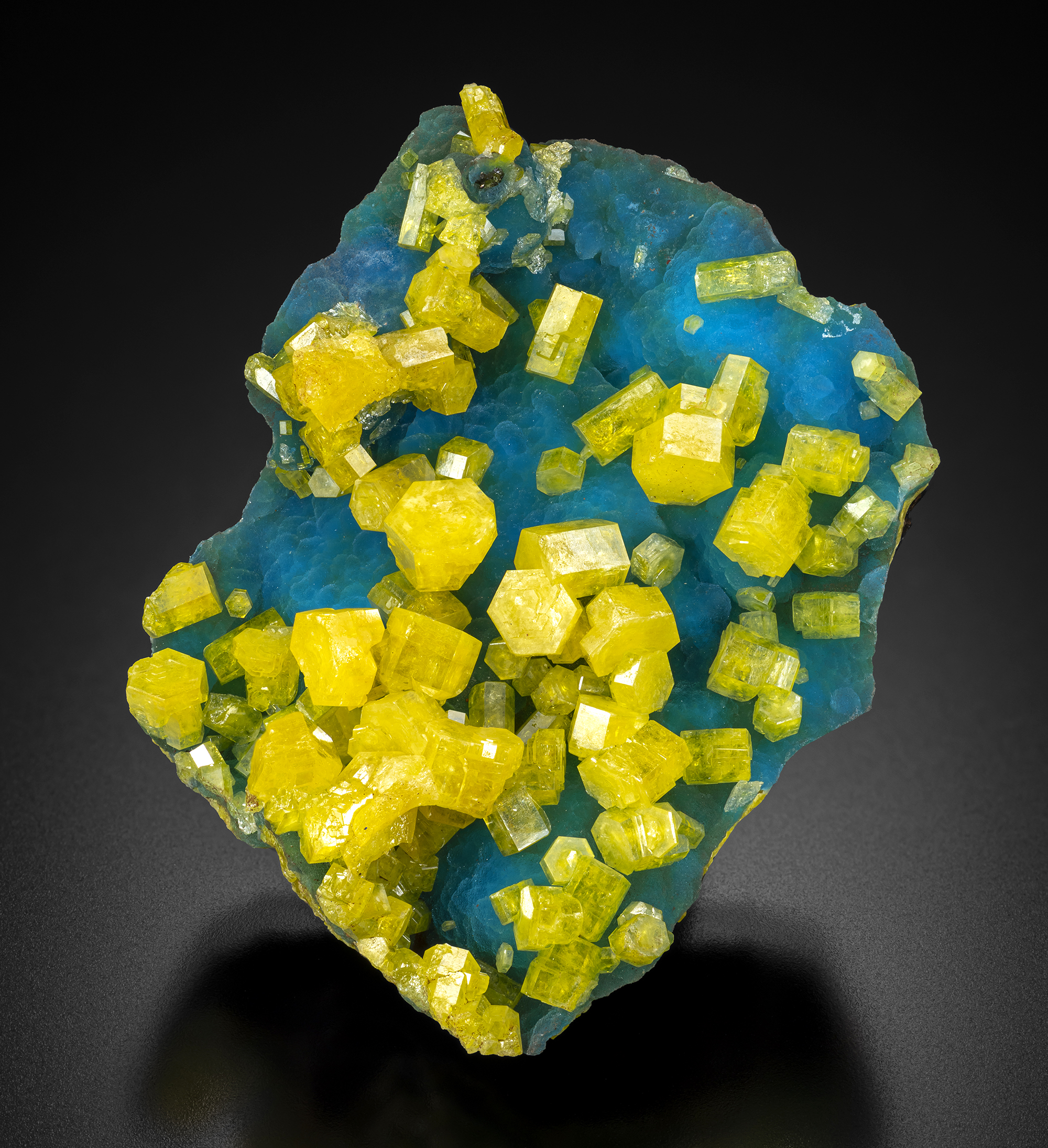
Mimetite growing on philipsbornite—a signature combination of the find. Size 3.3 cm. Photo by László Kupi.
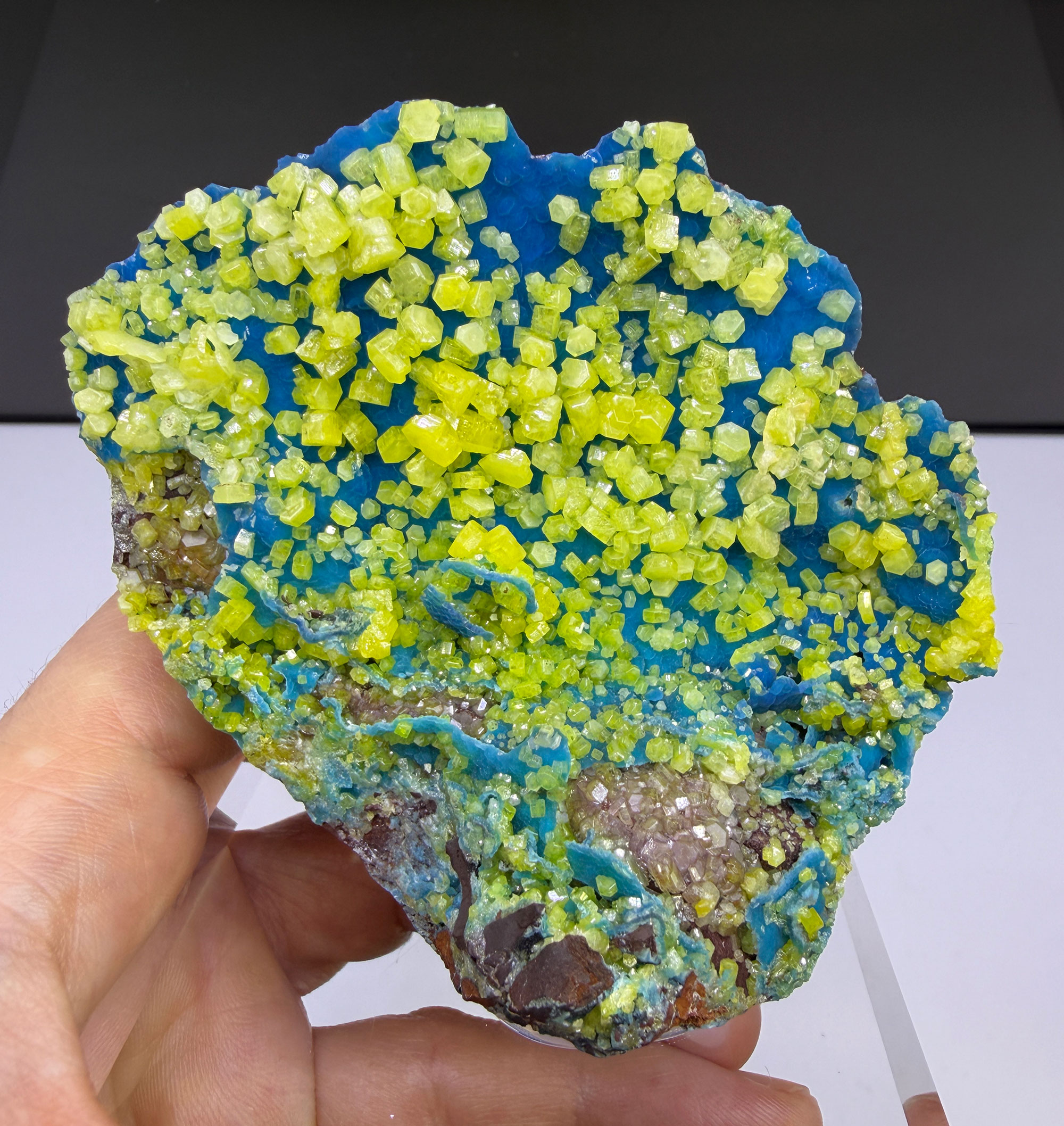
One of the very few larger specimens with mimetite growing on philipsbornite—a signature combination of the find.
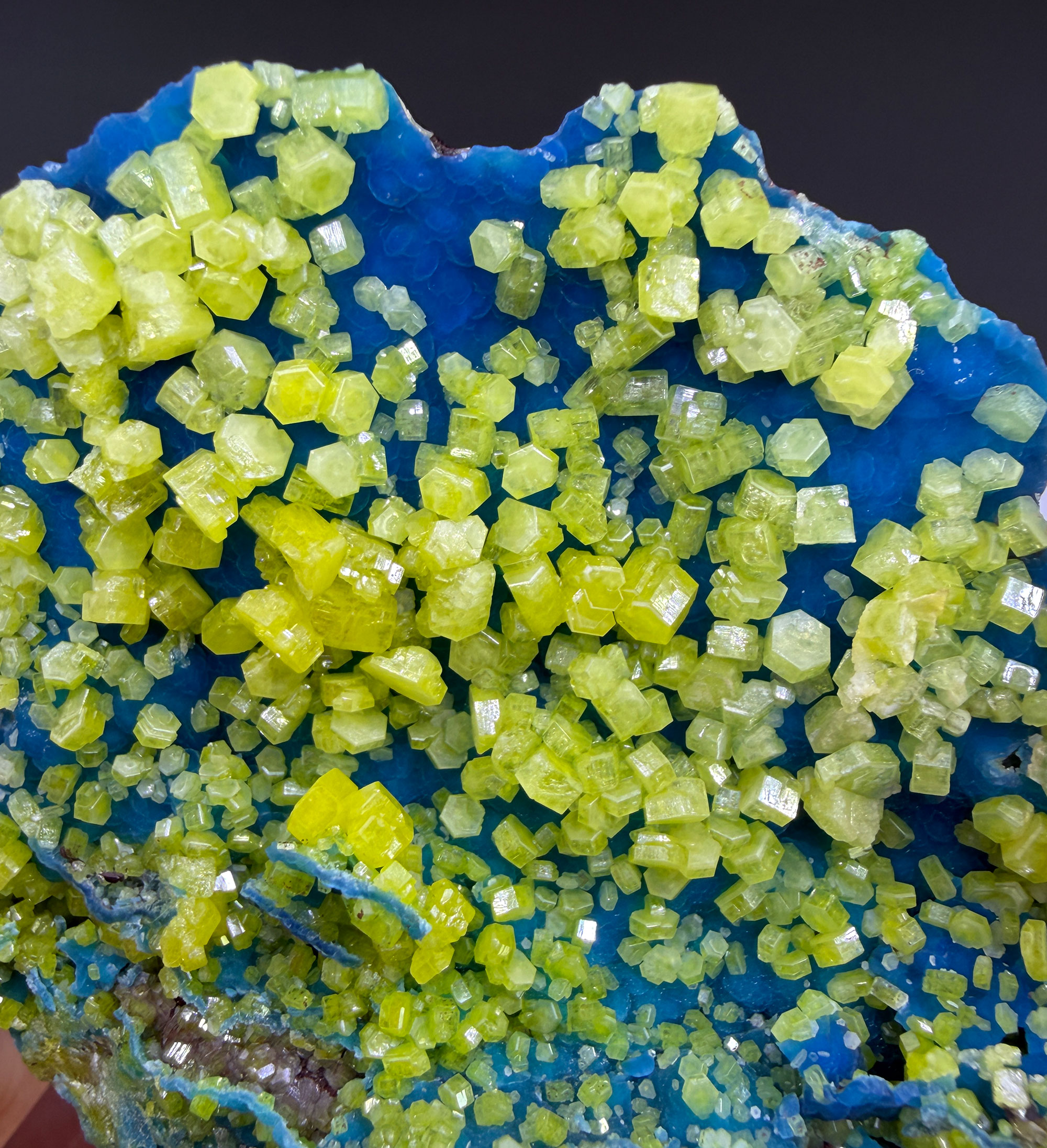
Close-up of the specimen shown above.
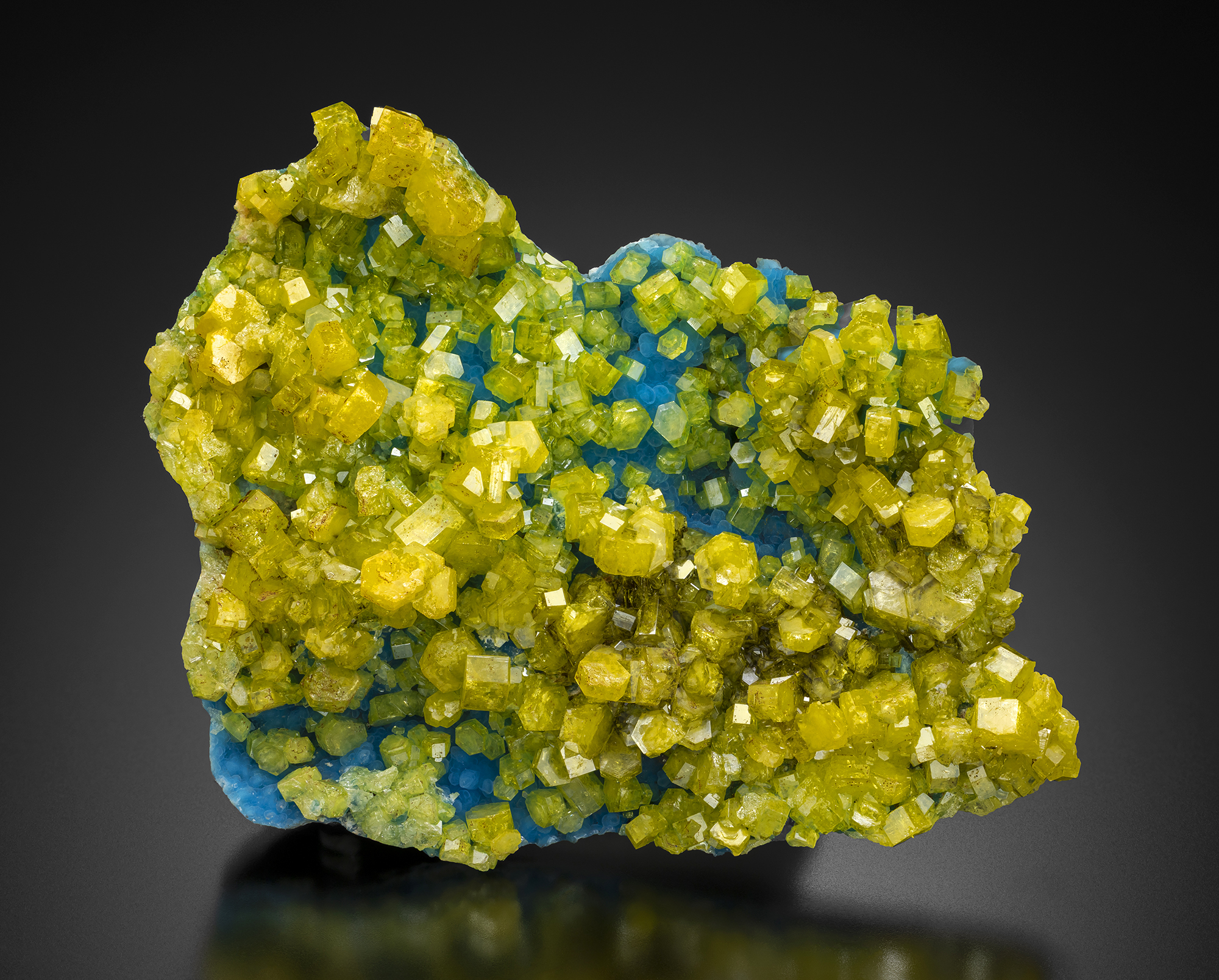
Mimetite growing on philipsbornite—a signature combination of the find. Size 6 cm. Photo by László Kupi.
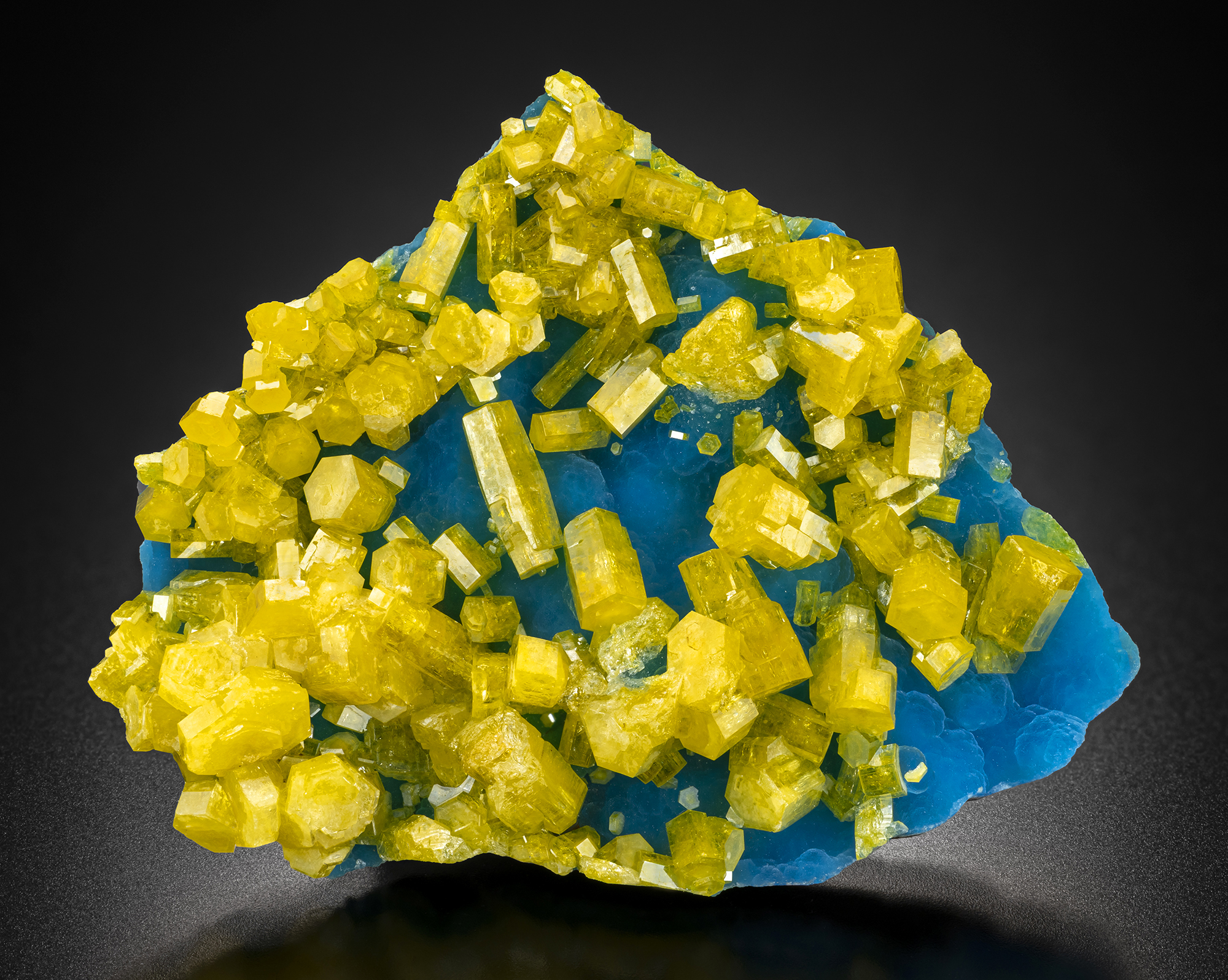
Mimetite growing on philipsbornite—a signature combination of the find. Spirifer collection. Size 3.8 cm. Photo by László Kupi.
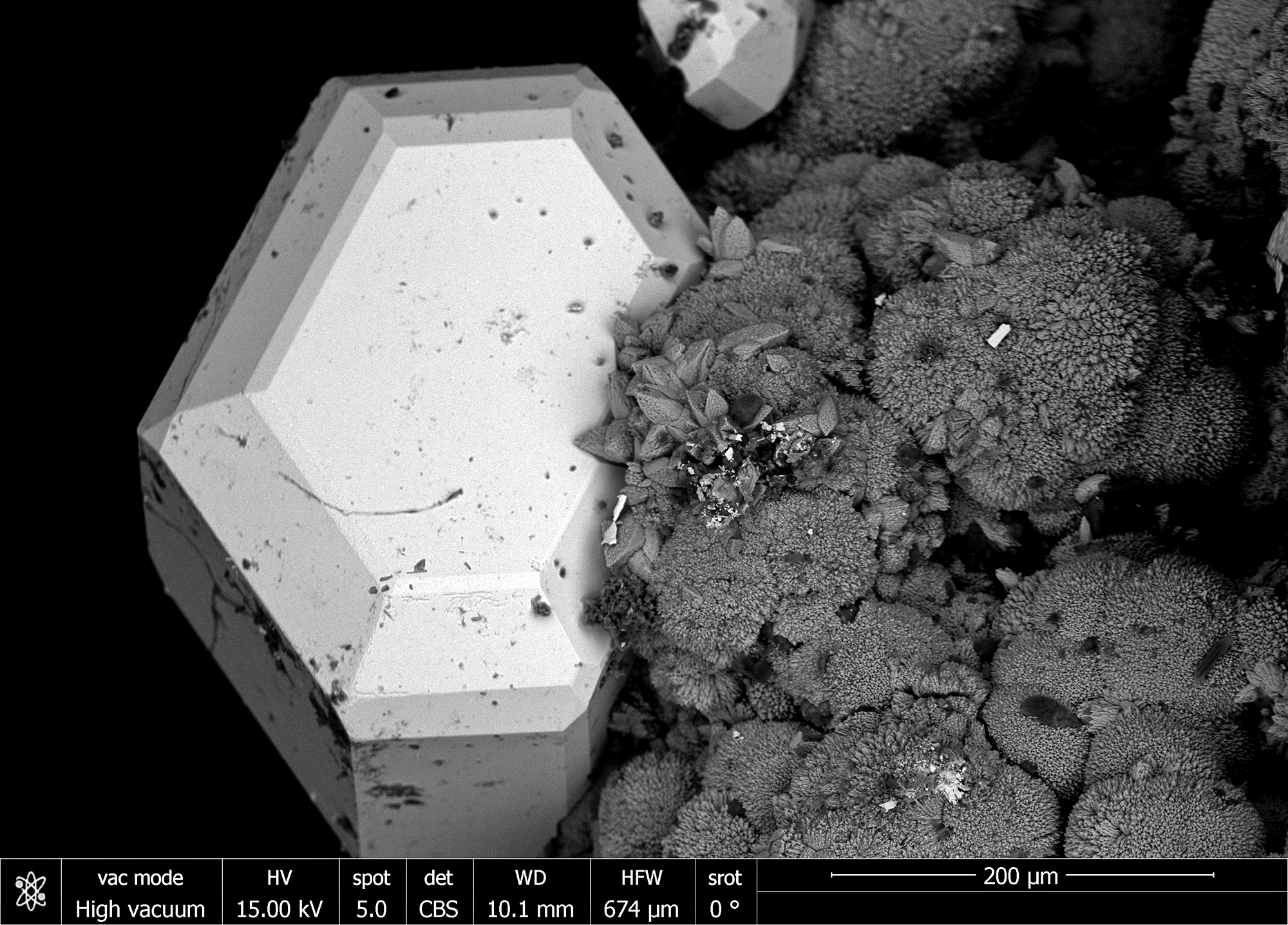
Scanning electron microscope image of a mimetite crystal with philipsbornite.
It is important to note that in some cases visual distinction between mimetite and pyromorphite is almost impossible without detailed knowledge of the analytical results for specific crystal morphotypes and color varieties.
Philipsbornite PbAl3(AsO4)(AsO3OH)(OH)6
Yanga Koubenza, and especially the nearby Palabanda area, is well known for vivid blue hemimorphite, which is why at an early stage the species described here was visually identified as such. Later, more detailed investigations raised doubts about this identification, resulting in a series of analytical studies (XRD and Raman spectroscopy) carried out to determine the species accurately. These analyses ultimately confirmed, without doubt, that the mineral is philipsbornite.
Within the find, philipsbornite occurs as carpet-like layers of drusy crystals coating pocket walls. The thickness of these coatings is typically around 1 mm but may locally reach 2–3 mm. Colors range from black through dark navy blue and lighter blue shades to nearly white. Part of this color variation depends on the thickness of the philipsbornite layer and the transmitted color of the underlying matrix. However, distinct differences in color saturation and hue are also observed within the species itself.
The origin of the blue coloration has not yet been the subject of dedicated research, but the slightly elevated copper content revealed in some analyses suggests that Cu is likely responsible for this phenomenon. “Pure” philipsbornite is nearly colorless.
The best philipsbornite specimens from Yanga Koubenza are arguably the finest examples of this species known worldwide. The most outstanding specimens measure from approximately 5 cm to over 10 cm and display vivid blue philipsbornite “carpets” coating the matrix, in some cases associated with yellow mimetite. Among the most striking specimens from the entire find are deep yellow, lustrous mimetite crystals growing on vivid blue philipsbornite. Such combinations are known exclusively from this unique occurrence.
The total number of high-quality philipsbornite specimens, including those associated with mimetite, is very limited and probably does not exceed a dozen specimens.
In some pockets, philipsbornite overgrows an older generation of mimetite, sometimes represented by prismatic crystals, up to 2 cm in length, partially mimicking their crystal shape. These philipsbornite coatings may in turn be overgrown by a later generation of mimetite.
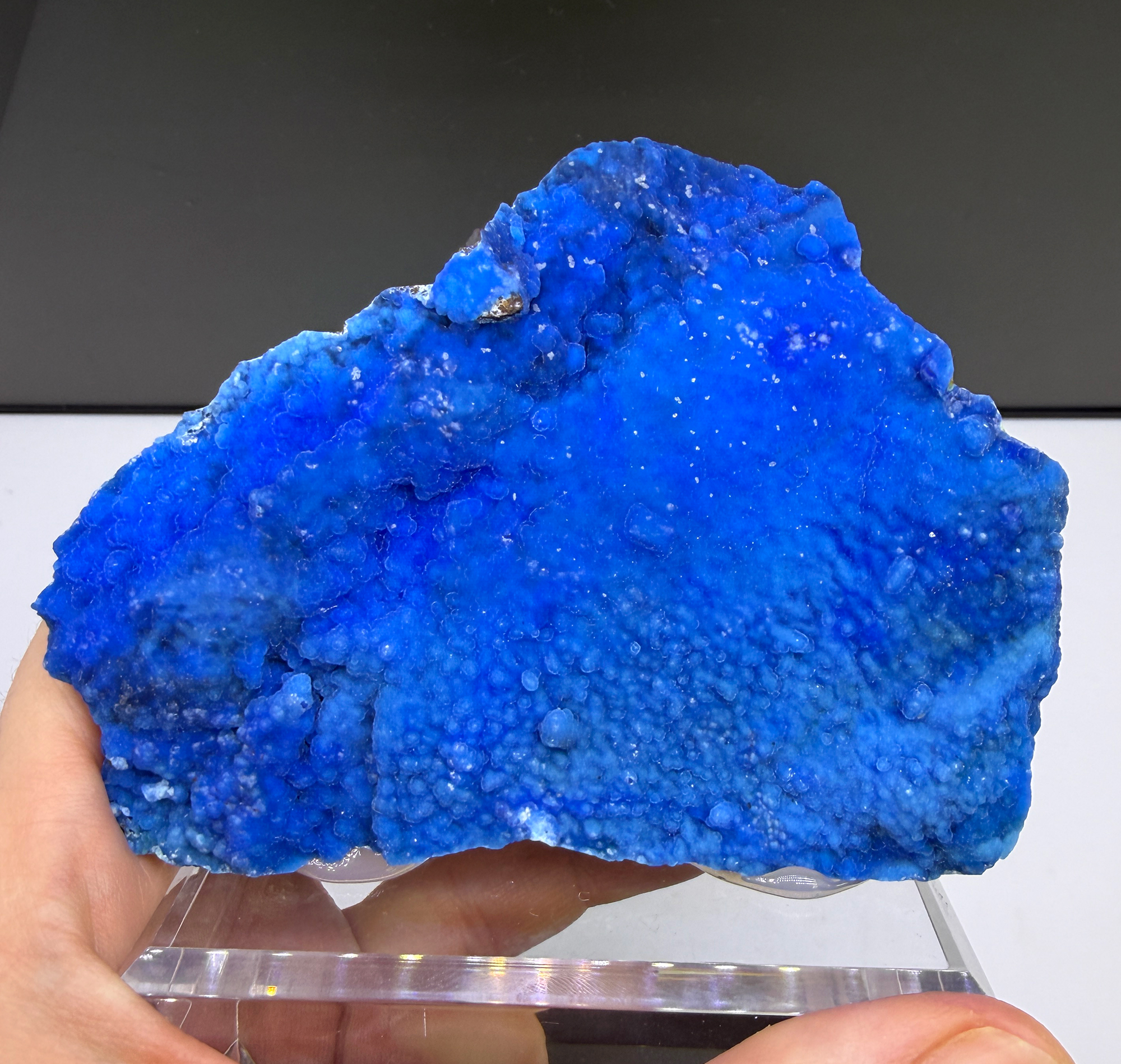
One of the largest high-quality philipsbornite specimens from the find. Size approximately 9 cm.
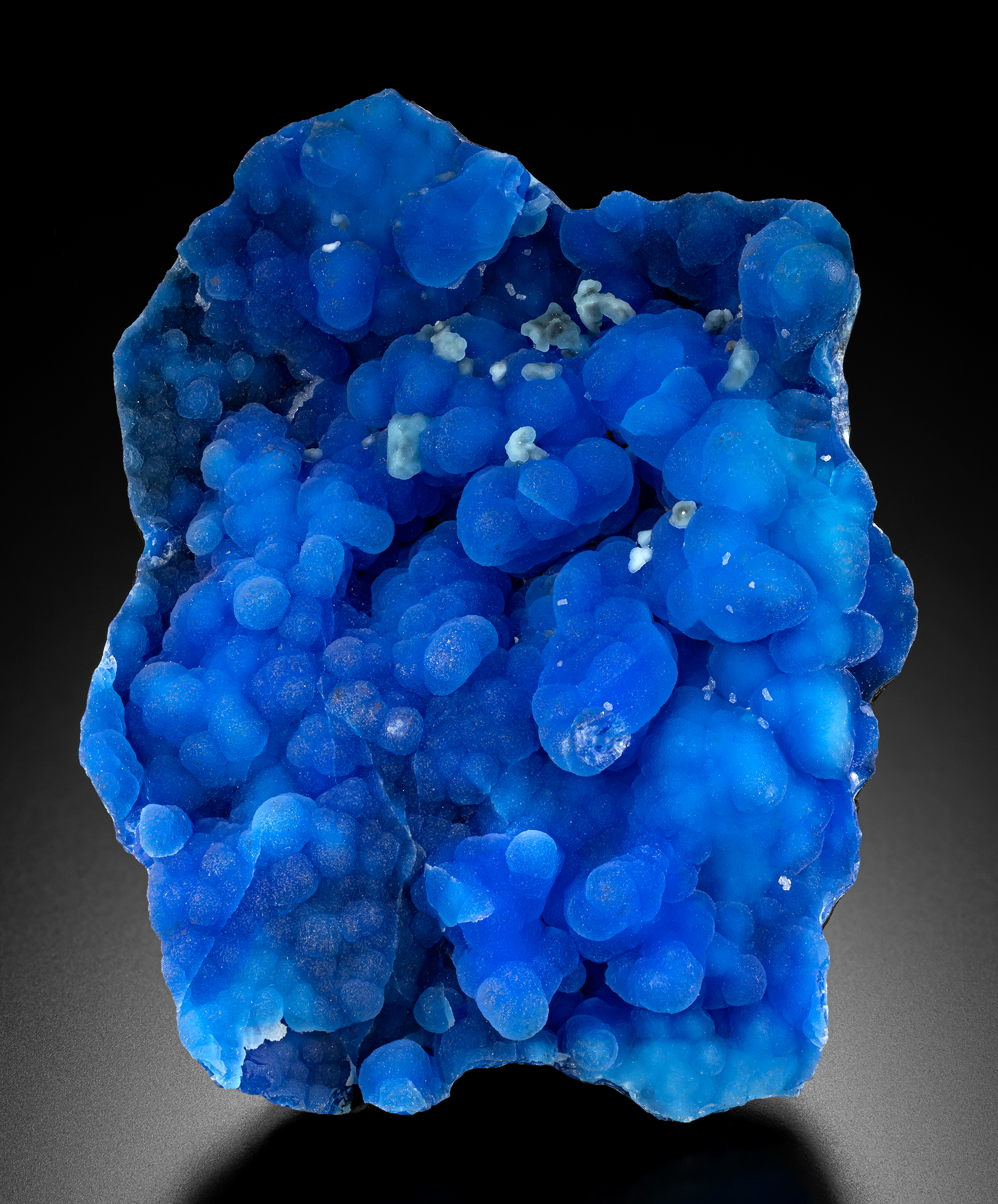
One of the best philipsbornite specimens from the find. Size 5.5 cm. Photo by László Kupi.
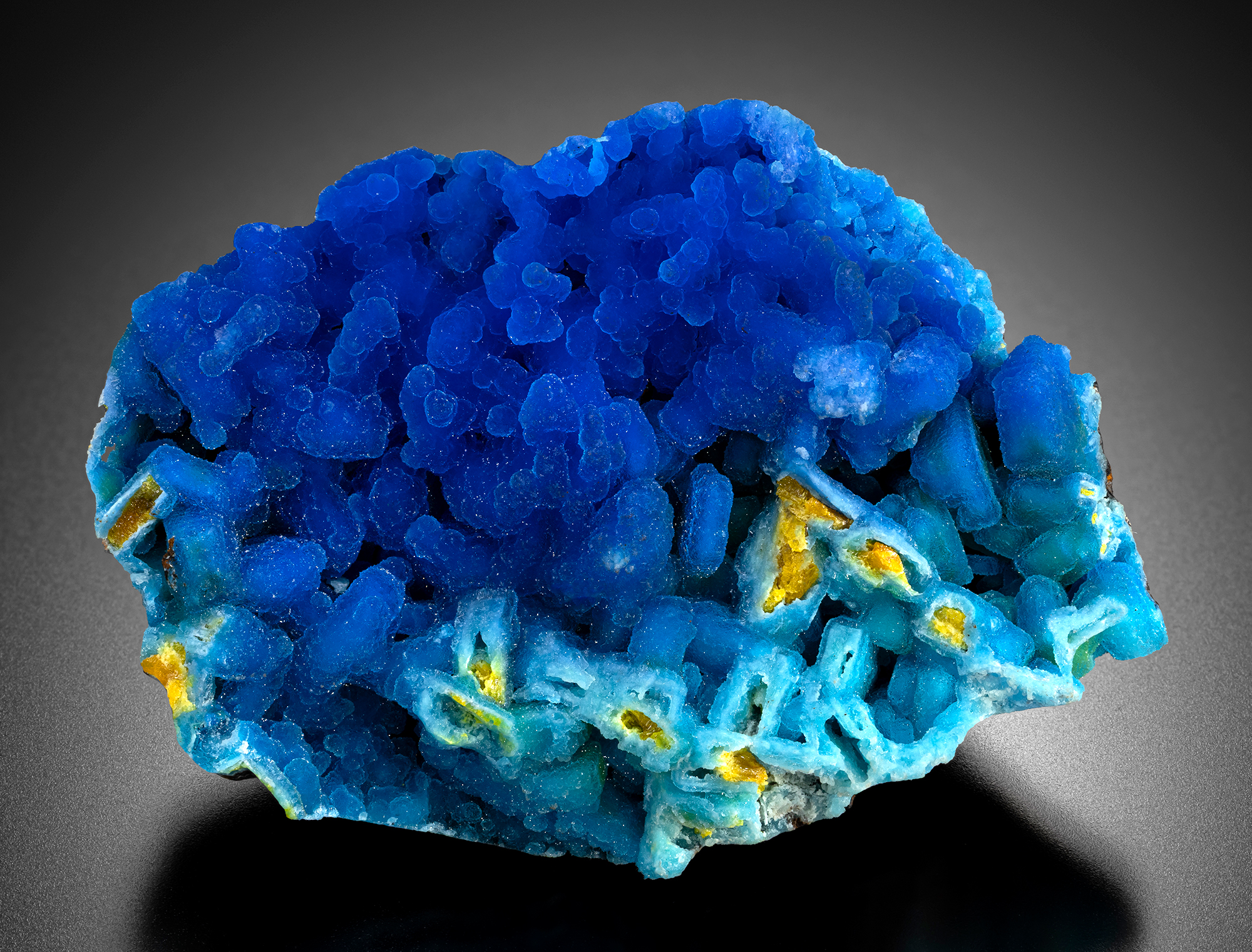
One of the best philipsbornite specimens from the find. The philipsbornite forms perimorphs after partially dissolved mimetite. Size 4 cm. Spirifer collection. Photo by László Kupi.
Video of the specimens shown above. Spirifer collection. Photo by László Kupi.
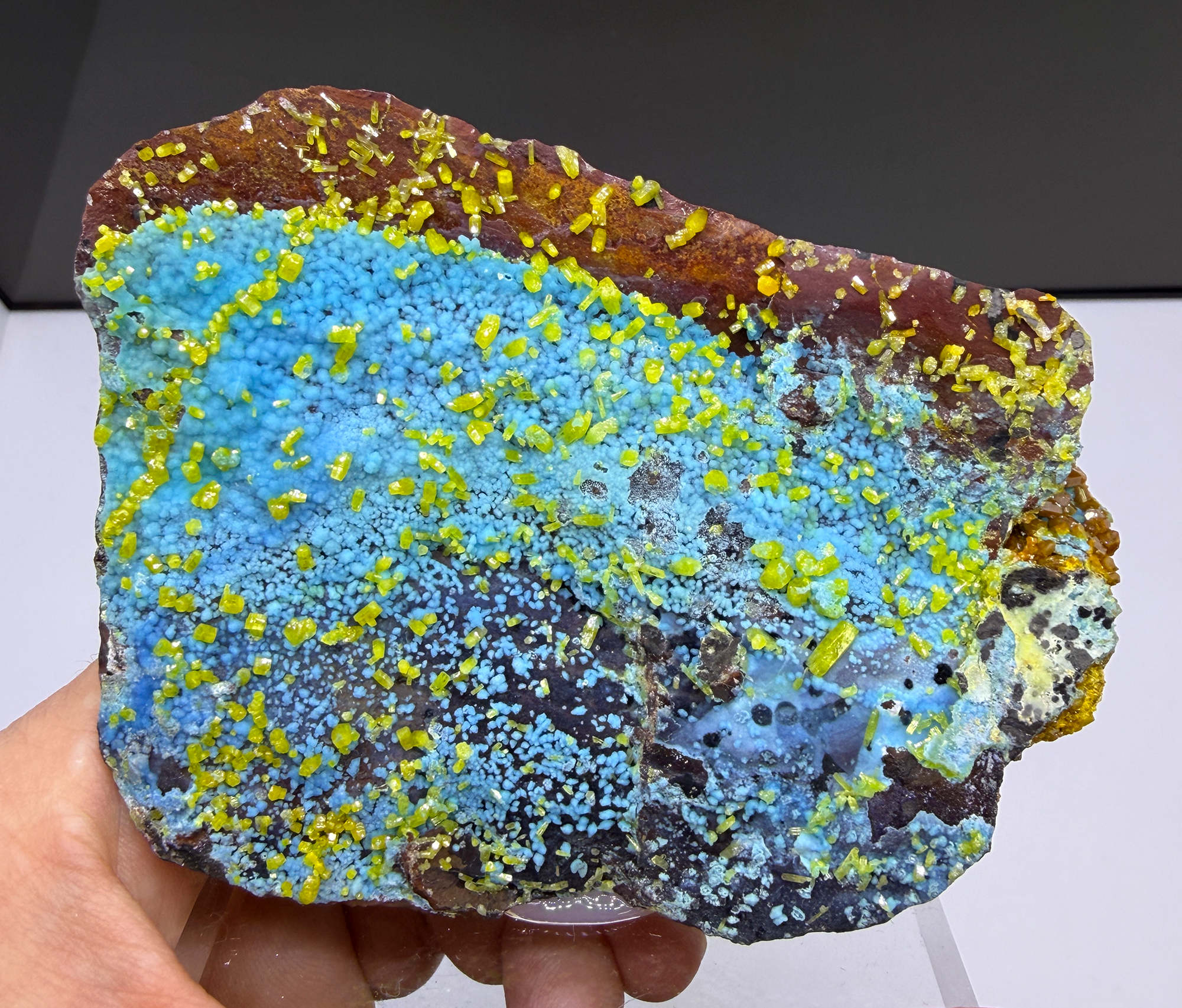
Relatively large specimens of philipsbornite with mimetite.
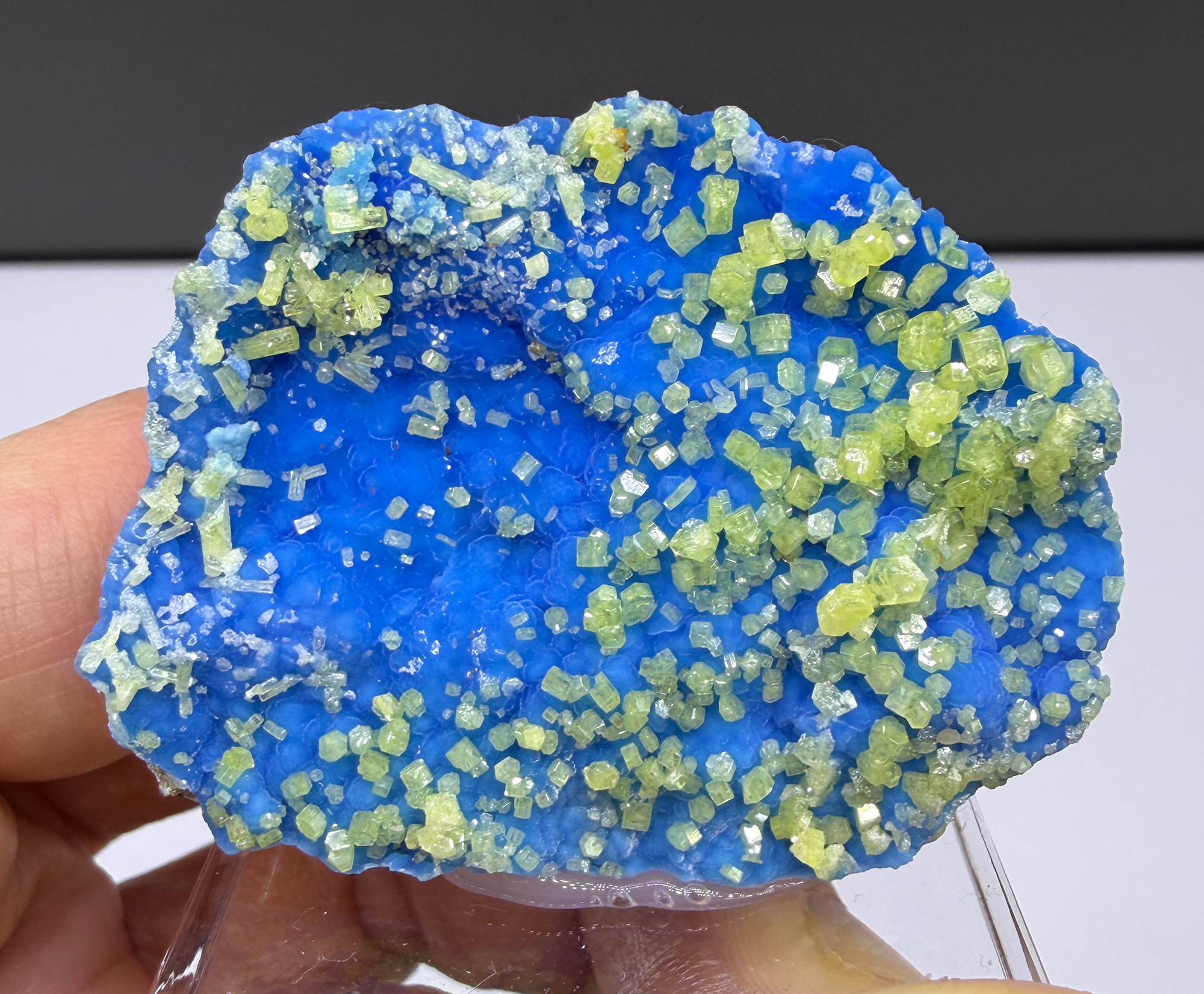
Philipsbornite with mimetite.
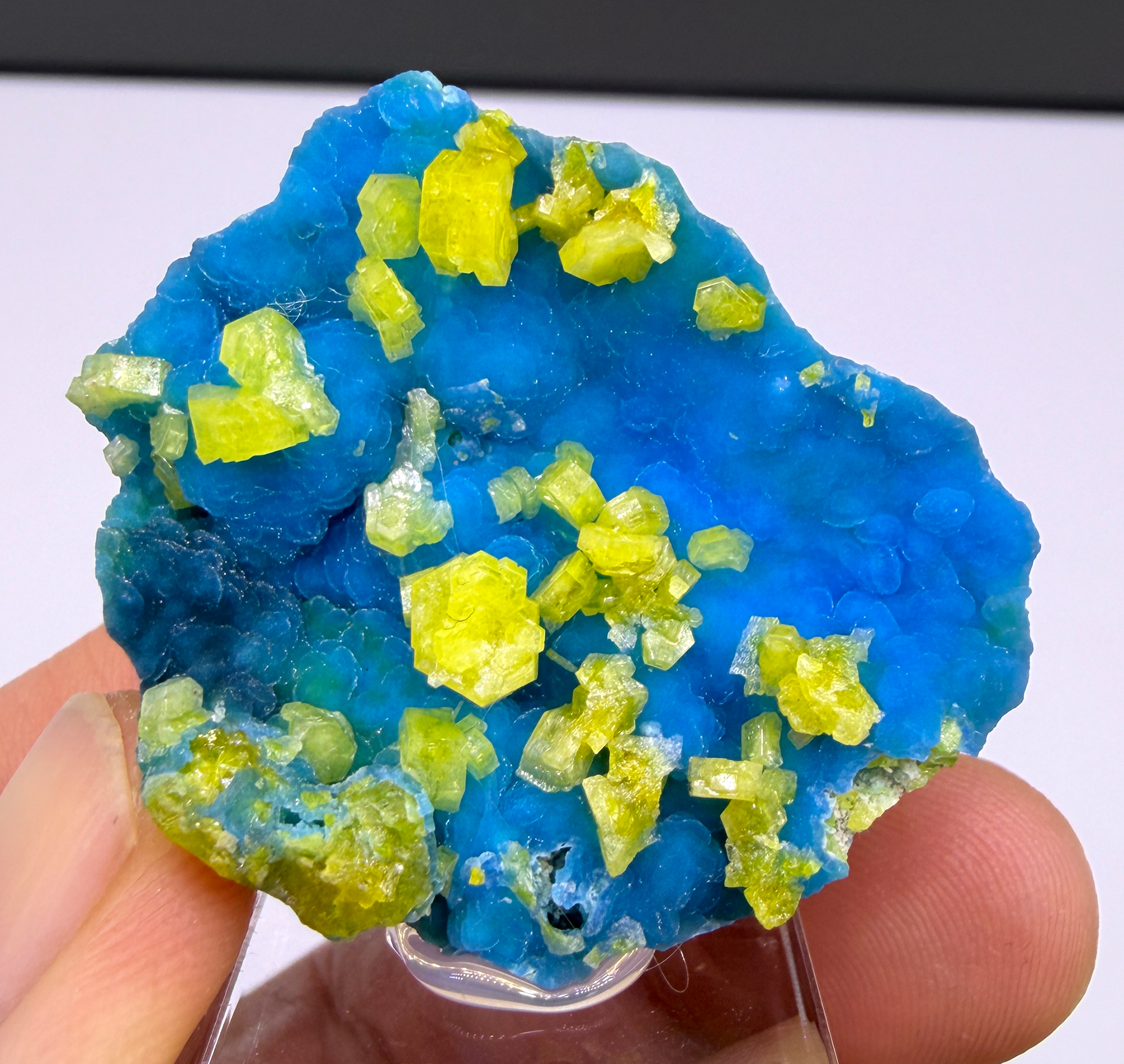
Mimetite growing on philipsbornite.
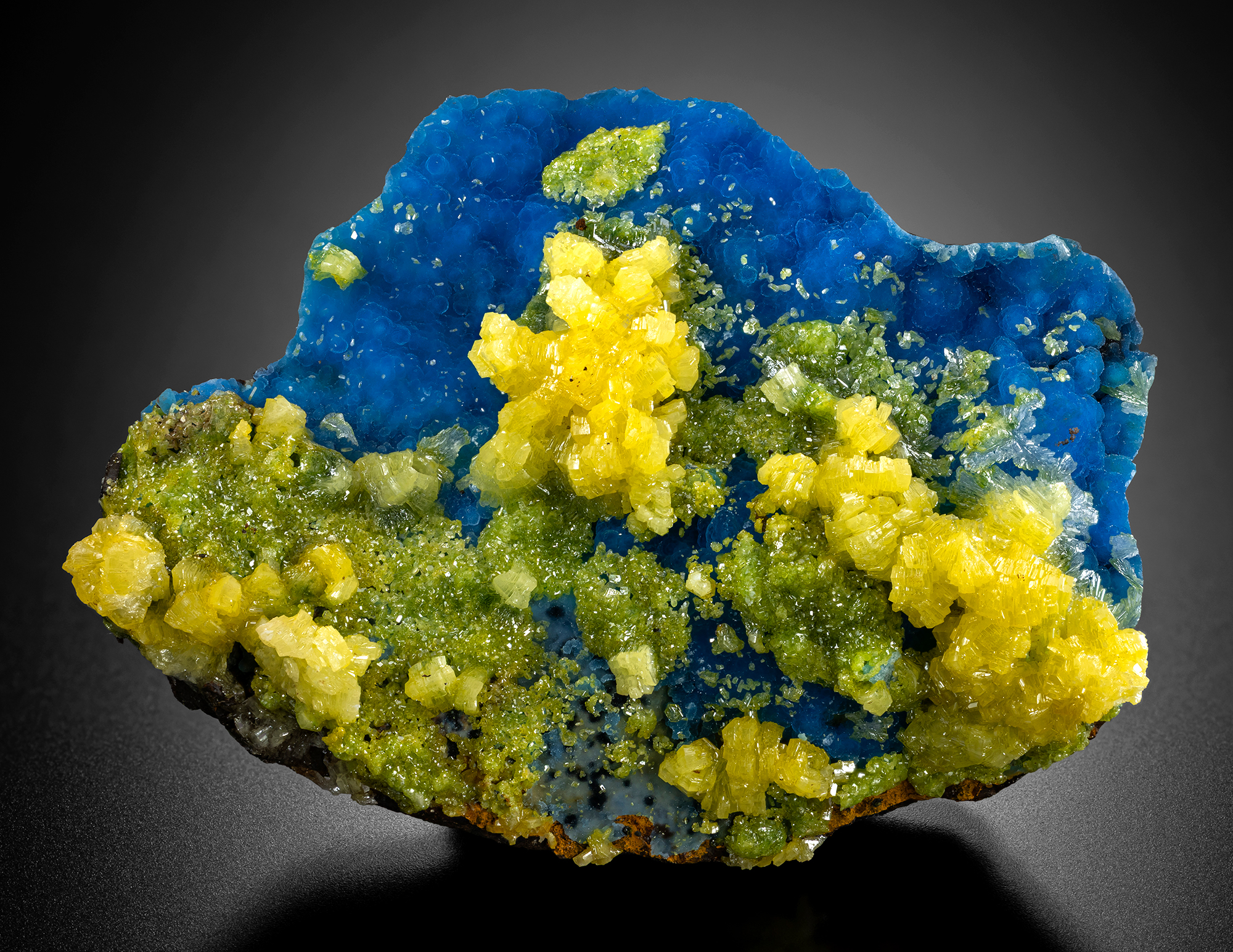
Mimetite growing on philipsbornite. Size 4.2 cm. Photo by László Kupi.
One of the finest specimens of mimetite growing on philipsbornite. Spirifer collection. Size 13.1 cm.
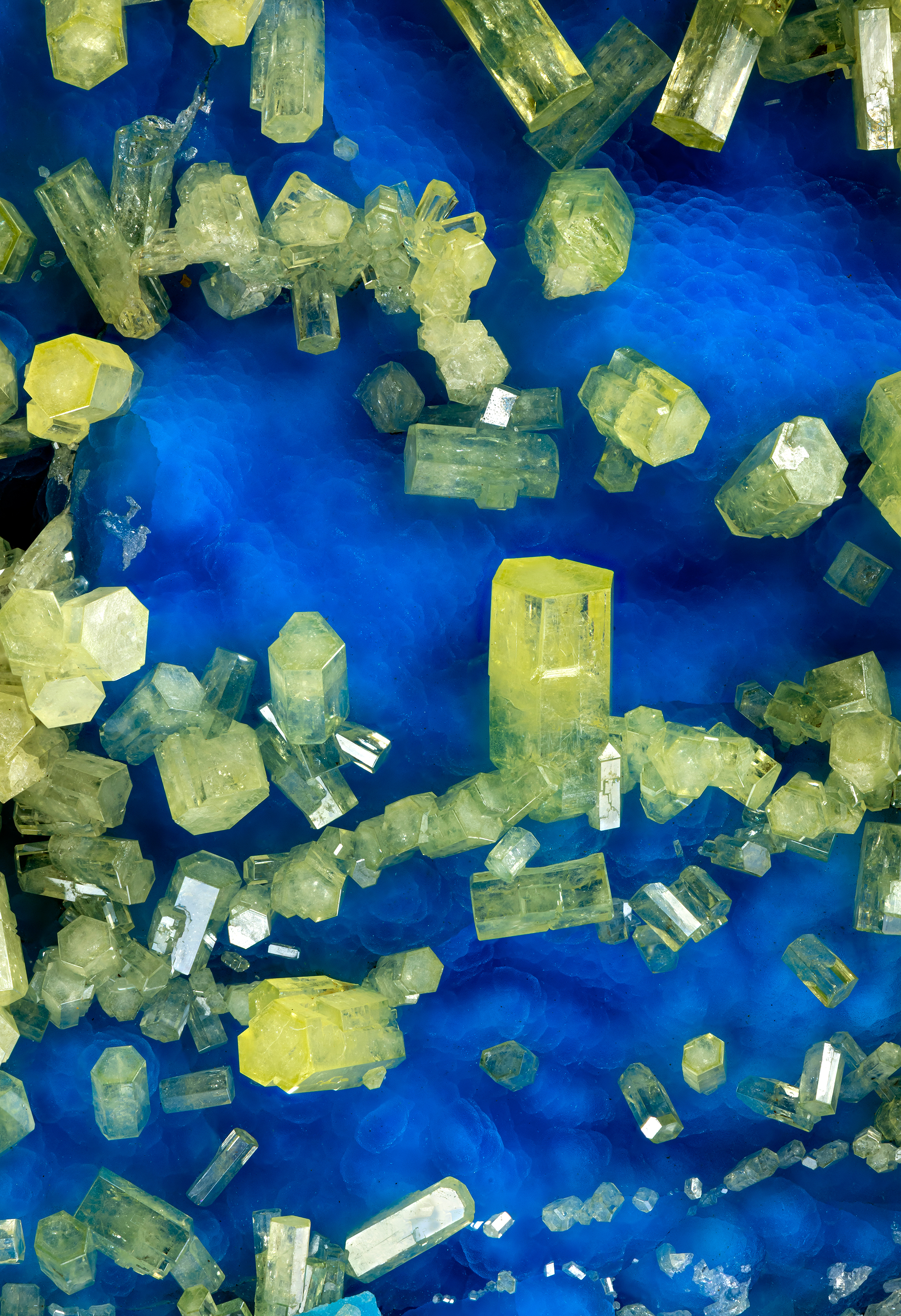
Close-up of a fragment of the same specimen. FOV 3.5 cm. Photo by László Kupi.
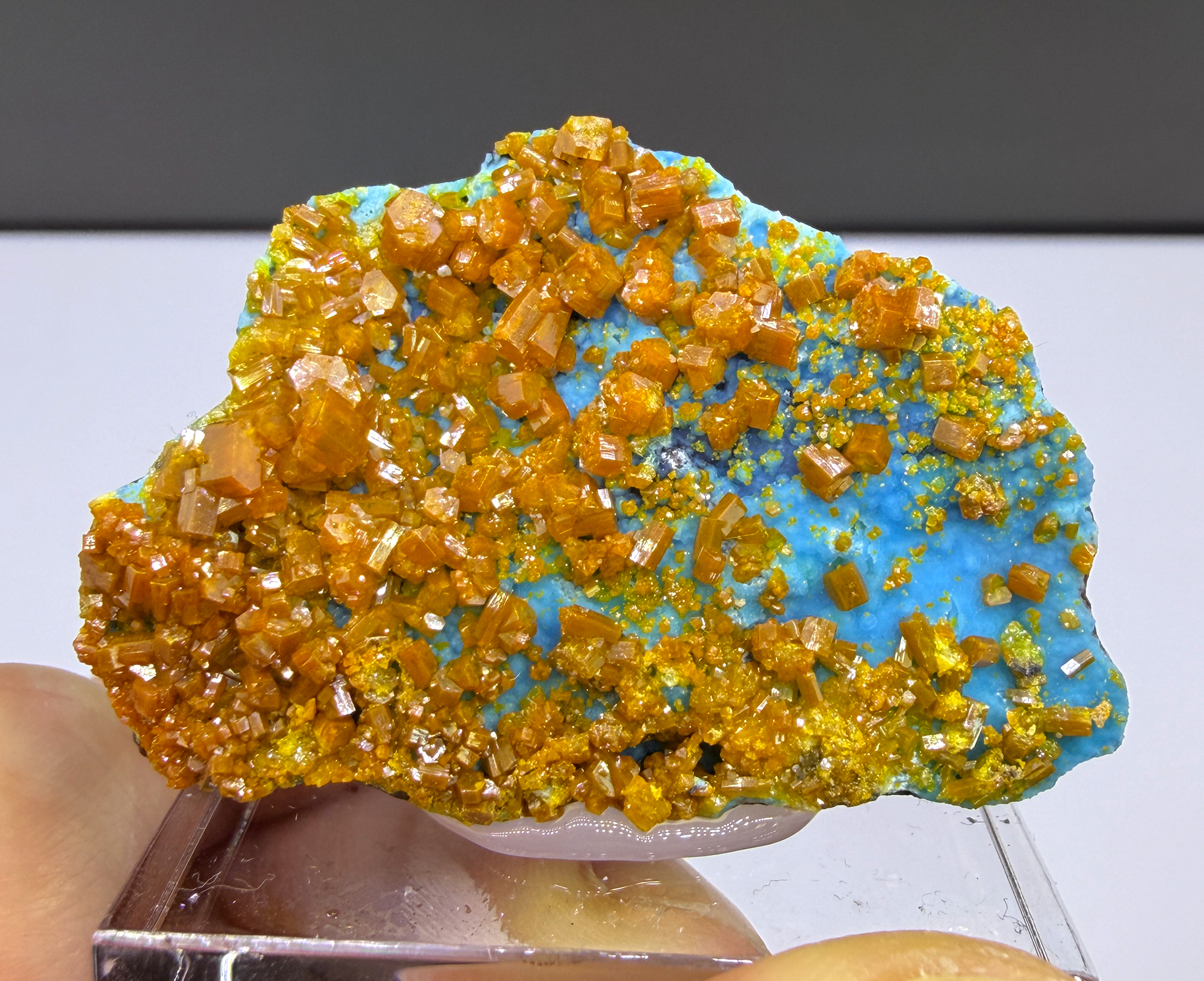
Reddish-orange mimetite growing on philipsbornite.
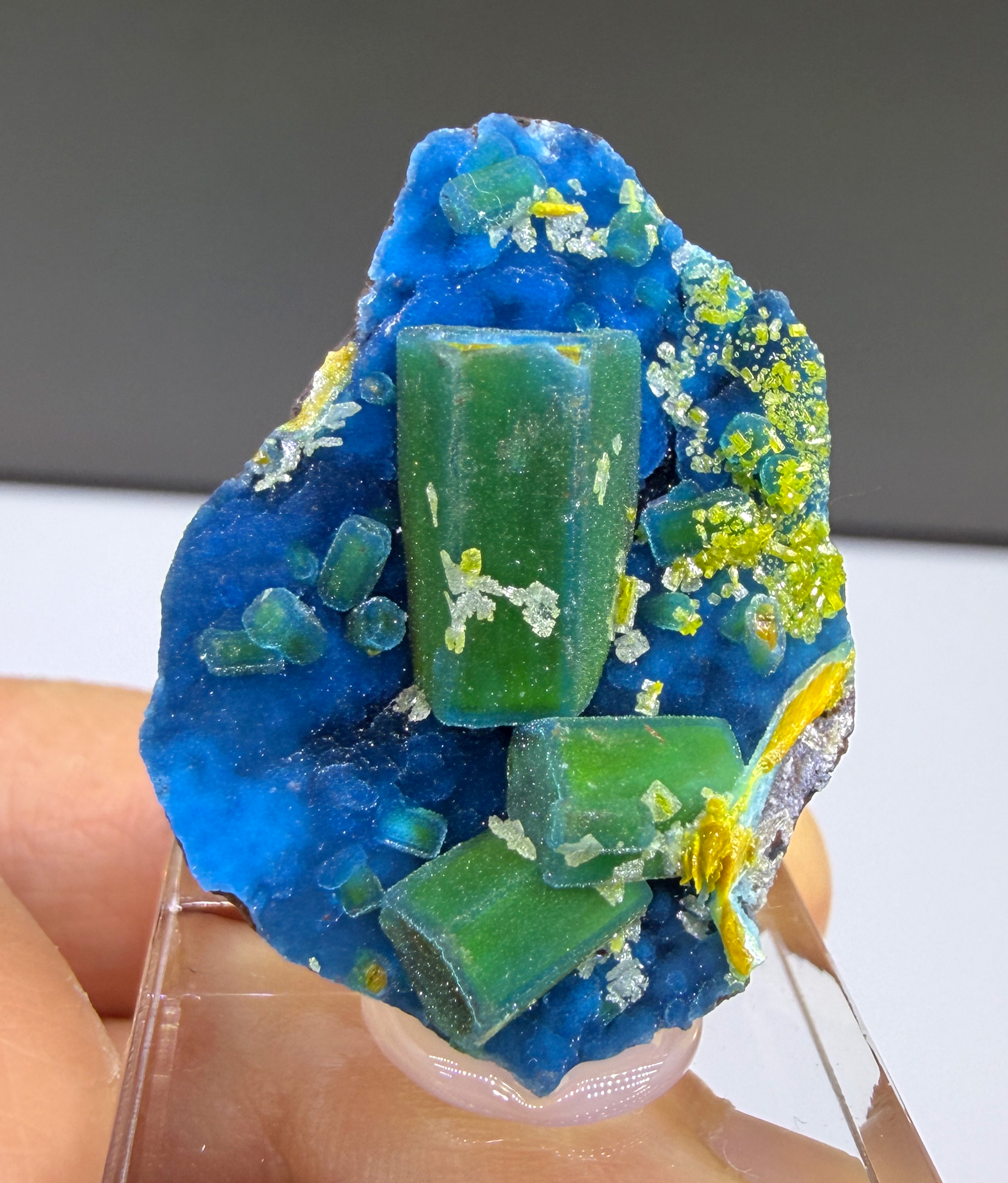
Philipsbornite overgrowing a mimetite crystal, with a second generation growing on the surface.
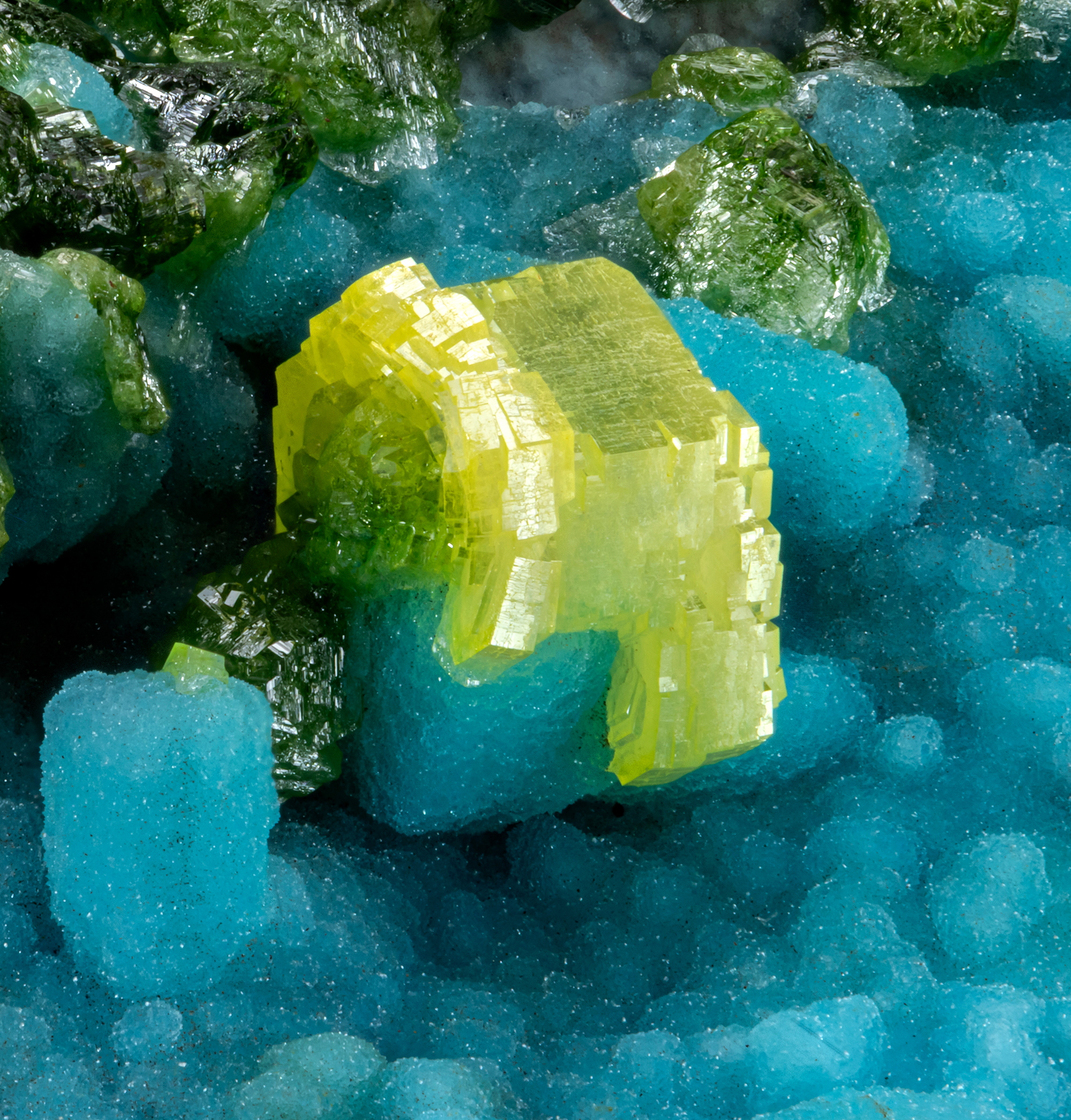
Syntaxial growth of mimetite overgrowing philipsbornite, which itself grows on an older generation of mimetite, with duftite present. FOV 1.5 cm. Photo by László Kupi.
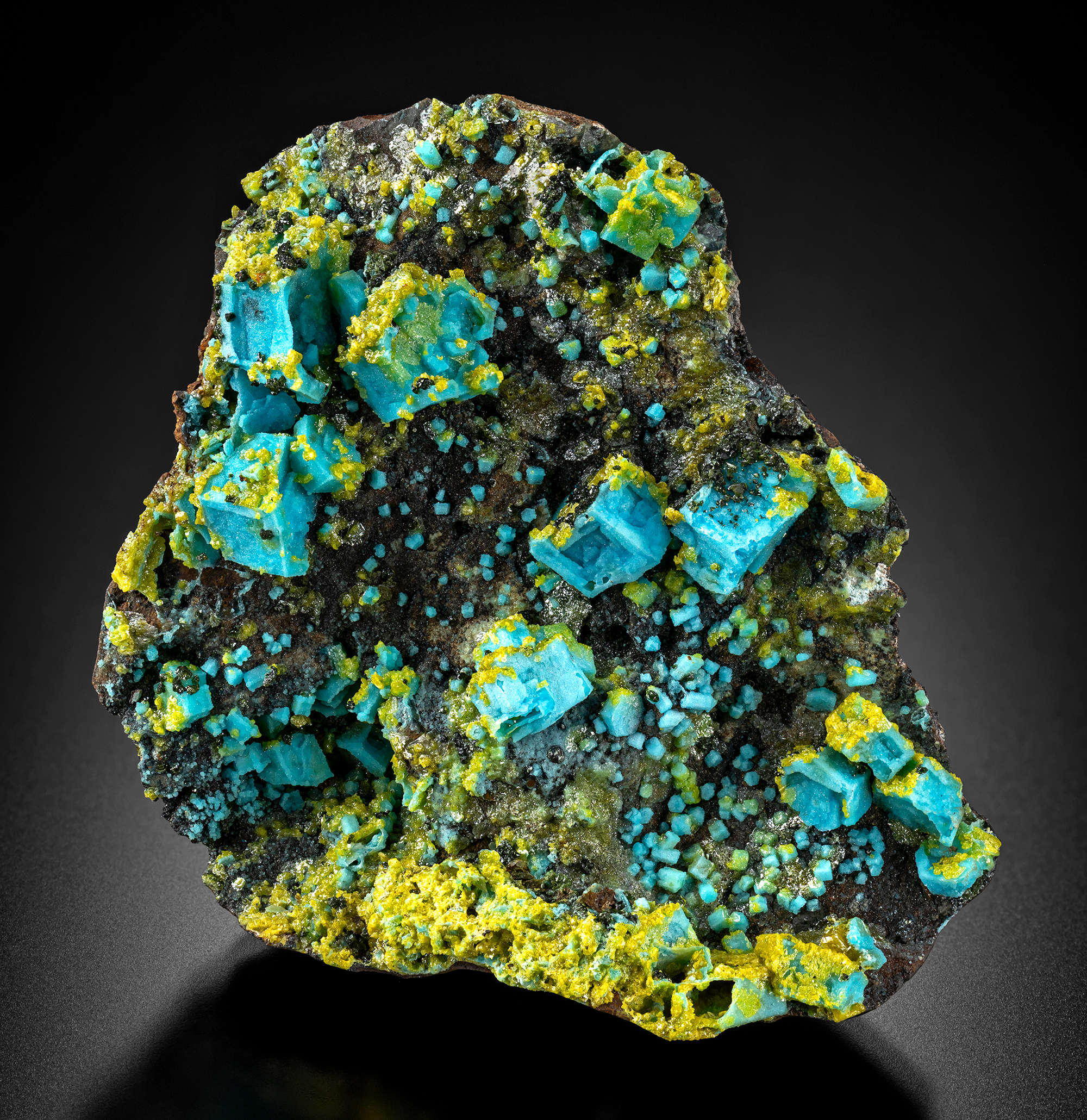
One-of-a-kind specimen of philipsbornite pseudomorphs after skeletal mimetite crystals, overgrown by a second generation of mimetite. Size 4.8 cm. Spirifer collection. Photo by László Kupi.
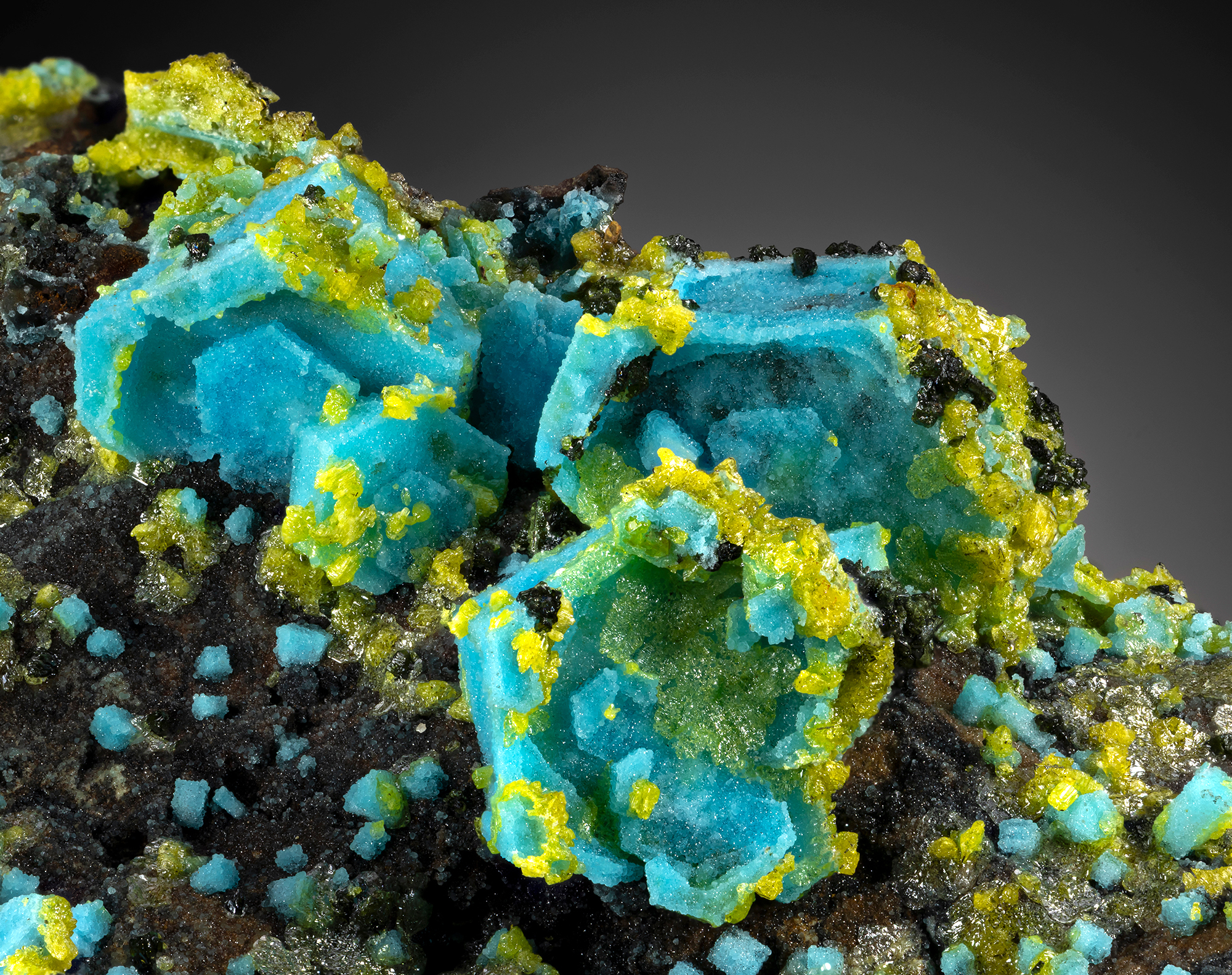
Close-up of the specimen shown above. FOV 4 cm. Spirifer collection. Photo by László Kupi.
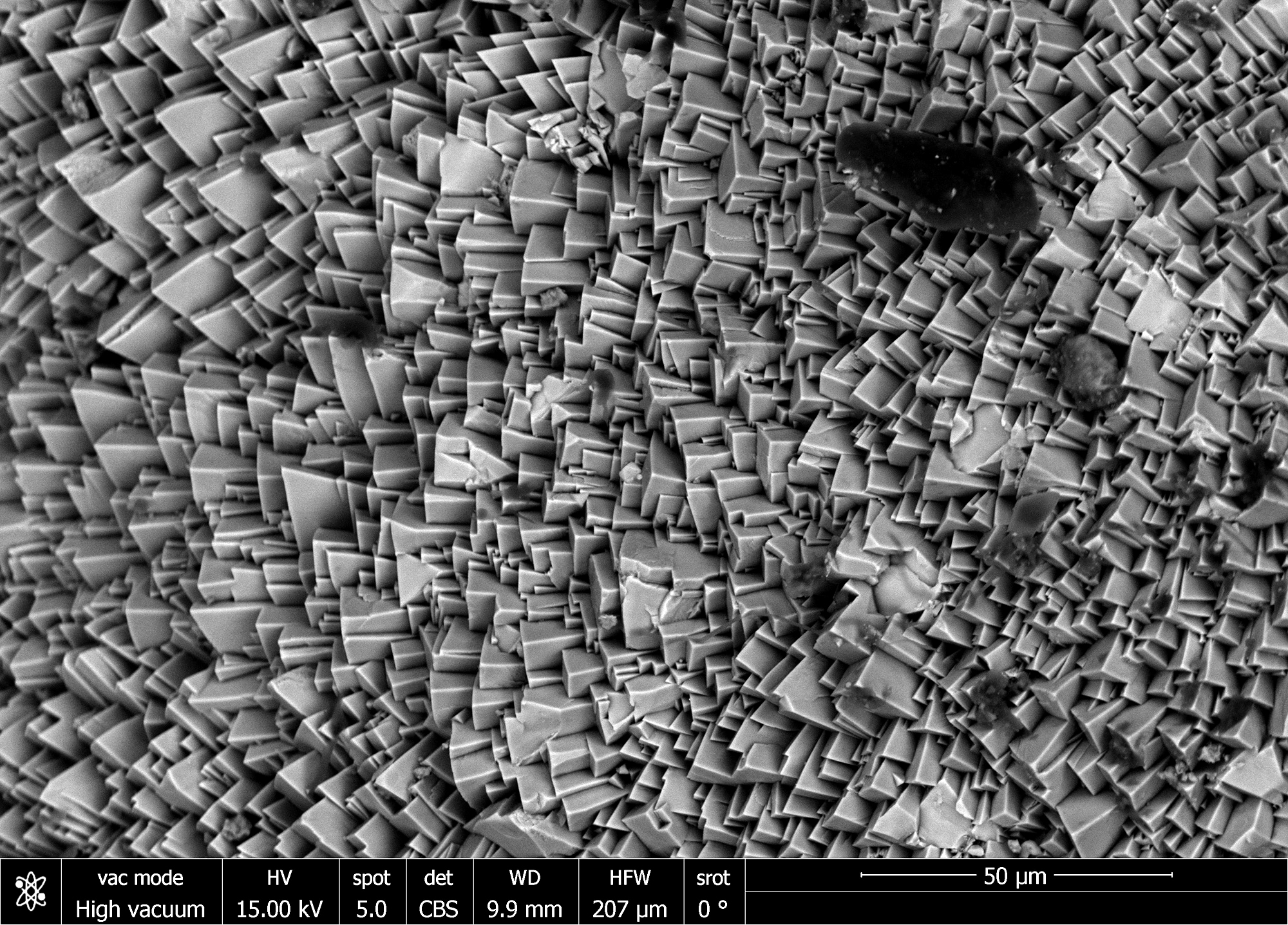
Scanning electron microscope image of an aggregate of philipsbornite crystals.
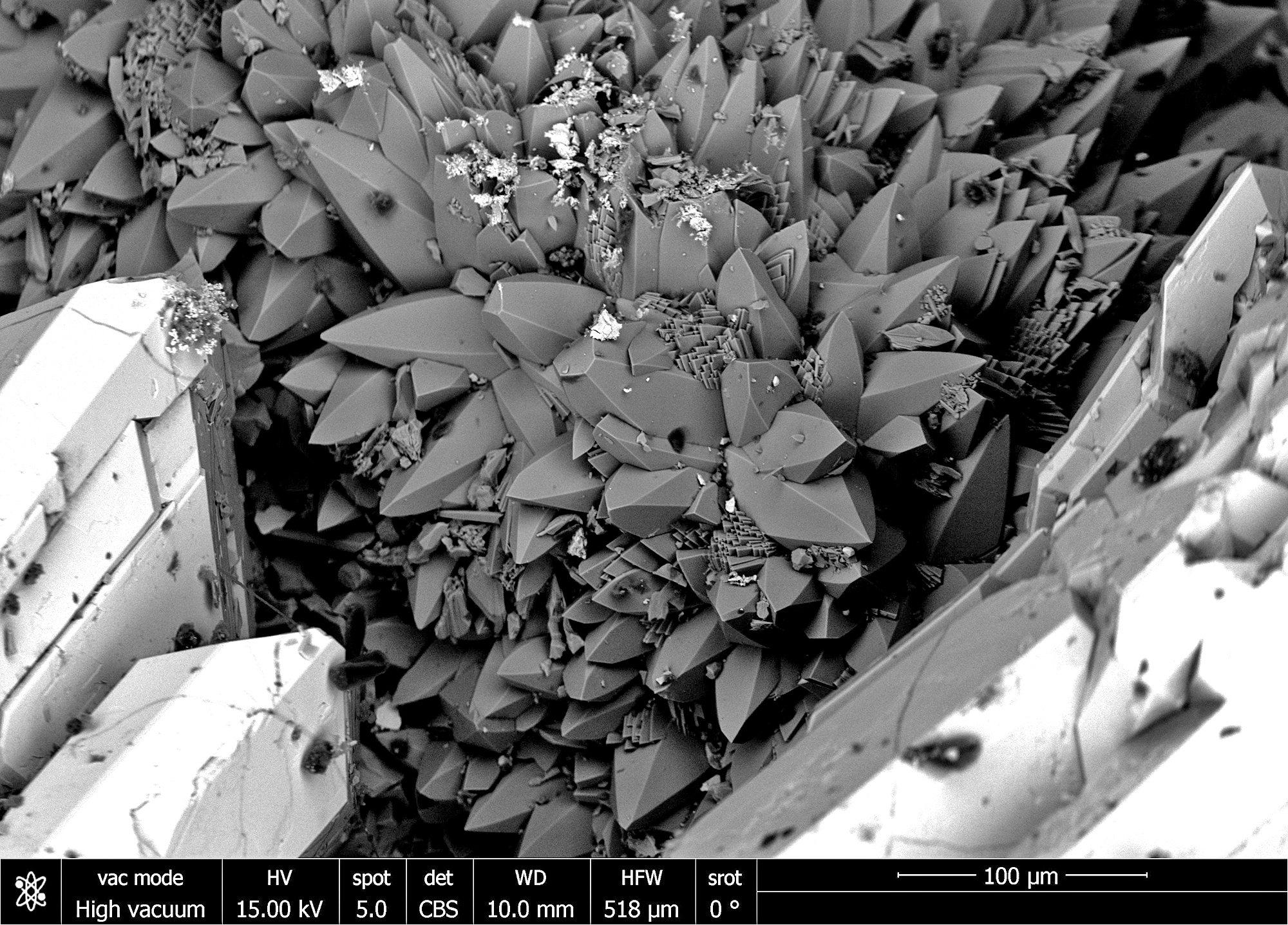
Scanning electron microscope image of an aggregate of philipsbornite crystals with mimetite.
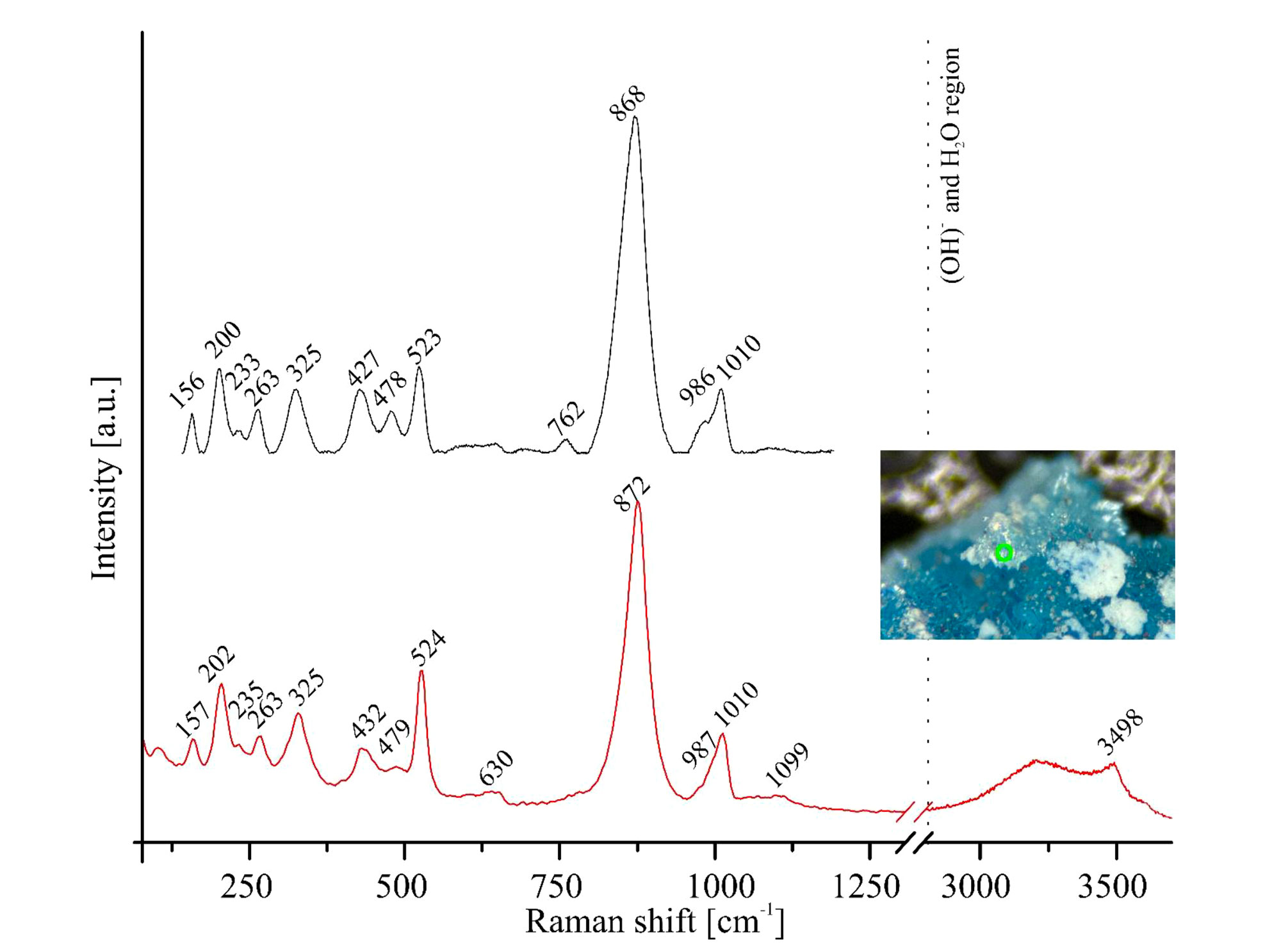
Raman spectrum confirming the presence of philipsbornite.
Pyromorphite Pb5(PO4)3Cl
Pyromorphite was known from the Yanga Koubenza quarry prior to the discovery of mimetite; however, specimens recovered from the mimetite zone represent a markedly higher quality.
In most cases, pyromorphite from this zone occurs as a solitary species, forming well-sized, well-formed crystals that completely cover the matrix. The majority of specimens consist of the typical prismatic pyromorphite crystals, with slightly curved faces resulting in a subtle barrel-shaped habit. Crystal colors range from vivid apple-green and yellowish-green through deep green to brownish-green. Individual crystals typically measure between 5 and 15 mm in length.
Very few specimens—most of them highly damaged—represent a different morphotype that is nevertheless worth mentioning. The best example of this type displays a complex aggregate of parallel-growing, highly elongated crystals exceeding 5 cm in length, exhibiting a slight barrel shape. The yellowish-green color and good luster are similar to those observed in the more common habit from this find.
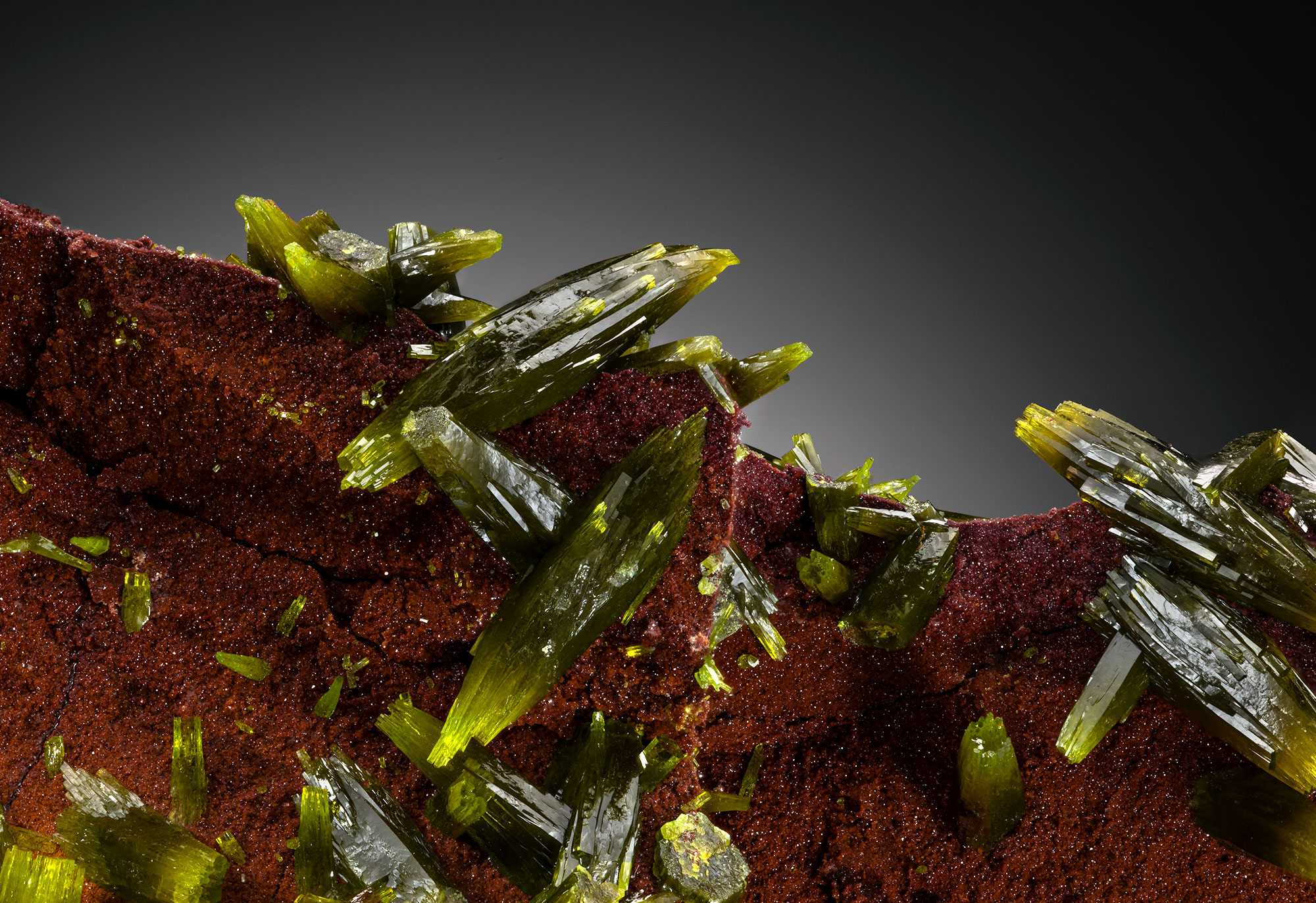
Pyromorphite crystals on matrix. FOV 3 cm. Photo by László Kupi.
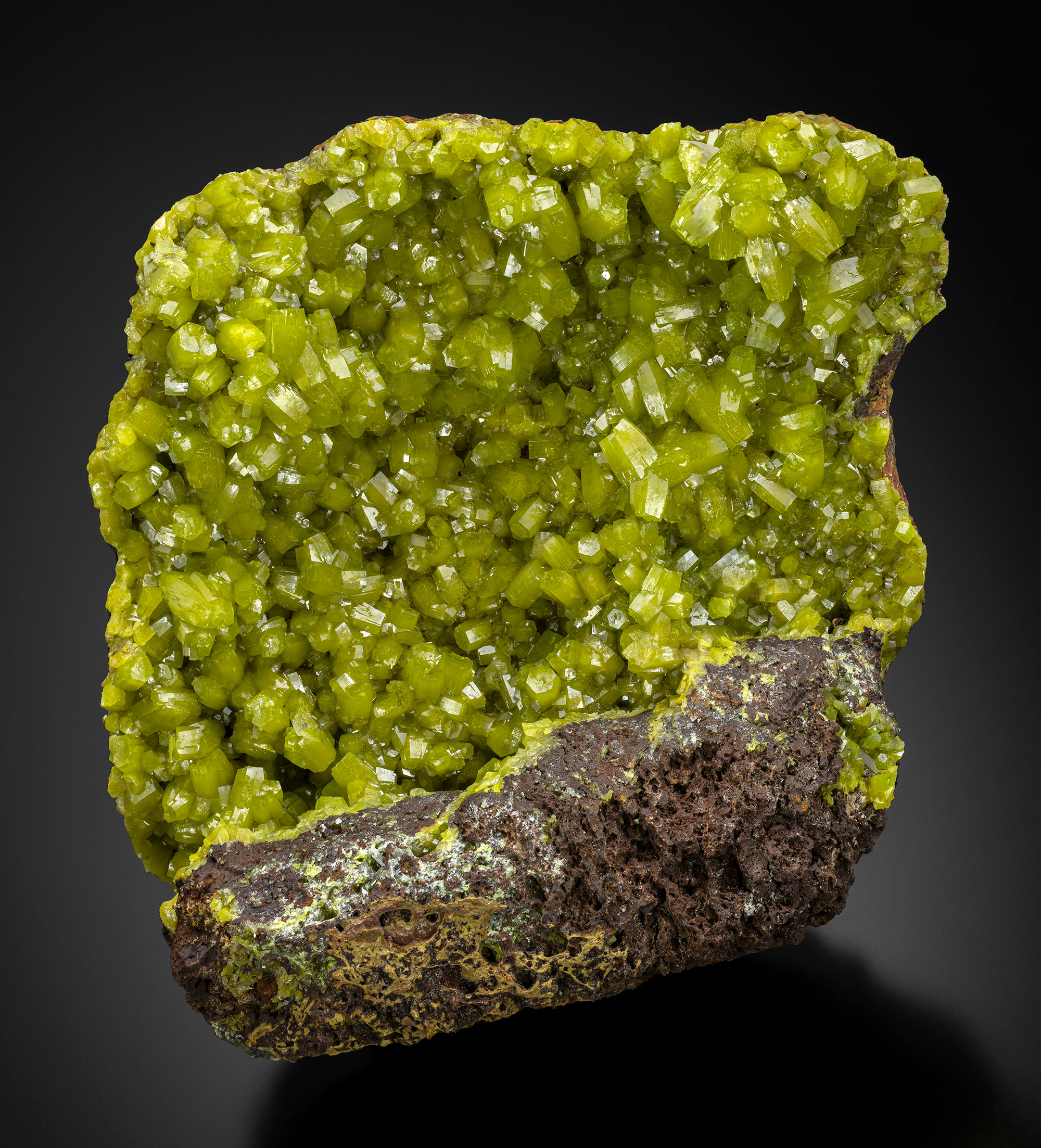
One of the finest pyromorphite specimens from the find. Size 9.3 cm. Photo by László Kupi.
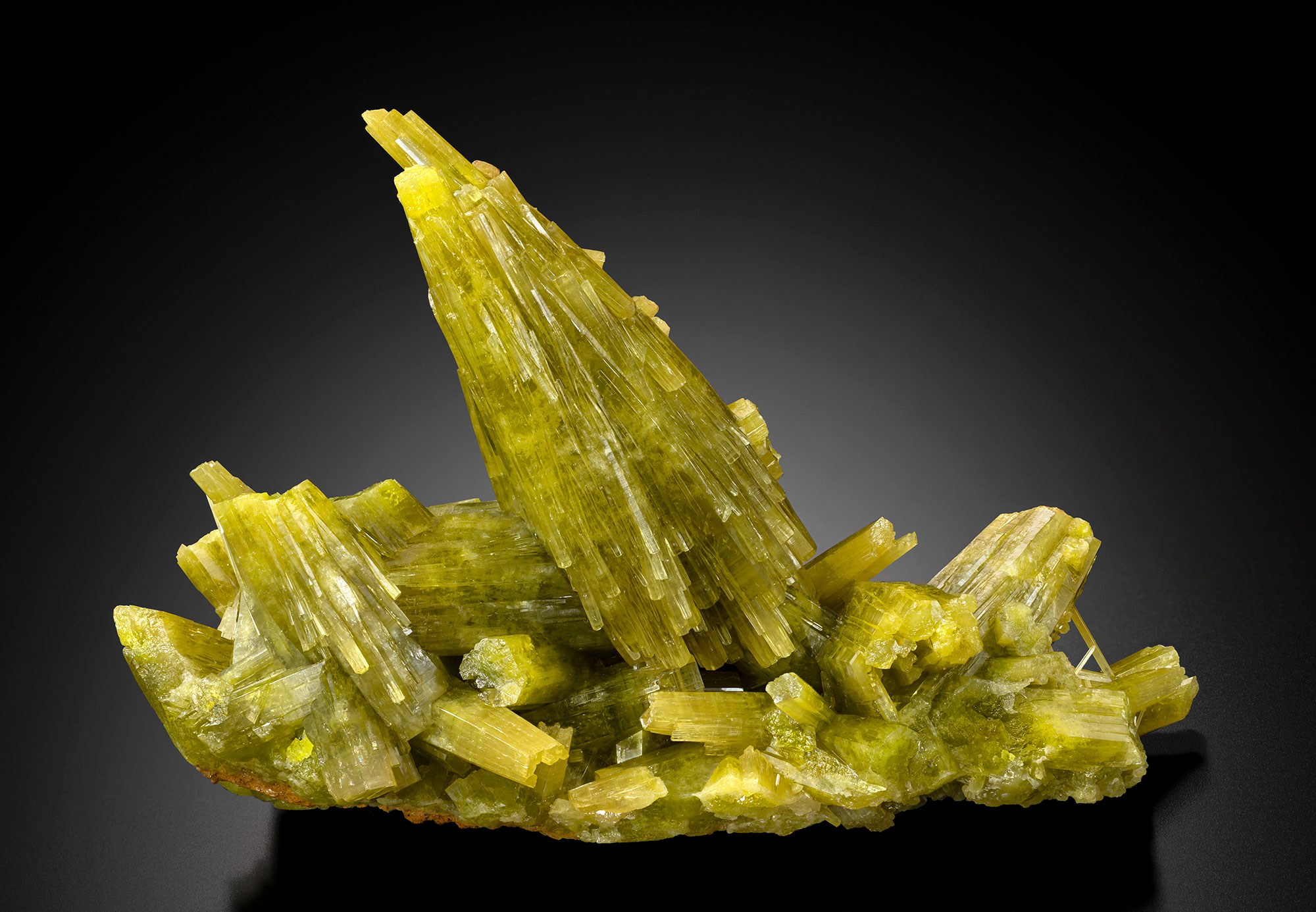
Probably the finest pyromorphite specimens from the find. Size 6,7 cm. Photo by László Kupi.
Video of the same specimen shown above. Size 6,7 cm.
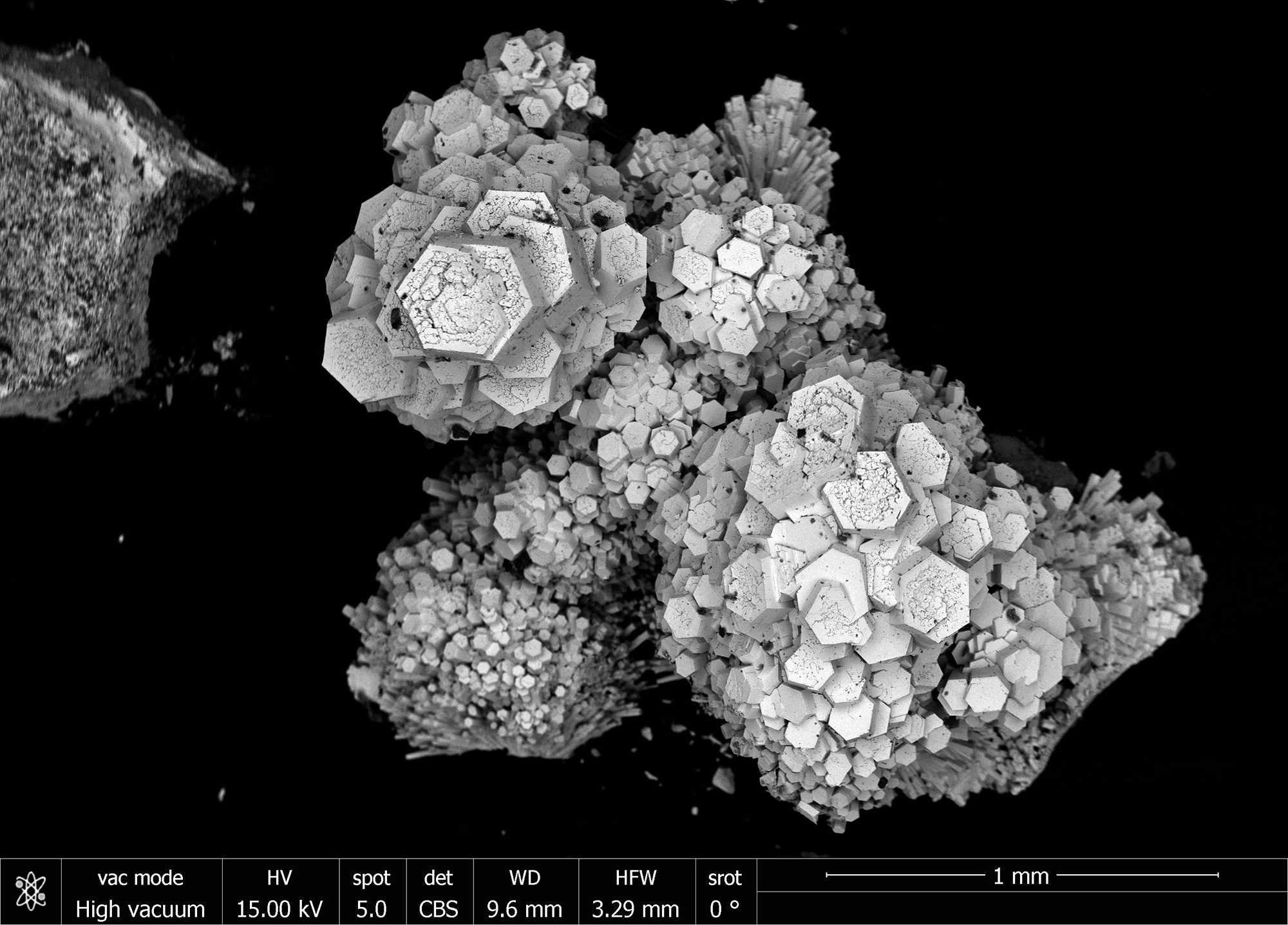
Scanning electron microscope image of an aggregate of pyromorphite crystals.
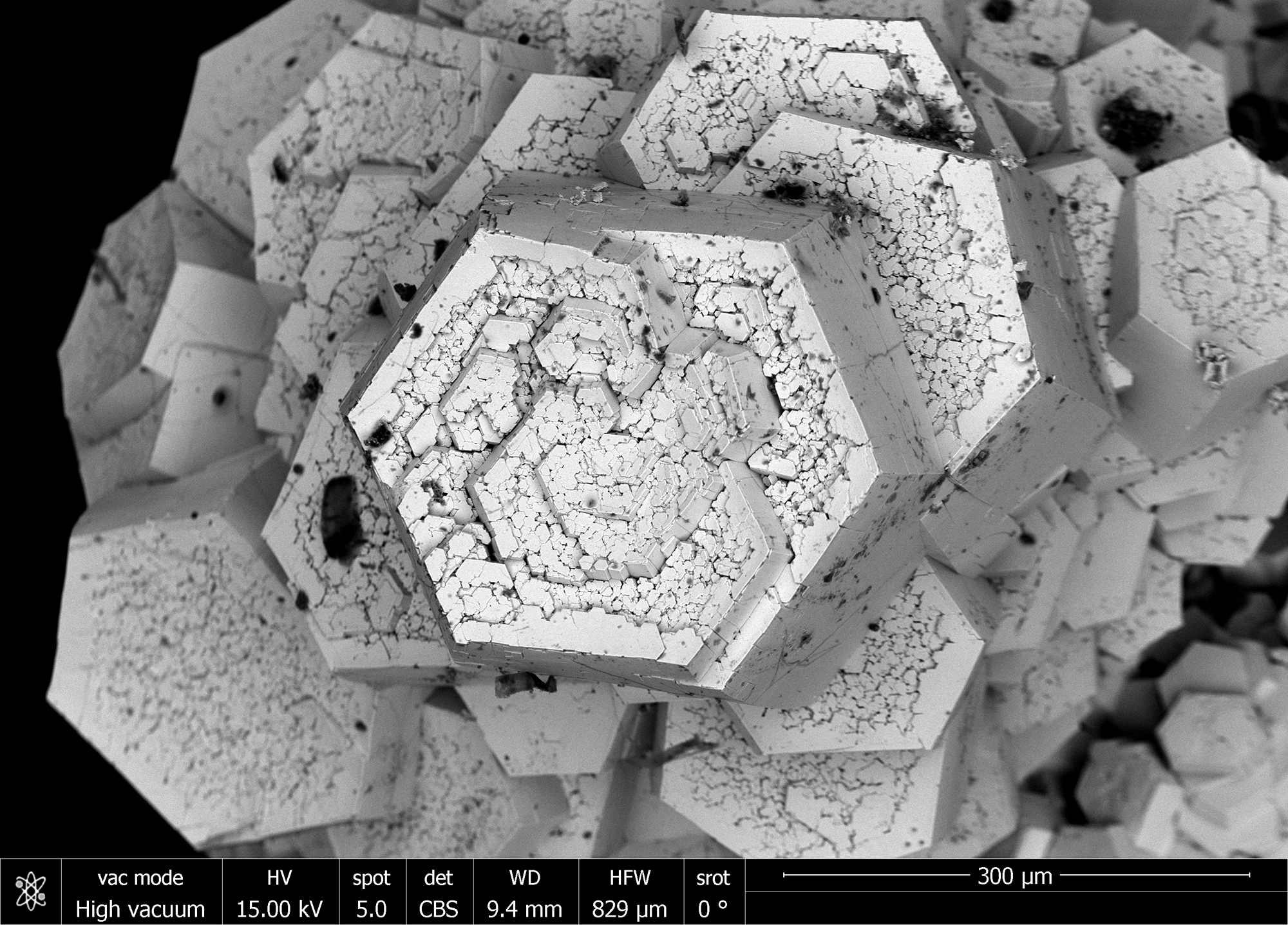
Scanning electron microscope image of pyromorphite crystals.
Acknowledgements
The author would like to thank Sławomir Szlinke for working with me—often under challenging conditions—during mineral specimen fieldwork in the Congo, including the discovery of the mimetite occurrence. I am grateful to Eligiusz Szełęg and the associated researchers for conducting a series of analyses on the provided material. Special thanks go to John Rakovan for his help with editing the article, and to Grzegorz Słowik for extensive discussions concerning the find. I also thank László Kupi for making the effort to travel to Warsaw to produce superb photographs of the material. Appreciation is extended to my colleagues in the laboratory for doing their utmost to preserve and prepare as many high-quality specimens as possible. Finally, and most importantly, I thank Asia, my wife, for valuable discussions and careful corrections of the text.
| Comments |
| This is absolutely wonderful! I felt that my 2 Yanga Koubenza specimens could be the start of a new suite in my collection, and now I look forward to expanding it with some of these beauties. Congratulations, and thank you for your work in the Congo. |
| Antoine |
| 2026-01-14 00:51:00 |
| Thank you! |
| Tomek Praszkier |
| 2026-01-14 00:54:02 |
| Incredible Tom, keep up with the amazing work in Congo! |
| Christos Spiromitros |
| 2026-01-14 06:44:36 |
| Thanks Christos! |
| Tomek Praszkier |
| 2026-01-14 07:58:22 |
| Got so engrossed in this that it has made me late for work....and I don`t care! |
| John Willmouth |
| 2026-01-14 08:23:24 |
| Nie moja działka niemniej artykuł rewelacja, kiedyś bym przy tym zasypiał każdej nocy ! Świetna robota - naprawdę. |
| gagat minerals |
| 2026-01-14 13:01:54 |
| Dzięki Krzysztof! |
| Tomek Praszkier |
| 2026-01-14 13:40:49 |
| Fantastic article with equally fantastic accompanying images |
| Brett Davis |
| 2026-01-14 13:59:27 |
| John and Brett - thank you! |
| Tomek Praszkier |
| 2026-01-14 14:33:11 |
| Super read, and it goes without saying super finds. |
| Steve Rust |
| 2026-01-14 16:15:00 |
| Niebywale ciekawy artykuł. Czuć magię. Można się zarazić! Fantastyczna ilustracja fotograficzna. Gratuluję! |
| Andrzej Jarzębowski |
| 2026-01-14 19:38:32 |
| Thank you guys, I am glad you enjoyed it! |
| Tomek Praszkier |
| 2026-01-14 20:40:29 |
| Fantastic article and finds. |
| Siyue Li |
| 2026-01-16 08:24:26 |
| Great report. And the specimens. Amazing! Must be exciting to recover these beauties! |
| Jan Erik Larsen |
| 2026-01-16 18:38:37 |
| Amazing! |
| tallwuyi |
| 2026-01-18 05:06:04 |
| Thank you all! I am very glad that you enjoy the article, I think this find is really special! |
| Tomek Praszkier |
| 2026-01-18 15:47:16 |
| excepcional reportaje. excepcionales ejemplares. máximo disfrute viéndolos en video y fotografía. tiene que ser algo grandioso tenerlos en la mano. gracias , por presentárnoslos. |
| ramon ro |
| 2026-01-19 23:07:53 |
| The quality and beauty are incredible, thank you so much for sharing. |
| Mineralesy cristales Chile |
| 2026-01-26 12:53:46 |
| Fantastic article and specimens. Is it possible to provide a download link to a .pdf of the article? |
| Graham Styler |
| 2026-02-08 02:54:00 |
| Incredible! What i would do for one of those mimetites on philipsbornite..... |
| John Hampton |
| 2026-04-03 17:39:15 |
NEW ARTICLES
TRAVELS & ARTICLES
- Mimetite Bonanza from Yanga Koubenza, Republic of the Congo
- Mineral notes: "Dragon Eye" fluorites from Namibia
- Mineral notes: Boltwoodite from Goanikontes, Namibia
- Pyrite find in Finland
- Mineral notes: New zircons and pyrochlores from Morocco
- Mineral notes: New natrolites from Morocco
- Mineral pottery by Dr. Justyna Domańska-Siuda
- Calcites from Malaysia
- Veszelyites and other minerals from Congo
- Travelling through Arizona & New Mexico, USA
OUR PUBLICATIONS
- "Barytes from Nador, Morocco" in Mineralogical Record
- "Fluorites from Taourirt, Morocco" in Mineralogical Almanach
- "Calcites from Grabiszyce, Poland" in LRM 2018
- "Baryte" article in the extraLapis
- MINERALS - The Collectors Newspaper #9
- MINERALS - The Collectors Newspaper #8
- Solno halites article in the Mineralogical Record
- MINERALS - The Collectors Newspaper #7
- MINERALS - The Collectors Newspaper #6
- Mibladen monograph in the Mineralogical Record